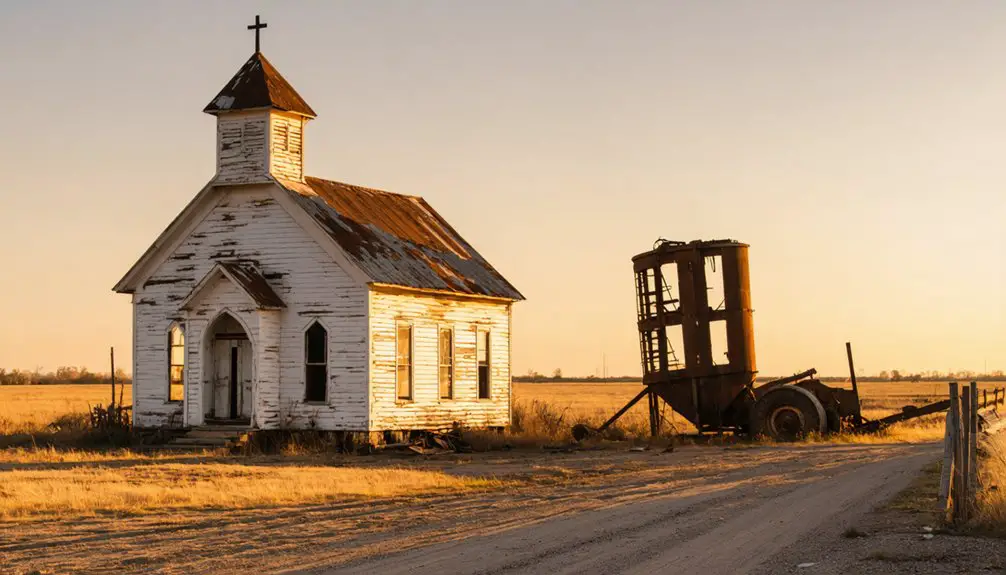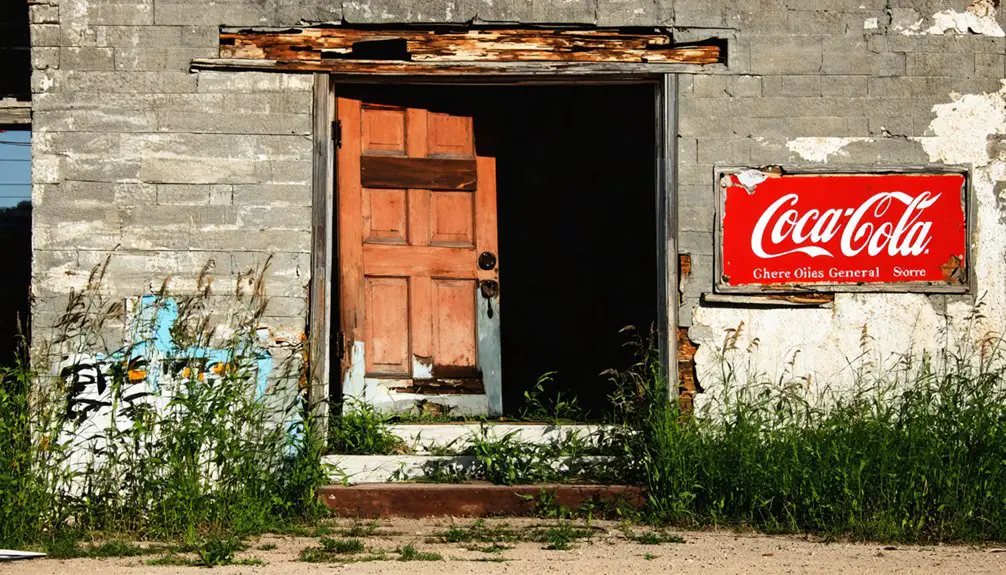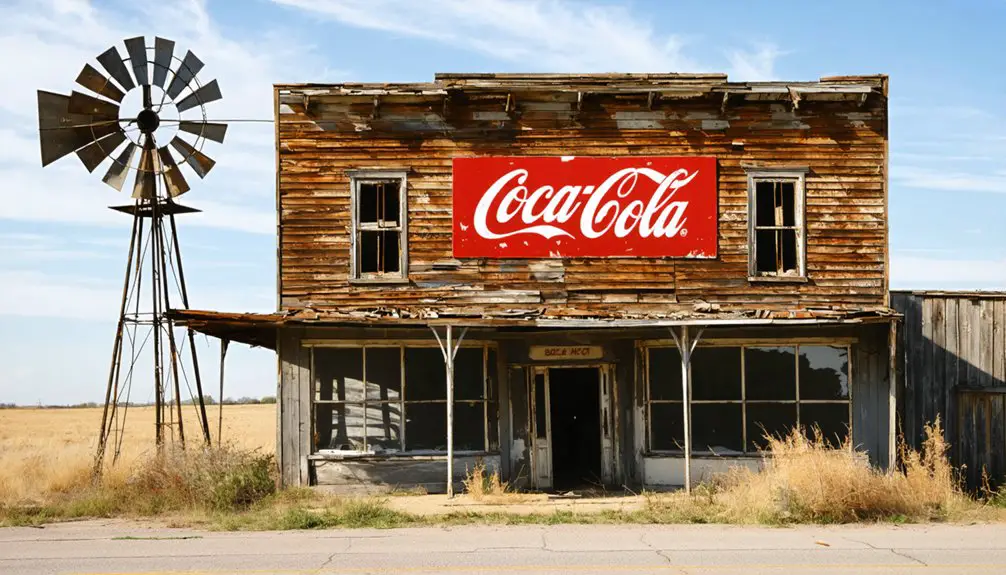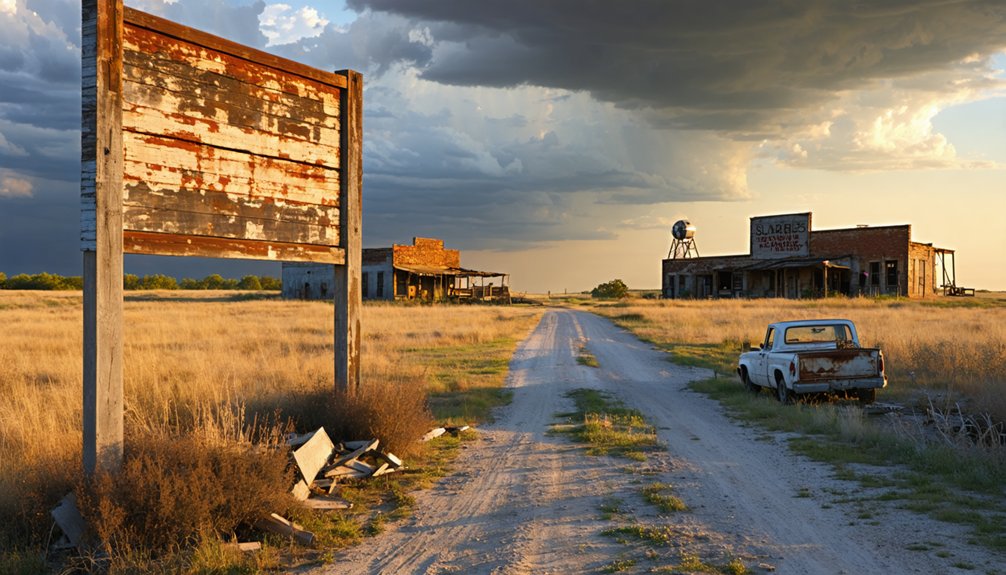
You’ll find Welcome, now called Alsuma, about 75-85 miles from Tulsa—a 2.5-3 hour drive through northeastern Oklahoma. Take US-412, OK-51, or I-44/Route 66, using landmarks like the Golden Driller or Blue Whale of Catoosa to guide you. This ghost town offers crumbling 1920s churches, mid-century ranch homes, and metal-sided facades concealing original wooden structures. The site’s accessible year-round, and you’ll discover how this settlement transformed from hopeful beginnings in 1905 to today’s atmospheric remnants that reveal Oklahoma’s boom-and-bust history.
Key Takeaways
- Welcome, now called Alsuma, is located 75-85 miles from Tulsa, requiring a 2.5-3 hour drive via US-412, OK-51, or I-44/Route 66.
- The town represents Oklahoma’s 2,000+ ghost towns, featuring population decline exceeding 80% from its 1905 founding peak.
- Navigate using landmarks like Tulsa’s Golden Driller, Catoosa’s Blue Whale, and Ed Galloway’s Totem Pole Park along the route.
- Visitors can explore mid-century ranch homes, 1920s churches, and metal-sided buildings covering original wooden facades from Welcome’s history.
- The site remains accessible year-round, showcasing architectural layers and abandoned infrastructure from boom-and-bust cycles.
The Story Behind Welcome’s Transformation Into Alsuma
The small community that sprouted up in northeastern Oklahoma Territory started out with high hopes in 1905, welcoming settlers with open arms—and a fitting name to match. When the post office opened as Welcome, you’d have found a promising frontier settlement.
But within a year, the town underwent its first identity crisis, becoming Alsuma in 1906. Competing naming theories swirl around this change: maybe it honored local merchant John Alsuma, or perhaps three women—Alice, Susan, and Mabel—compromised on the moniker. Some say squabbling town leaders settled their differences this way. The most popular legend suggests the name came from the first two letters of Alice, Susan, and Maria’s names.
Despite its small size, Alsuma developed into a tight-knit community where black and white families lived as good neighbors, sharing stores and playgrounds without the conflicts that plagued larger towns.
What Defines A Ghost Town In Oklahoma
When you’re exploring Oklahoma’s forgotten settlements, understanding what qualifies as a ghost town helps separate true relics from struggling communities. You’ll find a place earns this designation when its population decline reaches at least 80% from peak numbers—a threshold that includes over 2,000 Oklahoma locations. These settlements feature crumbling buildings, rusted foundations, and overgrown lots where thriving Main Streets once stood.
The economic causes behind these abandoned places typically involve exhausted oil fields, depleted mines, or failed agricultural ventures. When the resource supporting a community disappears, residents move toward more productive areas. Oklahoma’s oil boom towns earned distinctive names like Wolco and Whiz Bang, reflecting the unconventional spirit of their era. Some ghost towns, like Picher, gained notoriety for different reasons, now holding the distinction of being America’s most toxic ghost town. You’ll encounter everything from completely deserted sites with only cemetery markers to towns clinging to existence with fewer than 100 remaining souls, their empty storefronts and decaying infrastructure telling stories of boom-and-bust cycles.
Getting To Welcome/Alsuma From Tulsa And Broken Arrow
You’ll find Welcome/Alsuma roughly 150-200 miles from Tulsa, requiring 2.5-3 hours of driving along I-44 west and US-270 southwest toward the Texola area.
From Broken Arrow, expect to add an extra 15-20 miles and about 15-30 minutes to your journey as you connect to I-44 via the Muskogee Turnpike. Route planning can help you identify the most efficient path and minimize delays along the way.
The ghost town sits near I-40’s western edge, where the iconic “Welcome to Oklahoma” sign serves as your key navigation landmark. This roadside attraction is accessible 24 hours daily, allowing travelers to stop and photograph the landmark at their convenience.
Travelers seeking a unique experience can explore the ghost towns near Alpha, Oklahoma, which offer a glimpse into the state’s rich history. As you venture into these abandoned settlements, you’ll encounter remnants of the past, including dilapidated structures and fascinating stories waiting to be uncovered. Keep your camera ready, as each visit provides an opportunity to capture the haunting beauty of these quiet landscapes.
Oklahoma boasts several ghost towns to explore in Oklahoma, each with its own unique allure and historical significance. As you roam these once-thriving communities, you’ll find intriguing artifacts and local lore that add depth to your adventure. Don’t miss the chance to connect with the past while experiencing the eerie tranquility of these forgotten places.
Major Highway Routes Available
From Tulsa and Broken Arrow, you’ve got three distinct highway corridors to reach the ghost towns of Welcome and Alsuma near Stillwater.
Your route options include:
- US-412 Westbound – The fastest choice via Cimarron Turnpike, cutting through Sand Springs and crossing Keystone Dam before turning into tolled sections through Hallett to Glencoe, where SH-312 connects directly to Stillwater.
- OK-51 Historic Alignment – Follow Charles Page Boulevard’s scenic route along the Arkansas River, paralleling old MKT Railroad trails through Sand Springs and Mannford before rejoining at SH-48 toward Stillwater. The route features classic S-curve crossings over the historic Sand Springs Railroad. When unexpected forks appear along this historic route, keep driving toward the horizon.
- I-44/Route 66 Corridor – Experience Oklahoma’s legendary highway culture with business loops and roadside attractions, though this path requires connecting routes to reach your ghost town destination.
Each corridor offers different experiences balancing speed against historic alignments and turnpike systems.
Distance and Drive Time
Planning your ghost town adventure requires understanding the actual distances involved, which span approximately 75-85 miles depending on your chosen route from the Tulsa metropolitan area. From Tulsa, you’ll navigate roughly 90 minutes of open highway to reach Welcome’s abandoned streets.
As you embark on your journey exploring ghost towns in Oklahoma, be prepared to encounter remnants of history that tell stories of the past. Each stop offers unique sights and an eerie charm that draws adventurers and history buffs alike. Make sure to have your camera ready, as the decaying buildings and forgotten landscapes provide perfect opportunities for captivating photographs.
As you uncover the mysteries of ghost towns in Oklahoma, you’ll find a variety of fascinating structures, from old schools to crumbling storefronts. Each location presents a glimpse into the lives once lived there, offering a haunting yet beautiful narrative of the state’s past. Be sure to stop at any local museums or information centers you encounter along the way for interesting insights into these forgotten places.
Broken Arrow sits slightly closer, shaving about 10-15 minutes off your journey. These rural roads offer minimal traffic and expansive prairie views, letting you disconnect from urban constraints. The drive itself becomes part of the experience, shifting you from modern civilization into Oklahoma’s forgotten past.
Visitor accessibility remains straightforward year-round, though unpaved final approaches may challenge low-clearance vehicles during wet conditions. Understanding this historical context—Welcome’s isolation contributed to its eventual abandonment—helps you appreciate why this settlement faded into Oklahoma’s landscape. For those traveling from Oklahoma City, the distance of 171 km to Tulsa makes it convenient to start your ghost town expedition from the state’s capital before heading to Welcome. Oklahoma City holds a perfect rating of 10.000, making it an attractive base for exploring the surrounding region’s historical sites.
As you plan your journey, consider incorporating other ghost town attractions in Oklahoma, each offering unique stories and remnants of the past. From the eerie silence of abandoned streets to the lingering echoes of history, these sites provide a fascinating glimpse into the lives that once thrived in the region. Be sure to bring your camera, as the haunting beauty of these locations makes for unforgettable photographs.
Before entering Welcome’s forgotten territory, several prominent Tulsa landmarks serve as reliable waypoints that’ll keep you oriented during the initial leg of your journey.
Key Navigation Points:
- Golden Driller – This 76-foot yellow statue marks your starting position in Tulsa’s Expo Square, serving as an unmistakable departure reference point.
- Blue Whale of Catoosa – Located along Route 66 near Broken Arrow, this iconic roadside attraction confirms you’re heading in the right direction toward Oklahoma’s backroads.
- Ed Galloway’s Totem Pole Park – These towering 90-foot structures provide essential regional landmarks for reference as you venture deeper into rural territory.
These prominent roadside attractions anchor your route before civilization fades into Welcome’s ghostly landscape. They’re not just photo opportunities—they’re strategic markers ensuring you won’t lose your way while chasing Oklahoma’s abandoned past.
What Remains Of Welcome Today
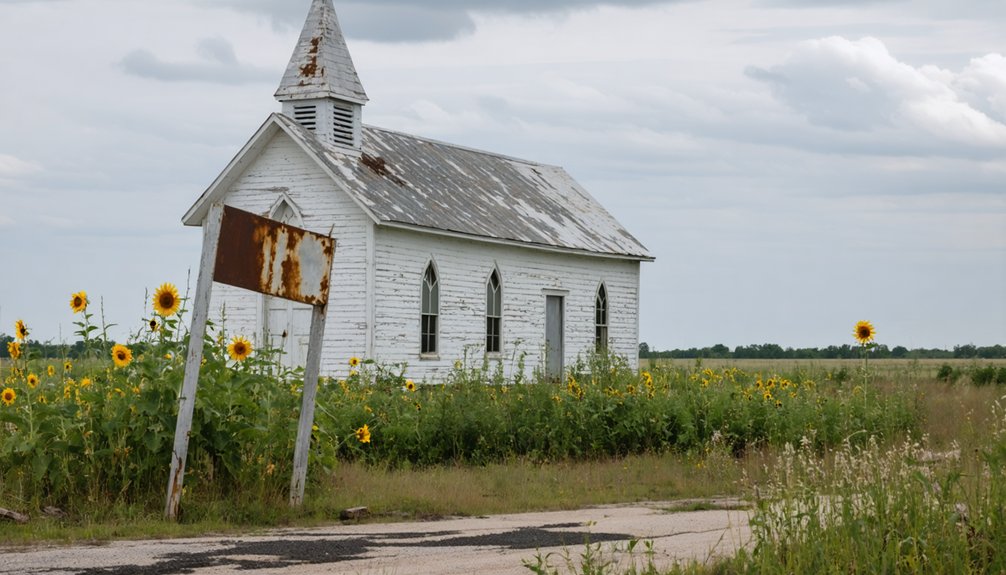
The physical landscape of Welcome tells its story through layers of architectural sediment. You’ll find mid-century ranch homes standing beside 1920s churches, their foundations settled deep into Oklahoma clay. Metal siding now covers original wooden facades—pragmatic repairs that extend structure lifespans without pretense.
The architectural character emerges from necessity rather than planning: restored bungalows neighbor trailer homes and vinyl-sided ranches in unpredictable sequences.
Functional railway tracks cut through town, remnants of anticipated prosperity that never materialized. Yet the train whistle still echoes at night, and residents treat the adjacent properties as normal landscape features. This community resilience manifests in maintained homes and enduring neighbor connections despite economic headwinds.
Welcome hasn’t disappeared or dramatically transformed—it persists, adapting through determination rather than design, building what’s needed with available resources.
Combining Your Trip With A Visit To Picher
Just 35 miles northeast of Welcome lies Picher, Oklahoma’s most haunting ghost town—a place where environmental catastrophe and natural disaster combined to erase an entire community from the map. Visiting Picher’s ruins offers a stark contrast to Welcome’s quiet abandonment, showcasing how toxic mining waste and a devastating 2008 tornado forced complete evacuation.
When comparing Picher’s decline to other ghost towns, you’ll notice three critical differences:
- Environmental disaster: Lead and zinc contamination created an EPA Superfund site, poisoning children and rendering the land uninhabitable
- Structural collapse: Unstable mine shafts beneath 86% of buildings threatened catastrophic sinkholes
- Federal intervention: Government buyouts in 2009 systematically erased the town
Today, spray-painted structures stand as government property markers among towering chat piles—testament to industrial excess.
Safety Precautions For Exploring Abandoned Sites
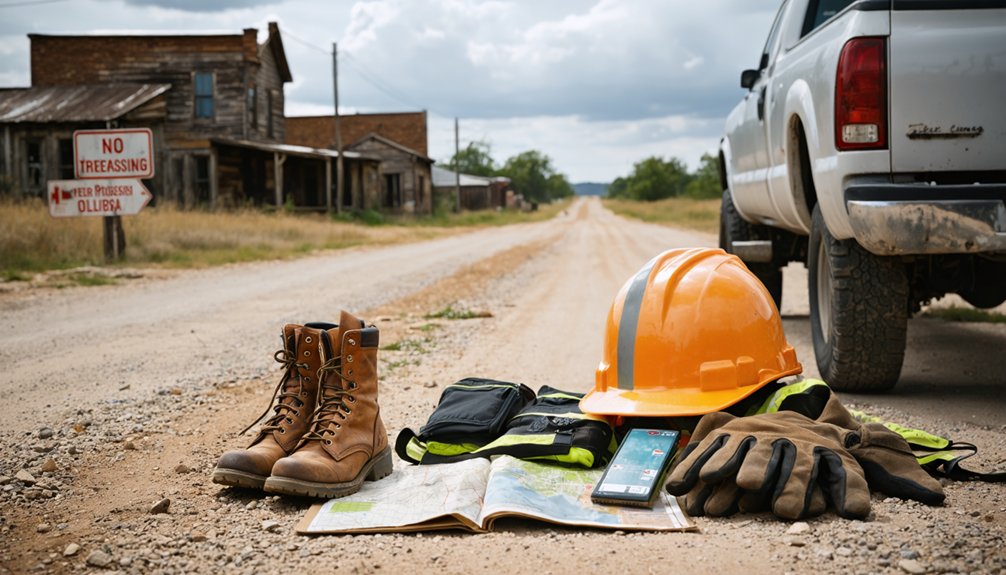
Exploring abandoned sites like Welcome and Picher demands rigorous safety protocols that could save your life. Your personal protective gear considerations start with heavy-duty boots, FFP3 respirators for mold and asbestos, durable gloves, and removable coveralls.
These ghost towns harbor black mold, industrial contaminants, and structural hazards like decayed floors and hidden drop-offs. Never explore alone—bring at least two companions for emergency response planning. If someone’s injured, one person stays while another seeks help.
Always notify someone outside your group about your location and expected return time. Research the site beforehand to identify specific dangers like radioactive materials or toxic gases. Scout during daylight to map exits and hazards. Carry your phone, first-aid kit, and proper identification. Remember: trespassing laws still apply to abandoned properties.
Other Notable Ghost Towns Near Tulsa County
Beyond Picher’s toxic landscape, Tulsa County’s periphery conceals several lesser-known ghost towns that’ll reward your curiosity with glimpses of Oklahoma’s forgotten communities.
exploring ghost towns in Oklahoma can lead to encounters with remnants of a bygone era, where crumbling structures tell stories of resilience and loss. Each site offers a unique perspective on the state’s history, allowing visitors to appreciate the rich tapestry of lives once lived in these now-silent places. As you wander through the dusty streets, you may discover artifacts that serve as echoes of the past, waiting to be uncovered.
Accessible Ghost Towns Worth Exploring:
- Dawson – This former coal mining town northeast of Tulsa features unique preservation challenges, including its surviving Little Rock schoolhouse built from local sandstone. You’ll find remnants between Pine Street and Dawson Road.
- Talala – Established in 1890 in Rogers County, this agricultural settlement offers restoration project potential despite minimal structures remaining from its early 1920s decline.
- Terlton – Founded in 1894 in Pawnee County, this faded community presents authentic abandonment with few traces of its original infrastructure.
Each location presents distinct characteristics reflecting Oklahoma’s diverse settlement patterns, from mining operations to agricultural hubs that couldn’t sustain modern economic pressures.
Best Time Of Year For Ghost Town Exploration
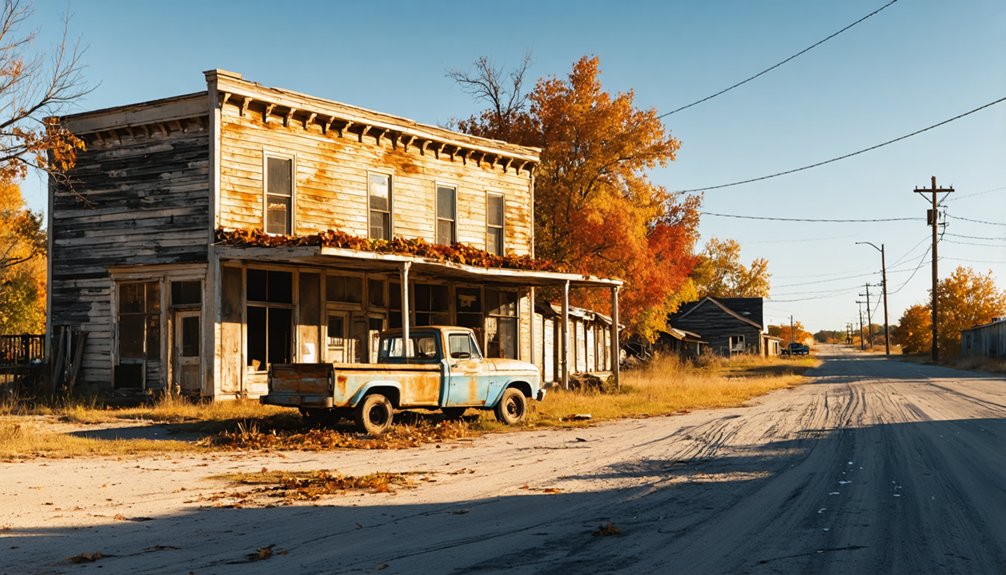
Oklahoma’s unpredictable weather patterns directly impact your ghost town adventures, making timing critical for safe and productive exploration. You’ll find spring (April-May) and fall (September-October) offer ideal visiting temperatures between 60-75°F, perfect for hiking through abandoned structures without battling extreme heat or ice.
Exploring ghost towns near Wybark, Oklahoma can provide a fascinating glimpse into the past, with each site telling its own unique story. Be sure to carry a camera and a journal to document your findings, as these forgotten landscapes are a treasure trove of history waiting to be discovered. As you wander through the remnants of these once-thriving communities, you’ll likely encounter unique architecture and remnants of daily life that sparked the imagination of those who once called these places home.
Summer’s scorching conditions can make metal ruins dangerously hot, while winter’s freezing rain creates treacherous road conditions on rural routes.
Weather forecast monitoring becomes essential when planning your Welcome expedition. Check seven-day forecasts before departure, as Oklahoma’s storms can roll in fast, turning dirt roads impassable. Early morning starts give you the best light for photography and cooler temperatures for exploration. You’re chasing freedom through forgotten places—don’t let poor timing compromise your adventure or safety.
Photography Tips For Capturing Historic Remnants
Your camera becomes a time machine when documenting Welcome’s weathered structures, transforming decay into visual poetry. Appropriate framing techniques include minimalist straight-on compositions from across the street, capturing the jail, saloon, and general store with deliberate symmetry. Emphasis on architectural details reveals the town’s character through door handles, window ornaments, and faded ghost signs advertising defunct businesses.
Essential Photography Approaches:
- Black and white shooting strips away distractions, highlighting geometry, shadows, and textures that color obscures
- Window reflections and latticing create layered compositions—turquoise letters casting wonky shadows on rattan curtains tell forgotten stories
- Scale and emotion emerge when you include a model in thematic clothing against crumbling facades
Pre-research property boundaries and permit requirements before exploring. Your tripod won’t face restrictions yet, though rules tighten after vandalism incidents.
Preserving Oklahoma’s Ghost Town History
You’ll play a vital role in preserving Oklahoma’s ghost town heritage by photographing deteriorating structures before they collapse into dust.
Recording oral histories from longtime residents and descendants captures irreplaceable stories that disappear with each passing generation.
Your challenge lies in balancing your curiosity as a visitor with the need to protect these fragile sites from the wear that increased tourism inevitably brings.
Documenting Structures Before Collapse
Time works against preservationists racing to document Oklahoma’s ghost town structures before they collapse into dust and memory. You’ll find over 2,000 ghost towns scattered across Oklahoma, each site revealing crumbling facades, decaying signs, and nature reclaiming abandoned spaces. Examining historic documentation methods shows urgent need for systematic cataloging before these structures vanish completely.
Critical Documentation Priorities:
- Structural Assessment – Years of vacancy accelerate deterioration through weather exposure, animals seeking shelter, and deferred maintenance creating irreversible damage
- Photographic Archives – Capturing current conditions before elements erase architectural details and historical context forever
- Timeline Cataloging – Recording deterioration progression helps identify which sites need immediate intervention versus long-term monitoring
Organizations like Ghost Towns In Oklahoma actively pursue this mission, preparing extensive documentation for future publications that’ll preserve what physical structures can’t withstand.
Oral History Collection Efforts
How do historians capture voices before silence claims them forever? You’ll find the answer in Oklahoma’s ambitious preservation initiatives, where over 3,000 recorded interviews spanning 1956 to present safeguard ghost town memories.
The Living Legends Collection alone houses 5,000 pioneer testimonies on reel-to-reel tapes, emphasizing community voices from average citizens who witnessed boom-to-bust transformations.
These efforts extend beyond mere documentation. The Mel Chatman Collection focuses on Black history in Lincoln County, while Oklahoma City Arts projects recover forgotten neighborhoods like Sandtown.
You can access recordings at Museum Broken Arrow’s listening stations or through the Oklahoma Historical Society’s YouTube archives. These initiatives preserve fading narratives of discrimination, resilience, and community building—capturing emotions, accents, and personal perspectives that written records can’t convey, ensuring future generations hear authentic Oklahoma stories.
Balancing Tourism and Preservation
While exploring Oklahoma’s ghost towns offers thrilling glimpses into the past, you’re stepping into a delicate ecosystem where every footprint matters. Responsible visitor practices guarantee these historic sites survive for future adventurers while maintaining their authentic character.
Many people are drawn to exploring ghost towns in Oklahoma for their unique stories and haunting beauty. As you wander through the remnants of these once-thriving communities, take a moment to appreciate the history etched into the worn structures. Each town has its own narrative, waiting to be uncovered by curious travelers.
From abandoned storefronts to crumbling homes, you can imagine the lives that once filled these spaces. With every step in your journey to explore ghost towns near Oklahoma, you become part of the ongoing story, contributing to the preservation of these historical gems. Whether you’re an avid history buff or simply in search of an off-the-beaten-path adventure, the allure of these ghost towns is undeniable.
Your exploration should follow these conservation priorities:
- Document without disturbing – Photograph structures and artifacts in place, never removing items or adding graffiti that erases historical authenticity.
- Stick to established pathways – Wandering off-trail accelerates erosion and damages fragile architectural elements already battling weather and time.
- Support preservation initiatives – Consider contributing to restoration funding or volunteering with documentation projects that safeguard Oklahoma’s heritage.
You’ll find that sustainable tourism transforms these abandoned spaces into vibrant cultural hubs where history breathes alongside modern appreciation, creating economic opportunities without sacrificing the very character that draws you here.
Frequently Asked Questions
Are There Any Guided Ghost Town Tours Available in the Tulsa Area?
You’ll find self-guided tours of ghost town sites through Let’s Roam and ScavengerHunt.com covering 1.85 miles. However, guided tours of abandoned buildings aren’t available—live ghost tours focus on downtown’s active haunted locations instead of deserted structures.
Can I Visit the Relocated Picher Mining Museum Exhibits?
Yes, you can visit the relocated Picher Mining Museum exhibits at Dobson Museum in Miami, Oklahoma. The collection’s available through December 2025, featuring mining photos and mineral specimens. Check their website for special museum events scheduled throughout the year.
What Caused Welcome to Be Renamed to Alsuma?
Welcome became Alsuma after a naming dispute among town leaders, though the historical significance of name change remains debated—either honoring merchant John Alsuma or combining wives’ names. These factors leading to town’s decline included eventual post office closure in 1926.
Are There Other Oil Boom Ghost Towns Near Welcome/Alsuma?
Yes, you’ll find several nearby oil boom ghost towns like Tatums and Oil/Cox City in Carter County. These settlements share Alsuma’s historical significance of oil industry boom-bust cycles, with local legends surrounding Alsuma’s decline echoing throughout the region’s abandoned communities.
Is Camping Allowed Near Any Oklahoma Ghost Town Sites?
Overnight camping options near Oklahoma ghost towns are severely limited. You’ll find dispersed camping at national grasslands like Black Kettle, but most sites sit on restricted state trust lands or private property requiring permission for access and local hiking trails.
References
- https://www.okhistory.org/publications/enc/entry?entry=GH002
- https://freepages.rootsweb.com/~gtusa/history/usa/ok.htm
- https://quirkytravelguy.com/visiting-picher-oklahoma-ghost-town-toxic-waste/
- https://okmag.com/blog/a-ghostly-site/
- https://www.youtube.com/watch?v=0KnAr4swnT8
- https://www.islands.com/1977293/americas-most-toxic-ghost-town-border-kansas-oklahoma-abandoned-mine-town-picher/
- https://www.hughescountytribune.com/article/alsuma-ghost-town-tulsa-oklahoma
- https://www.ghosttownsinoklahoma.com
- https://en.wikipedia.org/wiki/Alsuma
- https://www.alsuma.me/history-of-alsuma-oklahoma