Exit I-40 at 356 and follow Blair Road to Wheat’s eerie Greenway parking lot, where you’ll discover a 1.5-mile gravel trail through Tennessee’s most haunting ghost town. You’ll pass the solitary George Jones Memorial Baptist Church, explore cemeteries holding both named pioneers and 90 unmarked graves of enslaved individuals, and walk roads deliberately closed to forget civilization. Bring comfortable shoes and water for the slight inclines, and if you’re intrigued by the paranormal tales surrounding this abandoned community, there’s much more to uncover about Wheat’s mysterious past.
Key Takeaways
- Exit I-40 at 356 and park at Blair Road’s Wheat Greenway lot to access the 1.5-mile gravel walking trail.
- Visit George Jones Memorial Baptist Church, the only surviving building, and explore historic cemeteries including the African Burial Ground.
- Take free National Park Service guided walks or explore self-guided paths covering the former community’s landmarks and history.
- Attend annual homecoming on the first Sunday in October at George Jones Church to connect with descendant families.
- Bring comfortable shoes and water for slight inclines while exploring roads deliberately closed when the town was abandoned.
The Rise and Fall of a Thriving Appalachian Community
Long before the U.S. government drew its secret boundaries across East Tennessee, the rolling hills around what would become Wheat harbored a different story—one of Cherokee treaties and land-hungry settlers pushing westward. By 1794, European Americans carved homesteads from these valleys, initially stripping timber and floating logs downriver to Chattanooga mills—leaving the hills so bare they’d name the place Bald Hill.
But you’d hardly recognize that scarred landscape by the 1880s. The thriving farming community transformed into a peach production boom that shipped Grade-A fruit nationwide from seven orchards. When Henry Franklin Wheat became postmaster in 1881, the town claimed his name and its identity: nearly 1,000 families, multiple churches, schools including Roane College, stores, mills, and a Masonic Lodge—a proper Appalachian settlement built to last.
What Remains: Historic Landmarks You Can Visit Today
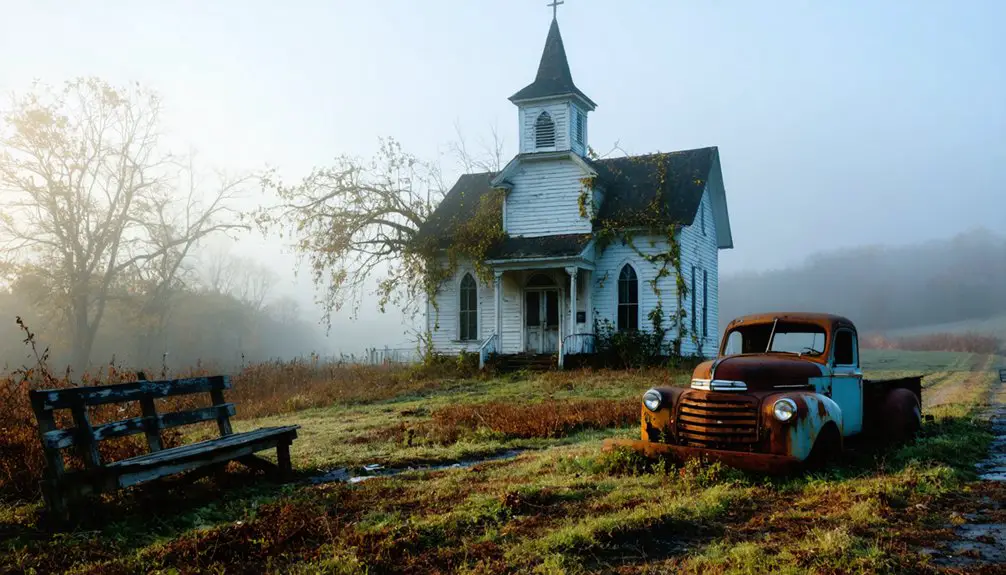
Though the government erased most of Wheat from the map in 1942, you’ll find the heart of this ghost town still beating in scattered remnants along Highway 58. The George Jones Memorial Baptist Church stands as the only surviving building—its white clapboard site architecture defying decades of abandonment. You can visit its cemetery year-round, where former residents still rest alongside their ancestors.
The Gallaher-Welcker Cemetery (designated AEC #1) preserves stories of enslaved individuals from the Gallaher-Stone Plantation, offering glimpses into the community’s early industry highlights. Crawford Presbyterian Church‘s cemetery remains accessible despite highway construction claiming the original building.
Park near the community monument and you’ll experience an eerie isolation—roads deliberately closed, civilization deliberately forgotten, yet stubbornly remembered.
The African Burial Ground and Its Forgotten Stories
Beyond the church and marked graves lies a cemetery that history nearly erased entirely. You’ll find the Wheat Community African Burial Ground marked only by field stones and sunken earth—90 to 100 graves with no names, no dates, no stories carved in stone. This is where enslaved individuals’ lives ended in silence, buried by the Welcker and Gallaher plantation families who valued their human property at $25,000.
Will Minter rediscovered these mysterious unmarked graves in 2000, after decades of federal neglect. The Department of Energy now maintains the site, placing a monument to acknowledge what was deliberately forgotten. You can visit this ground on Oak Ridge Turnpike, where fieldstone markers stand as silent witnesses to those whose names may never be recovered from history’s void.
Paranormal Encounters and Local Ghost Legends
When darkness settles over the Wheatlands Plantation, the weight of 70 recorded murders and deaths presses against the old walls like a physical force. You’ll find Granny Jane’s spirit still walks these halls—a former slave whose dark rituals created supernatural protectors that guard against intruders. Witnesses report colliding with an angry, dripping-wet boy apparition, while Lucy’s ghostly laughter echoes near the house. The parlor’s bloodstains tell their own violent tale.
Down the road, George Jones Church harbors something darker. Visitors report disembodied voices drifting through the cemetery, unexplained lights flickering between headstones, and malevolent spirits that follow you home. The Cherokee massacre victims, Civil War soldiers, and Chandler family members remain active throughout the property, creating an oppressive energy you’ll feel immediately.
How to Visit: Getting There and Annual Homecoming Events
Finding Wheat isn’t like locating most ghost towns—there’s no crumbling main street or abandoned storefronts marking your arrival. Instead, you’ll exit I-40 at 356 and navigate to Blair Road’s Wheat Greenway parking lot, 0.25 miles north of Oak Ridge Turnpike.
From here, a self guided walking tour covers 1.5 miles of gravel paths connecting the George Jones Memorial Baptist Church, African Burial Ground, and Roane College site. The National Park Service offers free guided walks discussing community oral histories and the 1942 displacement. Bring comfortable shoes and water for slight inclines.
Mark your calendar for the first Sunday in October—former residents gather at George Jones Church for their annual homecoming, keeping displaced memories alive through shared stories.
Frequently Asked Questions
Are There Restroom Facilities Available at the George Jones Memorial Baptist Church Site?
No restroom facilities or wheelchair accessibility exist at this remote historic site. You’ll find only gravel paths through kudzu-draped wilderness. Plan accordingly before heading down that gated half-mile road to explore this abandoned ghost town church.
Is the Wheat Greenway Accessible for Wheelchair Users or Strollers?
The gravel path feels like pushing through sand—wheelchair users and strollers will struggle immensely. Before attempting access, you’ll want checking parking availability and local weather conditions, since rain makes navigation even more arduous on unpaved terrain.
Can Visitors Bring Pets to the Church and Burial Ground Areas?
The site doesn’t explicitly state pet-friendly policies for these historic areas. You’ll want to contact park rangers directly about bringing pets, just as you’d verify accessibility accommodations. They’ll provide current rules for your visit’s planning.
What Cell Phone Reception Can Be Expected in the Wheat Community Area?
You’ll likely find limited cellular network coverage in Wheat’s remote location. Signal strength availability varies considerably by carrier, so check specific coverage maps beforehand and consider downloading offline maps. Wi-Fi calling won’t help without internet access here.
Are Guided Tours of the Historical Sites Available for Individual Visitors?
No formal guided tour scheduling exists for Wheat’s sites. You’ll explore independently using historical signage quality markers at the African Burial Ground and George Jones Church. October’s homecoming offers authentic community connection, but you’re free to wander respectfully year-round.