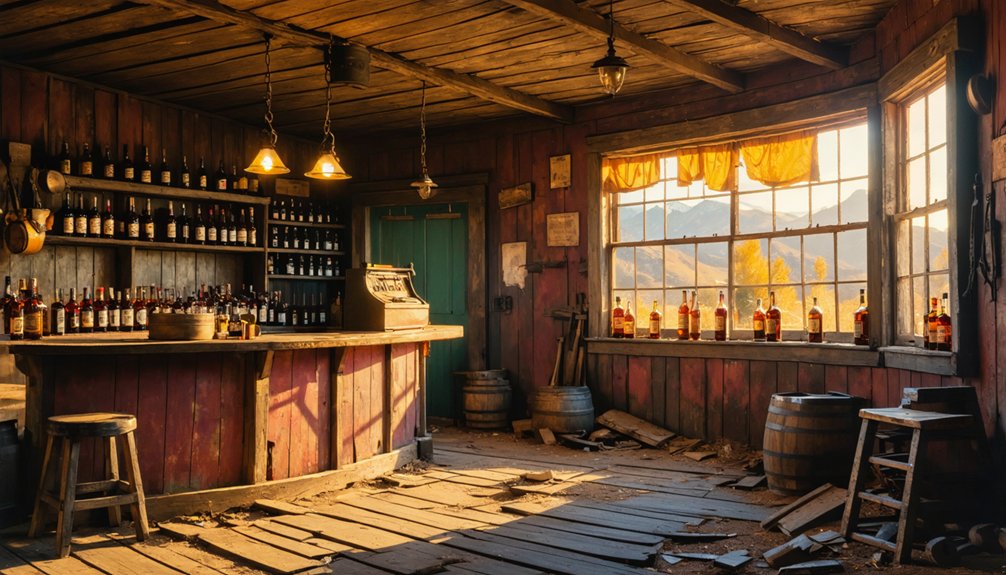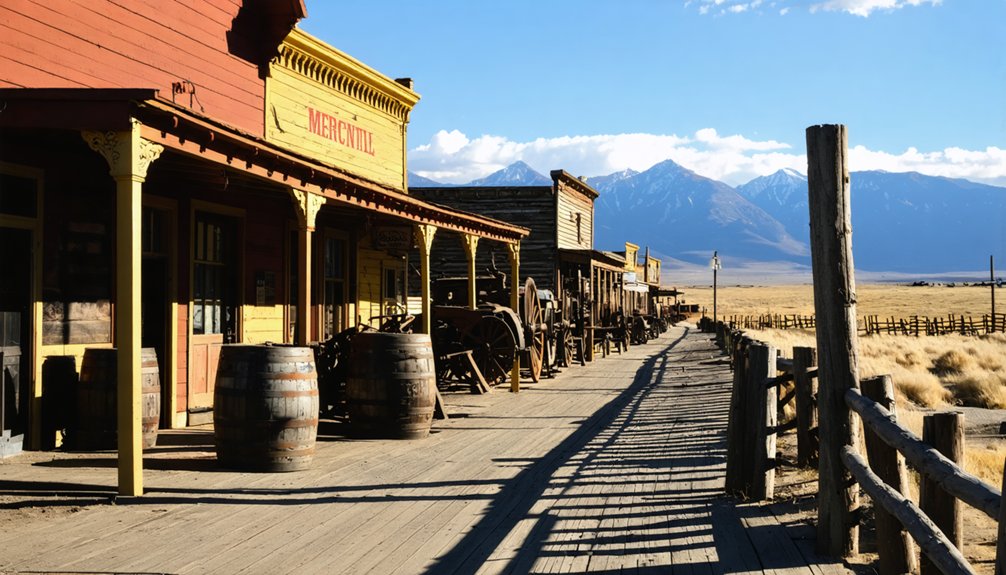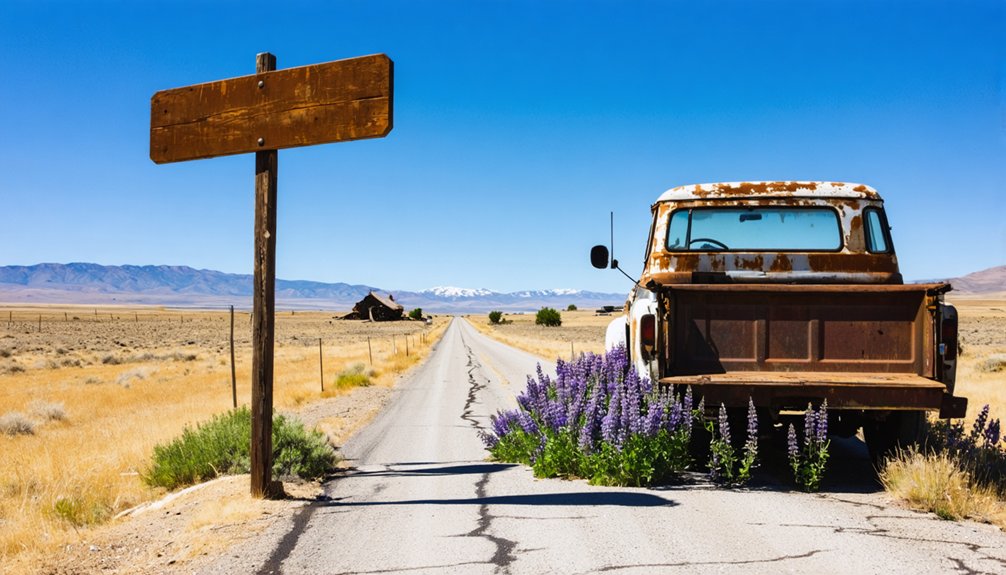
You’ll need to correct your maps first—Willard sits in Nevada’s Pershing County, not California, roughly 100 miles northeast of Reno along unimproved mining roads. Pack your high-clearance 4WD, offline maps, and emergency supplies including extra water and fuel, since cell service vanishes miles before you arrive. The scattered foundation stones and debris fields tell stories of a brief 1915 gold rush, while the crumbling Gibson Mill ruins await exploration nearby. Spring and fall offer ideal conditions for discovering what atmospheric desolation reveals.
Key Takeaways
- Willard is located in Nevada’s Pershing County, not California, requiring careful navigation with offline maps.
- A high-clearance 4WD vehicle is mandatory for unimproved mining roads leading to the remote townsite.
- Pack essential emergency supplies including extra water, fuel, tools, and spare tire before departure.
- Visit during spring or fall for optimal conditions; expect temperature extremes and limited cell service.
- Plan for brief 30-minute visits as scattered foundations and debris fields are all that remain.
The Gold Rush Origins of Willard and Its Transformation to Loring
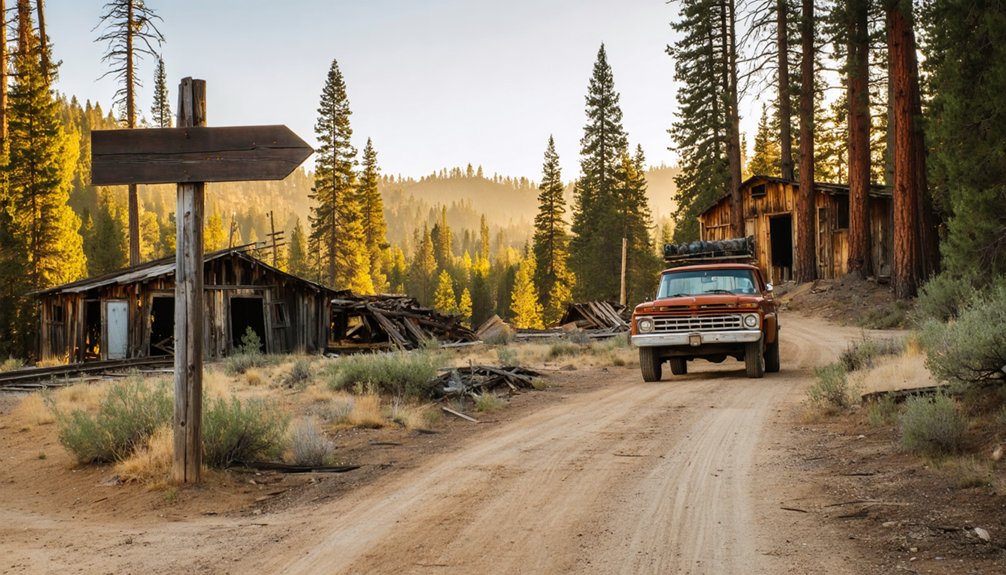
The screech of James W. Marshall’s saw blade changed everything on January 24, 1848, when gold flakes glimmered in Sutter’s Mill tailrace. You’ll find Willard’s story mirrors countless camps that sprang from those Sierra Nevada streams, where ancient sea deposits eroded into gravel beds ripe for panning.
Unlike settlements that faded when placer deposits exhausted by the mid-1850s, Willard evolved into Loring—a rare survivor that developed a thriving post mining economy instead of joining the ghost town roster. You’re exploring a place where organized capital and machinery replaced individual prospectors, where adaptation meant survival.
Today, preservation efforts underway protect what remains of this transformation, letting you witness how determination conquered the boom-bust cycle that claimed so many neighboring camps.
Getting to the Remote Mining Camp in Pershing County
Before you set your GPS coordinates, understand this essential correction: Willard isn’t nestled in California’s Sierra Nevada—it’s actually stranded in Nevada’s Pershing County, roughly 35 miles northeast of Lovelock.
Don’t let outdated sources mislead you—Willard sits in Nevada’s remote Pershing County, not California’s mountain ranges.
Historic mining operations left behind primitive roads that still wind through sagebrush-covered hills. Modern day accessibility depends entirely on your vehicle and nerve:
- High-clearance 4WD required – These unimproved mining roads feature deep ruts, loose gravel, and washboard surfaces that’ll punish standard sedans
- Download offline maps – Cell service vanishes miles before you arrive at the weathered structures
- Pack emergency supplies – Water, tools, and spare fuel aren’t optional luxuries here
The journey demands self-reliance. You’ll navigate by landmarks and intuition, following faint tire tracks where pavement surrendered to wilderness decades ago.
What Remains at the Historic Willard-Loring Townsite Today
When you finally navigate those brutal mining roads into Willard-Loring, you’ll confront an uncomfortable truth: time and scavengers have stripped this place nearly bare. The mining camp remnants amount to little more than scattered foundation stones and debris fields where wooden structures once stood.
Don’t expect photogenic ruins—this ghost town’s story lives in the landscape itself, the raw canyon walls that witnessed a brief 1915 gold rush before silence returned.
Modern day site access means you’re free to explore unhindered, but budget just thirty minutes here. Walk the empty flats, imagine desperate miners chasing veins that played out too quickly, then move on. Willard-Loring rewards those seeking atmospheric desolation over preserved history. It’s Nevada mining heritage reduced to whispers and dust.
The Gibson Mill at Kodak Siding and Railroad Connection
You’ll spot the crumbling foundation of Gibson Mill about a mile east of Willard’s main ruins, where Kodak Siding once connected directly to Southern Pacific’s mainline tracks.
During the 1920s boom, steam-powered grinders here processed up to 50 tons of gypsum daily, loading railcars bound for San Francisco’s building sites before dawn broke over the Inyo peaks.
Stand where the loading platform jutted out, and you can still trace the rusted rail spurs disappearing into sage—silent proof of how one siding kept an entire ghost town’s economy humming.
Mill Construction and Capacity
Standing at the weathered remnants of Kodak Siding today, you can almost hear the rhythmic thunder of stamp mills that once dominated this isolated stretch of California wilderness. Gibson Mill’s construction showcased mid-1800s ingenuity, employing:
- Wood and iron frameworks that withstood years of continuous operation
- Walking-beam engines that powered the manual ore processing through sheer mechanical force
- Standard stamp mill configurations designed specifically for crushing Placeritas gold ore
The mill dimensions remained modest by industry standards, perfectly scaled for processing the region’s placer deposits. You’ll appreciate how miners worked these machines by hand, coaxing out precious ounces—like that historic 18.34-ounce shipment to Philadelphia’s Mint in 1843. The railroad siding eliminated grueling wagon hauls, letting independent operators compete with larger operations while maintaining their autonomy.
Southern Pacific Railroad Access
The screech of iron wheels against standard gauge rails once signaled prosperity at Kodak Siding, where Southern Pacific’s mainline carved through California’s rugged wilderness to reach Gibson Mill’s loading platforms.
You’ll discover rusted remnants of railroad operations that transformed raw timber into profitable cargo—boxcars and flatcars departed loaded with freshly milled lumber while bringing logs from northern forests. The siding’s strategic placement minimized costs and maximized efficiency, with daily coordination between train crews and mill foremen creating seamless workflows.
Today, you can trace these historic tracks via dirt roads off Highway 58. Bring your 4WD and GPS (coordinates near 35.2°N, 118.1°W) to explore concrete foundations and deteriorating mill infrastructure. The two-hour drive from Bakersfield rewards adventurers with tangible connections to California’s industrial past, where commerce and wilderness collided.
Peak Production Years Output
Between 1905 and 1915, Gibson Mill’s steam-powered band saws screamed through 20,000 board feet of pine and fir daily, their rhythmic cutting punctuated by the hiss of planers smoothing lumber destined for California’s booming construction markets.
When you’re exploring Kodak Siding today, visualize these timber harvest volumes:
- 5 million board feet annually rolled through these vanished mill gates during peak years
- 10-15 railcars daily hauled finished lumber toward Southern Pacific’s main line
- 50-100 workers operated grueling 12-hour shifts feeding insatiable demand
The lumber output data tells Willard’s story better than any preserved building could. Stand where slag heaps still smolder beneath your boots, where horse-drawn skid roads once snaked through Sierra foothills. You’re witnessing America’s westward expansion crystallized in rust and ash.
Exploring Nearby Ghost Towns Along Your Route
Pack extra water and fuel—desert distances deceive.
Download offline maps since cell service vanishes between towns.
The remoteness becomes part of your liberation, connecting you with pioneers who once sought fortune in these unforgiving landscapes.
Best Times to Visit and Essential Preparations for Remote Travel
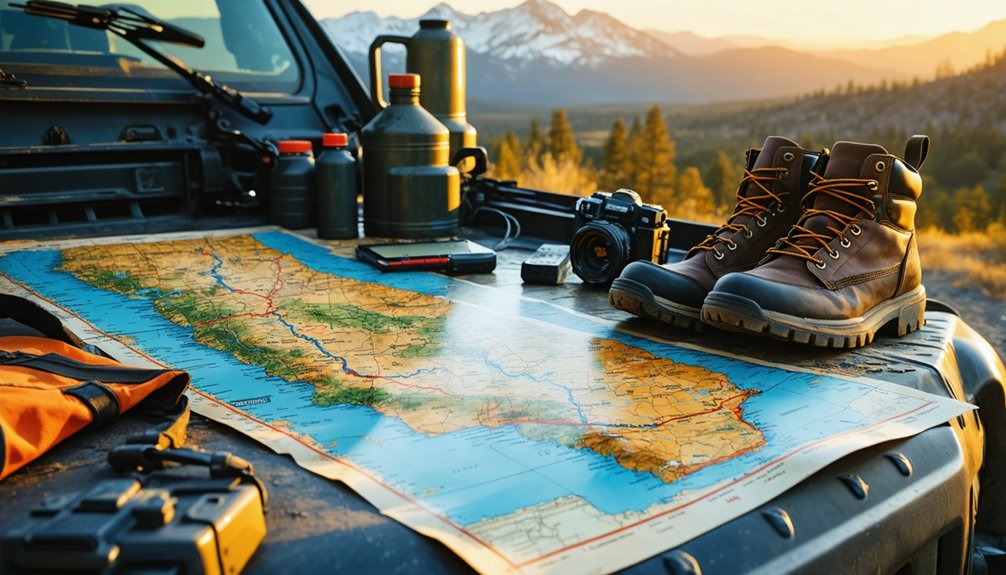
When planning your ghost town adventure, spring and fall emerge as the sweet spots for exploration, offering mild temperatures that let you wander crumbling structures without battling desert extremes or mountain snowdrifts.
Spring and fall deliver the perfect conditions for ghost town exploration—mild weather without harsh desert heat or impassable mountain snow.
Packing appropriate supplies becomes critical for these remote journeys. Fill your tank before leaving civilization—gas stations don’t exist near abandoned settlements. Check SR 270 conditions through Caltrans when traversing seasonal road closures, especially if you’re chasing high-elevation sites that demand snowshoes come winter.
Your essential checklist:
- High-clearance vehicle for unpaved access roads leading to forgotten towns
- Extra water and sun protection for desert temperature swings exceeding 40 degrees
- Layered clothing since 8,375-foot elevations shift from scorching days to frigid nights
Remember: summer extends operating hours until 6pm, while winter shrinks them to 4pm—plan accordingly.
Photography Tips and Historical Markers to Look For
Your camera becomes your time machine at Willard, capturing weathered wood textures and rusted mining equipment that tell stories no historian could match. Shoot during golden hour when sidelight reveals every crack in century-old timber and creates dramatic shadows across abandoned hydraulic mining channels.
Adjust your camera settings to f/8 or higher for sharp detail in deteriorating structures, and bracket exposures—these high-contrast scenes challenge even modern sensors.
Search for California Historical Landmark No. 771 marking the Dogtown Nugget discovery site, where A. K. Stearns found that legendary 54-pound gold chunk in 1859. Frame the marker against Feather River Canyon’s backdrop using leading lines from old mining ditches.
Master these lighting techniques now: overcast days eliminate harsh shadows on faded signage, while backlighting transforms dust particles into ethereal atmosphere.
Frequently Asked Questions
Are There Any Camping Facilities Near Willard or Loring Ghost Town?
Where there’s a will, there’s a way—you’ll find primitive camping options scattered throughout nearby recreation areas. Pack your gear, embrace solitude, and you’re free to pitch your tent under star-filled desert skies near these forgotten places.
What Permits or Permissions Are Needed to Explore the Townsite?
You’ll need landowner permission since Willard sits on private property. Trespassing creates serious liability concerns and legal headaches. Contact local ranchers beforehand—most appreciate respectful explorers who ask first. Your freedom depends on respecting others’ boundaries and building trust.
Is the Gibson Mill Structure Safe to Enter and Photograph?
Like a weathered sentinel guarding forgotten stories, Gibson Mill isn’t safe to enter. Structural integrity concerns from documented decay and contamination mean you’ll need serious safety precautions required—photograph from outside fenced perimeters only.
Can You Collect Ore Samples or Artifacts From the Site?
No, you can’t collect anything from Willard. Rare mineral specimens and potential archaeological finds remain protected on private property. Removing ore samples or artifacts isn’t just forbidden—it’s illegal. Respect preservation laws; photograph memories instead of pocketing history.
Are There Guided Tours Available for Willard and Nearby Ghost Towns?
Willard offers self-guided tours along dusty driving routes where you’ll discover freedom exploring abandoned structures independently. Nearby Bodie provides guided options, but Willard’s unmarked trails let you wander untethered, creating your own authentic ghost town adventure.
Venturing further into the wilderness, you’ll find enchanting spots that highlight the beauty of exploring ghost towns in California. From the remnants of old mines to crumbling saloons, each site whispers stories of a bygone era. Keep your camera ready, as these hidden gems offer endless opportunities for capturing their haunting charm.