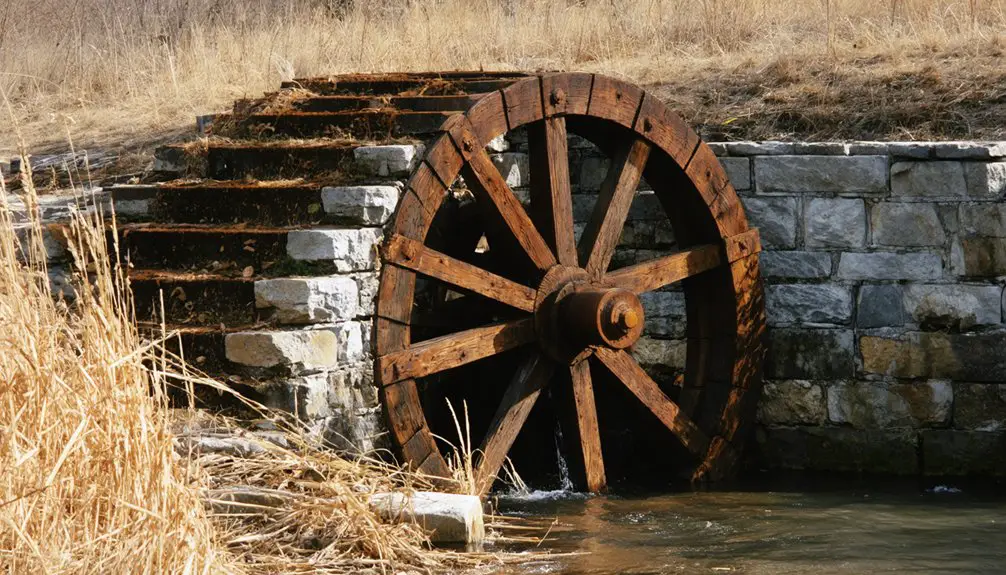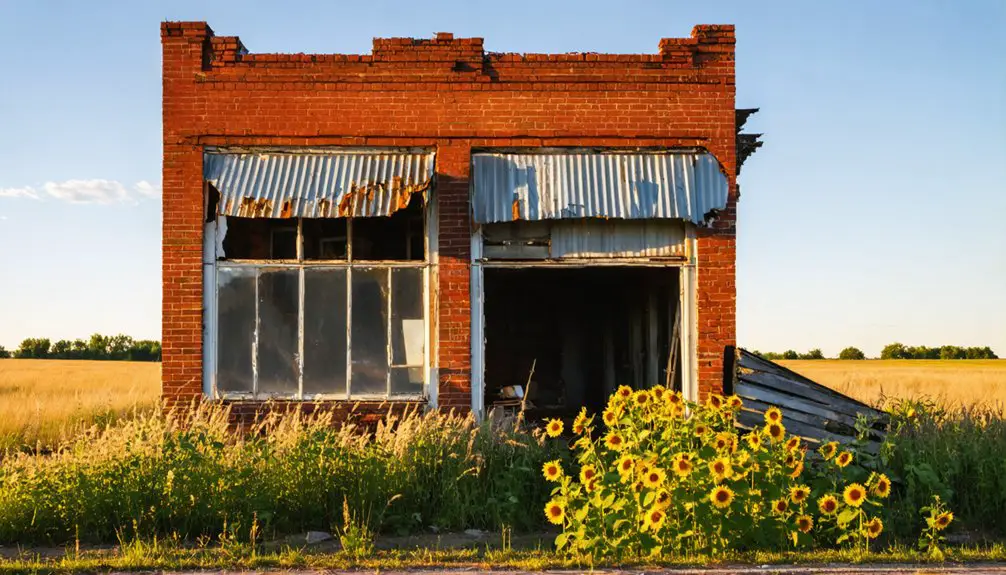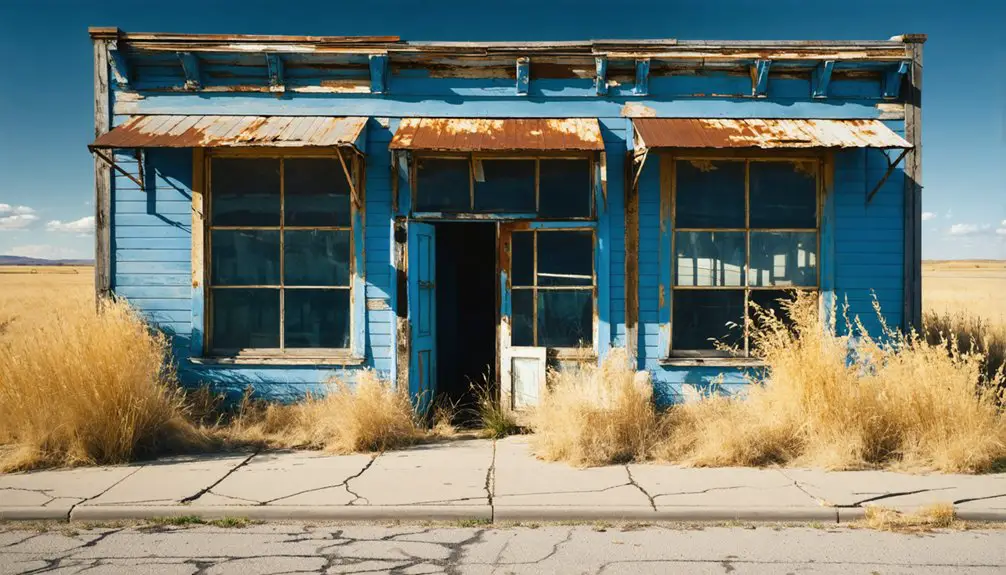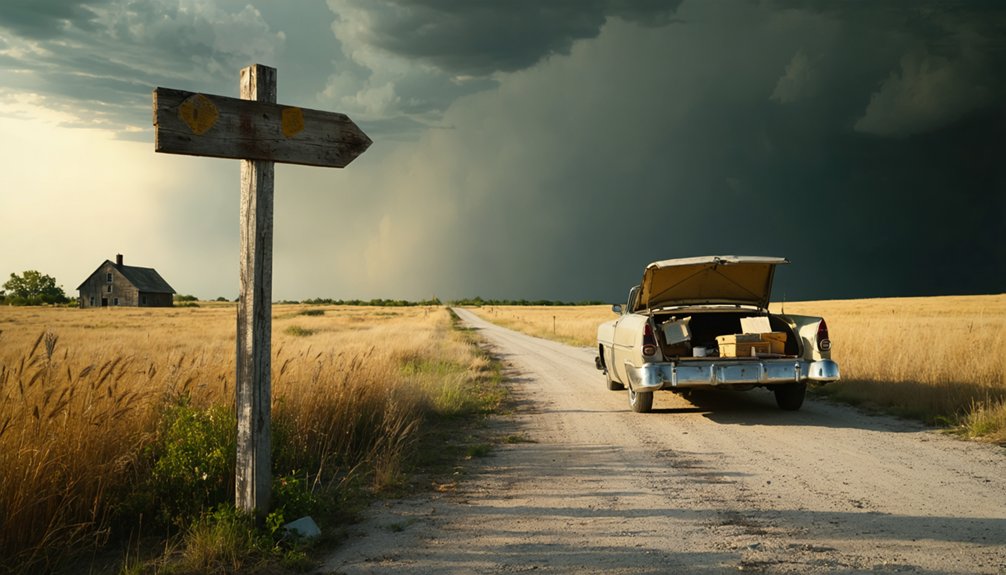
Planning your road trip to Williamsport requires preparation since this elusive Kansas ghost town won’t appear in most directories. You’ll need to navigate unmarked county roads off Highway 59, relying on instinct and local knowledge through remote prairie terrain. Pack extra water, download offline maps, and fuel up at that last gas station twenty miles back. When you arrive, you’ll discover weathered timbers, collapsed mine shafts, and preserved structures from the 1880s coal boom. The journey’s challenges make the authentic decay you’ll encounter even more rewarding.
Exploring the history of Williamsport reveals tales of miners who once thrived in this rugged landscape, facing both the beauty and brutality of nature. As you wander through the remnants, imagine the bustling activity that filled these streets during the peak of the coal era. Each step educates you about the resilience of a community that once was, allowing you to connect with a past that still breathes within the ruins.
Key Takeaways
- Download offline maps and locate Williamsport by instinct, as Kansas ghost town directories lack specific coordinates for this remote site.
- Pack essential supplies including extra water and ensure full fuel tank before navigating unmarked county roads through remote prairie terrain.
- Explore preserved structures including the schoolmaster’s house, weathered church, collapsed mine shafts, and coal weighing foundation from the 1880s boom.
- Visit nearby documented ghost towns like Sumner and Silkville as alternative destinations if Williamsport proves too difficult to locate.
- Discover coal mining history remnants and mineral springs while respecting ongoing preservation efforts and sealed mine openings for safety.
What Makes Williamsport a Must-Visit Kansas Ghost Town
The wind whispers through collapsed mine shafts and weathered timbers at Williamsport, where lead and zinc deposits once pulled fortune-seekers from across the country to this corner of Cherokee County. You’ll discover a haunting ambiance walking among structures that witnessed over 1,000 residents during the mid-1880s boom—a stark contrast to today’s silence.
The relics and discoveries here tell stories of untamed nights without police, where miners spent their earnings in bustling saloons. Touch the coal weighing foundation‘s rough stone, peer into the preserved schoolmaster’s house, and stand before the weathered church that refused to surrender. This isn’t some sanitized historical park—it’s raw industrial history where nature reclaims what human ambition built and abandoned, offering you genuine connection to Kansas’s resource-driven past. Consider exploring Williamsport on a glorious fall day when leaves turn and abundant sunshine illuminates the remaining structures. Like many Kansas settlements, Williamsport eventually succumbed to depletion of minerals that had originally drawn prospectors to establish the community.
Best Routes and Roads to Reach Williamsport
Before you pack your camera and set out for Williamsport, you’ll need to confront an uncomfortable truth: pinpointing this ghost town’s exact location proves frustratingly elusive even for seasoned explorers. No coordinates exist in Kansas ghost town directories, leaving you to navigate by instinct and local knowledge. Unlike neighboring Atchison County sites with clear railroad markers, Williamsport vanishes from official maps entirely.
As you delve into the heart of Kansas, you may find that there are many ghost towns to visit in Kansas that have similar stories of obscurity and loss. Each abandoned structure tells a tale of a community that once thrived, echoing the past amidst the overgrown landscapes. Exploring these forgotten places can offer a unique glimpse into Kansas’s rich history and the lives that once filled these now-desolate streets.
As you search for ghost towns near Kansapolis Rochester, you might come across remnants of forgotten settlements that tell stories of past generations. Many travelers have reported eerie encounters and unexplainable phenomena in these abandoned places. Exploring these areas not only satisfies a thirst for adventure but also uncovers the hidden histories that shaped the region.
As you wander through the surrounding area, exploring ghost towns in Kansas offers a unique perspective on the region’s history. Each abandoned building tells a story, beckoning the curious to uncover its secrets. With every step, the haunting beauty of these forgotten places invites you to imagine the lives once lived within their walls.
Exploring ghost towns in Kansas can be a thrilling adventure, but it often requires patience and creativity. As you meander through the remnants of these forgotten places, the stories of the past begin to unfold, hinting at the lives once lived there. You might just stumble upon a hidden gem that locals cherish, making your journey all the more rewarding.
You’ll face remote prairie terrain challenges that test your determination—unmarked county roads snake through grasslands where droughts once broke pioneers’ spirits. Access routes via county roads demand preparation: pack extra water, download offline maps, and fuel up beforehand. The freedom you crave comes with responsibility.
Consider exploring documented alternatives like Sumner, five miles west of Atchison, where crumbling foundations reward your adventurous spirit with tangible history. Another Franklin County option, Silkville, offers three surviving stone structures including a schoolhouse and two barns that earned National Register designation in 1972. While in the area, history enthusiasts might also seek out the Tall Oak Whispering Giant in Troy, Kansas, which stands 27 feet tall as part of artist Peter Wolf Toth’s Native American tribute sculptures.
Historical Background of Williamsport’s Mining Era
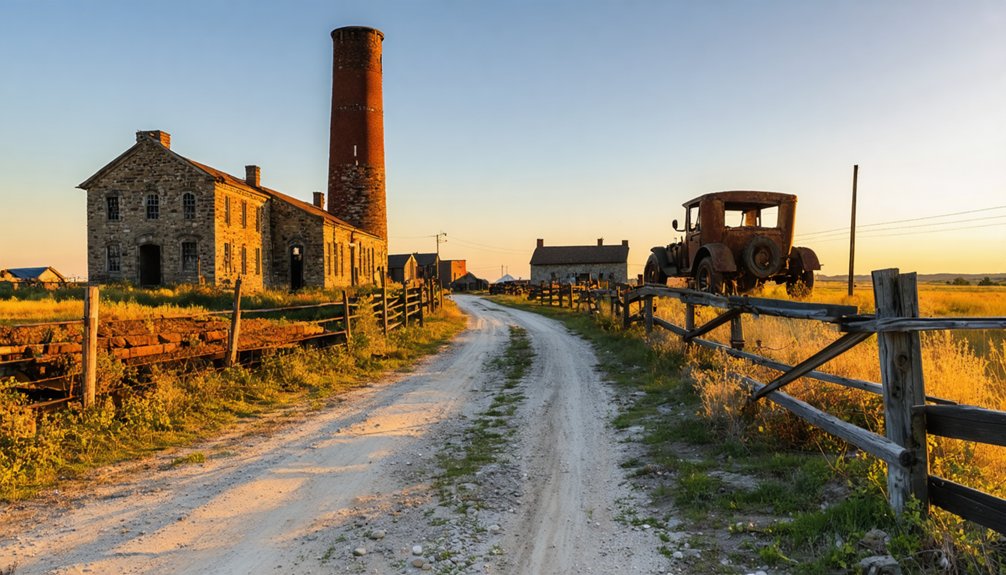
As you explore Williamsport’s abandoned streets, you’ll notice the remnants of a coal mining boom that transformed this quiet corner of Cherokee County in the late 1800s. The town’s mines once hummed with activity during southeast Kansas’s explosive growth period, when annual production skyrocketed from 50,000 tons in 1880 to nearly 6 million tons by 1900.
You’re walking through what remains of a community that thrived on the Weir-Pittsburg coal seam—the same rich vein that employed nearly 10,000 underground workers across the region during World War I. The room-and-pillar system became the dominant underground mining method after Cherokee County dug its first mineshaft in 1874. The landscape here still bears the marks of mining history, much like the nearby Mined Land Wildlife Area that now spans Crawford, Cherokee, and Labette Counties.
Mining Operations and Development
Walking through what remains of Williamsport today, you’d never guess that hammers once echoed through these hills and mining operations shaped every aspect of daily life here. The town’s undocumented mining operations left few official records, making it difficult to piece together the full story of what drew settlers to this remote corner of Kansas.
Land development disputes frequently erupted as miners staked competing claims, creating a wild atmosphere where fortunes could be made or lost overnight. You can still trace the ghostly outlines where extraction sites once hummed with activity, though nature has reclaimed most of the scarred earth. Before shaft mining revolutionized the industry in 1874, early miners relied on drift mining techniques along coal outcroppings, operating what locals called “gopher hole” mines. Underground operations typically employed room-and-pillar methods, where miners excavated ore while leaving support columns to hold up the mine roof. The absence of detailed historical documentation only deepens Williamsport’s mystery, leaving you to imagine the chaos and opportunity that once defined this forgotten place.
Peak Production Years
During the first three decades of the twentieth century, Kansas coal fields roared with an intensity that transformed the landscape into a churning industrial engine.
You’d have witnessed production volumes surge to 7.25 million tons in 1917 as World War I demanded fuel for the nation’s machinery. The Weir-Pittsburg seam—Kansas’s thickest at 60 inches—powered this boom, stretching across 100 square miles of scarred earth where open-pit scars and shaft towers dominated the horizon.
Miners extracted the coal using room and pillar methods, carving out systematic chambers while leaving structural columns to support the mine roof above. The Weir-Pittsburg coal seam alone accounted for two-thirds of the state’s total coal production during this era, cementing its status as the most important deposit in Kansas mining history.
Economic Decline and Abandonment
The ground beneath Williamsport’s streets began to betray its people long before the final mine shafts sealed shut. You’ll find the remnants of community resilience in the abandoned storefronts and silent rail lines that once carried Pennsylvania’s superior anthracite westward, crushing demand for local lignite.
By 1964, Kansas’s last deep mine closed, leaving behind acidic water pooling in forgotten tunnels and sinkholes yawning open after heavy rains. The Eagle-Picher shutdown in 1970 marked the end of a century-long mining legacy that extracted 2.9 million tons of zinc but left toxic metals seeping into groundwater.
Today’s environmental reclamation efforts continue sealing nearly 700 coal openings since 1996, though new collapses still appear—persistent reminders of Williamsport’s hollowed-out foundations.
Current Attractions and Old West Entertainment
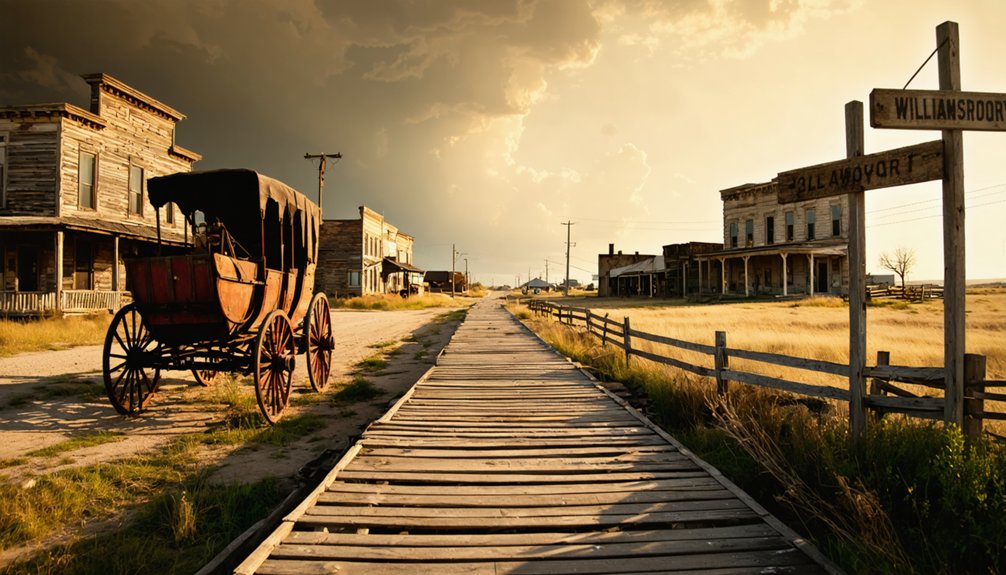
Long before Route 66 became America’s most famous highway, Williamsport thrived on a different kind of magic—the mineral springs that bubbled up from the earth, drawing visitors who believed in their healing powers.
Today, you’ll find a different attraction entirely. This ghost town has reinvented itself with Old West themed attractions that capture the raw spirit of its mining past. You’re free to wander among weathered structures that tell stories of boom and bust, where the visitor experience blends authentic abandonment with frontier nostalgia.
The decaying houses stand as silent witnesses, offering eerie exploration through their empty windows and sagging porches. No gates restrict your curiosity here—just the atmospheric remains of a community that once pulsed with life, now preserved in fascinating decay.
Nearby Ghost Towns to Add to Your Itinerary
Your exploration of Williamsport’s weathered facades naturally sparks curiosity about what other forgotten settlements dot this Kansas landscape. Within striking distance, you’ll find Comiskey in Morris County—a solitary memorial to lesser known settlement history where railroad tracks once promised prosperity.
Head south to Sumner County’s Milan, your gateway to Perth’s crumbling depot and Drury’s skeletal buildings clinging to abandoned rails. Population decline factors become tangible at Atchison County’s Sumner, where drought, cyclones, and grasshoppers conspired to scatter residents in 1860. Now briers choke overgrown streets while forest reclaims what settlers built.
Each stop reveals sun-bleached wood, rusted hinges, and wind-whistled silence—reminders that freedom often meant gambling everything on towns that couldn’t survive Kansas’s unforgiving temperament.
Diamond Springs and Dunlap: Confederate Attack Sites Worth Exploring
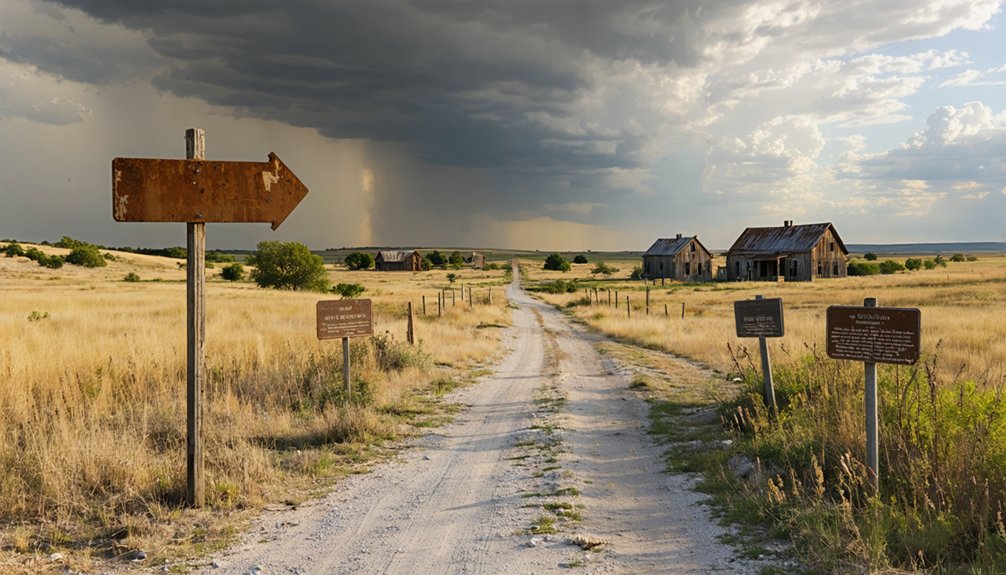
Two dusty ribbons of wagon ruts still carve through the prairie grass at Diamond Springs, where Missouri Bushwhacker Dick Yeager and his Confederate raiders descended on May 4, 1863, leaving blood-soaked earth and ashes.
Your diamond springs exploration reveals more than interpretive signs—you’ll trace the spring where U.S. Dragoons frantically beat back Kaw Indian prairie fires in 1852, and stand where station manager Augustus Howell died defending his post.
What You’ll Discover:
- Visible Santa Fe Trail ruts cutting through untamed grassland
- Spring waters that drew pioneers to their fate
- Dunlap’s civil war connections through nearby bushwhacker raid sites
- Highway 50 access threading through Flint Hills country
- Preserved battlefield where border warfare claimed innocent lives
The station never rebuilt—freedom’s price, paid in frontier blood.
Essential Stops Along the Way: Elmdale and Clements
You’ll find Elmdale six miles west of Cottonwood Falls, where the post office arrived from Middle Creek in January 1873 and transformed this railroad hub into a proper town. The limestone buildings still standing—the 1898 bank, the red brick Methodist church, the late 1880s schoolhouse—survived floods that drove out most residents, leaving only crumbling storefronts and silent streets behind.
Just down the road, Clements barely exists anymore, though in 1883 this stop bustled with three stores, mills, and a diverse population that included a large percentage of colored settlers who made Joseph Dunlap’s namesake town their home.
Elmdale’s Historic 1873 Roots
As you roll into Elmdale, the whistle of trains that once echoed through the Flint Hills still seems to linger in the air. This prairie settlement exploded to life when the Atchison, Topeka & Santa Fe Railway carved through in 1871.
The post office relocation impact from extinct Middle Creek in January 1873 transformed this railroad stop into a legitimate community.
By 1878, you’d have found a thriving hub of 100 souls:
- Key growth industries: Osage flour mills grinding local grain into profit
- Three competing churches serving spiritual needs
- Telegraph lines connecting isolated prairie dwellers to civilization
- Stagecoach routes running north to Junction City
- Grain and livestock exports fueling the local economy
This wasn’t some dusty waystation—it was freedom materialized through commerce, connection, and determination.
Clements’ Confederate Attack Remnants
The scorched earth of Clements still whispers secrets from August 1863, when Quantrill’s Raiders tore southward through Chase County with blood on their hands. You’ll find remnant foundations where guerrillas torched abolitionist homesteads, their charred timbers long buried beneath prairie grass.
Follow the roadside markers tracing the Raiders’ escape route—each one marking where freedom fighters or terrorists (depending on which side claimed your ancestors) ambushed Union militia. By 1865 Quantrill’s raiders had scattered, but their violent legacy remained etched in rifle pits you can still trace near abandoned farmsteads.
Related battle artifacts occasionally surface after spring rains: rusted stirrups, spent cartridges, fragments of the border war’s brutal truth. Stand here where bushwhackers once reloaded, and you’re breathing history’s rawest air.
What to Expect When You Arrive: Buildings and Remnants
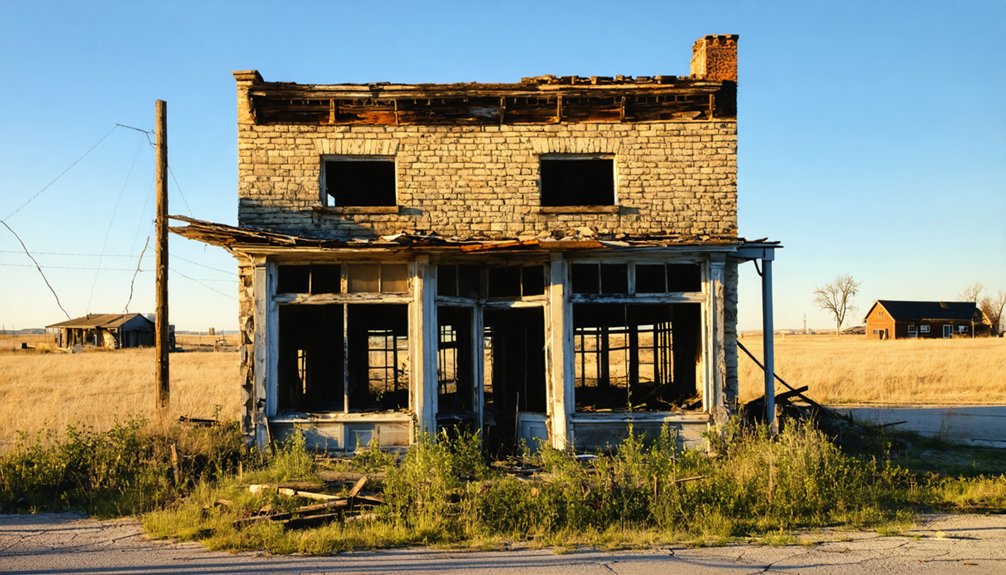
Weathered structures emerge from Kansas prairies like memories refusing to fade completely.
When you reach Williamsport, you’ll discover a landscape where history whispers through overgrown rural landscapes and crumbled building foundations. The settlement vanished, but traces linger for those willing to explore beyond marked roads.
What you’ll encounter:
- Cemetery markers standing sentinel over forgotten families, headstones weathering decades of prairie winds
- Church remnants where communities once gathered, walls holding echoes of hymns and Sunday gatherings
- Foundation outlines revealing where homes and businesses anchored daily life before abandonment
- Overgrown pathways winding through tall grass, tracing routes residents once traveled regularly
- Isolated structures persisting against elements, their peeling paint and sagging frames testimony to resilience
You’re witnessing authentic abandonment—no preserved museum pieces, just raw history reclaiming itself.
Tips for Planning Your Multi-Town Ghost Town Drive
When you’re mapping out a ghost town road trip that spans multiple abandoned settlements, your success hinges on clustering locations strategically rather than zigzagging aimlessly across state lines. Montana’s Pioneer Mountain Scenic Byway connects Coolidge, Bannack, and Elkhorn Hot Springs in one satisfying sweep, while Colorado bundles Caribou City, Silver Plume, and St. Elmo along accessible mountain corridors.
Vehicle preparation determines which routes you’ll conquer. Pack a full-size spare, maintain good tires, and fuel up before venturing toward sites like Kirwin, where four-wheel drive tackles river crossings and steep grades.
Road conditions shift dramatically—Gilman’s southern approach welcomes all vehicles, while northern routes demand careful navigation. Check weather forecasts religiously; rainy seasons transform manageable dirt roads into treacherous mud traps that’ll strand your adventure before it begins.
Frequently Asked Questions
What Are the Best Seasons to Visit Kansas Ghost Towns?
You’ll find spring and fall perfect for exploring Kansas ghost towns. Fall foliage paints abandoned streets in amber hues, while winter solitude offers unmatched freedom—crisp air whispering through forgotten doorways, footprints yours alone across silent, snow-dusted prairies.
Are Kansas Ghost Town Sites Accessible for People With Mobility Limitations?
You’ll face challenges—accessibility for disabled visitors isn’t guaranteed at these sites. Crumbling foundations, overgrown paths, and gravel trackbeds create rough terrain conditions. Most locations offer roadside viewing from your vehicle, letting you explore freely without extensive walking required.
Do I Need Special Permits to Explore Ghost Town Properties?
You don’t need special permits for Williamsport’s ghost town, but you’ll want to respect private property access and trespassing laws. Always seek landowner permission first—it’s about honoring boundaries while satisfying your wanderlust and adventurous spirit.
What Supplies Should I Bring for a Full-Day Ghost Town Road Trip?
Ready to explore freely? You’ll need plenty of water and snacks to fuel your adventure, comfortable footwear for wandering crumbling structures, plus sunscreen, a first aid kit, and your camera to capture those hauntingly beautiful moments.
Are There Accommodations Available Near Williamsport and Surrounding Ghost Towns?
You’ll find several haunted hotels like the historic Genetti and cozy bed and breakfasts near Williamsport. While camping options aren’t mentioned, ghost town accommodations range from shared bathrooms to private suites—choose your adventure level freely.
References
- https://thewanderingpigeon.com/2015/10/03/day-of-kansas-ghost-towns/
- https://www.youtube.com/watch?v=KBXINX0xqnU
- https://www.youtube.com/watch?v=dF7vGl5xasI
- https://www.onlyinyourstate.com/trip-ideas/usa/small-towns-odd-claim-to-fame-usa
- https://paranormalghostsociety.org/PalmettoNV.htm
- https://legendsofkansas.com/shawnee-county-extinct-towns/
- https://www.hhhistory.com/2019/05/ghost-towns-of-kansas.html
- https://www.youtube.com/watch?v=ie3zwwHm2Jg
- https://kellycodetectors.com/content/pdf/site_locator_books/KS.pdf
- https://en.wikipedia.org/wiki/Silkville