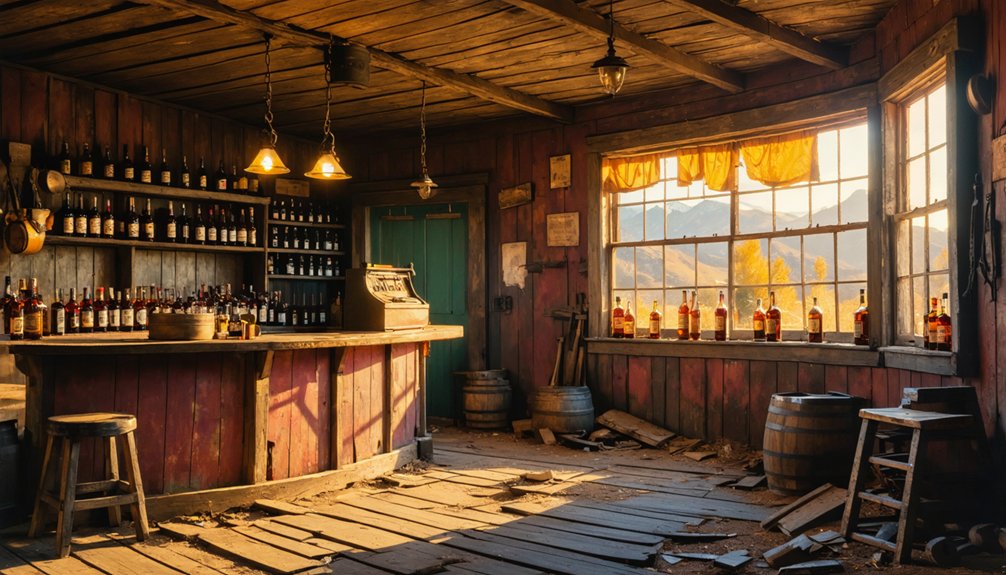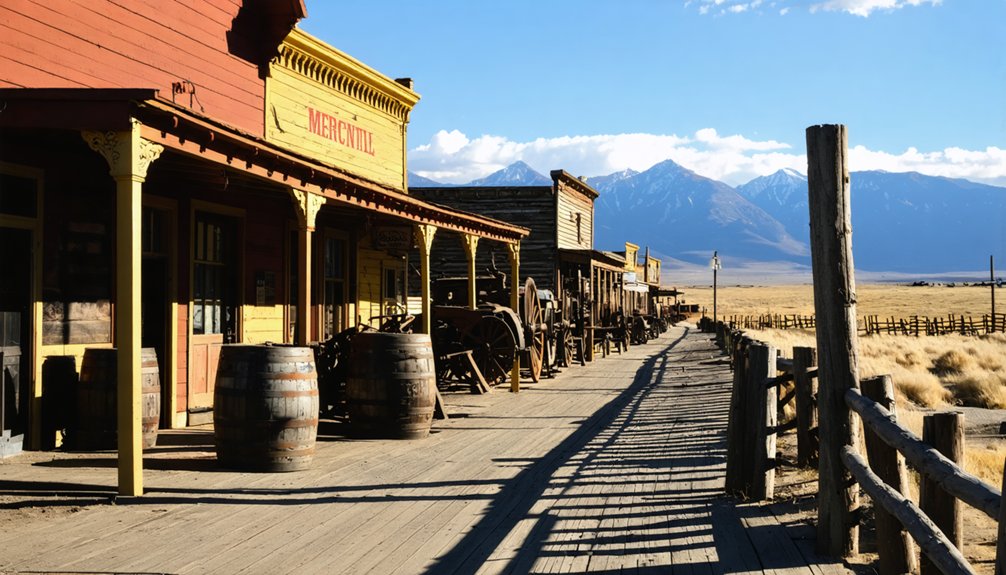
You’ll find Goffs (not Wycoff) along historic Route 66 in California’s Mojave Desert, about 100 miles east of Barstow. This authentic ghost town centers around the restored 1914 Mission Revival schoolhouse, now a fascinating museum showcasing railroad artifacts, WWII relics from General Patton’s desert training camp, and working gold mining equipment. The best visiting months are October through April when desert temperatures stay comfortable. Keep scrolling to discover hidden artifacts, photographer-worthy ruins, and insider tips for exploring this remarkably preserved Old West settlement.
Key Takeaways
- Visit the restored 1914 Goffs Schoolhouse Museum, a mission-style building featuring original student records and single-classroom artifacts.
- Explore working 19th-century gold mining equipment including operational stamp mills that demonstrate the actual recovery process.
- Drive authentic 1926-1931 Route 66 pavement remnants and view historic rail depot artifacts from the 1883 Santa Fe mainline.
- Tour General Patton’s WWII desert training camp relics and railroad supply stop memorabilia from the 10,000-soldier base.
- Access Mojave National Preserve and photograph Boulevard of Dreams’ diverse Old West artifacts along the antique trail.
The Rich History Behind This Mojave Desert Settlement
The railroad brought Goffs to life in 1883, when the Atlantic and Pacific Railway struck a deal with Southern Pacific to push steel rails through this desolate stretch of Mojave sand.
You’ll find a resilient community took root here when gold appeared in the New York Mountains during the 1890s, transforming a simple rail station into a proper mining settlement. The town flourished as a junction connecting Nevada’s mining districts with the Los Angeles corridor.
Route 66’s arrival in 1926 sparked thriving commerce—the general store expanded into a gas station, bar, and dance hall. By the 1930s, twenty-nine students filled the Mission-style schoolhouse, mostly children of Mexican railroad workers who kept the trains running westward. World War II brought new purpose when Goffs served as a training camp and strategic railroad supply stop for military operations.
Today, the restored early 1900s schoolhouse stands as the centerpiece of the Mojave Desert Heritage & Cultural Association museum, preserving this railroad junction’s remarkable past.
What Makes Goffs Stand Out Among California Ghost Towns
While most California ghost towns offer fragments of frontier life, Goffs delivers an uncommonly complete portrait of the Old West’s final chapter. You’ll discover where railroad heritage, Route 66 history, military training grounds, and mining operations converge on 113 sun-baked acres.
Exploring ghost towns near Nadeau reveals even more stories waiting to be uncovered. Each site tells its own tale of resilient communities and economic booms and busts that shaped the region. As you wander through these remnants, you can almost hear the echoes of the past coming to life amidst the crumbling structures and dusty trails.
The restored stamp mills aren’t museum pieces—they’re working demonstrations that bring gold recovery to life. You can trace original 1926-1931 Route 66 pavement scattered through the desert, explore rail depot artifacts from the 1883 Santa Fe mainline, and examine relics from General Patton’s 10,000-soldier desert training camp. The carefully curated Boulevard of Dreams stretches along a dirt boulevard lined with artifacts that transform every turn into a photographer’s paradise.
This cultural diversity stems from strong community partnerships preserving multiple eras simultaneously. The centerpiece Goffs Schoolhouse was built in 1914 as a one-room mission style desert school and now serves as a museum on the National Register of Historic Places. Between the scattered mining equipment and protected desert tortoise populations, you’re experiencing authentic Mojave Desert history without interpretive barriers.
Exploring the Goffs Schoolhouse Museum
When you step inside the 800-square-foot Mission Revival schoolhouse, you’ll notice the distinctive stucco-over-steel-mesh walls that survived decades of abandonment before the 1998 restoration brought the building back to its 1914 glory.
The single classroom displays original student records alongside artifacts that tell stories of children who traveled across a 1,000-square-mile desert district to learn here. A single teacher managed all students from grades 1-8 in this one-room facility. Outside, mining equipment and vintage automobiles dot the grounds, while inside exhibits illuminate how families adapted to the harsh Mojave environment—from bilingual students bridging language gaps to the building’s transformation into a WWII canteen. The schoolhouse closed in 1937 after serving the community for over two decades.
Mission-Style Architecture and Restoration
Standing stark against the desert landscape, Goffs Schoolhouse represents one of the finest examples of mission-style architecture still remaining in the Mojave Desert. When you visit, you’ll discover architectural details that transport you to 1914—the original 800-square-foot classroom where one teacher educated grades 1-8, complete with its distinctive mission-style aesthetic.
The preservation efforts tell a remarkable story of community dedication:
- 1982 condition: vandalism had destroyed the east wall and the ceiling sagged dangerously
- 1993: MDHCA formed to oversee complete restoration
- 1998: extensive restoration returned the building to its original configuration
The schoolhouse earned recognition when it was placed on the National Register of Historic Places in 2001, cementing its importance to American heritage. Beyond academics, students learned valuable life lessons by being assigned individual trees to water and care for, with cottonwood trees eventually providing much-needed shade across the schoolyard.
Student Records and Artifacts
As you step inside the Goffs Schoolhouse Museum, you’ll find yourself surrounded by carefully preserved remnants of Mojave Desert education from 1914 to 1937. The walls display original student photo albums showing children from ranches, mines, and railroad camps who once filled this single-room schoolhouse.
You can flip through printed booklets containing actual student records, offering intimate glimpses into frontier education. Behind the main classroom, a small library space remains intact where all eight grades once shared resources.
Outside, you’ll discover a replica of the teacher living quarters—the “Teacherage” where instructors lived from 1915 onward. A detailed guidebook helps you explore outdoor artifacts scattered across the property, including a Nevada Iron Works Two-Stamp Mill that’s particularly rare for being manufactured in Reno. This isn’t just preserved history; it’s your chance to touch authentic desert schoolhouse life.
Desert Life Educational Exhibits
Beyond the classroom walls, the Goffs Schoolhouse Museum transforms into a sprawling outdoor classroom where the Mojave Desert’s rugged past comes alive through hands-on exhibits. You’ll discover informative nature exhibits scattered across 75 acres, where history isn’t roped off behind velvet—it’s meant to be experienced.
The museum offers educational interactive demonstrations featuring:
- Working 19th-century mining equipment including operational mills, gyrators, and crushers where you can even earn certification
- Original Mojave Road School Bus alongside quirky monuments like Frog and Gnome
- Antique trail showcasing vintage cars and artifacts discovered throughout the desert
At the Flywheel Cafe, you’ll picnic among railroad relics and WWII-era artifacts. This gateway to Mojave National Preserve lets you explore Route 66’s authentic 1926 alignment, free from crowds and modern constraints. The facility houses an impressive research collection including over 6,000 volumes, tens of thousands of news clip files, and more than 40,000 historical photographs documenting the region’s heritage.
Outdoor Mining Exhibits and Desert Artifacts
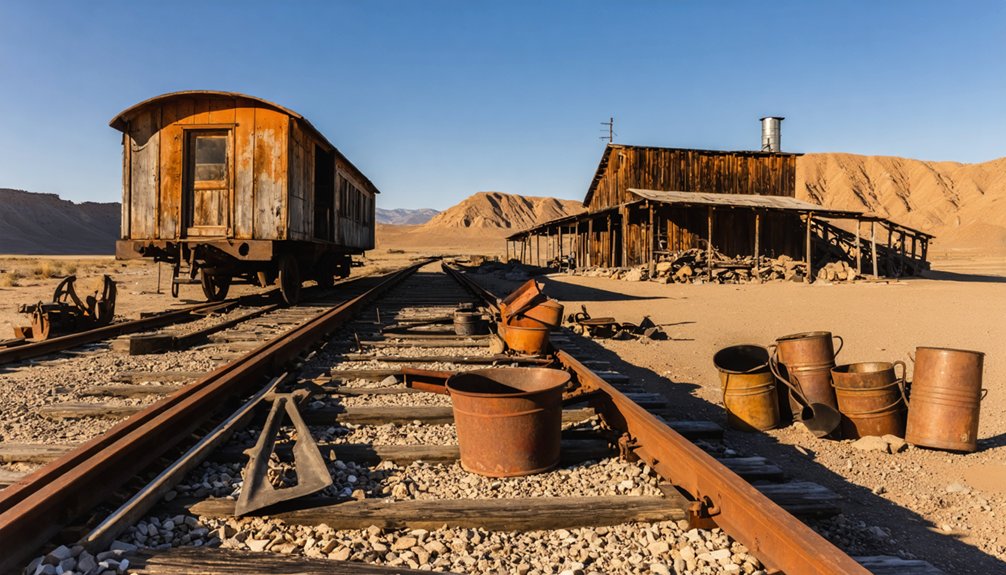
The desert sun beats down on rusted iron machinery scattered across California’s ghost towns, each piece telling stories of fortunes sought and often lost. At Goffs Ghost Town, you’ll discover working stamp mills that still demonstrate how miners extracted gold from raw ore. Walk among ore carts, pulleys, and grinding mechanisms that once powered round-the-clock operations.
Underground drilling artifacts from 1950s operations show the brutal reality of tunnel work, while desert mineral collections at the Assay Office reveal what miners sought beneath scorched earth.
Don’t miss the aerial tramways in Inyo County’s Beveridge Mining District—engineering marvels that transported ore across impossible terrain. These outdoor exhibits beat any museum. You’re free to explore authentically, touching history that corporate tours sanitize away.
Military Heritage From Camp Goffs and General Patton
You’ll discover Camp Goffs’ remarkable transformation from empty desert to a sprawling military training ground in 1942, when the U.S. Army constructed ammunition depots, firing ranges, and facilities to house 15,000 troops across this harsh Mojave landscape.
The 7th Infantry Division spent three critical months here preparing for Pacific combat, utilizing the ten ammunition igloos and extensive rifle ranges that stretched across the terrain near Goffs Butte.
General Patton’s Desert Training Center selected this remote location specifically because its unforgiving conditions perfectly mimicked the North African battlefields where American soldiers would soon face enemy fire.
Camp Goffs Training Operations
During World War II’s darkest days, General Patton transformed this remote Mojave Desert outpost into a vital training hub that would prepare troops for the scorching battlefields of North Africa. You’ll discover remnants of a sophisticated logistics center operations that kept thousands of soldiers supplied and combat-ready throughout 1942-1944.
The camp’s infrastructure included:
- Medical facilities support with a full military hospital treating heat casualties and training injuries
- Supply warehouses and ammunition dumps serving as the primary railhead for desert maneuvers
- Training grounds where over one million soldiers practiced combat tactics across 18,000 square miles
The 7th Infantry Division headquartered here for three months before their Aleutian Campaign. Today, you can explore these historic sites where troops endured brutal conditions, forging the resilience that would prove essential in defeating Rommel’s Afrika Korps.
Desert Warfare Preparation Site
Few visitors to this remote desert crossroads realize they’re standing at the edge of history’s largest military training ground—a vast 18,000-square-mile proving ground where General Patton forged an army capable of defeating Rommel. Between 1942 and 1944, over a million soldiers trained across this unforgiving landscape, learning desert warfare tactics that would prove decisive in North Africa.
Patton’s desert leadership transformed raw recruits into battle-hardened warriors through spartan tent camps and grueling maneuvers. He deliberately chose conditions harsher than Libya itself, believing extreme preparation guaranteed survival overseas. Today, remnants of training facilities still dot the landscape—from Camp Young’s massive terrain map etched into the desert floor to firing ranges near abandoned camps. You’ll find freedom in exploring these weathered monuments, where America’s military might was tested under relentless sun.
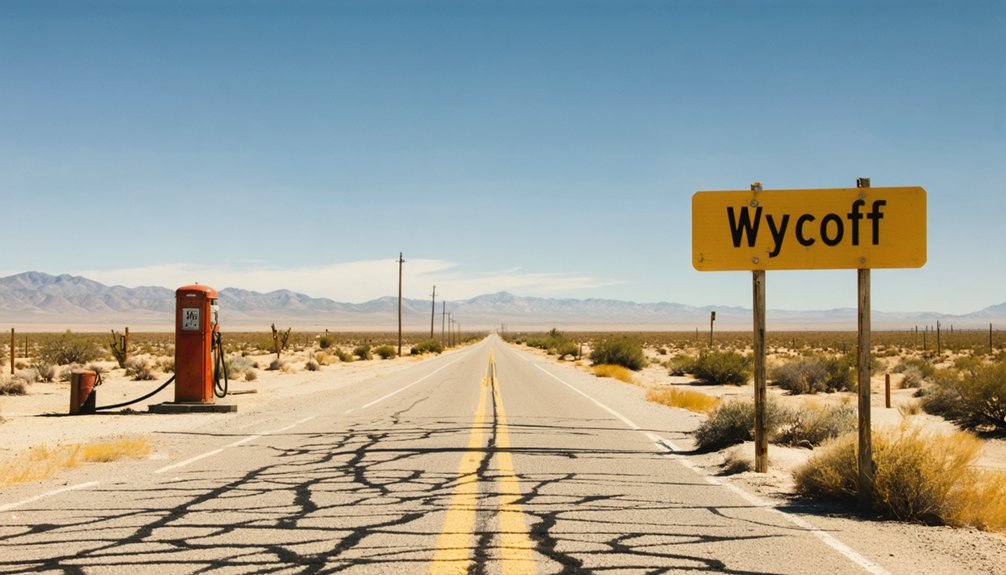
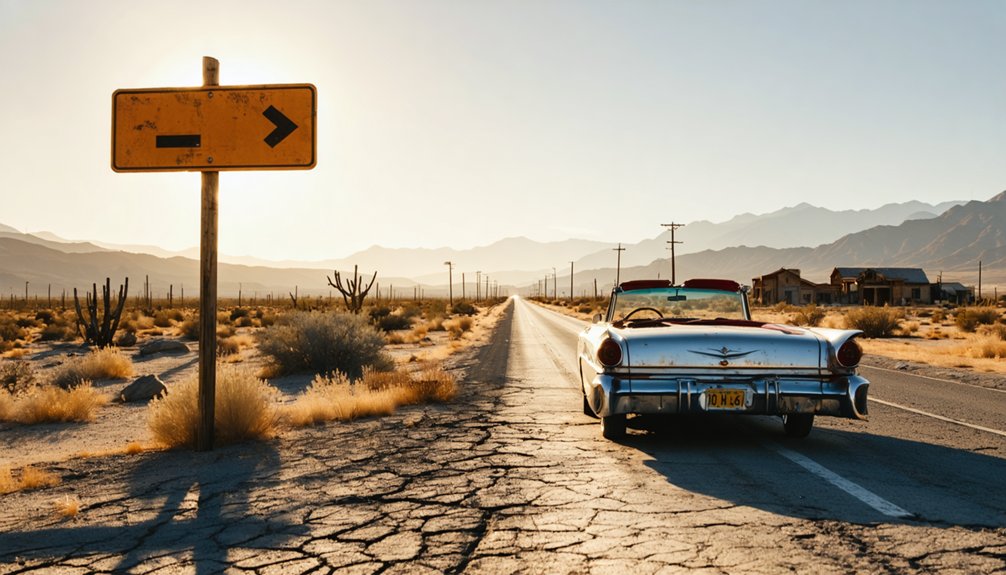
Reaching Goffs requires exiting Interstate 40 at Exit 107, where you’ll find yourself stepping back onto one of the most authentic stretches of old Route 66 remaining in the Mojave Desert. The Mother Road parallels I-40 here, meaning you won’t need to backtrack—just pure forward momentum through open country.
Exit 107 opens a portal to authentic Route 66—no backtracking needed, just open desert and the unfiltered spirit of the Mother Road ahead.
Navigate this segment using these wayfinding markers:
- Follow the railroad line running alongside the historic roadbed from the 1926-1931 alignment
- Watch for directional signs marking the turquoise line on maps near West Park Rd., indicating the original route
- Continue west toward Fenner ghost town on well-maintained pavement
From Las Vegas, take US 95 south. The elevation climbs to 2,595 feet at this high desert junction, where freedom-seekers discover California’s unvarnished past.
Best Time to Visit and What to Expect
The Mojave Desert doesn’t forgive poor timing—I learned this the hard way during my first July visit to Goffs, when 115-degree heat turned my camera’s metal body into a branding iron.
Spring and fall deliver stunning seasonal shifts, transforming this ghost town into an explorer’s paradise with temperatures hovering between 60-80 degrees. You’ll find the 1914 Goffs Schoolhouse Museum open Friday through Sunday, 9am to 4pm, though you’re free to roam the grounds daily during those hours.
Winter brings crisp mornings perfect for photography, while summer demands dawn departures and gallons of water. The wide range of activities—from architectural documentation to desert tortoise spotting—depends entirely on choosing your season wisely.
Nearby Attractions and Extended Desert Adventures
Standing at the weathered crossroads of Goffs, you’ll quickly realize this ghost town isn’t meant to be experienced in isolation—it’s your launching pad into one of America’s most historically dense desert corridors. The Mojave Desert Heritage and Cultural Association hosts stargazing events on their 113-acre grounds, where light pollution hasn’t yet stolen the Milky Way from view.
Three essential destinations extend your adventure:
- Calico Ghost Town (daily 9am-5pm): Lucy Lane Museum, Maggie Mine Tour, and gold panning experiences
- Randsburg: A living ghost town south of Ridgecrest preserving its 1890s character
- Eagle Mountain: Abandoned mining town 157 miles distant for serious explorers
Outdoor recreational activities include off-roading trails, mountain biking, and hiking through protected desert tortoise habitat at 2,595 feet elevation.
Practical Tips for Your Ghost Town Experience
Before you load your camera and water bottles, understand that visiting Goffs requires desert-specific preparation that differs markedly from typical tourist destinations. This isn’t a place with guided tours or seasonal events—you’re exploring independently.
Bring at least one gallon of water per person, as summer temperatures exceed 115°F and services are nonexistent for miles. Your vehicle needs a full tank; gas stations are scarce in this remote Mojave stretch. Cell service is unreliable, so download offline maps beforehand.
The schoolhouse museum keeps limited hours, typically weekends, so verify schedules before departure. Wear sturdy boots for exploring uneven terrain scattered with weathered wood and rusted metal. Most importantly, respect the fragile structures—they’ve survived decades without you touching them.
Frequently Asked Questions
Are There Any Restaurants or Food Services Available in Goffs?
You’ll find hidden treasures like Capital City Wraps’ catering and The Burger Bus for events in Goffs. While options are limited, nearby Gott’s Roadside serves local delicacies including their famous California Burger with fried egg and balsamic onions.
Can Visitors Camp Overnight Near the Goffs Schoolhouse Museum?
While no camping facilities are available directly at the schoolhouse, MDHCA members enjoy free onsite camping with advance reservations. You’ll find full RV hookups and tent sites, though nearby lodging options remain limited in this remote desert location.
Is the Goffs Schoolhouse Museum Wheelchair Accessible for Disabled Visitors?
The Goffs Schoolhouse offers wheelchair rentals and accessible trails, though detailed accessibility features aren’t confirmed. You’ll want to contact them directly about guided tours for disabled visitors, since this historic desert structure has limited modern accommodations documented.
Are Pets Allowed at the Outdoor Exhibits and Museum Grounds?
You’ll find pet friendly policies welcome your leashed dogs at outdoor exhibits, though they’re banned inside museum buildings. While accessibility accommodations exist for wheelchairs, your furry companions can’t explore indoor historical spaces—only external grounds and developed areas.
What Are the Operating Hours and Days for the Schoolhouse Museum?
The museum hours run Friday through Sunday, 9:00 AM to 4:00 PM. You’ll find the museum operating schedule flexible—outdoor exhibits welcome you daily during those same hours, and they’ll arrange special appointments with advance notice.
References
- https://whimsysoul.com/must-see-california-ghost-towns-explore-forgotten-histories/
- https://www.islands.com/1984642/goffs-california-once-thriving-abandoned-ghost-town-historic-rustic-desert-charm/
- https://www.youtube.com/watch?v=372NMuITWVA
- https://www.youtube.com/watch?v=hK_5nEBhbkQ
- https://www.youtube.com/watch?v=0l9mTQqomNQ
- https://www.tripadvisor.com/Attraction_Review-g32360-d3590428-Reviews-Goffs_Ghost_Town-Essex_California.html
- https://www.theroute-66.com/goffs.html
- https://sunset.com/travel/where-are-the-real-ghost-towns-of-the-west
- https://www.barnesandnoble.com/w/how-to-read-the-american-west-william-wyckoff/1124330434
- https://pinintheatlas.com/travel-blogs/goffs-ghost-town/