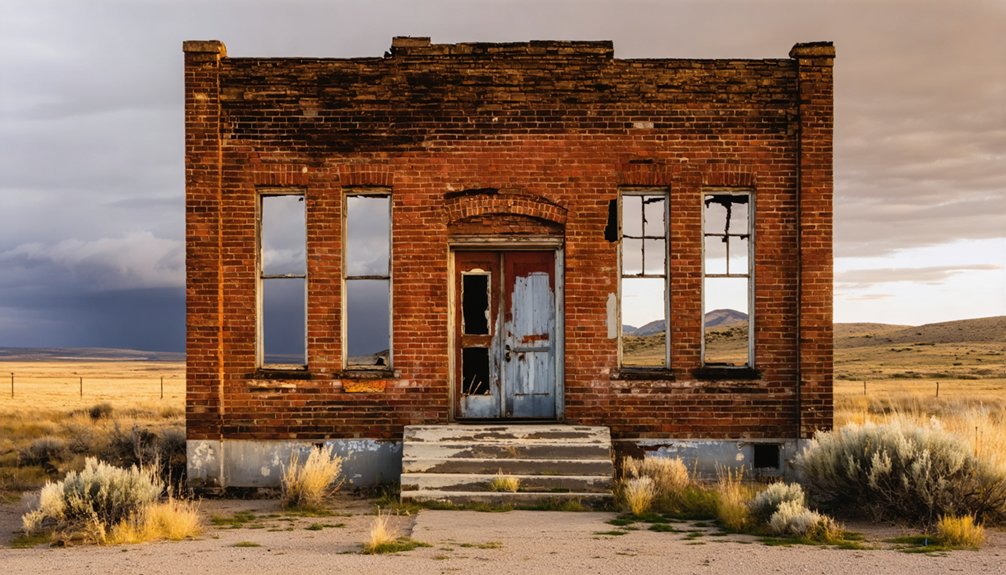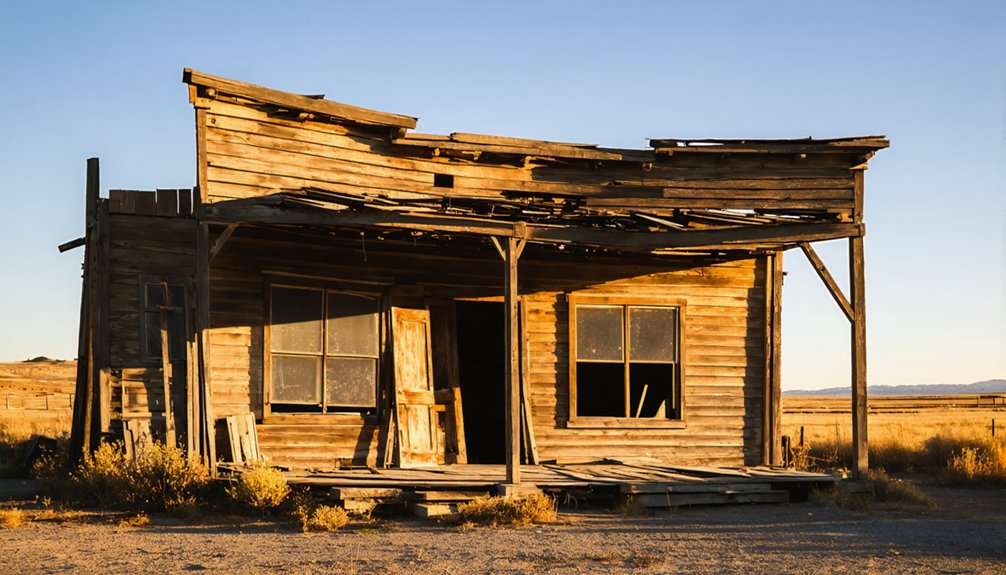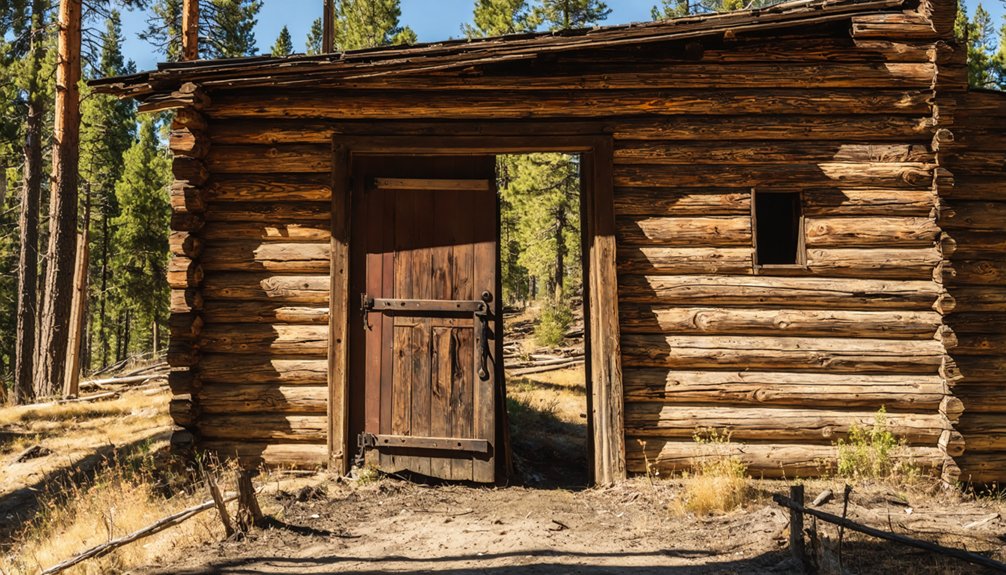
You’ll find Yellow Jacket ghost town in Idaho’s Yankee Fork Mining District, accessible via Forest Road 172 from Sunbeam. The dramatic five-story skeletal hotel dominates the landscape, surrounded by weathered cabins, massive stamp mill ruins, and remnants of an 8,400-foot aerial tramway system. This 1869 gold rush camp reached 1,000 residents before labor strikes and dwindling profits forced abandonment by 1914. The remote wilderness setting rewards adventurous travelers with authentic frontier structures and compelling stories of ambition meeting harsh economic reality.
Key Takeaways
- Yellow Jacket Mining Camp, abandoned in 1914, features a five-story unfinished hotel, stamp mill ruins, and aerial tramway remnants.
- The site sits in remote Idaho wilderness, requiring careful trip planning for backcountry access and no modern amenities.
- Key structures include weathered frontier cabins, massive water-powered mill ruins, and a wooden flume tracing the creek.
- Tramway system remains span 8,400 feet up the mountainside, with cable fragments and terminal station foundations still visible.
- No historic restoration exists, allowing visitors to witness authentic decay and explore structures frozen since early 1900s abandonment.
The Rise and Fall of Yellow Jacket Mining Camp
In late 1869, a lone prospector traced Yellow Jacket Creek through Idaho’s backcountry and struck gold in its placer deposits. Word spread fast—tales rivaled California’s legendary strikes. Within months, nearly 1,000 souls carved a settlement from the wilderness, embodying true frontier lifestyle despite brutal winters and mountain passes that tested every supply wagon.
By 1894, they’d hauled in a sixty-stamp mill—the country’s largest. The Morrison-Steen operation extracted 4,800 ounces of gold in just four years.
You’ll find evidence of remarkable community resilience in what they built: stamp mills in 1875 and 1883, stores, saloons, an 8,400-foot aerial tramway. The tramway slashed transportation costs from $2.50 to $0.07 per ton, transforming the mine’s economics overnight.
But freedom’s price ran high. Labor strikes in 1896 and inconsistent profits broke the camp’s spirit. By 1914, most had abandoned their mountain dream, leaving behind $400,000 in extracted wealth. Today, privately owned islands of tailings, mine shafts, and rusting machinery dot the mountains—testament to an important chapter of Idaho’s human history.
Must-See Remains and Structures at the Site
You’ll spot the five-story hotel immediately as you arrive—its weathered frame dominates the townsite skyline, an ambitious structure that never saw completion by 1924. Scattered across the hillside, rough-hewn cabins and the massive mill ruins tell stories of grueling work and fleeting prosperity.
Look closely along the slopes and you’ll find remnants of the tramway system, including heavy cables that took eighty packhorses weeks to haul into these remote mountains. The stamp mills, brought in during 1875 and 1883, stand as monuments to the determined efforts to develop the mines and extract the quartz-laced gold that kept miners’ hopes alive. The original water powered mill operated with a wooden flume, visible portions of which still trace the creek’s path today.
The Unfinished Five-Story Hotel
Rising against the Salmon River Mountains skyline like a monument to shattered dreams, the unfinished five-story hotel dominates Yellow Jacket’s ghostly landscape. Construction halted abruptly on January 15, 1924, when the Salt Lake Company’s funds evaporated, leaving this ambitious frame structure frozen in time. You’ll discover a striking centerpiece that represents the town’s failed 1922 revival.
What makes this structure unforgettable:
- Towering five stories above scattered abandoned equipment and mining debris
- Original framework still standing despite roof collapse in 1976
- Designed for modern conveniences that never materialized in this remote wilderness
- No historic restoration plans exist—you’re witnessing authentic decay
The skeletal remains frame Idaho’s rugged backcountry perfectly, offering photographers and adventure seekers an unfiltered glimpse into early 20th-century mining ambitions gone spectacularly wrong. The site traces back to the 1870s gold claims when the founder’s great-grandfather first staked his claim in this remote canyon. Visitors are asked to wait momentarily while site conditions are verified for safety before exploring the structure’s perimeter.
Historic Cabins and Mill
Scattered across the valley floor and clinging to hillside benches, Yellow Jacket’s weathered cabins tell stories of frontier families who carved out lives amid Idaho’s unforgiving wilderness. These 1890s structures showcase authentic cabin architecture—hand-hewn logs and simple rooflines that’ve endured over a century of mountain storms. You’ll find them remarkably intact despite abandonment in 1914.
The star attraction remains the massive stamp mill ruins, once America’s largest water-powered facility processing quartz ore from surrounding mines. Walk alongside the wooden flume that still traces the roadside, channeling water that powered enormous mill machinery. Look for remnants of the tramway system and imagine the 625-pound camshaft crushing ore into fortunes. Historical photographs from the USGS 1926 survey document the town site’s original layout and structures. These tangible connections to 1869’s gold rush era await your discovery off accessible 2WD roads.
Tramway Cable System Remains
The ingenious Swem aerial tramway once stretched 8,400 feet up the mountainside, bridging the 1,200-foot elevation gap between mill and mine with engineering prowess that revolutionized Yellow Jacket’s operations. This aerial tramway design slashed transportation costs to just seven cents per ton during the 1890s boom.
Today, you’ll discover remnants of this ambitious cable transport system:
- Terminal station foundations where brake mechanisms controlled ore-loaded buckets
- Intermediate support structures positioned along the mountain route
- Cable fragments from the original 7/8-inch wire rope
- Bucket debris designed to haul 125 pounds of ore each
The cable transport challenges were legendary—twenty mules needed three trips to haul the stiff wire rope. Mexican mule packers like Jesus Urquides were often called upon to transport such massive pieces of machinery into Idaho’s backcountry mining operations. The system’s efficiency came from the double-rope bi-cable design, which German engineers pioneered in 1874 to overcome the distance limitations of earlier single-rope configurations. You’re standing where determined pioneers conquered mountains with ingenuity.
Getting There: Routes and Road Conditions
Reaching Yellowjacket requires commitment and preparation, as this remote ghost town sits deep in Idaho’s backcountry where paved roads give way to gravel and modern conveniences fade into memory.
Where pavement ends and wilderness begins, Yellowjacket awaits those willing to trade convenience for adventure in Idaho’s untamed heartland.
Your route planning begins in Salmon, Idaho, the nearest supply hub where you’ll want to fuel up and stock provisions. From there, forest service roads wind through rugged terrain, demanding high-clearance vehicles and off-road capability.
Transportation logistics become critical during spring runoff when streams cross your path, and winter snows render access impossible from November through May. You’ll traverse narrow mountain passes where cell service disappears and self-reliance becomes essential.
Check current conditions with the Salmon-Challis National Forest before departing, as weather and maintenance schedules dramatically impact accessibility to this isolated destination. The terrain rises to elevations of approximately 6,211 feet in the surrounding area, adding another challenge for travelers unaccustomed to high-altitude driving conditions.
Best Times to Visit and What to Expect
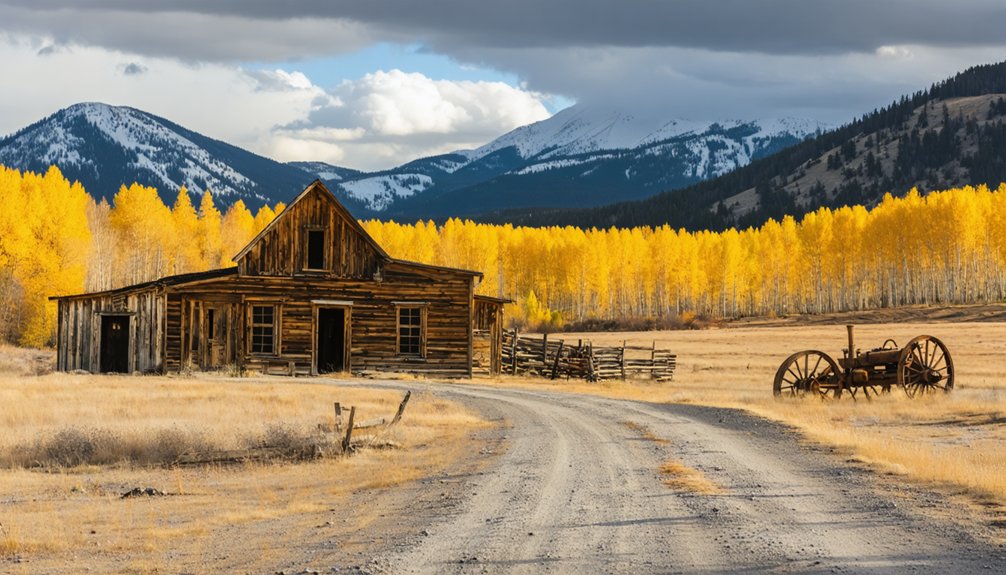
You’ll want to plan your Yellow Jacket adventure for late spring through early fall, when mountain roads shed their snow and temperatures climb into the comfortable 70s and 80s.
Winter’s harsh conditions—with lows plunging near 10°F and heavy snow blocking backcountry access—make the ghost town nearly impossible to reach safely.
During the warmer months, you’ll find crumbling five-story hotel ruins, weathered mining cabins, and remnants of water flumes set against breathtaking mountain scenery, all accessible from sunrise to sunset for self-guided exploration.
Seasonal Weather and Accessibility
When planning your ghost town road trip to Yellow Jacket, Idaho, understanding the region’s seasonal rhythms becomes indispensable for both accessibility and comfort. Weather driven population shifts dramatically affect your experience, with mild winters enabling earlier spring access—sometimes 10 days ahead of normal schedules. However, these warmer conditions boost pest activity, making seasonal pest control knowledge pivotal.
As you embark on the journey of exploring yellow jacket ghost town, take the time to research the history and legends that surround this fascinating place. Engaging with local stories and the remnants of past inhabitants adds depth to your visit, transforming it into an immersive experience. Remember to pack accordingly, as the temperature can vary significantly from day to night, impacting your exploration of this intriguing destination.
Optimal timing windows include:
- Late spring after cold snaps drop temperatures below 45°F for 5-7 consecutive days
- Early fall before sustained 32°F freezes trigger peak aggression
- Idaho’s comfortable 55°F-75°F range for clearest roads and trails
- Post-freeze periods when only hibernating queens remain underground
Avoid high-humidity summer days and monitor winter mildness indicators that signal heightened spring pest density ahead.
Key Historic Sites Remaining
The windswept remains of Yellow Jacket tell their story through four distinct landmarks that anchor your exploration of this remote ghost town. You’ll spot the five-story hotel first—its skeletal frame reaching skyward since 1922, abandoned when gold dreams faded.
Down by Yellowjacket Creek, massive mill ruins stand memento to 1869’s placer discovery, their stamp frames still intact beside weathered wooden flumes. Scattered cabins from the 1890s boom dot the landscape, their timbers whispering tales of mining camp life when a thousand souls called this place home.
Tramway cables and frames trace engineering ambition across the hillsides, while the cemetery marks final claims. Between these monuments, local natural scenery reclaims what humanity briefly borrowed.
Photography and Exploration Tips
Summer transforms Yellow Jacket into a photographer’s canvas, where warm June-through-September weather clears mountain passes and dries the backcountry roads leading to this isolated site. Golden hour delivers dramatic lighting across weathered structures, while early morning reveals streaming light through sky holes in aged wood.
Essential preparation includes:
- Equipment considerations: Pack a wide-angle lens, tripod for low-light interiors, and full-frame camera to capture intricate details like window latticing and rusty relics
- Safety precautions: Bring a high-clearance vehicle, extra fuel, and emergency supplies for this remote east-central Idaho location
- Access research: Verify property status before exploring, as some areas remain private
- Light scouting: Scout positions the evening before to maximize fleeting sunrise opportunities
Respect these historic remnants—your documentation preserves their stories for future wanderers.
Mining Heritage and Historic Operations
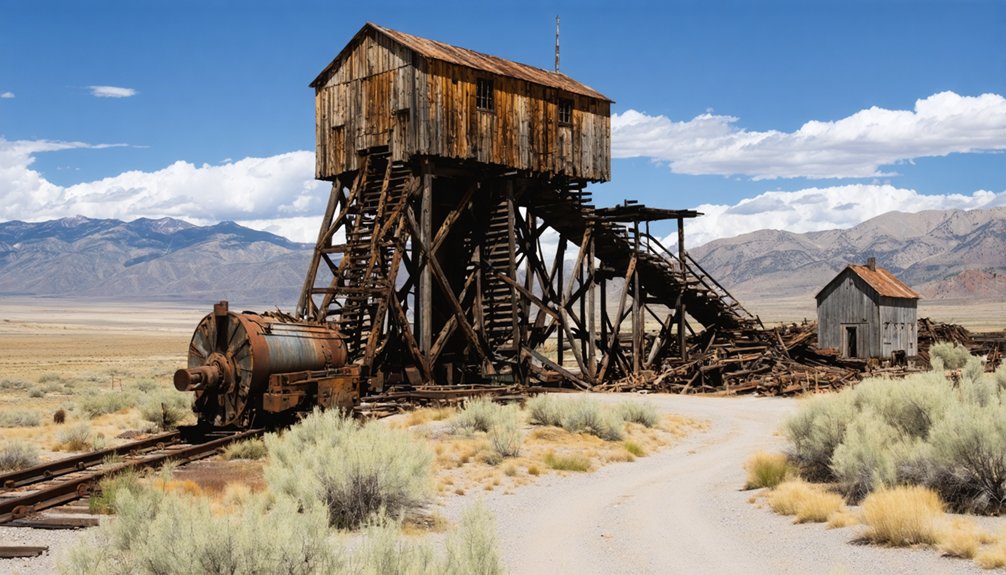
Gold fever struck Yellow Jacket Creek in late 1869 when Nathan Smith’s prospecting party uncovered rich placer deposits that would transform this remote corner of Lemhi County into one of Idaho’s most ambitious mining ventures. You’ll discover remnants of an operation that defied brutal isolation challenges through sheer determination.
Miners packed a ten-stamp mill through twelve-foot snow drifts in April 1883, then hauled ore from workings 1,200 feet above the processing facility. By 1894, a sixty-stamp mill—the nation’s largest—thundered away, processing thirty tons daily. The lack of infrastructure meant everything traveled over rugged mountain passes by mule train.
This site ultimately yielded $2.5 million worth of gold and silver, proving what free-spirited prospectors could accomplish beyond civilization’s reach.
Nearby Attractions and Additional Resources
While Yellow Jacket’s mining legacy draws history enthusiasts to this isolated valley, you’ll find the surrounding Lemhi County landscape offers equally compelling reasons to extend your stay. The region delivers authentic outdoor adventure activities that’ll satisfy your wanderlust beyond the ghost town itself.
Essential experiences near Yellow Jacket:
- Yellowjacket Lake Campground – Seven remote sites at 8,000 feet elevation beneath Sugarloaf Rock’s dramatic backdrop
- Sharkey Hot Springs – Natural hot spring experiences just a short drive for post-exploration soaking
- Frank Church River of No Return Wilderness – Trail access from Yellowjacket Guard Station into America’s largest contiguous wilderness
- Salmon River fly fishing – World-class waters twelve minutes from Salmon
You’re five hours from Idaho Falls, positioning this destination perfectly for those seeking genuine backcountry solitude.
Frequently Asked Questions
Are There Any Camping Facilities or Accommodations Near Yellow Jacket Ghost Town?
You’ll find yourself trading satellite maps for trail dust at Yellowjacket Lake Campground’s seven remote sites. Nearby campgrounds dot the Salmon-Challis National Forest, while lodging options nearby include the historic 1925 Guard Station for authentic backcountry freedom.
Do I Need Special Permits to Explore the Abandoned Buildings?
You won’t need special permits for casual exploration of Yellow Jacket’s abandoned buildings on public land. However, respect the site’s historical significance—vandalism concerns have led to restrictions at similar locations, so tread carefully and leave everything untouched.
Is the Site Safe for Children to Visit?
Yellow Jacket’s a siren song best left to adults. Safety concerns for young children are severe—lead-contaminated soil, collapse hazards, and risks of exploring abandoned structures make this no place for kids. You’ll want experienced adventurers only here.
Are There Guided Tours Available at Yellow Jacket?
You won’t find traditional walking tours at Yellow Jacket—this remote ghost town offers self-guided tours through its weathered ruins. However, river trip operators provide guided adventures accessing the canyon, letting you explore this backcountry treasure independently.
Can I Bring My Dog to the Ghost Town?
You’ll likely find Yellow Jacket welcomes your four-legged companion, though pet friendly policies aren’t officially documented. Before venturing down that remote sixty-mile road, verify current regulations and accessibility for disabled visitors through local tourism offices.
References
- https://www.youtube.com/watch?v=zQFDwEi_0sg
- https://www.ghosttowns.com/states/id/yellowjacket.html
- https://1043wowcountry.com/10-idaho-ghost-towns/
- https://lemhi.idgenweb.org/places.html
- https://history.idaho.gov/wp-content/uploads/0385.pdf
- https://www.yjriverguides.com/yjrg-history
- https://www.idahogeology.org/pub/Staff_Reports/1997/S-97-21.pdf
- https://www.truewestmagazine.com/article/confessions-of-a-ghost-town-maniac/
- https://caspercollege.cvlcollections.org/items/show/9827
- https://yellowpinetimes.wordpress.com/2016/04/03/idaho-history-april-3-2016/