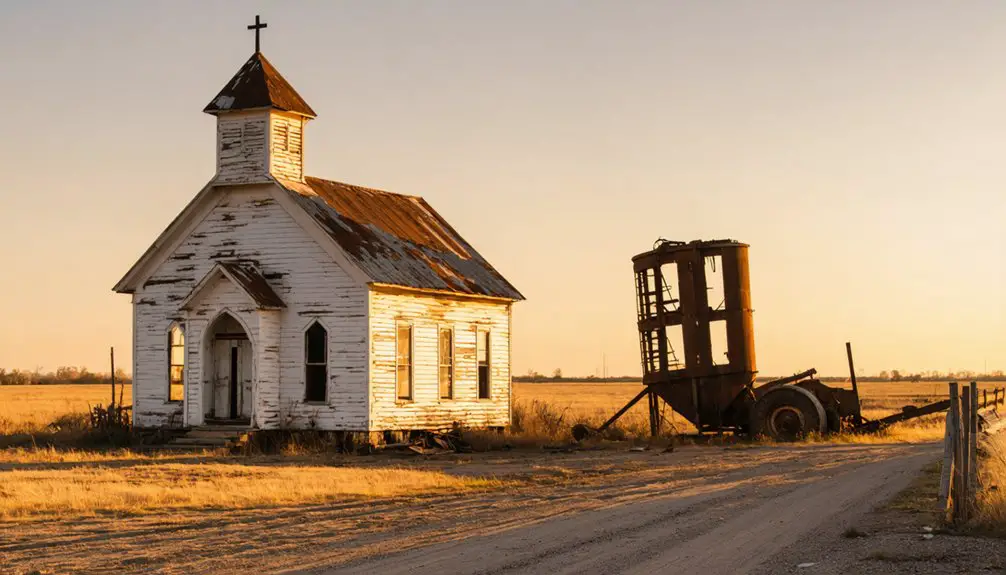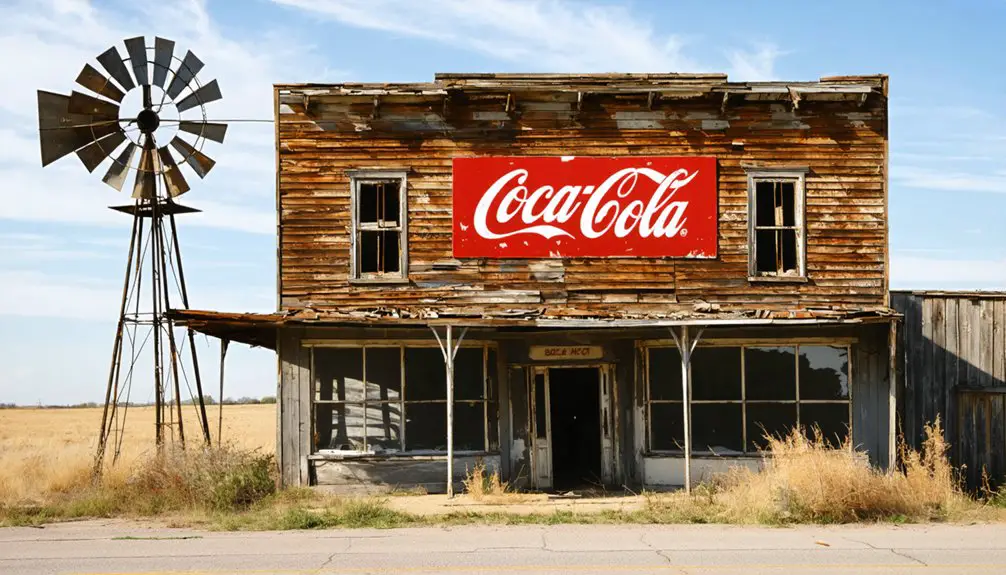
You’ll find Zena along State Highway 127 in Delaware County at 944 feet elevation, where chat piles and abandoned homes tell stories of 14,000 departed souls. Spring (April-May) or fall (September-October) bring the best weather for exploring this semi-ghost town and nearby abandoned sites like Picher and Lehigh. Base yourself in Grove or Jay, then spend your days photographing crumbling foundations and crystal-clear Lake Eucha. Your Ozark foothills adventure connects mining history, Native American heritage, and haunting landscapes that reveal deeper tales.
Key Takeaways
- Zena is located on State Highway 127 in Delaware County at 944 feet elevation in the Ozark foothills.
- Visit during spring or fall for mild temperatures and scenic foliage; avoid scorching summers and icy winters.
- Explore chat piles, abandoned homes, and foundations from Zena’s mining past that displaced 14,000 former residents.
- Combine your trip with nearby ghost towns: Picher, Lehigh, Depew, and Route 66’s Texola for classic roadside Americana.
- Add Lake Eucha’s 2,800-acre reservoir for kayaking, fishing, and recreation just beyond the ghost town landscape.
Getting to Zena: Routes and Transportation Options
Finding Zena requires more determination than GPS skills, since this tiny ghost town sits tucked along State Highway 127 in Delaware County, Oklahoma, where coordinates 36.5233° N, 94.8405° W mark its location on your device.
You’ll navigate through rolling Ozark foothills at 944 feet elevation, following SH-127 as your primary artery to this census-designated place that housed just 122 souls in 2010. The highway cuts through terrain mapped on USGS Grove and Jay topographic sheets, guiding you past vanishing quaint local businesses and weathered structures.
Your journey rewards you with authentic historic buildings preservation—or what remains—untouched by commercial development. Pull over anywhere along this forgotten stretch; there’s no bustling downtown to navigate, just raw Oklahoma history waiting for explorers willing to venture off their predictable routes.
What Remains: Exploring Zena’s Semi-Abandoned Landscape
When you step onto Zena’s cracked pavement today, you’re walking through what mining’s appetite left behind—a landscape more void than village. Those white chat piles you’ll spot aren’t hills—they’re monuments to 100 million tons of tailings still leaching metals into the earth beneath your boots.
By 2024, only scattered structures break the horizon. You’ll find maybe a handful of abandoned homes refusing to surrender, their foundations compromised by underground voids that turned solid ground hollow. The high school stood until recently. So did the mining museum before arsonists claimed it in 2015.
What you won’t find: the 14,000 residents who once called this home. They left when the government finally admitted what everyone knew—you can’t build futures on poisoned ground.
Delaware County’s Native American Heritage and Early Settlement
Standing in Zena’s quiet landscape, you’re treading ground that witnessed waves of displaced nations—the Delaware Tribe arrived here around 1820 after being pushed westward from their ancestral lands along the Delaware River, followed by Cherokee and Seneca peoples who’d faced their own forced removals.
The convergence of these three tribes transformed this corner of northeastern Oklahoma into what would become Delaware District, a strip of Cherokee Nation territory where the Delaware purchased settlement rights for $438,000 in 1867.
That treaty money bought both land and a peculiar status: the Delaware became partial Cherokee citizens while struggling to maintain their own tribal identity, a legal tangle that wouldn’t fully unravel until federal recognition came in 1996.
Delaware Tribe’s 1820 Arrival
By 1820, the Delaware people who’d eventually shape this corner of Oklahoma had already endured decades of forced relocations that scattered them across half a continent. These pre 1820 migrations fragmented the tribe—one group crossed the Mississippi into Spanish Missouri seeking land grants near Cape Girardeau, while the main body settled along Indiana’s White River before moving to southwest Missouri in 1818.
Land acquisition challenges mounted relentlessly. You’ll find that sixteen treaties by 1830 forced constant movement from Ohio, Indiana, and Missouri as white encroachment intensified. The tribe split around 1789 into sovereign entities: one faction headed toward Missouri-Kansas-Oklahoma, while the Absentee Delaware took the Cape Girardeau route. Their first U.S. treaty in 1778 merely initiated this westward drift that’d continue for another century.
Cherokee and Seneca Migrations
The Delaware weren’t alone in reshaping this landscape. By 1828, Western Cherokee had already claimed territories south of present-day Delaware County, setting the stage for complex early multi-tribal dynamics that would define this region.
You’ll find their story intersecting with the Seneca of Sandusky, who arrived in summer 1832 after an eight-month journey from Ohio that reduced their numbers from 358 to 275.
Meanwhile, 258 Mixed Band Seneca-Shawnee reached the Cowskin River that December, sparking immediate Seneca Cherokee land negotiations when their assigned tract overlapped Cherokee territory. These weren’t clean boundaries on government maps—they were contested homelands where survival meant traversing both nature’s challenges and political pressures.
The 1832 Stokes Commission attempted resolving disputes, ultimately uniting these Seneca groups into one nation.
Delaware District Formation
Long before Delaware County existed on any map, ancient peoples left their mark across this landscape—twenty-three Archaic period sites, seventeen from the Woodland era, and sixty-three Eastern Villager settlements that archaeologists had excavated by 2004. You’ll find these stories beneath your feet, though some now rest underwater, including 1939 University of Oklahoma discoveries along Grand River containing Hopewell-like artifacts from 2,000 years ago.
Around 1820, Delaware settlers established their town two miles south of present-day Eucha on Spavinaw Creek. Their presence shaped the Delaware district boundaries when Cherokee formally designated this northeastern territory in their honor.
The Delaware district influence expanded through an 1867 treaty:
- $438,000 purchase of 10-by-30-mile tract
- Cherokee citizenship rights granted
- 160 acres per registered Delaware
- Autonomous governance within Cherokee lands
- 83.2-foot maximum depths perfect for serious anglers
- Annual Delaware County Gigging Tournament each April
- Traditional Cherokee fishing methods with multi-pronged spears
- Consistent year-round fishing opportunities
- Eucha lakefront cabins: Boat docks and fire pits on Grand Lake O’ the Cherokees
- Jay’s Intimacy Suite: Hiking trails and spa amenities for total off-grid rejuvenation
- Broken Bow lodges: 2,800-square-foot retreats sleeping 16 adventure-seekers
- 564 Vrbo properties: Full kitchens and local amenity services throughout the region
Lake Eucha and Surrounding Recreational Destinations
Your ghost town exploration leads you past Lake Eucha, a 2,800-acre reservoir created in 1952 when the City of Tulsa dammed Spavinaw Creek and displaced the Cherokee community of Eucha beneath its waters.
The lake’s crystal-clear depths—reaching 83 feet at maximum—have made it Oklahoma’s premier spot for kayaking visibility, while anglers crowd its 50 miles of shoreline claiming it’s the best fishing in Delaware County.
You’ll find four boat ramps scattered around the water’s edge, plus Lake Eucha Park’s 31-acre day-use area where picnic tables overlook the same valley where a town once stood.
Lake Eucha History Overview
Completion of the Eucha dam in 1952 transformed Spavinaw Creek into an 8.5-mile reservoir that would forever alter the landscape of Delaware County. W.R. Holway designed this massive project to supply Tulsa’s growing water demands, creating 2,800 acres of surface water and 50 miles of shoreline. The tribal resettlement impacts ran deep—the Cherokee community of Eucha relocated to higher ground while lake waters swallowed Delaware Town and Chief Oochalata’s original burial site.
Today’s recreational amenities for visitors include:
You’ll discover this working reservoir still serves Tulsa while offering authentic Cherokee cultural experiences and remote wilderness access.
Nearby Water Recreation Activities
Beyond the historical significance of Lake Eucha’s creation, you’ll find a 31-acre day-use park perched above the water’s edge that serves as your base camp for exploring Delaware County’s aquatic playground.
Multiple boat ramps grant you access to Oklahoma’s clearest waters—perfect for kayaking experiences where you’ll actually see the lake bottom beneath your paddle strokes. Largemouth bass strike Alabama rigs near brush piles and weed beds, while crappie hide in submerged structure.
Five launch points circle the lake, including ramps at Eucha Point and near the dam. The boating opportunities extend beyond Eucha to Grand Lake State Park‘s multiple areas: Bernice, Cherokee, Disney/Little Blue, and Honey Creek all offer camping and trails. You’re free to roam between fishing docks, swimming areas, and open water.
Nearby Ghost Towns and Historical Sites Worth Visiting
Northeastern Oklahoma harbors a constellation of abandoned communities within a two-hour radius of Zena, each telling distinct chapters of the state’s boom-and-bust history. You’ll find stark contrasts between farming communities and industrial ruins shaped by early industry decline.
Picher (30 minutes northeast): Toxic chat piles and collapsed mining structures create an apocalyptic landscape where lead-zinc extraction once thrived before environmental catastrophe forced complete evacuation
Lehigh (2 hours south): Coal County’s mining ghost showcases crumbling residences and business foundations from its 1880 origins through 1956 closure
Depew (90 minutes southwest): Route 66‘s half-alive town offers walkable brick streets and the photogenic Gimmel Gas Station
Texola (3 hours west): Mother Road’s westernmost Oklahoma outpost preserves classic roadside Americana
Best Times to Visit and Travel Considerations
Timing your ghost town expedition to Zena requires balancing Oklahoma’s volatile weather against your tolerance for solitude versus accessibility. Spring and fall offer sweet spots—mild 60-75°F temperatures in April-May let you explore without crowds, while September-October delivers stunning foliage along State Route 82.
As you journey through these ghost towns in Oklahoma, it’s essential to consider the stories etched into the crumbling structures and abandoned streets. Each site often tells a tale of dreams unfulfilled, inviting adventurers to reflect on the past. Embrace the stillness around you, as it adds to the eerie charm that characterizes these forgotten places.
Seasonal weather variations hit extremes: summer scorches above 90°F, winter ice makes gravel roads treacherous. Rural road conditions deteriorate fast after spring rains, turning access routes into washout zones. You’ll find fuel stations scarce, so tank up in Salina.
Avoid tornado season’s April-June chaos unless you’re chasing more than ghosts. Weekday mornings give you the abandoned structures to yourself, no tour groups snapping photos of your discovery. Pack offline maps—cell service vanishes where Zena’s stories linger.
Accommodations and Base Camp Towns for Your Adventure
Your ghost town adventure needs a comfortable headquarters, and Zena’s surrounding towns deliver unexpected luxury amid the rural isolation. Afton and Grove anchor your exploration, positioning you minutes from Grand Lake while offering cabin booking platforms loaded with highly-rated properties. The Groveport Resort Waterfront Cabin ($152 nightly) and Twin Retreat with its hot tub earn perfect 10/10 scores from seasoned travelers.
Afton and Grove provide luxurious cabin bases near Grand Lake, with top-rated properties starting at $152 per night for ghost town explorers.
Consider these base camp options:
Most stays start at $125 nightly with full refunds available—freedom without financial risk.
Frequently Asked Questions
Is It Legal to Explore Zena or Is It on Private Property?
Zena’s legal status remains unclear since abandoned structures ownership often shifts to private hands. You’ll need to research local trespassing laws and verify current property records through Delaware County’s assessor before exploring, respecting landowners’ rights while pursuing your adventure.
Are There Any Guided Tours Available for Zena Ghost Town?
You won’t find commercial tours here—Zena’s gloriously forgotten by the tourism machine. Instead, you’ll create your own self-guided tours, wandering freely through weathered ruins where wild grass reclaims crumbling foundations, discovering secrets tour groups never see.
What Original Structures From 1956 Can Still Be Seen in Zena?
You’ll discover original wooden buildings weathering the decades and crumbling stone foundations scattered across the landscape. These 1956 remnants stand as silent witnesses to Zena’s past, offering you an authentic glimpse into Oklahoma’s forgotten frontier history.
Is Zena Safe to Visit Alone or Should I Go With a Group?
You’ll find Zena safer than Tornado Alley’s ghost suggests—local crime statistics show minimal risk. Still, take personal safety precautions: share your itinerary, bring charged phones, and watch for sinkholes. Solo exploration works, but groups add security and adventure.
Can I Camp Overnight in Zena or Nearby Undeveloped Areas?
You’ll need camping permits for designated camping areas nearby like Grand Lake’s GRDA sites or Chickasaw National Recreation Area. Zena itself doesn’t allow overnight camping in undeveloped areas—residential restrictions prohibit RV occupancy, protecting your freedom through proper planning.