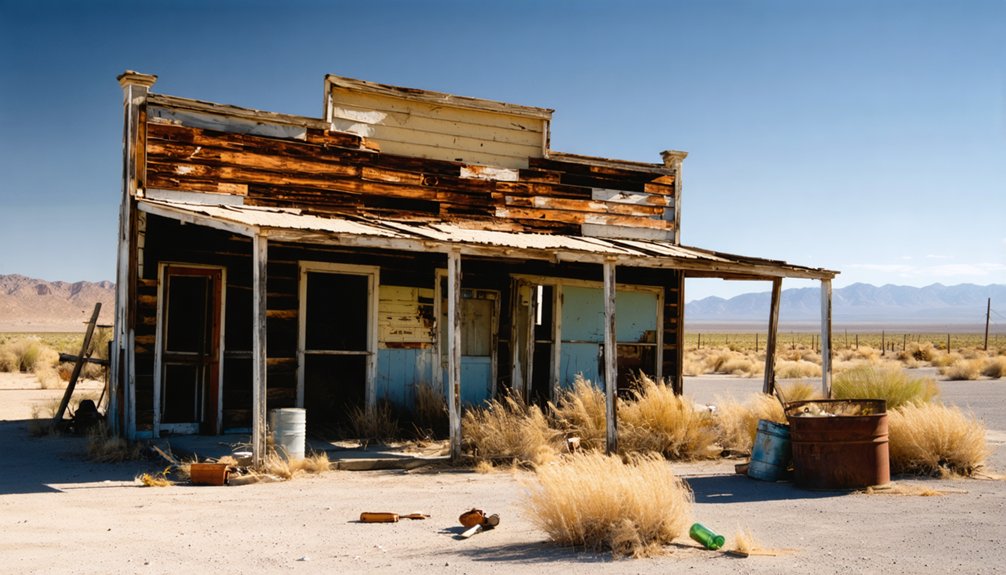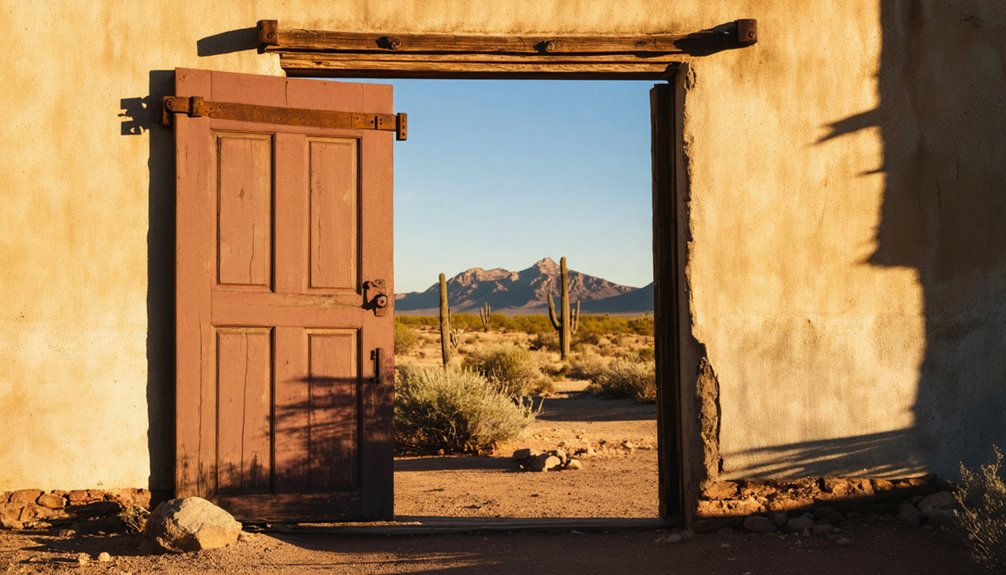
Your journey to Zeniff begins 15 miles southwest of Holbrook on SR 377, where you’ll navigate County Road 7156’s challenging dirt roads requiring a high-clearance vehicle and GPS coordinates. This 1904 Mormon settlement, now reduced to three weathered adobe buildings, demands preparation: bring abundant water, navigation tools, and visit during dry seasons to avoid impassable conditions at 5,889-foot elevation. The remoteness that doomed Zeniff’s settlers—coupled with nearby ghost towns like Adair and Wilford—creates a haunting circuit through Arizona’s abandoned frontier history.
Key Takeaways
- Start 15 miles southwest of Holbrook on SR 377, then follow County Road 7156 using GPS coordinates where cellular service disappears.
- Bring a high-clearance vehicle, abundant water, and navigation tools to handle rutted dirt roads and the 5,889-foot elevation terrain.
- Visit during dry seasons to avoid impassable quagmires and flash floods that can trap visitors on remote trails.
- Exercise caution exploring three weathered adobe buildings and stone ruins, respecting private property boundaries near the active ranch.
- Extend your trip to nearby ghost towns like Adair, Sunset, and Wilford within 50 miles, all abandoned due to water scarcity.
When Brigham Young gathered Mormon leaders in Salt Lake City during early 1876, he set in motion a colonization effort that would reshape Arizona’s northern frontier. Despite two earlier failures, optimistic scouting reports promising clear water and rich soil drew settlers to the Little Colorado River Valley.
You’ll discover that Zeniff emerged much later in 1904, when pioneers from Woodruff and Joseph City transformed summer cattle pasture into farmland twenty miles west of Snowflake. By 1956, only five residents remained. The reasons for population decline reveal harsh realities scouting reports overlooked.
Factors contributing to unsustainability—isolation, economic limitations, and the basin’s challenging conditions—gradually strangled this remote outpost. Unlike earlier settlements like Brigham City that was abandoned by 1890, Zeniff persisted for several more decades before meeting a similar fate. Young’s 1876 meeting in Salt Lake initiated a chain of Mormon colonization attempts that would ultimately include dozens of settlements across northern Arizona. Zeniff became another record/chronicle/account to freedom-seeking settlers who dared the frontier, only to abandon their dreams.
What Remains at the Zeniff Townsite Today
Three weathered adobe buildings anchor the Zeniff townsite, their sun-baked walls standing as silent witnesses to a community that couldn’t outlast the harsh realities of Arizona’s frontier. Stone walls and adobe ruins hint at former porches, while massive railroad ties suggest where roofs once provided shelter.
You’ll spot agricultural remnants across the landscape—faint outlines of pastures and crop fields, with large trees marking old field boundaries. Your GPS will confirm you’ve arrived, though you won’t find any signage or post office traces from its 1922-1933 operation. Thick undergrowth reclaims remote sections while an active ranch operates nearby, proving the land’s better suited for grazing than the crops that doomed Zeniff’s Mormon settlers. The sandy and salty soil that plagued early settlers still characterizes the terrain today. Among the ruins, you can still find the remains of the schoolhouse that once served the community’s children.
From Holbrook, your journey to Zeniff’s weathered ruins begins fifteen miles southwest along SR 377, where pavement gives way to the unforgiving dirt of County Road 7156. You’ll navigate by GPS coordinates rather than signage—this ghost town refuses conventional markers.
The 5,889-foot elevation brings inclement weather concerns that transform these trails into impassable quagmires during storms. Off highway driving hazards multiply as thick undergrowth obscures the route, and one wrong turn delivers you deep into isolation where cellular service vanishes.
Watch for Dry Lake as your geographical anchor point. The same reliable water source that once drew cattle drives now serves as your landmark. The settlement’s namesake traces back to Zeniff’s peaceful reign, which lasted approximately 40 years before his son Noah took power. Thick vegetation and sparse infrastructure demand attention—this isn’t tourist-friendly terrain, but rather an authentic backcountry experience. Along this route, you’ll pass the nearby Adamana Ghost Town, where a dinosaur sculpture marks the entrance to another of Arizona’s forgotten settlements.
While exploring ghost towns in Arizona, you’ll uncover stories etched in the remnants of abandoned buildings and rusted vehicles left behind. Each town holds a unique history, from mining booms to vibrant communities that once thrived before fading into obscurity. This journey not only reveals the gripping tales of the past but also showcases the eerie beauty of the desert landscape that surrounds these lost places.
Essential Tips for Visiting This Isolated Ghost Town
Before you venture into Zeniff’s desolate landscape, arm yourself with provisions that transform potential disaster into manageable adventure. Pack abundant water—scarce water resources destroyed this settlement’s dreams and can endanger yours.
Bring navigation tools since cell service vanishes fifteen miles southwest of Holbrook. Your high-clearance vehicle conquers rutted dirt roads leading to this 5,889-foot elevation ghost town.
Time your visit during dry seasons when flash floods won’t trap you. The three remaining adobe buildings and crumbling stone walls demand caution—stability’s an illusion here.
Respect private property boundaries, particularly near the defunct paper mill site. Some ghost town sites are now privately owned, requiring careful attention to posted boundaries. Remember: financial challenges and environmental catastrophes drove Zeniff’s inhabitants away. You’re exploring freedom’s harsh reality where isolation tests survival skills. Pack out everything you bring.
Exploring Other Abandoned Communities Near Zeniff
Zeniff’s desolation echoes across northeastern Arizona’s high desert, where several ghost towns cluster within a fifty-mile radius—each one memorandum to Mormon pioneers who battled identical demons of drought and distance.
kofa’s ghost town history reveals the remnants of communities once thriving amidst the arid landscape. As travelers venture through this stark terrain, they stumble upon abandoned structures that whisper stories of resilience and hardship. Each site serves as a poignant reminder of those who sought fortune in the unforgiving wilderness, leaving behind traces of their dreams and struggles.
the history of zeniff ghost town adds another layer to this narrative, showcasing the unique challenges faced by its inhabitants. As the sun sets over the crumbling remains, echoes of laughter and toil reverberate through the empty streets, reminding visitors of a once-vibrant community. Further exploration reveals artifacts that paint a vivid picture of daily life, encapsulating the spirit of those who dared to call this harsh land home.
water scarcity challenges devastated these settlements systematically. Adair’s families hauled creek water until exhausted soil forced abandonment, while Aripine (originally Joppa) perished from water scarcity challenges before establishing roots. Sunset mill town withstood flash floods paradoxically paired with devastating drought before settlers fled in 1888.
Explore these remnants that crop cultivation difficulties destroyed:
- Wilford’s loose rock foundations mark where hopeful farmers surrendered by 1926
- Obed’s 10-foot fort walls couldn’t protect 123 members from disease and flooding
- Fool Hollow Lake now covers Adair’s failed agricultural dreams
Each abandonment validates your understanding: freedom sometimes means knowing when survival demands retreat. These semi-abandoned sites have buildings still standing, but most structures remain empty and deteriorating.
Frequently Asked Questions
What Wildlife or Safety Hazards Should Visitors Watch for at Zeniff?
Watch for rattlesnake sightings near abandoned structures and rocky outcrops. You’ll want to check your boots for scorpion stings before wearing them. Stay alert for rabid wildlife, keep your distance from all animals, and avoid exploring alone.
Are There Any Camping Facilities Near the Zeniff Ghost Town Site?
Like a mirage in the desert, camping grounds availability near Zeniff is nonexistent. You’ll need to venture to nearby dispersed BLM sites where camping amenities offered are minimal—just raw wilderness, freedom, and your self-reliant spirit under Arizona’s endless skies.
Can I Legally Take Artifacts or Souvenirs From the Abandoned Structures?
No, you can’t legally take artifacts or souvenirs from Zeniff’s abandoned structures. Respect cultural heritage by leaving items untouched—federal and state laws protect these sites. Refrain from trespassing on private land, and explore responsibly without removing anything.
What’s the Best Time of Year Weather-Wise to Visit Zeniff?
Spring paints the perfect canvas for your Zeniff adventure. You’ll enjoy comfortable seasonal temperature changes from March through May, with local precipitation patterns staying minimal. Temperatures hover around 63-68°F with clear skies—ideal conditions for exploring freely without weather constraints.
Are Guided Tours Available for Zeniff and Nearby Ghost Towns?
Zeniff offers no guided experience details—you’ll explore independently. However, tour booking options abound nearby: Goldfield’s lantern-lit paranormal walks, Jerome’s EMF ghost hunts, and regional operators covering Tombstone and Bisbee let you chase spirits throughout Arizona’s haunted mining country.
References
- https://azgw.org/navajo/ghosttowns.html
- https://en.wikipedia.org/wiki/List_of_ghost_towns_in_Arizona
- http://www.buildnaz.com/blog/arizona-ghost-town-adventure/
- https://en.wikipedia.org/wiki/Zeniff
- https://coloradosghosttowns.com/Zenif AZ.html
- https://www.ghosttowns.com/states/az/zeniff.html
- https://rsc.byu.edu/pioneer-women-arizona/appendix-1
- https://octa-trails.org/archaeology/mormon-history-and-archaeology-in-northern-arizona/
- https://archiveswest.orbiscascade.org/ark:80444/xv44747
- https://contentdm.lib.byu.edu/digital/api/collection/EoM/id/5484/page/0/inline/EoM_5484_0