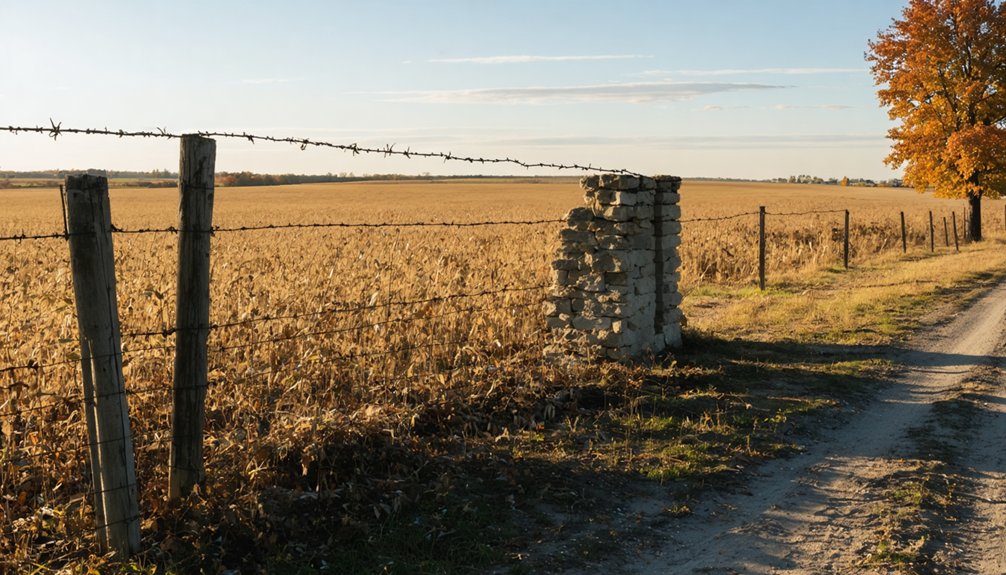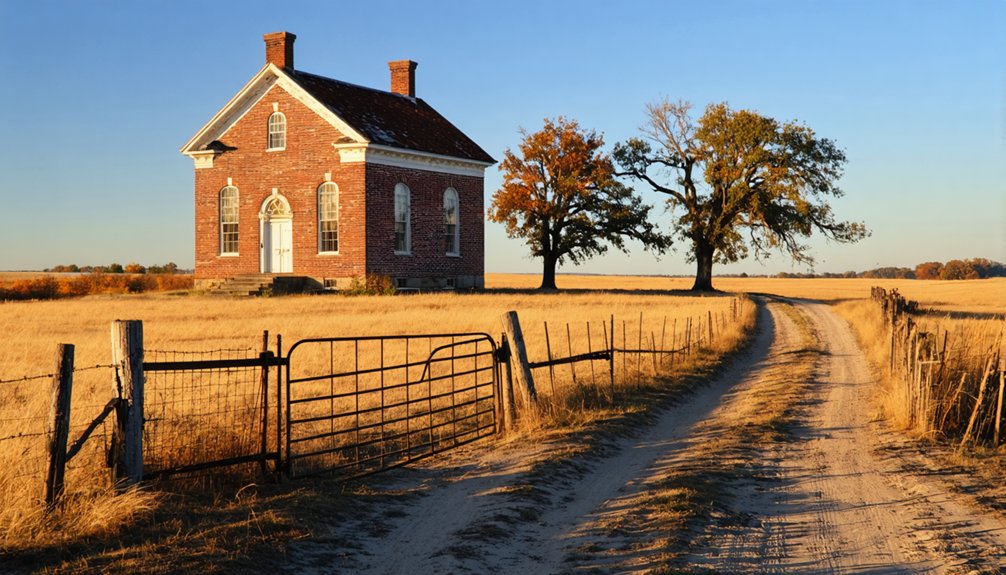
If you’re planning a ghost town road trip, Weston in DuPage County, Illinois, offers something unlike any other abandoned community. It’s not crumbling in an empty field — it’s hidden inside Fermi National Accelerator Laboratory. Developer William Riley once envisioned a city of 50,000 residents here, but legal battles and a federal takeover erased that dream. The original houses still stand, repurposed for scientists. Keep exploring to uncover the full story behind Weston’s remarkable fate.
Key Takeaways
- Weston, now within Fermilab’s grounds in western DuPage County, is accessible via the main entrance near Kirk and Pine Streets intersection.
- Original Weston houses still stand inside Fermilab, repurposed as scientist dormitories, and can be viewed from accessible roads within the campus.
- Fermilab’s visitor center provides historical context about Weston’s transformation from a planned suburb into a federal research campus.
- Public access to Weston’s residential area is restricted, so plan to view homes only from permitted roads near the main entrance.
- Weston sits between Batavia, Winfield, and West Chicago, making it an easy addition to a broader DuPage County road trip itinerary.
What Happened to Weston, Illinois?
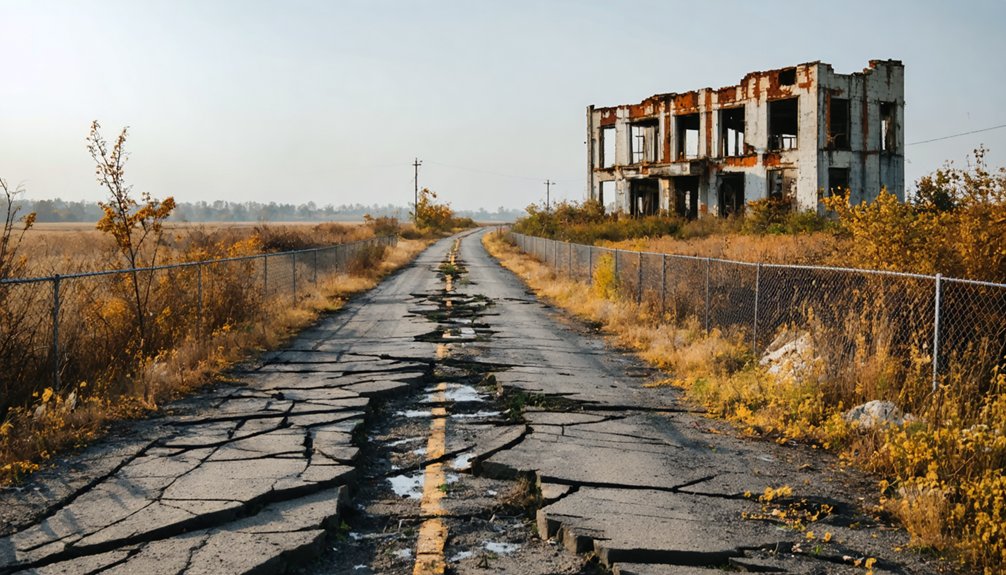
When you look at the quiet, fenced-off houses sitting on Fermilab’s grounds today, it’s hard to imagine they once made up a thriving subdivision with dreams of becoming one of Illinois’ largest cities.
Weston history begins with developer William Riley’s ambitious vision: a planned city of 50,000 residents, North America’s largest mall, an airport, and 11,000 homes.
But suburban decline hit fast. DuPage County sued Riley in 1964, blocking incorporation on legal technicalities and triggering his bankruptcy.
Residents fought back, attempting re-incorporation, but county challenges kept trapping them.
Why Did the Weston Ghost Town Development Collapse Before It Started?
Weston’s collapse wasn’t just bad luck — it was a chain reaction set off by one legal blow. In 1964, DuPage County sued developer William Riley, arguing that Weston’s unincorporated status gave it no legal right to annex surrounding land.
Four months after Riley disclosed his ambitious development plan, incorporation was denied, and Riley’s company went bankrupt.
That single ruling unraveled everything. The planned mall, airport, and 11,000 homes never materialized.
Residents who’d already bought homes found themselves trapped — unable to even relocate houses across the railroad tracks due to ongoing county challenges.
Weston’s development challenges reveal how legal technicalities can erase an entire community’s future.
When you visit today, you’re standing in the shadow of what could’ve been one of Illinois’s boldest postwar cities.
How Fermilab Turned Weston Into a Ghost Town
When William Riley’s development dream collapsed, Weston’s residents turned to an unlikely savior: the U.S. Atomic Energy Commission.
In 1966, the Commission selected the Weston site for a new nuclear research facility, and the village board voted to dissolve on December 16th of that year to make way for construction.
You can trace the town’s final chapter to that moment, when residents were forced to sell their homes and land to the State of Illinois, scattering a community that had fought so hard just to exist.
Atomic Energy Commission’s Role
Trapped in a web of legal battles and unable to grow, Weston’s residents turned to an unlikely savior: the U.S. Atomic Energy Commission. Desperate for federal intervention, they invited the Commission to evaluate their land for a major atomic research facility.
The National Academy of Sciences visited the site in 1966, and despite controversy, federal authorities selected Weston as the location for a national nuclear accelerator laboratory. It seemed like salvation, but it came at a devastating cost.
The facility’s boundaries consumed the entire development at Kirk and Pine Streets. What residents hoped would preserve their community identity instead erased it completely.
The government that couldn’t protect their incorporation rights now claimed their homes, their streets, and ultimately, their town itself.
Village Board Dissolution Vote
On December 16, 1966, Weston’s village board cast the vote that ended the town’s existence—dissolving the incorporation they’d fought so hard to establish.
Village governance, once a symbol of residents’ hard-won independence from DuPage County’s control, became the very mechanism that erased the community from the map.
The board’s decision cleared the path for Fermilab’s construction, transferring authority over the land to the State of Illinois.
Community dissolution wasn’t instantaneous—residents held on through 1969—but that December vote sealed Weston’s fate.
The people who’d renamed the subdivision, battled county officials, and built their lives here surrendered what little remained of their self-determination.
When you visit the Fermilab grounds today, you’re standing inside what was once a functioning, fighting community.
Residents Forced To Relocate
After the village board’s December 1966 vote, the State of Illinois moved quickly to acquire Weston’s land, forcing residents to sell their homes and relocate.
Most complied, but some resisted, clinging to the community they’d built despite overwhelming government pressure.
Their community resilience, though ultimately no match for eminent domain, speaks to the historical significance of what ordinary people sacrificed for scientific progress.
Can You Still Visit the Original Weston Houses at Fermilab?
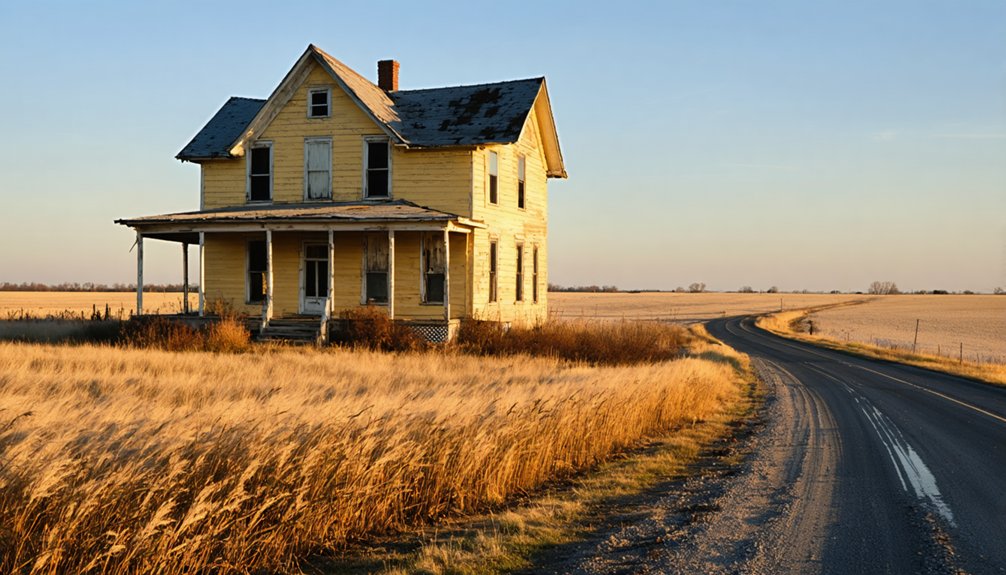
If you’re curious about what’s left of Weston, the original houses are still standing on Fermilab’s grounds, but don’t expect a casual walk-through.
The lab has repurposed them as dormitories for visiting international scientists, giving the structures a second life far removed from their suburban origins.
You can’t access them as a member of the public, so your ghost town road trip ends at Fermilab’s perimeter.
Houses Repurposed As Dorms
Though the village of Weston no longer exists, its original houses still stand within Fermilab’s grounds, repurposed as dormitories for the laboratory’s international scientists and researchers.
This dormitory history connects modern physics to mid-century suburban ambition, preserving the architectural significance of Riley’s failed dream city.
Here’s what you should know before visiting:
- The houses aren’t open to the public, so you can only view them from accessible Fermilab roads.
- Scientists from around the world now sleep where Weston families once built their lives.
- The homes retain their original suburban character, making them a quiet reminder of what this ghost town once represented.
You’re fundamentally looking at living history — where Cold War science absorbed an entire community’s broken dream.
Public Access Restrictions Apply
While Fermilab welcomes visitors to much of its campus, the original Weston houses aren’t open to the public. You can drive through Fermilab’s grounds and explore its nature trails, buffalo prairie, and public exhibits, but the residential area where Weston’s ghost town once stood remains off-limits.
The houses serve as active dormitories for Fermilab’s international scientists, making public access impossible. Still, you’re free to stop at the main entrance near Kirk and Pine Streets in Batavia and take in the landscape that once held a community of 100 families.
Fermilab’s visitor center offers historical context about the site’s transformation from planned suburb to world-class research facility. You’ll leave with a clear picture of what Weston was and why it disappeared.
Where Exactly Is the Weston Ghost Town Site Located?
Where exactly do you find the ghost town of Weston today? It sits quietly within the boundaries of Fermi National Accelerator Laboratory, tucked between three competing municipalities in western DuPage County, Illinois.
Understanding ghost town dynamics here means recognizing suburbanization impact at its most dramatic — an entire community erased by science.
Your three geographic anchors are:
- Intersection of Kirk and Pine Streets, Batavia — the heart of the original development
- Western DuPage County — positioned between Batavia, Winfield, and West Chicago
- Fermilab’s secured campus — where original houses still stand as scientist dormitories
You won’t drive freely through this site. Fermilab’s boundaries now define Weston’s footprint completely, making the laboratory itself your only geographical reference point when locating this lost Illinois community.
Which Other Illinois Ghost Towns Were Swallowed by the Same Postwar Suburbanization Wave?
Weston wasn’t the only Illinois community swallowed by postwar suburbanization‘s relentless march outward from Chicago. Dozens of Illinois ghost towns vanished beneath subdivisions, highways, and industrial corridors during the same postwar suburbanization wave that consumed Weston.
You’ll find traces of Babcock Grove near today’s Lombard, a once-thriving settlement absorbed by DuPage County’s explosive residential expansion. Holmesville disappeared under similar pressures west of Chicago. Cottage Hill surrendered its independent identity entirely, eventually becoming Elmhurst.
What distinguishes Weston from these others is its unusual fate — rather than becoming another suburb, it became a federally controlled research campus.
Most swallowed communities simply lost their names and boundaries to sprawl. Weston lost everything, yet paradoxically preserved its original houses longer than many towns that technically survived.
Frequently Asked Questions
What Native American Tribes Originally Lived on Weston’s Land?
You’ll discover rich Native heritage on Weston’s land, where the Potawatomi, Sac, Fox, and Winnebago tribes once roamed freely. Their tribal history ended when an 1816 treaty transferred this Illinois territory to the government.
Who Were the First White Settlers Near the Fermilab Site?
Jude and Erastus Gary were the first white settlers near the Fermilab site in 1832. Their settler motivations drove early agriculture on this land, and you’d later find Rev. Charles and siblings arriving in 1837.
What Happened to Developer William Riley After His Bankruptcy?
Coincidentally, Riley’s legacy ends where Fermilab’s begins — his bankruptcy impact dissolved his grand vision after DuPage County’s 1964 legal block denied incorporation. You’d find his ambitious dreams replaced by nuclear research, not 2,000 stores.
Some former Weston residents may still be alive, carrying ghost stories and local legends you’d love to hear! Track them down through historical societies, where their firsthand accounts can fuel your freedom-seeking road trip adventure.
Did Any Weston Residents Receive Fair Compensation for Their Homes?
You’ll find compensation disputes shadowed Weston’s “voluntary changes,” as resident testimonies reveal many felt pressured into accepting state-determined prices. The Illinois government didn’t always offer what you’d consider truly fair market value for surrendered homes.
References
- https://www.frrandp.com/2021/02/weston-illinois.html
- https://drloihjournal.blogspot.com/2022/08/lost-towns-of-illinois-weston-illinois.html
- https://www.worldabandoned.com/weston
- https://dupagemuseum.org/history-shines-a-light-on-dupage-ghost-towns-in-historical-museum-exhibit/
- https://history.fnal.gov/exhibit/weston.html
- https://en.wikipedia.org/wiki/List_of_ghost_towns_in_Illinois
- https://www.youtube.com/watch?v=93k0qtvzkn4&vl=en-US
- http://livinghistoryofillinois.com/pdf_files/History_of_DuPage_County_Illinois_1857.pdf