When exploring Native American ruins, prioritize guided tours for cultural context, stay on designated paths to prevent erosion, assess site accessibility against your physical abilities, and carry essential navigation and hydration gear. Apply broad-spectrum sunscreen, wear UPF-rated clothing, and research cultural significance beforehand. Support preservation by choosing Native-led experiences and purchasing authentic crafts. These practices honor sacred spaces while ensuring the legacies of ancient civilizations endure for future generations.
Key Takeaways
- Choose Native American-led tours for cultural enrichment and access to restricted areas while supporting indigenous communities.
- Stay on designated paths to prevent archaeological damage, erosion, and disruption to sacred sites.
- Pack essential gear including sun protection, navigation tools, and adequate water for exploring exposed archaeological sites.
- Consider accessibility needs when selecting ruins, as many feature uneven terrain and challenging staircases.
- Respect cultural significance by researching sites beforehand and adhering to photography restrictions and tribal guidelines.
Plan Your Visit Around Guided Tours for Maximum Cultural Context
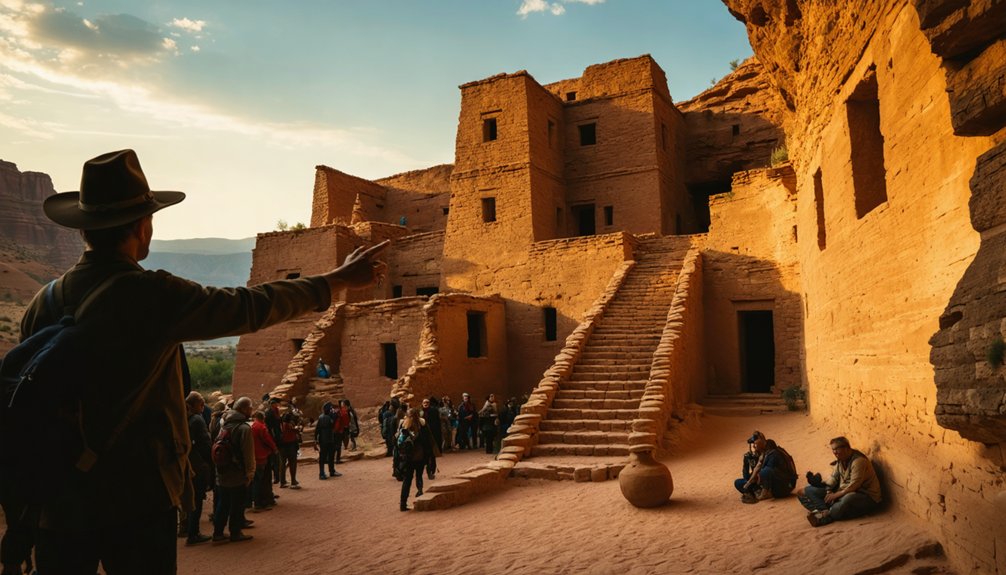
When planning a visit to preserved Native American ruins, prioritizing guided tours offers unparalleled cultural enrichment beyond what self-guided exploration can provide. Expert guides decode archaeological significance while sharing oral traditions absent from standard signage, providing essential cultural insights otherwise inaccessible.
The guided tour benefits extend beyond interpretation. You’ll gain access to restricted areas, participate in exclusive cultural demonstrations, and engage with sites through interactive storytelling methods. Many archaeological areas explicitly require guided access for preservation purposes.
Additionally, by choosing Native American-led tours, you’re supporting local economies while experiencing authentic perspectives. These guides bridge ancient history with contemporary Native life, transforming what might otherwise be merely visual experiences into profound cultural exchanges.
Their expertise transforms ruins from silent structures into vibrant testimonies of living traditions. Tours like the one to Montezuma Castle National Monument allow visitors 30 minutes to explore ancient Native American cliff ruins with professional guidance. The high overall rating of 4.7/5 from over 1,000 travelers confirms the exceptional value that guided archaeological experiences provide.
Respect Preservation Boundaries and Stay on Designated Paths
Your footprints across undesignated areas can permanently damage fragile archaeological deposits and accelerate structural deterioration of ancient ruins.
Preservation boundaries establish protected zones where visitor access is restricted to prevent inadvertent harm to artifacts, architectural features, and undocumented cultural materials.
Footprints Damage History
Though seemingly insignificant, individual footprints contribute to substantial archaeological damage at Native American ruins, with studies documenting up to 20 cm of fill loss over just two decades.
Your steps pulverize sediments, accelerating erosion and undermining structural integrity. Each footprint compounds this archaeological degradation exponentially.
When you venture off designated paths, you’re actively participating in site destruction.
Fragile architectural elements—wooden lintels, adobe jambs, unstable walls—deteriorate rapidly under visitor pressure. Even formal trail use leaves cumulative negative impacts.
Standing on ancient roofs or climbing through doorways destabilizes these irreplaceable structures; some may collapse within 3-5 years due to such activities.
The recent lawsuit filed by Native American tribes against Caltrans demonstrates how construction projects can irreversibly damage sacred archaeological sites when proper boundaries aren’t respected.
With over 90% of known American Indian archaeological sites already damaged by looters, preservation of remaining intact structures becomes increasingly critical.
preserving ancient remains in Arizona is not only vital for understanding the cultural heritage of the region but also serves as a reminder of the importance of protecting our history for future generations. Efforts to safeguard these sites must be prioritized to prevent further loss of invaluable knowledge and artifacts. Collaborative initiatives between local communities, archaeologists, and government agencies can foster a deeper appreciation and commitment to these significant resources.
Remember that conventional preservation messaging falls short: your footprints aren’t harmless, but rather catalysts for permanent historical loss.
Barriers Protect Artifacts
Physical barriers and boundary demarcations serve as critical preservation mechanisms at Native American archaeological sites, not merely as visitor inconveniences. These protective measures—fences, restricted areas, and controlled pathways—safeguard fragile artifacts and maintain the archaeological context essential for scientific interpretation.
Federal laws including ARPA and NAGPRA enforce artifact protection with substantial penalties: up to five years imprisonment and $250,000 fines for violations.
You’ll notice designated trails guiding your exploration precisely to minimize impact on sensitive features while still providing meaningful access.
When you encounter these boundaries, recognize they represent collaborative decisions between tribal communities and preservation authorities. By respecting these limitations and staying on marked paths, you’re participating in site preservation while honoring indigenous communities’ spiritual connections to these places—a balance that protects cultural heritage without unnecessary restriction of your experience.
Unauthorized access to sacred sites not only disrupts their physical integrity but also interferes with ceremonial activities that are essential to maintaining Native American cultural identity and community well-being. Sites like Agua Fria National Monument, with its ancient settlements, demonstrate why these protections are crucial for preserving history.
Choose Sites Based on Your Physical Abilities and Time Constraints
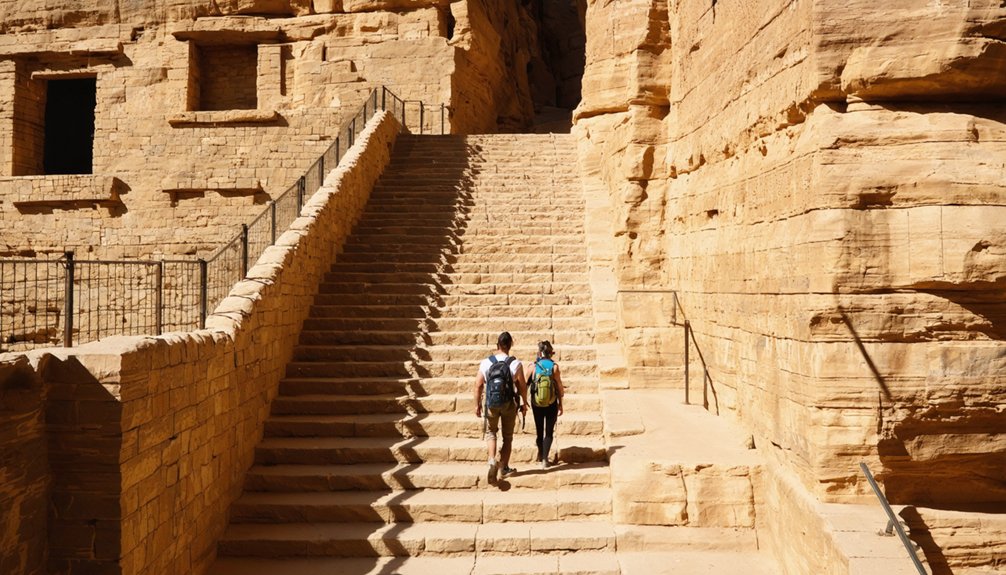
When planning visits to preserved Native American ruins, selecting appropriate sites based on your physical capabilities and available time is essential for a fulfilling experience.
Consider site accessibility and mobility considerations—many ruins feature uneven terrain and steep staircases that challenge those with limited mobility.
Choose locations with amenities matching your needs: paved paths at Mesa Top Loop or accessible viewing platforms at Chaco Canyon accommodate wheelchair users.
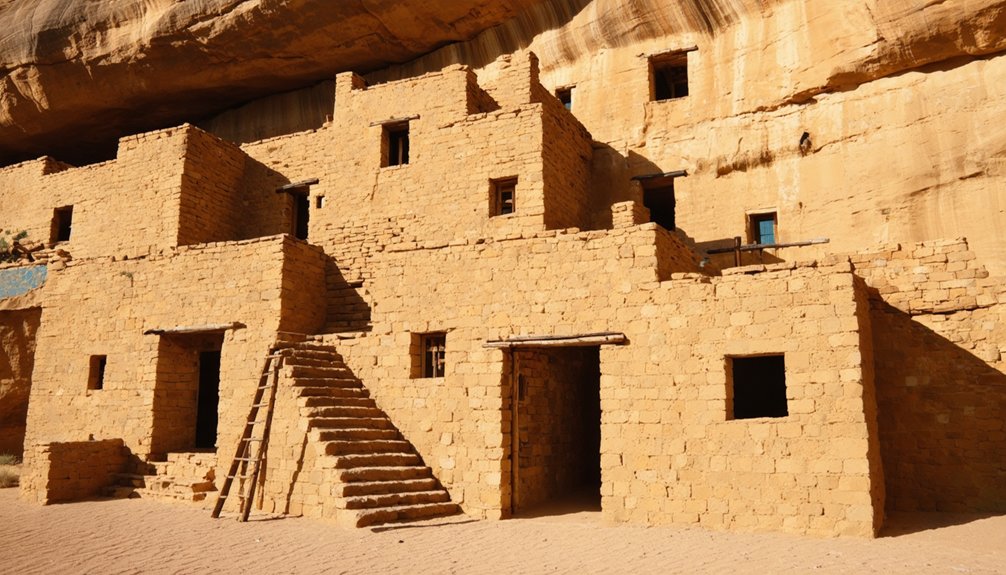
For time constraints, focus on short loops (1/3 to 1.3 miles) and factor in travel time on remote roads. Walnut Canyon requires navigating a steep stone staircase that may be unsuitable for some visitors, so assess your abilities beforehand. Sites at high elevations (above 5,600 feet) require additional stamina even for brief walks.
Visitor centers offer interpretive resources for those unable to navigate difficult terrain, while guided tours can provide safer access to otherwise challenging ruins.
Always check accessibility features beforehand and plan for rest stops. For a fascinating cultural experience, consider visiting Taos Pueblo, where you can observe one of North America’s oldest continuously inhabited communities.
Bring Essential Gear for Remote Ruin Exploration
When exploring remote Native American ruins, you’ll need thorough sun protection including wide-brimmed hats, UV-blocking sunglasses, and high-SPF sunscreen to prevent dehydration and sunburn in exposed archaeological sites.
Your navigation toolkit must include topographic maps specific to the ruin site, a reliable compass, and a GPS device with extra batteries to maintain precise orientation in complex, unmarked terrain.
These navigation tools aren’t optional luxuries but critical safety equipment that prevents disorientation in isolated locations where cellular service is nonexistent and landmarks can appear deceptively similar.
Don’t forget to include traditional water containers for carrying sufficient hydration, as surviving without water for more than three days in these harsh environments could be fatal.
Consider bringing a custom first aid kit that’s lightweight and contains essentials for common field injuries you might encounter during archaeological exploration.
Pack Sun Protection Essentials
Exploring preserved Native American ruins demands thorough sun protection due to their typically exposed desert locations and limited natural shade.
Pack broad-spectrum SPF 30+ sunscreen and apply it 30 minutes before exposure, reapplying every two hours. Your clothing choices greatly impact protection—opt for lightweight, UPF-rated garments with long sleeves and pants that block up to 98% of UV radiation while maintaining breathability.
Essential gear includes UV-protective sunglasses, a wide-brimmed hat, and SPF lip balm. Light-colored, synthetic fabrics outperform cotton, which loses protection when wet.
Maintain adequate hydration by carrying water or portable filters for natural sources. Consider adding accessories like neck gaiters, cooling towels, and emergency shade tarps for thorough protection.
Avoiding peak sunlight hours (10 a.m. to 4 p.m.) reduces your UV exposure during exploration.
Why do navigation tools make the critical difference between a successful expedition and a dangerous situation in remote ruins? They establish your lifeline in complex backcountry terrain.
Equip yourself with a three-tiered navigation strategy: physical maps (both small-scale for context and large-scale USGS quads for detail), a magnetic compass with declination adjustment for accurate bearings, and digital GPS backup.
Your navigation strategies should incorporate redundancy—never rely solely on electronics. Compass accuracy depends on proper calibration and understanding magnetic variation.
Pair your compass readings with altimeter data to pinpoint locations at elevation/direction intersections. Download offline maps to your smartphone via GaiaGPS, but carry portable batteries for extended trips.
Annotate physical maps with key landmarks, water sources, and escape routes to maintain situational awareness when exploring poorly marked ancestral sites.
Learn About Cultural Significance Before Your Visit
Before setting foot on preserved Native American ruins, you’ll need to comprehend their profound cultural significance to indigenous communities. These sites aren’t merely historical attractions—they’re sacred spaces with deep spiritual significance to contemporary tribes like the Hopi, Pueblo, and Apache.
Research which tribes maintain cultural connections to your destination site, as significance varies by region. Great kivas, cliff dwellings, and pictographs often relate directly to creation myths and ceremonial practices that continue today.
Each sacred site tells a unique tribal story, connecting ancient structures to living indigenous traditions.
Many ruins remain active places of worship where tribes conduct ceremonies honoring ancestral traditions.
Understanding that these locations often appear in tribal oral histories will transform your visit from simple tourism to respectful cultural appreciation. When you recognize the living heritage embodied in these ancient structures, you’ll naturally approach them with appropriate reverence.
Support Preservation Efforts Through Responsible Tourism
Armed with cultural understanding, your responsibility extends to practical preservation actions that safeguard these irreplaceable sites for future generations.
Choose Native-led tours that authentically interpret cultural significance while directly supporting Indigenous economies. Your purchasing power matters—buy authentic crafts from tribal artisans rather than mass-produced imitations.
Sustainable tourism requires respecting all posted guidelines and obtaining proper permissions before visiting restricted areas.
Stay on designated paths to prevent erosion and damage to fragile structures. Never remove artifacts or disturb offerings—even touching can transfer harmful oils to ancient surfaces.
Community engagement means recognizing that these aren’t merely tourist attractions but living cultural landscapes.
When tribes limit photography or access to certain ceremonies, these boundaries protect sacred practices.
Remember: every respectful visit helps preserve both physical sites and living traditions.
Photograph Respectfully Without Disturbing Cultural Materials
Photography at Native American ruins requires a deliberate, ethical approach that balances documentation with preservation.
Approaching ancestral sites through the lens requires equal commitment to historical documentation and cultural preservation.
When composing your shots, maintain distance from rock art panels and structures to prevent accidental contact. Never use flash photography, as light exposure can deteriorate fragile pigments in pictographs.
Practice ethical photography by using tripods instead of leaning on walls for stability. Capture images in natural light or use infrared techniques that emphasize detail without causing harm.
Always comply with site-specific photography restrictions and tribal regulations regarding sacred areas.
Remember that cultural sensitivity extends to how you share images—never post photographs of human remains or ceremonial objects online.
Instead, use your photography to communicate the historical significance of these sites while respecting their continued importance to Native communities.
Frequently Asked Questions
Are Children Allowed to Visit All Native American Ruin Sites?
No, you cannot take children to all sites. Many restrict access based on sacred protocols, while others offer educational programs with safety measures to protect both children and invaluable cultural heritage.
How Do Tribes Today Connect With These Ancient Sites?
Today’s tribes maintain connections through traditional ceremonies at ancestral sites, practicing cultural preservation through direct visitation, DNA verification projects, sacred rituals, and asserting stewardship over lands containing their heritage.
What Causes Deterioration of Ancient Structures Besides Human Activity?
Like unshielded warriors against time’s army, ancient structures battle natural weathering from rain and UV rays, biological forces including microorganisms and plant roots, chemical deterioration from pollutants, and geological shifts that destabilize foundations.
Can Visitors Participate in Archaeological Digs at Ruin Sites?
No, you can’t directly excavate ruins. Archaeological ethics restrict excavation to professionals, though you’ll find supervised programs offering lab work under strict visitor guidelines instead of actual digging.
Which Ruins Offer Wheelchair or Mobility-Impaired Accessibility?
Like ancient paths opening to new explorers, you’ll find wheelchair accessibility at Canyons of the Ancients, Mesa Verde, and Jeffers Petroglyphs. These sites offer mobility aids, accessible pathways, and terrain-specific accommodations for unrestricted exploration.
References
- https://npshistory.com/publications/sw-hist-prehist-ruins.pdf
- https://www.infoplease.com/history/native-american-heritage/american-indian-archaeological-sites
- https://www.nps.gov/yell/learn/historyculture/archeology.htm
- https://www.letsroam.com/explorer/ancient-ruins-in-america/
- http://revealnews.org/article/oops-federal-officials-divulge-secret-info-about-native-american-artifacts/
- https://timetraveltrek.com/native-american-ruins-in-arizona/
- https://www.wilderness.org/articles/article/10-extraordinary-native-american-cultural-sites-protected-public-lands
- https://en.wikipedia.org/wiki/Native_American_Heritage_Sites_(National_Park_Service)
- https://activities.marriott.com/north-america/usa/arizona/phoenix/activities/small_group_or_private_sedona_and_native_american_ruins_day_tour-XB2AJQ
- https://www.travelstride.com/guide/ruins-archaeology-tours