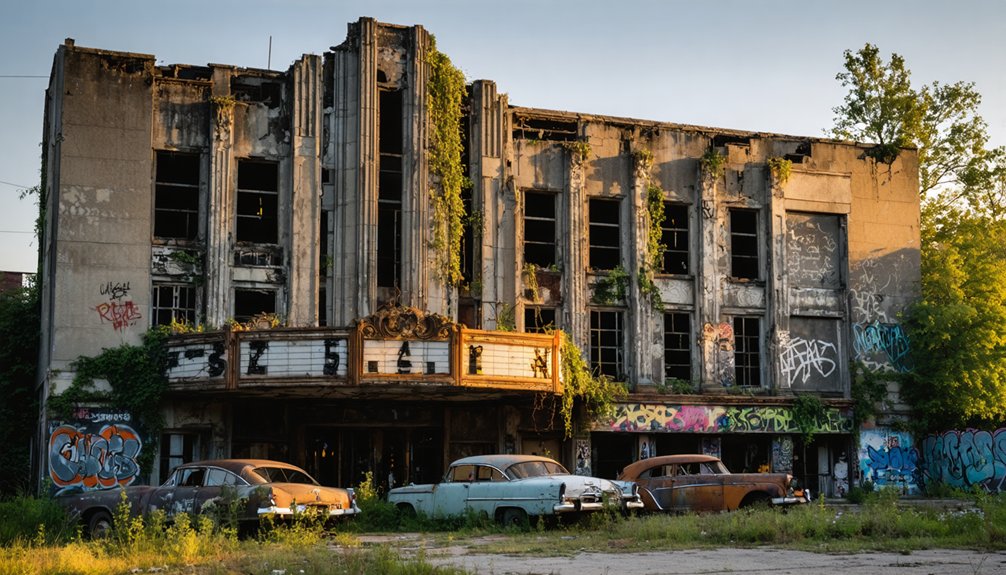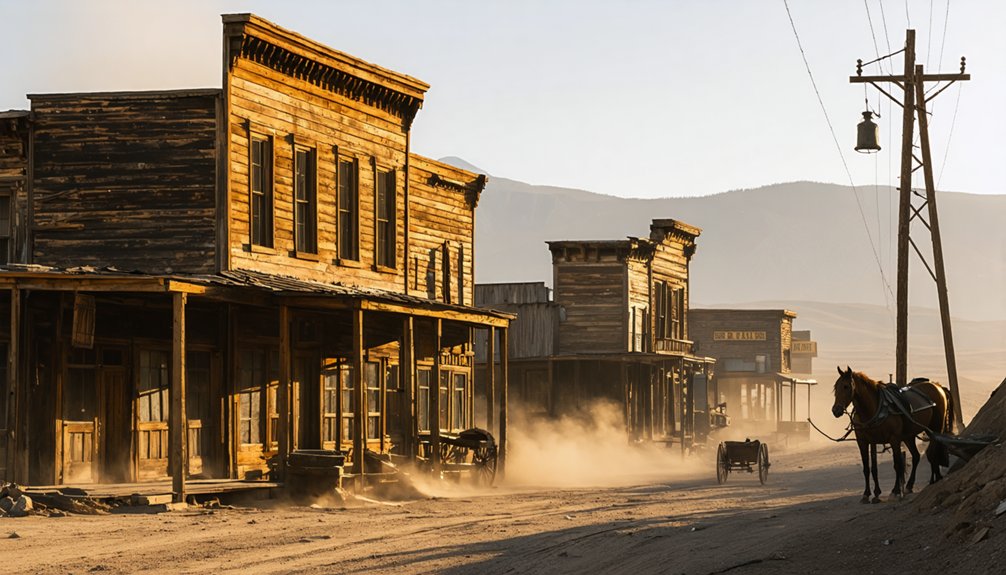
Preserving post-apocalyptic ghost town structures involves employing the “arrested decay” philosophy—maintaining buildings in their deteriorated state while preventing further collapse. You’ll need to address rising water tables and extreme temperature fluctuations that threaten foundations and materials. Secure legal protections through historic registry designation, verify property ownership, and establish community partnerships for volunteer workdays. Funding options include CLG grants, heritage tourism models, and crowdfunding campaigns. The intersection of legal frameworks and environmental mitigation creates a sustainable preservation approach.
Key Takeaways
- The “arrested decay” philosophy maintains structures in their current state while preventing further deterioration through minimal interventions like roof repairs.
- Environmental threats including rising water tables and extreme temperature fluctuations accelerate structural deterioration and require mitigation strategies.
- Legal protections through historic designation provide funding opportunities and safeguards against demolition for abandoned ghost town structures.
- Community involvement through partnerships with preservation organizations creates volunteer workforces and local stewardship of historic abandoned structures.
- Sustainable funding models combining grants, heritage tourism, and revolving funds ensure long-term preservation of post-apocalyptic-looking sites.
The Art of “Arrested Decay” in Post-Apocalyptic Preservation
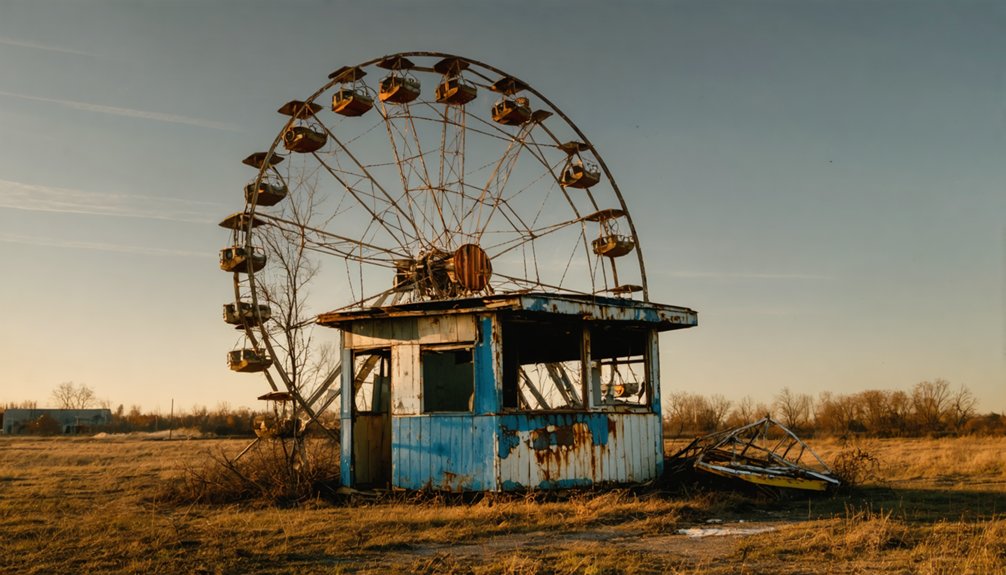
While the term “arrested decay” may seem contradictory, it represents a sophisticated preservation philosophy that deliberately maintains structures in their deteriorated state rather than fully restoring them.
The beauty of preservation through arrested decay lies in embracing imperfection rather than erasing time’s authentic marks.
You’ll find this approach applied to abandoned buildings where preventing further deterioration becomes the priority rather than reconstruction.
This preservation philosophy originated in California for the ghost town of Bodie, where structures are maintained as they were found at a specific historical moment.
You’ll notice interventions like new roofs, foundation rebuilding, and window sealing—all performed to protect against environmental damage without altering the building’s character. This approach shares similarities with arrested caries in dentistry, where certain deterioration is contained without progressing to deeper layers.
When you visit sites employing arrested decay, you’re experiencing a carefully managed state of ruin, where minimal replacements occur and the haunting dissonances of forgotten places remain intentionally intact and comprehensible. Eastern State Penitentiary in the United States follows a similar approach they call preserved ruin to maintain its historical integrity.
Environmental Threats to Abandoned Structures
You’ll find that rising water tables present immediate threats to abandoned structure foundations, causing accelerated deterioration through freeze-thaw cycles and hydrostatic pressure.
Extreme temperature fluctuations compound these issues by expanding cracks in masonry, warping wooden elements, and breaking down protective surface treatments.
These environmental forces work relentlessly against preservation efforts, transforming minor structural weaknesses into catastrophic failures within remarkably short timeframes. The risk is particularly heightened in marginalized communities, where abandoned buildings already exist at disproportionately high rates and have fewer resources for maintenance or restoration. Abandoned properties often become sites of illegal dumping which introduces additional environmental hazards and accelerates structural degradation.
Rising Water Damage
Rising water levels present one of the most destructive environmental threats to ghost town structures, systematically undermining their structural integrity through multiple deterioration pathways.
Water level fluctuations create cycles of wetting and drying that accelerate material deterioration, demanding regular structural integrity assessment to identify vulnerable components.
You’ll encounter several destructive mechanisms when exploring these deteriorating sites:
- Hydrostatic pressure buckles walls and floors as water rises
- Saltwater intrusion accelerates corrosion of metal components
- Biological colonization occurs as mold and invasive species take hold
- Foundation undermining from sediment erosion destabilizes entire structures
- Material decay accelerates as wood rots and concrete spalls
Don’t underestimate how quickly water damage progresses.
In just one season of flooding, a salvageable structure can become unsalvageable as water methodically attacks every vulnerability in the building’s composition.
This rapid deterioration was dramatically demonstrated in Adamsville, Alabama, which never rebuilt after being largely destroyed by a flood.
The devastating effects of water damage are clearly evident in Epecuen, where high-salinity lake water caused catastrophic structural failure throughout the once-thriving tourist destination.
Extreme Temperature Effects
Extreme temperature fluctuations pose serious threats to ghost town structures through both thermal expansion and contraction cycles that compromise material integrity at multiple levels.
You’ll notice these abandoned sites experiencing temperature swings of up to 20°F higher than surrounding vegetated areas, accelerating material fatigue throughout the structures.
The urban heat island effect intensifies this degradation, as concrete and asphalt surfaces absorb heat while tall, abandoned buildings create urban canyons that trap warm air.
Without maintenance interventions like reflective coatings or green infrastructure, these effects compound yearly.
Your freedom to explore these sites diminishes as metals warp, concrete spalls, wood splits, and protective coatings deteriorate under repeated thermal stress.
These temperature fluctuations ultimately hasten chemical reactions that break down building materials, especially when combined with humidity that promotes biological decay.
Low-income neighborhoods are particularly affected as these areas contain more concrete surfaces that retain heat during both day and night.
In Houston alone, approximately 10,000 acres of abandoned buildings contribute to this dangerous thermal environment, creating public health risks and deteriorating structural conditions simultaneously.
Legal Frameworks for Ghost Town Conservation

You’ll need to understand the National Historic Preservation Act provisions that allow ghost town structures to qualify for Historic Registry Designation, providing legal protection against demolition and access to preservation funding.
Transfer of ownership laws vary considerably between jurisdictions, potentially restricting how abandoned properties can be acquired through adverse possession, tax foreclosure, or public auction processes.
Addressing vacant properties through legal mechanisms can help municipalities recover potential tax revenue while preserving historical significance.
Effective preservation requires establishment of protective inventories of cultural property, especially in areas where ghost town structures face immediate endangerment from development or natural deterioration.
Familiarizing yourself with both federal preservation frameworks and local property regulations creates the essential legal foundation for any ghost town conservation initiative.
Historic Registry Designation
The tangled web of legal frameworks that govern ghost town conservation begins with formal historic registry designation.
You’ll need to navigate multiple bureaucratic pathways when seeking protection for these forgotten structures. Understanding the key differences between national, state, and local designation is essential as each provides varying levels of protection against demolition.
- National Register listing provides primarily honorific recognition with minimal demolition protection
- Local designation typically offers the strongest legal safeguards against alteration
- State Historic Preservation Offices (SHPOs) serve as gatekeepers for National Register nominations
- Section 106 review applies only when federal funding or permits are involved
- Certified Local Government status opens access to specialized preservation funding
Meeting historic criteria presents unique preservation challenges for ghost towns, as their significance often lies in their abandonment rather than conventional architectural or historical values.
preserving artifacts in ghost towns is crucial for understanding the lives of those who once inhabited these places. By carefully maintaining these relics, we can piece together the stories and experiences of communities that have long since faded away. This approach not only honors their memory but also enriches our historical narratives for future generations.
Ownership Transfer Laws
Legal ownership and proper title verification form the foundation of any ghost town preservation effort. You’ll need to conduct thorough title searches to navigate the fragmented ownership often resulting from generational transfers or abandonment. County deed records provide essential documentation for ownership verification.
When confronting title disputes, consider adverse possession as a potential pathway to legal claim—in Texas, this requires 10 years of continuous possession for registered land while maintaining the property and paying taxes.
For properties with tax delinquency, monitor foreclosure timelines, typically three years, which may present acquisition opportunities through auctions.
If you’re targeting a ghost town with multiple parcels, prepare to negotiate with separate owners or pursue partition actions for jointly owned properties.
Remember that zoning laws will dictate your preservation activities and may require special permits.
Sustainable Tourism Models for Fragile Historic Sites
As global interest in heritage tourism continues to rise, with projections indicating a market value of USD 778.07 billion by 2030, sustainable tourism models have become crucial frameworks for preserving fragile historic sites while enabling responsible visitor experiences.
You’ll find these sustainable practices increasingly important for ghost town preservation:
- UNESCO designation can dramatically increase visibility and revenue streams while providing protective frameworks.
- Community-driven governance models guarantee equitable distribution of tourism benefits.
- Digital technologies like AR/VR reduce physical impact while enhancing visitor engagement.
- Smart infrastructure and waste management systems minimize environmental footprints.
- Strategic visitor management policies balance access with preservation priorities.
These approaches not only protect heritage tourism assets but create authentic experiences that connect you with history while maintaining site integrity—important considerations as the sustainable tourism market expands toward its projected USD 11.39 trillion valuation by 2034.
Community Involvement in Structural Stabilization Efforts
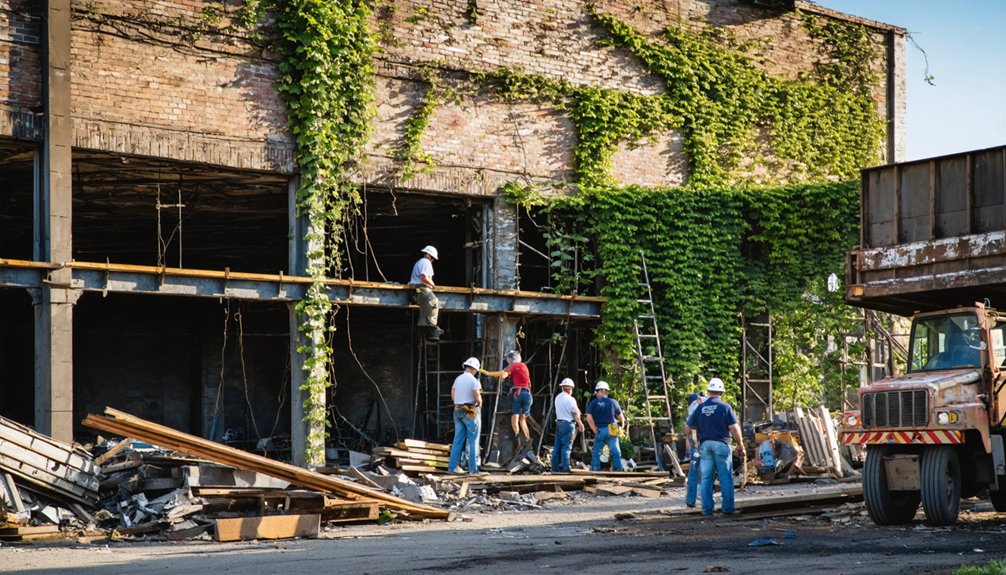
While sustainable tourism frameworks provide strategic direction for ghost town preservation, actual structural stabilization increasingly depends on coordinated community action.
You’ll find organizations like Ghost Town Club of Colorado partnering with local preservation groups on projects such as the Idarado Houses, demonstrating effective community engagement through volunteer workdays.
Collaborative initiatives emerge when entities like Carolina Climbers Coalition mobilize their 1,050 members to contribute 8,000+ annual stewardship hours.
These efforts operate within regulatory frameworks established by authorities including the Bureau of Land Management and National Parks Service, which oversee compliance with preservation standards.
Educational components further strengthen stabilization work, as demonstrated by Cal Poly Humboldt’s archaeological training programs that simultaneously preserve sites while building practical skills.
These multi-stakeholder approaches represent the most viable path toward long-term preservation of these fragile historic structures.
Funding Strategies for Long-Term Architectural Maintenance
Securing sustainable funding represents the cornerstone challenge for ghost town preservation efforts, particularly when addressing long-term architectural maintenance needs.
You’ll need to leverage diverse funding mechanisms while pursuing resource allocation strategies that maximize financial sustainability.
- Apply for CLG grants and National Trust Preservation Funds ranging from $2,500 to $5,000 through meticulously prepared grant applications
- Implement heritage tourism models that generate revenue while maintaining historical integrity
- Establish revolving funds that acquire, restore, and resale historic properties
- Launch targeted crowdfunding campaigns to engage public support for specific restoration projects
- Develop multi-sector partnerships between government agencies, private enterprises, and non-profits
These approaches will liberate your preservation efforts from sole reliance on government funding, creating a self-sustaining financial ecosystem that guarantees ghost town structures endure for generations.
Frequently Asked Questions
Can Radiation-Contaminated Ghost Towns Ever Be Safely Preserved?
You can safely preserve radiation-contaminated ghost towns by implementing stringent safety protocols and advanced radiation containment systems, but these measures require perpetual monitoring to maintain long-term structural integrity against radioactive degradation.
How Are Looters and Vandals Deterred From Damaging Remote Sites?
Like Argus with his hundred eyes, you’ll encounter layered security measures: surveillance systems, ranger patrols, and barrier installations. Community engagement fortifies protection through volunteer presence, education programs, and collective vigilance against unauthorized disturbance.
Who Owns the Artifacts Found Within Abandoned Post-Apocalyptic Structures?
Artifact ownership depends on whether the structure sits on private, public, or tribal land. You’ll need to navigate legal implications of abandonment laws and archaeological protection regulations before claiming anything.
Are Digital Preservation Techniques Effective for Severely Degraded Buildings?
Amid crumbling walls and fading memories, you’ll find digital restoration highly effective. Your degraded buildings achieve 44-56% recovery rates through virtual reconstruction, enabling non-destructive documentation while maintaining acceptable error ranges of 0.2-0.59.
How Do Preservationists Handle Unexploded Ordnance in War-Abandoned Towns?
You’ll implement unexploded ordnance management through historical research, geophysical surveys, and strict safety protocols. Areas are marked, fenced, and monitored while trained EOD specialists execute controlled removal or on-site detonation procedures.
References
- https://travelnoire.com/reviving-ghost-towns-sustainable-tourism-in-abandoned-places
- https://www.residenturbanist.com/p/reviving-ghost-towns-turning-neglected
- https://savingplaces.org/stories/preserving-decay-exploring-the-ghost-town-of-bodie-california
- https://www.atlasobscura.com/articles/column-preservation-of-abandoned-places
- https://www.youtube.com/watch?v=yeTVfoQxqJc
- https://www.californist.com/articles/interesting-california-ghost-towns
- https://grokipedia.com/page/Ghost_Town
- https://mbird.com/everyday/memories-from-the-future-a-word-on-abandoned-houses-nostalgia-and-the-hope-of-the-world/
- https://wordnik.com/words/arrested decay
- https://en.wikipedia.org/wiki/Arrested_decay