Preserving Native American remains in ghost towns requires honoring the sacred connection between tribes and their ancestral lands. You’ll find NAGPRA provides legal protection, but true preservation emerges through collaborative partnerships that prioritize tribal perspectives and ceremonial practices. Archaeologists now work alongside Indigenous communities using documentation methods that respect spiritual dimensions of sites. Beyond physical preservation, this work acknowledges that these aren’t abandoned places but living landscapes where cultural continuity endures despite development pressures.
Key Takeaways
- NAGPRA legally protects Native American burial sites and requires consultation before disturbing remains found in ghost towns.
- Archaeological documentation methods now prioritize tribal partnerships with 50/50 resource sharing and hiring tribal members.
- In-situ preservation respects the spiritual connection between Native peoples and their ancestral lands within ghost town sites.
- Tribal-led preservation models emphasize ceremonial access and understanding ghost towns as living cultural landscapes.
- Digital mapping technologies and careful excavation techniques help document and preserve Native American remains with minimal disturbance.
The Sacred Connection Between Native Tribes and Ancestral Lands
While centuries of colonization have dramatically altered the physical relationship between Native American tribes and their territories, the spiritual bond between Indigenous peoples and their ancestral lands remains unbroken.
You’ll find that these sacred landscapes form the foundation of tribal identity, with creation stories linking specific geographical features to cultural origins. Despite losing 99% of their original homelands, tribes maintain powerful connections through language, ceremonies, and oral traditions that encode their relationship with the natural world. In some Indigenous languages like Secwepemctsín, the words for land and people share the same root emc, illustrating their inseparable connection.
Sacred landscapes anchor tribal identity through unbreakable spiritual bonds, despite generations of displacement from ancestral homelands.
When you hear land acknowledgments, you’re witnessing a contemporary practice that honors the original stewards of territories. This acknowledgment represents more than historical recognition—it affirms that Native peoples view themselves as inseparable from the land itself.
The enduring spiritual connection transcends physical displacement, remaining central to Indigenous worldviews and cultural revitalization efforts today. Through reclamation efforts like the Land Back movement, tribes are actively working to restore sovereignty over their ancestral territories.
NAGPRA’s Role in Protecting Indigenous Burial Sites
When the Native American Graves Protection and Repatriation Act (NAGPRA) passed in 1990, it fundamentally transformed the relationship between Indigenous communities and their ancestral remains. This landmark legislation empowers tribes to reclaim their ancestors and sacred objects from federal agencies and museums receiving federal funds.
If you discover Native American cultural items on federal or tribal lands, you’re legally required to halt activities, protect the items, and notify proper authorities. NAGPRA strongly encourages in situ preservation of archaeological sites containing burial remains whenever possible. The law emerged after centuries of grave desecration by settlers, scientists, and government agencies. NAGPRA compliance isn’t optional—violators face serious criminal penalties and civil fines.
Through this law, burial site protection involves more than just physical preservation; it acknowledges the living cultural connection between present-day tribes and their ancestors.
While implementation has been slower than hoped, NAGPRA represents an essential step toward respecting Indigenous peoples’ rights to determine the final resting places of their ancestors.
Archaeological Documentation Methods for Ghost Town Preservation
The meticulous process of documenting ghost town sites requires archaeological methods that honor both physical remnants and cultural narratives embedded within them.
When you explore these abandoned spaces of Indigenous memory, you’ll witness how stratigraphic excavation reveals multiple occupation layers, each telling distinct stories of community life.
As you walk among silent foundations, each soil layer whispers generations of Indigenous stories waiting to be carefully revealed.
Your preservation work must establish grid systems with fixed datum points, ensuring every artifact’s location is precisely mapped within its original context.
As you carefully excavate each layer, document soil changes that indicate different time periods. Label artifact bags with specific coordinates and layer numbers to maintain their spatial relationships. Digital data collection using Android tablets and Open Data Kit software can significantly improve efficiency compared to traditional pen and paper methods.
Artifact documentation through photography from multiple angles creates visual records that complement your written observations, preserving not just objects but the cultural knowledge they embody—connecting present communities with their ancestral spaces.
Understanding these sites in the context of vast landscapes of ghost towns throughout the American West provides critical comparative data for interpreting abandonment patterns.
Challenges of Development Projects on Sacred Indigenous Sites
Beyond the careful documentation of ghost towns lies a more immediate struggle for Indigenous communities across America.
You’re witnessing sacred site encroachment accelerate as development projects bulldoze burial grounds and ceremonial spaces without regard for their spiritual significance.
When tribes attempt to protect these sites, they face overwhelming legal challenges. Courts routinely deny protection despite clear evidence of cultural desecration, forcing communities to seek permission to access their own ancestral grounds.
The system fundamentally misunderstands Indigenous spiritual practices. Unlike the dominant culture’s separation of religious and secular life, Indigenous traditions view religion as interdependent with law, art, and economics.
This struggle extends beyond physical barriers. With unemployment exceeding 30% on many reservations, economic vulnerability often forces difficult choices between development and preservation.
Projects like the U.S. border wall continue to desecrate sacred sites, directly impacting traditional ceremonies and spiritual connections essential to community well-being.
As fences rise and access diminishes, the transmission of cultural knowledge falters. Each destroyed site represents not just land loss, but the erosion of living traditions that have sustained communities for generations.
Cultural Significance of Ceremonial Burial Practices
Throughout countless generations, Native American tribes have developed intricate burial ceremonies that transcend mere disposal of remains, instead serving as profound spiritual bridges between dimensions.
These burial customs reflect deep connections to land, ancestors, and the cosmos, with each tribe’s practices uniquely honoring their cultural heritage. Among the Navajo, graves are approached with extraordinary care, with mourners walking counterclockwise around the site during ceremonies. After contact with the deceased, Navajo individuals underwent extensive purification rituals to cleanse themselves of death’s spiritual contamination.
- Scaffold and tree platform burials elevate the deceased toward the sky, allowing souls to ascend while bodies naturally return to elements through exposure.
- Earth burial practices connect the deceased with Mother Earth, reflecting ceremonial symbolism of completing life’s sacred cycle.
- Preparation rituals involve specific community members adorning bodies with red ochre, pollen, and special garments, accompanied by personal possessions for the afterlife journey.
You’ll find these traditions weren’t merely ritualistic—they embodied extensive spiritual frameworks ensuring proper passage between physical and spiritual dimensions.
Tribal-Led Initiatives for Reclaiming Ancestral Remains
Since the passage of the Native American Graves Protection and Repatriation Act (NAGPRA) in 1990, tribal nations across America have mobilized powerful grassroots initiatives to reclaim their ancestors’ remains from museums, universities, and federal repositories.
You’ll find tribal leadership at the forefront of these efforts, engaging in government-to-government consultation that honors their sovereignty. These initiatives aren’t merely about compliance with federal law—they represent a profound restoration of ancestral stewardship.
Despite significant challenges, including funding limitations and institutional delays, tribes have established meaningful processes for returning their ancestors to their final resting places.
Despite adversity, Native nations forge dignified pathways home for their ancestors.
When institutions properly support these efforts, they acknowledge that repatriation isn’t optional but a matter of dignity and respect. Through voluntary co-curation agreements and traditional knowledge integration, tribes are reclaiming not just remains, but their rightful place as protectors of their heritage.
Historical Displacement and Its Impact on Native Communities
The brutal displacement of Native American peoples from their ancestral homelands represents one of the darkest chapters in American history, with consequences that continue to reverberate through tribal communities today.
You can see historical trauma manifest in the devastation wrought by the Indian Removal Act of 1830, which forcibly relocated approximately 100,000 Native Americans. During the Trail of Tears alone, an estimated 6,000 Cherokee died from hunger, disease, and exposure.
- Military suppression killed countless tribal members who resisted, including pregnant women and elders.
- Native populations plummeted from 5 million in 1492 to just 237,000 by 1900.
- Despite this genocide, cultural resilience persisted as survivors maintained spiritual practices and community bonds.
These displacements severed tribes from sacred sites and burial grounds, fragmenting communities but never extinguishing their spirit.
Building Collaborative Partnerships Between Archaeologists and Tribes
Against the backdrop of historical trauma, a paradigm shift has emerged in how archaeologists interact with Native American tribes.
You’re witnessing the transformation from extractive research models to ethical partnerships centered on tribal concerns.
These collaborative frameworks now prioritize reciprocity—hiring tribal members for excavation teams, implementing 50/50 sharing arrangements, and ensuring tribes control sacred site documentation.
Archaeologists acknowledge past damages and commit to repair through sustained relationships spanning decades.
The protection of cultural resources now incorporates traditional stewardship practices alongside conventional methods, with tribes leading repatriation efforts.
Universities like UCLA are returning remains and artifacts to restore cultural sovereignty.
What matters most in these evolving partnerships is the recognition that tribal interests aren’t secondary considerations but primary motivating factors in archaeological work—a profound shift redefining the field’s future.
The Future of Ghost Town Preservation Through Indigenous Perspectives
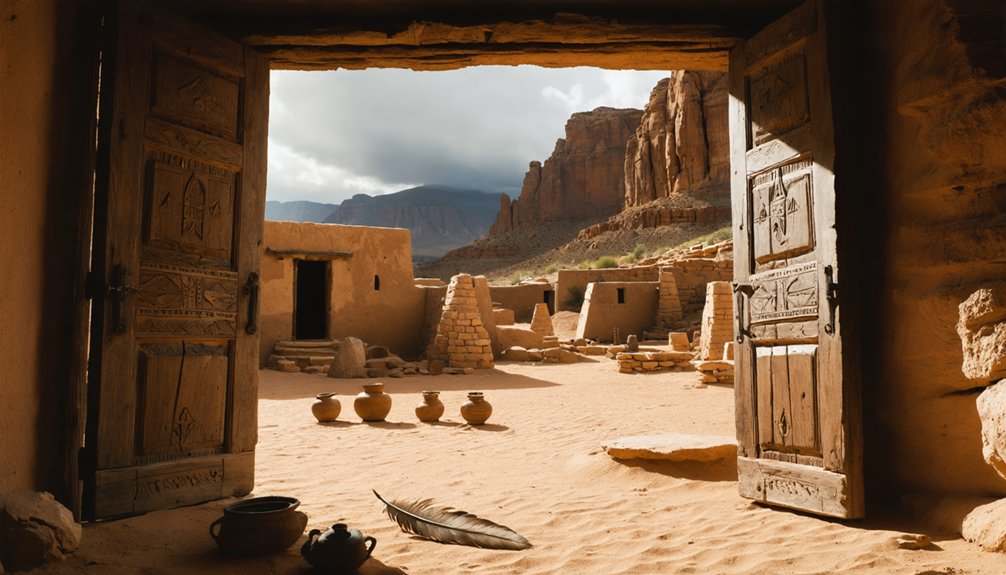
As abandoned settlements stand silent across America’s landscape, Indigenous perspectives are dramatically reshaping what “ghost town preservation” means beyond the colonial imagination.
preserving history in ghost towns opens up dialogues about cultural continuity and the diverse narratives that once thrived in these spaces. By uncovering the stories of their original inhabitants, we can enrich our understanding of these sites and honor the legacies that have shaped our collective past. This approach encourages a more inclusive remembrance that respects the multiple histories interwoven in these forgotten places.
You’ll find tribal communities advocating for protection that honors the spiritual continuity of these sites while creating opportunities for heritage education through community engagement.
- Sacred spaces aren’t abandoned in Native worldviews—they remain active within spiritual dimensions even as physical structures deteriorate.
- Tribal-led stewardship models prioritize land return and ceremonial access over tourist-centered preservation.
- Language revitalization connects place names to their original meanings, reclaiming narratives erased by settler histories.
The future of ghost town preservation isn’t about freezing these places in time, but understanding them as living landscapes where Indigenous communities can heal historical trauma through reconnection with ancestral sites and cultural practices.
Frequently Asked Questions
How Are Conflicts Between Tribal Spiritual Beliefs and Scientific Research Resolved?
You’ll see conflicts resolved through collaborative models that prioritize spiritual reconciliation alongside scientific inquiry, with ethical considerations guiding protocols that respect Indigenous worldviews while advancing collective knowledge through respectful dialogue.
What Technologies Are Used to Locate Unmarked Native American Graves?
You’ll find communities using ground penetrating radar as their primary non-invasive tool, alongside soil resistivity, magnetic gradiometry, and conductivity surveys. Forensic excavation occurs only when culturally appropriate and tribally approved.
How Do Tribes Handle Repatriated Remains With Uncertain Cultural Affiliations?
You’ll find tribes approach uncertainly affiliated remains with cultural sensitivity, often conducting communal ceremonies that honor ancestors without specific tribal attribution. They’ll balance ethical considerations with the spiritual need for proper burial.
What Legal Recourse Exists for Sites Discovered on Private Property?
You’ll find your legal recourse limited by property rights, with state laws and local ordinances as your primary legal frameworks. Consider voluntary agreements with landowners to honor ancestral connections despite legal constraints.
How Has Climate Change Affected Preservation of Submerged or Remote Sites?
Like a clock drowning in rising tides, you’re witnessing climate impacts devastating underwater sites through erosion and ice melt. Your ancestors’ stories face unprecedented preservation challenges from saltwater intrusion and earlier seasonal thaws.
References
- https://savingplaces.org/stories/rassawek-and-the-monacan-indian-nations-fight-to-protect-its-historic-capital
- https://nvtami.com/2022/03/27/lost-city-ghost-town/
- https://archaeology.org/issues/may-june-2024/letters-from/ghost-towns-of-the-ashokan-reservoir/
- https://www.nps.gov/subjects/archeology/napgra.htm
- https://www.scmp.com/lifestyle/travel-leisure/article/3254037/ultimate-us-ghost-towns-exploring-ancient-native-americans-settlements-and-culture-and-camping-under
- https://www.fs.usda.gov/lei/archeological-resources-protection.php
- https://familytraveller.com/usa/national-parks/american-west-ghost-towns/
- https://www.azcentral.com/story/news/local/arizona/2025/11/25/native-homelands-give-people-a-strong-connection-to-their-past/86989387007/
- https://www.audubon.org/magazine/how-tribes-are-reclaiming-and-protecting-their-ancestral-lands-coast-coast
- https://www.silvotherapy.co.uk/articles/nature-connection-native-americans