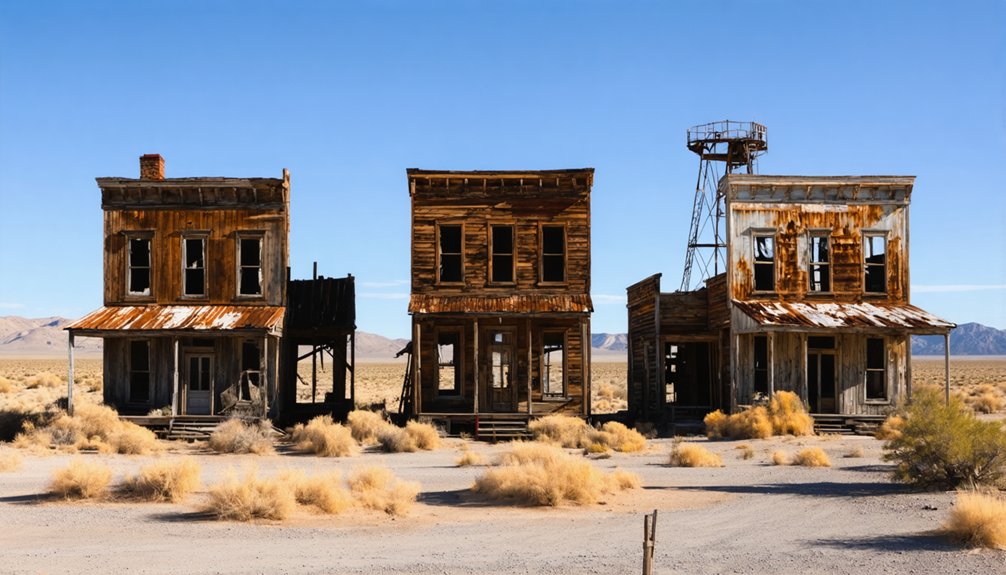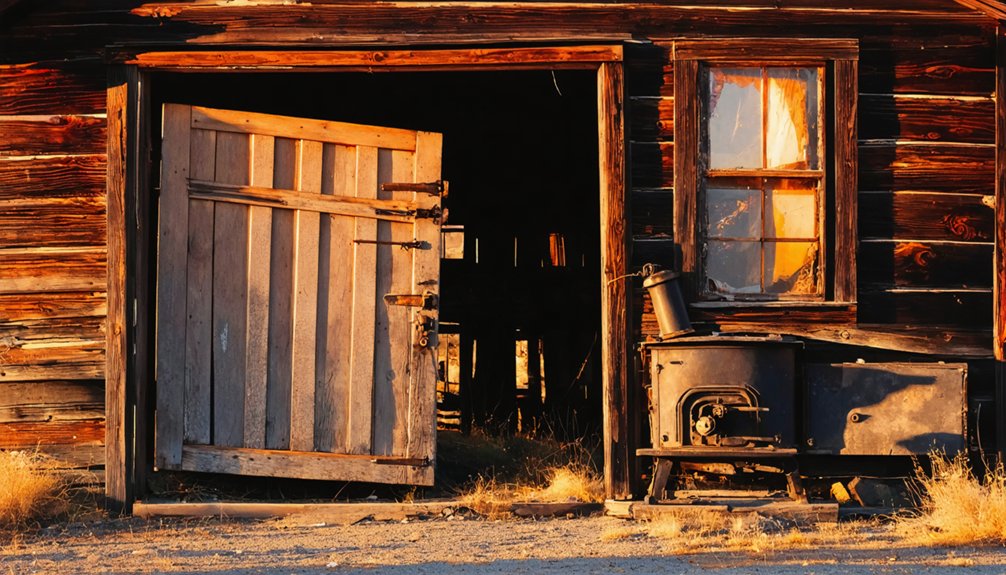
Nevada’s 600+ ghost towns face critical preservation challenges as wooden structures crumble and stone foundations erode in the harsh desert. You’ll find success stories at Berlin-Ichthyosaur State Park and Rhyolite, where tourism revenue funds restoration efforts. Preservation techniques include stabilizing foundations and applying protective coatings to authentic remnants. Community-led initiatives in places like Jarbidge demonstrate how these historic mining communities can be saved despite limited funding and infrastructure challenges.
Key Takeaways
- Nevada’s 600+ ghost towns face structural deterioration from extreme desert conditions, mine shaft collapses, and flash floods.
- Preservation techniques include stabilizing foundations, applying protective coatings, and replacing critical structural elements while maintaining authenticity.
- Historical structures like Rhyolite’s Cook Bank Building and Tom Kelly’s Bottle House demonstrate mining-era construction techniques worth preserving.
- Success stories include Berlin-Ichthyosaur State Park, Jarbidge, and Goodsprings, where preservation efforts have maintained historic character.
- Tourism provides sustainable funding through entrance fees and visitor spending, creating a cycle where better preservation attracts more tourists.
The Rise and Fall of Nevada’s Mining Communities
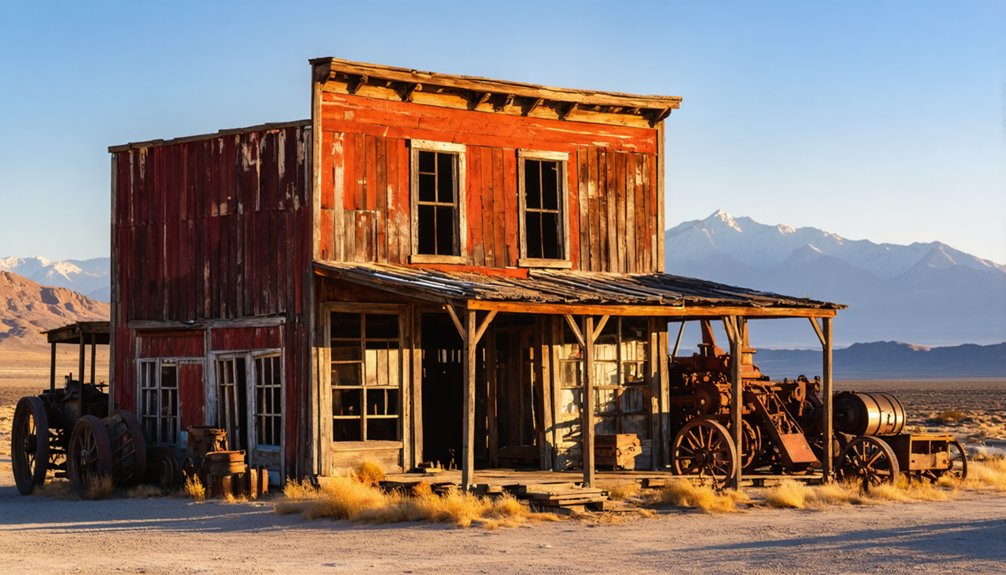
You can trace Nevada’s boom-and-bust pattern across generations.
Mining districts multiplied rapidly after territorial establishment in 1861, creating distinctive community cultures from Tonopah to Ely. The completion of the transcontinental railroad in 1869 further accelerated exploration.
Yet prosperity proved fleeting. The Comstock’s 1877 production peak gave way to economic depression, followed by Tonopah’s silver revival in 1900 and eventual decline by 1915. This pattern of boom-and-bust reflected the enormous wealth generated by the Comstock Lode, which produced an output of $700,000,000 throughout its history. The discovery of the Carlin gold in 1962 marked another significant turning point in Nevada’s mining history.
Why 600+ Ghost Towns Dot the Silver State Landscape
You’ll find Nevada’s unprecedented concentration of ghost towns stems directly from the state’s boom-and-bust mining cycle, where silver and gold discoveries sparked rapid town formation only to collapse when deposits depleted.
The Silver State’s landscape provided rich but finite mineral veins that could sustain communities for mere years rather than generations, leaving abandoned structures when economic foundations crumbled.
This pattern of transience over permanence repeated hundreds of times across Nevada’s rugged terrain, creating the remarkable phenomenon of over 600 ghost towns scattered throughout the state. Different historians and explorers like Shawn Hall have estimated there could be as many as 1,200 ghost towns throughout Nevada, with the exact count varying based on classification criteria. Many of these abandoned settlements occupy public land, with their remnants spread across more than 60 million acres accessible to explorers and history enthusiasts.
Mining’s Fleeting Boom
While tales of overnight fortunes captivate our imagination, Nevada’s mining history reveals a more complex pattern of meteoric rises followed by dramatic collapses. The 1859 Comstock Lode discovery triggered explosive growth across the state, transforming barren landscapes into bustling communities virtually overnight.
You’ll find evidence of this booming economy in places like Rhyolite, which grew to 8,000 residents complete with concrete sidewalks and electricity. Eureka expanded to 10,000 people with 50 active mines during the 1870s.
These transient populations created impressive infrastructure including multiple rail lines and innovative smelting technology. General McCoy’s new smelter technology in 1869 was particularly revolutionary for Eureka’s development. Today, these sites provide haunting atmospheres for visitors exploring Nevada’s rich mining heritage.
Yet these boomtowns were destined for abandonment. Resource depletion, labor disputes, and natural disasters eventually rendered over 600 communities obsolete—scattered reminders of Nevada’s volatile mining past where prosperity proved as fleeting as the ore itself.
Today, efforts are underway for revitalizing ghost towns in Nevada, where history meets innovation. Artists, entrepreneurs, and historians are drawn to these remnants, eager to breathe new life into the abandoned structures and landscapes. As these initiatives take shape, the past can become a canvas for future opportunities, merging nostalgia with sustainable development.
Transience Over Permanence
Unlike permanent settlements built around sustainable resources, Nevada’s ghost towns represent a pattern of transient occupation driven entirely by extractable wealth.
You’ll find over 600 documented ghost towns scattered across the Silver State’s landscape—each a representation of the inherently temporary nature of mining economies.
When you examine these abandoned communities, you’re witnessing the remains of temporary settlements that weren’t designed for longevity.
From Belmont’s rapid rise to 2,000 residents and subsequent collapse, to Jarbidge’s brief 1,200-person boom ending in the 1930s, these places prioritized immediate resource extraction over sustainable community building.
These abandoned towns often remain unmarked on modern maps, making them difficult to locate without specific geographical coordinates or local knowledge.
Nevada’s mining legacies reflect a fundamental truth: when settlements are established solely for resource depletion, permanence becomes impossible.
Once the ore disappeared, so did the people.
Rhyolite exemplifies this pattern, having transformed from a bustling town with stock exchange and hotels to complete abandonment by 1916 after the financial panic of 1907.
Architectural Remnants: What Survives Today

As you explore Nevada’s ghost towns today, you’ll encounter an array of architectural remnants that have withstood time’s harsh desert elements.
From the concrete skeletons of Rhyolite’s banking structures to the weathered wooden miners’ cabins in Belmont, these fragments tell a story of boom-to-bust economic cycles through their vulnerable historic facades.
The distinctive bottle houses, crumbling mill chimneys, and the stately Belmont Courthouse exemplify the diverse building methods employed during Nevada’s mining heyday, now preserved in varying states of “arrested decay.” Virginia City stands out among these historic sites with its numerous historic buildings that capture the essence of Nevada’s silver mining prosperity. Nevada’s landscape contains more ghost towns than populated communities, creating an unparalleled open-air museum of Western frontier architecture.
Remaining Building Foundations
Despite over a century of harsh desert conditions, Nevada’s ghost towns contain an astonishing array of architectural remnants that offer silent testimony to frontier ambition and engineering prowess.
You’ll find stone foundations enduring most prominently—Unionville’s schoolhouse walls have withstood 160 years of desert weathering, while Rhyolite’s three-story concrete bank building demonstrates industrial-scale construction techniques.
The building materials reveal historical significance beyond mere survival.
Tom Kelly’s Bottle House, constructed from 50,000 discarded bottles, represents frontier resourcefulness. Commercial infrastructure foundations in Rhyolite map the town’s explosive growth, supporting 18 grocery stores and 50 saloons during its peak.
Meanwhile, transportation networks remain visible through concrete sidewalks and railway foundations, completing the skeletal outline of these once-thriving communities.
Weathered Wood Structures
The weathered wooden structures standing in Nevada’s ghost towns represent remarkable feats of survival against the harsh desert elements.
You’ll find log cabins, saloons with original clapboard siding, and miners’ dwellings dating from the 1860s to early 1900s throughout these abandoned settlements.
The structural resilience of these buildings stems from Nevada’s arid climate, which inhibits rot while still allowing the weathered aesthetics of silver-gray patina and textured surfaces to develop over decades.
At sites like Berlin-Ichthyosaur State Park and Rhyolite, you can witness how locally sourced pine and fir have withstood temperature extremes and occasional flash floods.
Conservation efforts now focus on stabilizing foundations, applying protective coatings, and replacing critical structural elements—preserving these authentic wooden remnants for future generations to experience.
Vulnerable Historic Facades
While wooden structures reveal one dimension of Nevada’s ghost town heritage, the crumbling facades of concrete, stone, and brick buildings tell equally compelling stories of architectural ambition and abandonment.
You’ll find impressive concrete ruins like Rhyolite’s Cook Bank Building, with its three-story facade still defying time despite harsh desert elements.
Stone and masonry structures, particularly in Humboldt City, demonstrate superior resilience, making them prime candidates for facade restoration.
Brick remnants, from storefronts to towering mill chimneys, punctuate these abandoned landscapes, though they’re increasingly vulnerable to freeze-thaw damage.
Modern preservation techniques now focus on stabilizing these architectural treasures without compromising their authenticity.
Unique features like Tom Kelly’s Bottle House and mission-style train depots represent the innovative spirit that once animated these settlements—architectural heritage that deserves protection despite the challenges of remote locations and limited resources.
Critical Preservation Challenges in Desert Environments
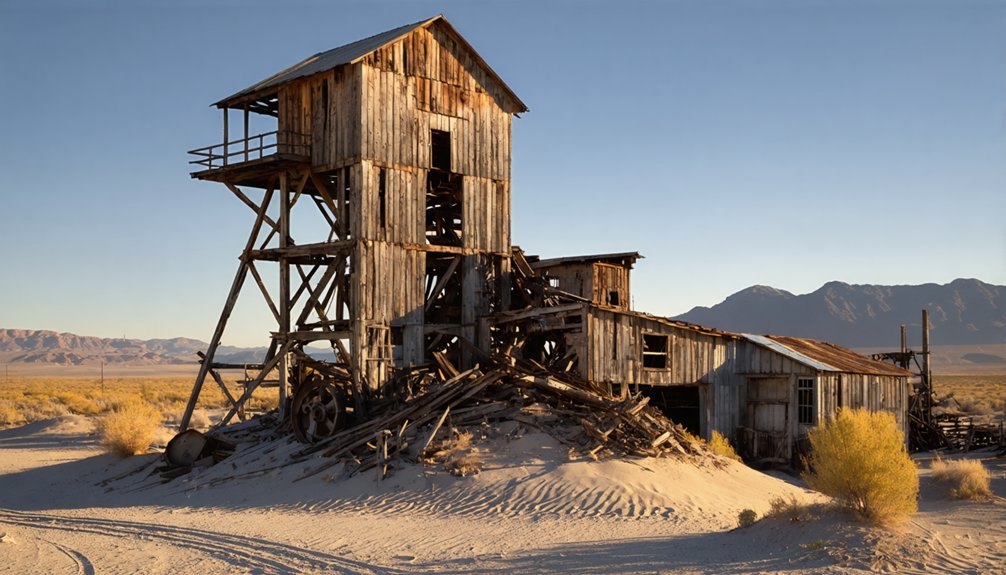
Across Nevada’s vast arid landscape, ghost towns face unique preservation challenges that extend far beyond simple structural maintenance. While the desert’s “arrested decay” can slow deterioration, it introduces complex problems requiring specialized preservation techniques and historical documentation.
You’ll find infrastructure completely absent—water, power, and road access remain prohibitively expensive to restore. Underground mine shafts collapse regularly, threatening both structures and visitors. Flash floods sweep through canyons, displacing artifacts and washing away historical context.
Funding remains perpetually insufficient with limited grant money stretched across 600+ ghost towns.
When you examine wooden buildings, you’ll notice extreme temperature fluctuations cause warping and foundation settling. The combination of seismic activity, unstable terrain, and material degradation creates preservation dilemmas that demand both technical expertise and substantial resources.
Success Stories: Ghost Towns Brought Back From the Brink
Despite facing seemingly insurmountable challenges, several Nevada ghost towns have undergone remarkable transformations through dedicated preservation efforts.
In Berlin-Ichthyosaur State Park, you’ll find stabilized original structures and guided Diana Mine tours, creating a perfect blend of mining and paleontological heritage tourism.
Jarbidge’s community-led initiatives have preserved its authentic character, maintaining historic buildings while supporting its dozen residents.
Rhyolite’s iconic Bottle House, restored in 1925, demonstrates early ghost town revitalization, while its proximity to Death Valley guarantees continued visitation.
Goodsprings exemplifies living history, with century-old buildings integrated into modern life through collaborative preservation projects.
Even Metropolis, though largely gone, benefits from stabilization efforts highlighting its unique agricultural origins, setting it apart from typical mining settlements in Nevada’s preservation landscape.
Tourism’s Role in Funding Historic Preservation

These preservation success stories showcase what’s possible, but behind each restored building and maintained site lies a critical financing question: who pays for it?
Tourism funding has emerged as the most sustainable answer. When you visit sites like Bodie, your entrance fees directly support preservation strategies that maintain these fragile structures.
Nevada’s ghost towns attract over 200,000 visitors annually, generating revenue through tours, museums, and special events that fund restoration of key buildings and infrastructure improvements.
This heritage tourism model reduces dependence on government subsidies while creating economic opportunities for nearby communities.
Despite challenges like seasonal fluctuations and visitor impact, tourism creates a virtuous cycle—the better preserved a ghost town, the more visitors it attracts, securing additional funding for ongoing preservation work.
How Climate Change Threatens Our Mining Heritage
While preserving Nevada’s historic ghost towns has progressed through tourism efforts, climate change now poses unprecedented threats to these fragile remnants of the state’s mining past.
You’ll witness escalating wildfire risks threatening remote sites as hotter, drier conditions and invasive species create perfect burning conditions. Heritage preservation efforts face mounting challenges from extreme temperature fluctuations that accelerate wood rot, masonry cracking, and metal corrosion.
The climate impact extends beyond structures. Nevada’s increasing water scarcity undermines the ecological context of these historic sites, while unpredictable flash floods wash away foundations and artifacts.
Even more concerning, rising temperatures and altered precipitation patterns mobilize legacy mining pollutants, creating a chemical assault on already vulnerable structures.
Without immediate intervention, these irreplaceable windows into Nevada’s pioneering spirit may disappear entirely within your lifetime.
Community-Led Initiatives for Ghost Town Restoration
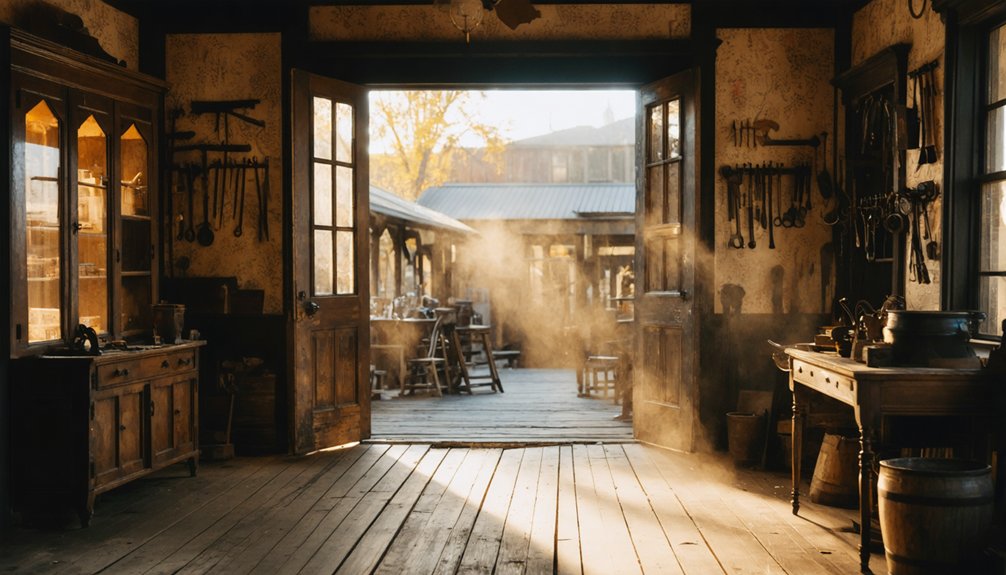
Across Nevada’s rugged landscape, passionate community volunteers have emerged as the frontline defenders of the state’s disappearing mining heritage. Organizations like Friends of Sutro Tunnel coordinate regular workdays where volunteers tackle everything from structural stabilization to historical documentation.
These grassroots efforts thrive through community partnerships with historical societies and state agencies, mobilizing resources despite funding challenges. You’ll find dedicated individuals contributing thousands of dollars to rebuild single miner’s cabins, while others organize fundraising events to offset rising material costs.
Volunteer engagement remains essential, with groups providing specialized training in preservation techniques. Their extensive approach includes creating interpretive displays, conducting “Then & Now” photography projects, and developing educational programs—all while prioritizing both historical integrity and visitor safety in these remarkable windows to Nevada’s past.
Frequently Asked Questions
Are Ghost Towns Legally Protected From Treasure Hunting or Metal Detecting?
Yes, you’ll face penalties under treasure hunting laws and metal detecting regulations. Ghost towns are federally and state protected—unauthorized artifact removal can result in fines or imprisonment.
How Do Ownership Disputes Affect Preservation of Abandoned Mining Properties?
Crumbling history awaits while legal battles rage. You’ll find ownership rights controversies prevent your preservation efforts, creating insurmountable challenges when investing time and money into structures you can’t legally claim or protect.
What Indigenous Histories Existed at These Sites Before Mining Began?
You’ll find indigenous cultures thrived on these lands long before mining, with established communities maintaining sustainable practices. Their historical significance includes traditional water management, seasonal hunting, and deep spiritual connections to these territories.
Can Visitors Stay Overnight in Any Nevada Ghost Towns?
While camping offers freedom, you’ll find exceptional overnight accommodations in several Nevada ghost towns. Gold Point offers authentic cabins starting at $110/night, while Goldfield Stop Inn provides private cabins with hot tub access and ghost town tours.
How Do Ghost Towns Compare to California’s Gold Rush-Era Abandoned Settlements?
You’ll find Nevada’s ghost towns more silver-focused and widely dispersed compared to California’s concentrated gold rush settlements, though both share boom-bust cycles, abandoned structures, and rich frontier histories worth exploring.
References
- http://usaheaven.com/articles/state-most-ghost-towns
- https://nvtami.com/2025/01/27/rhyolite-ghost-town-nevadas-diamond-in-the-desert/
- https://savingplaces.org/stories/explore-wild-west-mining-history-in-nevada-ghost-towns
- https://www.youtube.com/watch?v=mEjb9dGwgtg
- https://nevadamining.org/nevada-mining-towns-eureka/
- https://nevadabusiness.com/2025/07/rural-nevada-where-the-past-and-the-future-meet/
- https://www.blm.gov/blog/2024-11-01/blm-archaeologists-tell-ghost-town-story-nevada-day-weekend
- https://epubs.nsla.nv.gov/statepubs/epubs/497727-2024-2025-winter.pdf
- https://nbmg.unr.edu/mining/MiningHistory.html
- https://ndep.nv.gov/land/abandoned-mine-lands/anaconda-home/anaconda-history