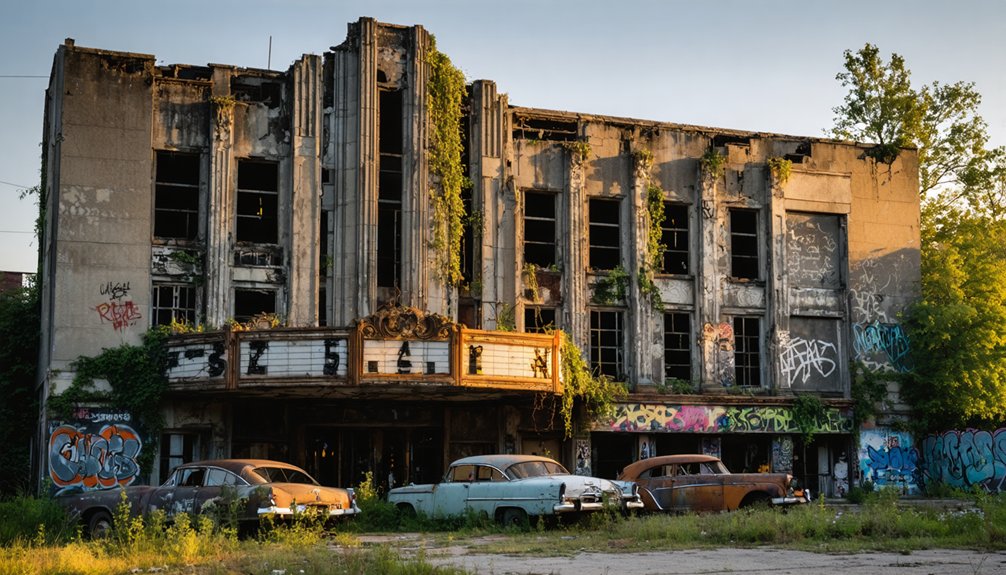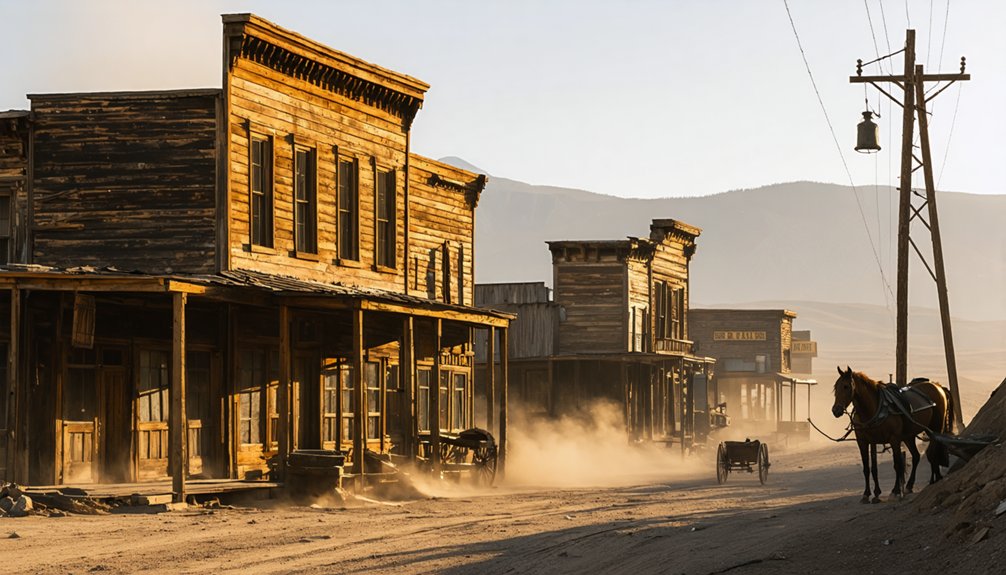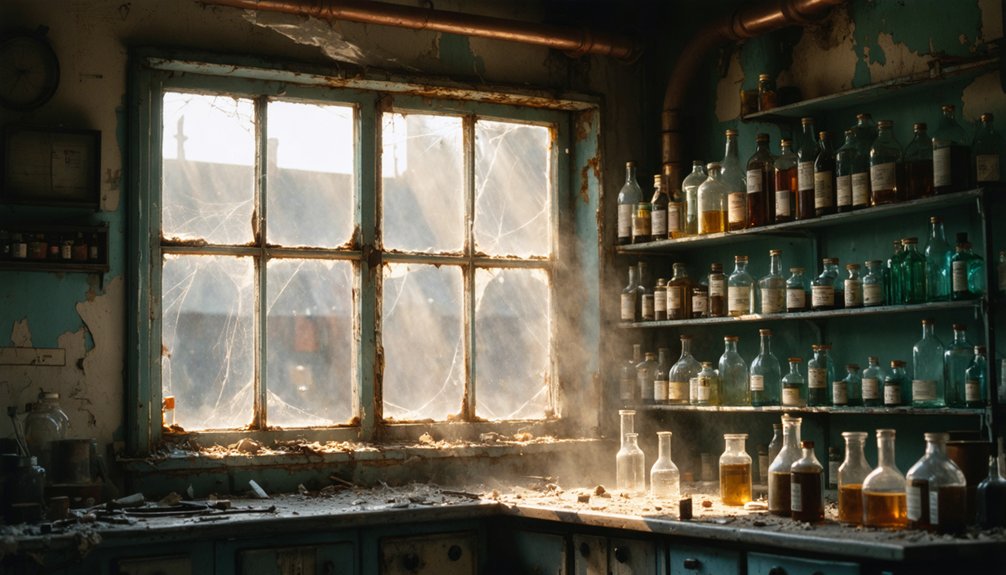
To preserve post-apocalyptic ghost town artifacts, you’ll need systematic documentation using unique identifiers and condition assessments (CC 0-4). Implement weather-resistant techniques by creating raised gravel bases and installing roofed structures with overhangs. Control temperature and humidity levels below 35% for metals and 50% for composites. Engage local communities to drive authenticity in preservation efforts while securing diverse funding sources. The thorough approach outlined below transforms scattered remnants into valuable historical records.
Key Takeaways
- Implement comprehensive tagging systems with unique identifiers and condition assessments (CC 0-4) for all artifacts found in ghost towns.
- Create digital archives using standardized metadata formats, 3D scans, and photogrammetry to preserve detailed records of decaying structures.
- Apply weather-resistant preservation techniques including raised gravel bases, protective roofed structures, and appropriate humidity controls for different materials.
- Engage local communities in preservation efforts to combine professional expertise with local knowledge and build sustainable conservation projects.
- Develop effective storytelling methods through museum exhibitions, digital archives, and interactive experiences to share ghost town histories.
Identifying Valuable Artifacts in Post-Apocalyptic Settings
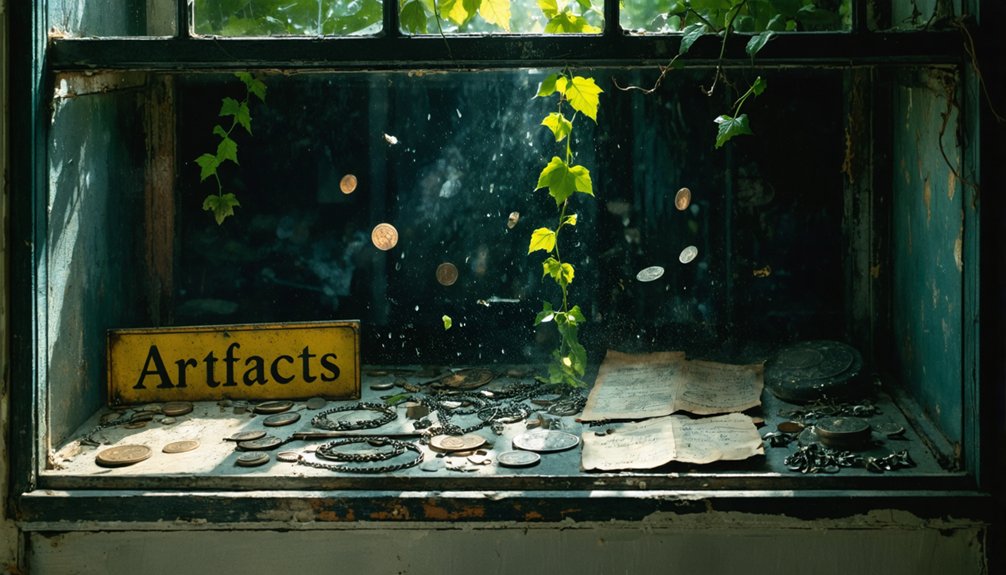
When exploring the remnants of post-apocalyptic ghost towns, identifying valuable artifacts requires a systematic approach and keen observational skills.
You’ll need to focus first on material composition—ceramics, metals, and preserved organics often yield the highest artifact significance. Look for manufacturer marks or inscriptions that provide dating context.
Examine artifact context carefully; items found in domestic settings reveal survival strategies of previous inhabitants, while institutional locations may contain historically significant objects.
Context reveals an artifact’s true value—domestic items show how people survived; institutional remains tell civilization’s final chapter.
Pay special attention to modified or repaired items, as these demonstrate adaptation techniques that could inform your own practices.
For ideal identification, use magnification tools to inspect fine details and compare findings with any available reference materials. Remain alert for stone tools with polished exteriors as these are distinguishing features of ground stone artifacts rather than naturally occurring rocks.
The most valuable discoveries often display unique craftsmanship or represent the sole surviving example of pre-collapse technology.
Remember to leave all artifacts in their original position to maintain the archaeological context, which is crucial for proper analysis and understanding of the site.
Essential Documentation Protocols for Decaying Structures
When documenting artifacts in post-apocalyptic sites, you’ll need to implement an extensive tagging system that assigns unique identifiers following condition class assessments (CC 0-4) to prioritize preservation efforts.
Your digital archive creation should integrate standardized metadata formats that guarantee interoperability across research platforms while capturing both quantitative measurements and qualitative observations about material degradation.
These records must incorporate geospatial references, temporal data points, and detailed photographic evidence that collectively establish baseline conditions for ongoing monitoring of structural and material deterioration rates. This comprehensive approach enables the effective identification and evaluation of potential hazards to cultural heritage artifacts in decaying structures. Moving systematically from exterior to interior spaces during documentation ensures a hierarchical structure for proper recording and assessment of all building elements.
Artifact Tagging Systems
As post-apocalyptic structures continue to deteriorate, extensive artifact tagging systems represent the cornerstone of effective preservation efforts. Your tagging strategies must implement multi-part naming conventions that incorporate project identifiers, artifact types, condition assessments, and precise location coordinates.
Effective artifact management requires hierarchical tags reflecting maturity phases (original, stabilized, fragile) alongside material classifications that enable targeted handling procedures. Social tagging approaches have proven successful due to their inherent simplicity while maintaining sufficient documentation rigor.
You’ll need to capture both creation and discovery dates within structured metadata while establishing artifact connectivity between functionally associated items.
Implement both proactive and reactive governance mechanisms to guarantee tagging consistency. Deploy filtered search capabilities based on multiple classification dimensions, and consider physical QR codes that link to detailed digital records.
These systems preserve freedom of information access while maintaining the scientific integrity necessary for longitudinal preservation studies. Following the four-part naming structure recommended by JFrog enhances clarity and helps avoid confusion when organizing and accessing your artifact repository.
Digital Archive Creation
Digital archive creation forms the backbone of sustainable preservation efforts for post-apocalyptic structures through its extensive documentation protocols.
You’ll need to implement three-dimensional surveys as your foundation, generating digital twins with millimeter-level accuracy through photogrammetry and 3D scanning techniques.
Establish robust data integrity mechanisms through checksums, redundant storage, and format migration to protect against technological obsolescence—essential considerations in archival strategies where physical access may become impossible.
Organize your documentation using standardized metadata systems that enable efficient retrieval and collaborative analysis across preservation teams.
For effective digital preservation, integrate parametrical objects within Heritage-BIM to systematically document decay phenomena.
This approach allows you to monitor structural degradation remotely while maintaining thorough audit trails that verify authenticity and completeness of your ghost town artifact documentation. Using preferred archival formats like PDF/A, TIFF, and XML enhances long-term accessibility and prevents future compatibility issues.
The non-destructive methods employed in digital preservation ensure that fragile architectural elements remain intact while still capturing their complete data profile.
Weather-Resistant Preservation Techniques for Fragile Materials

Preserving artifacts in post-apocalyptic ghost towns requires implementing specialized weather-resistant techniques that address the unique challenges posed by outdoor environments.
You’ll need to construct raised bases from coarse gravel to prevent direct soil contact, while installing roofed structures with substantial overhangs to shield items from precipitation and sunlight.
For metal artifacts, maintain humidity below 35% for pure metals and under 50% for composite items.
Terracotta and marble ceramics demand 40-60% relative humidity, while silver requires levels below 50%.
Apply microcrystalline wax coating to protect lead, tin, and pewter alloys.
Temperature stabilization between 16-22°C is essential for preserving bronze, brass, and ceramic pieces.
When selecting display materials, choose inert options like perspex rather than wood, which releases damaging acidic compounds.
Consider using modified bentonite-based hydrogels to strengthen fragile sandstone artifacts by penetrating cracks and pores and solidifying into durable cement.
Proper weather resistant materials guarantee your preservation techniques withstand environmental extremes.
Regular inspection for and removal of organic growth such as fungus, moss, and lichen is crucial for preventing long-term deterioration of wooden components exposed to moisture.
Creating Digital Archives of Ghost Town Remnants
When you’re documenting ghost town artifacts, high-resolution scanning of historical fragments provides critical digital surrogates that capture microscopic details invisible to the naked eye.
You’ll need to implement standardized metadata schemas for each digitized item, ensuring proper documentation of provenance, condition, and historical context according to established preservation principles.
Cloud-based heritage catalogs offer redundant storage solutions while democratizing access, allowing researchers and the public to explore these digital remnants through virtual platforms regardless of geographical limitations.
Scanning Historical Fragments
Modern technology has revolutionized the preservation of ghost town artifacts through advanced digital scanning techniques. When you’re documenting historical fragments, handheld 3D scanners like Artec Eva capture intricate details and textures that might otherwise be lost to time.
You’ll encounter various challenges in these deteriorating environments—unstable structures, poor lighting, and dust-covered artifacts demand adaptable equipment and methodologies.
Despite these obstacles, artifact preservation strategies now include real-time projection mapping and mobile scanning applications that allow you to document everything from small, carved objects to entire room layouts in minutes.
Processing these scans transforms raw data into thorough digital models, creating permanent records even as physical remnants continue to decay.
This digital archiving grants you freedom to share, study, and replicate historically significant items that might otherwise remain hidden in remote ghost town locations.
Cloud-Based Heritage Catalogs
The digitization of artifact data flows naturally into sophisticated storage systems for long-term access and preservation.
Cloud-based heritage platforms enable you to catalog ghost town artifacts with unprecedented flexibility, ensuring artifact accessibility from any internet-connected device. These systems support real-time cloud collaboration among researchers, preservationists, and volunteers—regardless of geographical constraints.
Your digital archives benefit from robust security protocols with industry-standard encryption and automated backup systems that protect irreplaceable data from loss.
Platforms like CatalogIt, Minisis, and CollectionSpace offer intuitive interfaces for non-specialists while maintaining compliance with international standards such as CIDOC-CRM and Dublin Core.
The integration capabilities with web publishing tools allow you to selectively share your preserved heritage, connecting remote ghost town history with researchers and enthusiasts worldwide through customizable portals.
Community-Based Restoration Projects and Volunteer Management
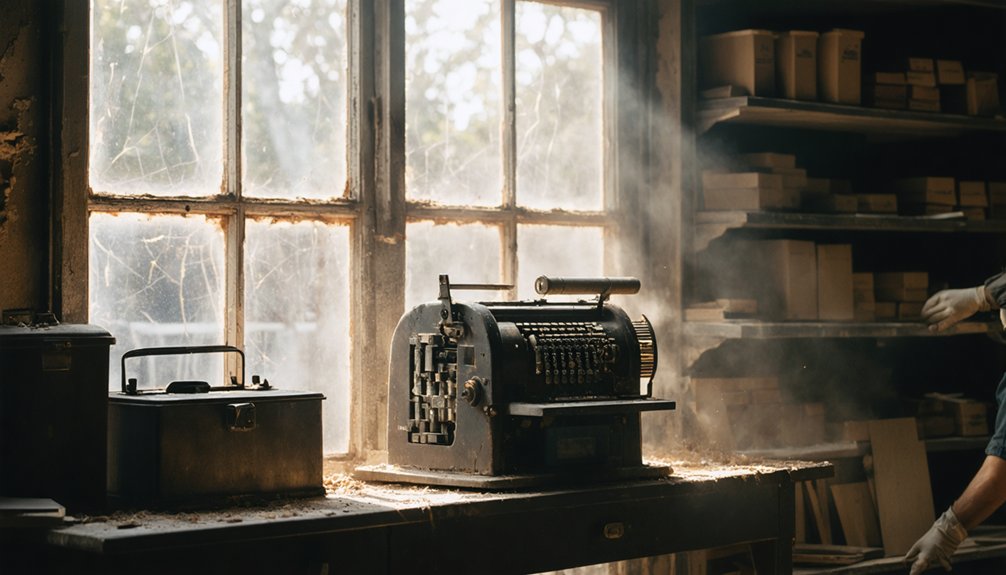
Community-based restoration projects form the backbone of successful ghost town preservation efforts, as they harness local knowledge, passion, and manpower to tackle complex rehabilitation challenges.
You’ll find the most effective initiatives leverage dedicated citizens who organize around specific sites, like Silverton’s residents who coordinated preservation efforts at Animas Forks.
Efficient volunteer coordination transforms weekend workforces of 20-50 individuals into synchronized teams performing critical repairs identified through architectural assessments.
Your crews can simultaneously address roof repairs, drainage improvements, and window installations while reducing project costs.
This community involvement guarantees cultural authenticity throughout restoration processes and builds local investment in outcomes.
The $1.5 million rehabilitation projects demonstrate how volunteer labor, when properly managed, enables phased implementation across multiple structures while maintaining historical accuracy and creating meaningful visitor experiences.
Securing Funding for Long-Term Ghost Town Conservation
Securing adequate funding represents the cornerstone of sustainable ghost town conservation efforts, particularly in post-apocalyptic contexts where deterioration accelerates without intervention.
The financial foundation of preservation work becomes most critical when abandoned settlements face the compounded ravages of time and circumstance.
You’ll need to identify multiple funding sources, beginning with the Historic Preservation Fund (HPF), which has distributed over $1 billion since 1968. Your organization should prioritize grant applications to State Historic Preservation Offices (SHPOs), which serve as critical intermediaries for federal funds.
Diversify your approach by targeting specialized programs like Save America’s Treasures, which provided $292,670 for Constitution Hall preservation.
Consider the Bipartisan Infrastructure Law‘s $70 million conservation allocation with its March 2026 deadline. Remember that most grants require matching funds—the Ghost Town Trail in Pennsylvania leveraged $372,000 in Keystone grants into millions of total support through strategic partnerships with private, local, and federal entities.
Addressing Environmental Threats to Artifact Integrity
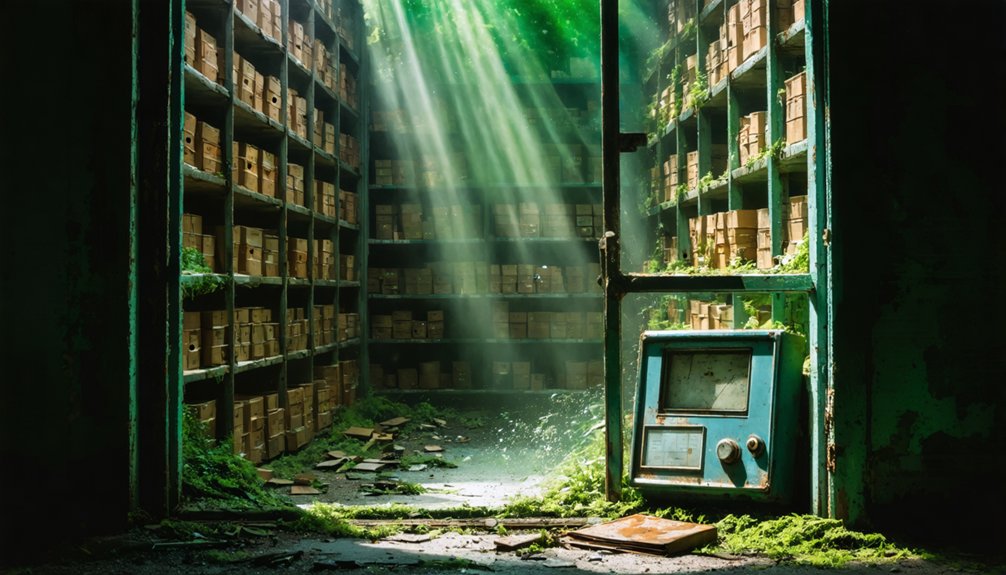
Environmental challenges pose perhaps the most insidious threat to artifact integrity in post-apocalyptic ghost towns, as they operate continuously and often invisibly until damage becomes irreversible.
Your preservation techniques must address temperature fluctuations (maintain 65–70°F/18–21°C) and relative humidity (keep between 40–60%) to prevent accelerated deterioration, mold growth, and material brittleness.
Climate adaptation requires installing HVAC systems with HEPA filters while ensuring continuous operation—never power down during unoccupied periods.
Seal all building envelope penetrations to minimize external environmental influences. Protect artifacts from ultraviolet radiation by avoiding direct sunlight exposure. Monitor for pests using sticky traps and store items in archival-quality containers.
As climate change intensifies, anticipate increased degradation rates, water damage risks, and changing local conditions that necessitate adaptive preservation strategies.
Balancing Authenticity With Structural Stability in Preservation
The preservation paradox of post-apocalyptic ghost towns emerges when artifact authenticity confronts structural integrity requirements.
Exploring ghost town adventures in Arizona offers a unique glimpse into the past, revealing the stories and struggles of those who once inhabited these now desolate places. Visitors often find themselves captivated by the remnants of old structures, each telling a tale of resilience and decay. These sites not only serve as a testament to history but also as a canvas for the imagination, sparking curiosity about what life was like during their heyday.
You’ll face challenging decisions between maintaining original appearances and ensuring buildings remain standing. When implementing arrested decay principles, prioritize minimal intervention—stabilize foundations and reinforce walls without altering the abandoned aesthetic.
Your preservation work should remain invisible to visitors while effectively protecting structures.
Install internal framing behind original walls when necessary, and address roofing issues using period-appropriate materials. You’ll need to document every intervention to maintain authenticity preservation standards.
Remember that successful ghost town conservation balances structural integrity with historical accuracy.
Educational Approaches to Sharing Post-Apocalyptic Cultural Heritage

When sharing post-apocalyptic cultural heritage, educational approaches must transcend mere preservation to actively engage communities in meaningful knowledge transfer.
You’ll find success through three integrated strategies: community-based documentation, technological innovation, and formal academic programs.
Consider implementing interactive learning through 3D modeling and virtual reality recreations that allow audiences to viscerally connect with ghost town environments.
Collaborative expeditions combining local volunteers with heritage professionals create powerful documentation networks while building community investment.
Heritage storytelling becomes especially impactful when delivered through museum exhibitions and digital archives that make remote exploration possible.
Train locals in preservation techniques through workshops, creating sustainability in your educational efforts.
Frequently Asked Questions
How Do I Determine if an Artifact Has Radioactive Contamination?
Like a detective seeking evidence, you’ll need specialized radiation detection equipment. Use Geiger-Mueller counters for initial contamination assessment, then employ scintillation detectors to confirm radioactive particles’ presence with greater precision.
Can I Legally Remove Artifacts From Abandoned Post-Apocalyptic Settlements?
No, you can’t legally remove artifacts without permits. Abandoned settlements still have artifact ownership considerations and significant legal implications under federal and state protection laws.
What Ethical Considerations Exist When Documenting Human Remains?
You’ll face ethical implications when documenting remains, requiring descendant community consultation, dignified handling, and transparency. Cultural sensitivity demands you obtain proper consent, avoid unnecessary imagery, and respect diverse mortuary beliefs.
How Do I Authenticate Artifacts Without Access to Laboratory Testing?
You’ll need to employ artifact identification techniques through detailed physical observation, documentation of provenance, ultraviolet light testing, and consultation with experts. Historical context analysis strengthens authentication when laboratory resources aren’t available.
What Specialized Equipment Is Needed for Underwater Ruin Preservation?
You’ll need ROVs, submersibles, underwater imaging equipment, specialized containers, desalination systems, and corrosion-resistant tools. Conservation requires photogrammetry, protective tarpaulins, and preservation techniques appropriate for saltwater-degraded artifacts.
References
- https://travelnoire.com/reviving-ghost-towns-sustainable-tourism-in-abandoned-places
- https://www.youtube.com/watch?v=I-cqQ_aITQU
- https://www.goldpointghosttown.com/the-quest-to-restore-preserve-gold-point-ghost-town/
- http://arcana.wikidot.com/post-apocalyptic-decay
- https://www.youtube.com/watch?v=xEut3UavWfk
- https://www.youtube.com/watch?v=kx_XKA5e-rE
- https://www.dhr.virginia.gov/blog-posts/spotlight-on-collections-online-sources-for-identifying-artifacts/
- https://archaeologymuseum.ca/stories/think-you-found-an-artifact/
- https://www.pdx.edu/anthropology/artifact-identification
- https://methods.sagepub.com/ency/edvol/the-sage-encyclopedia-of-communication-research-methods/chpt/artifact-selection