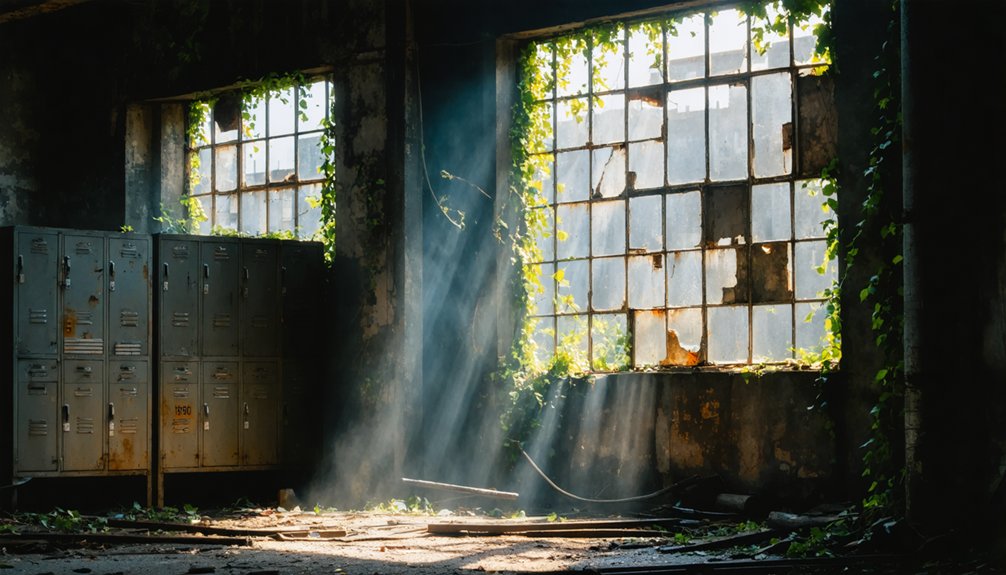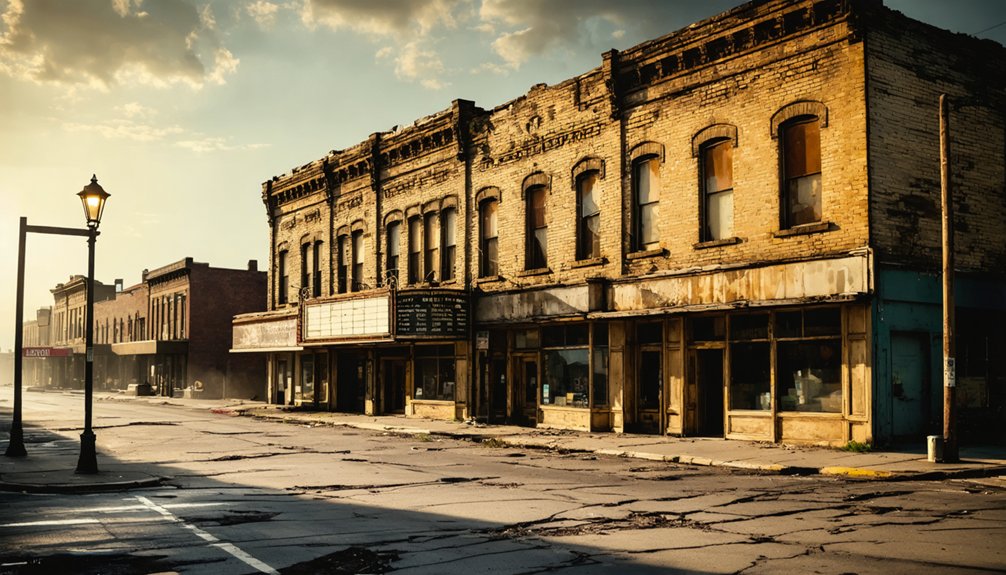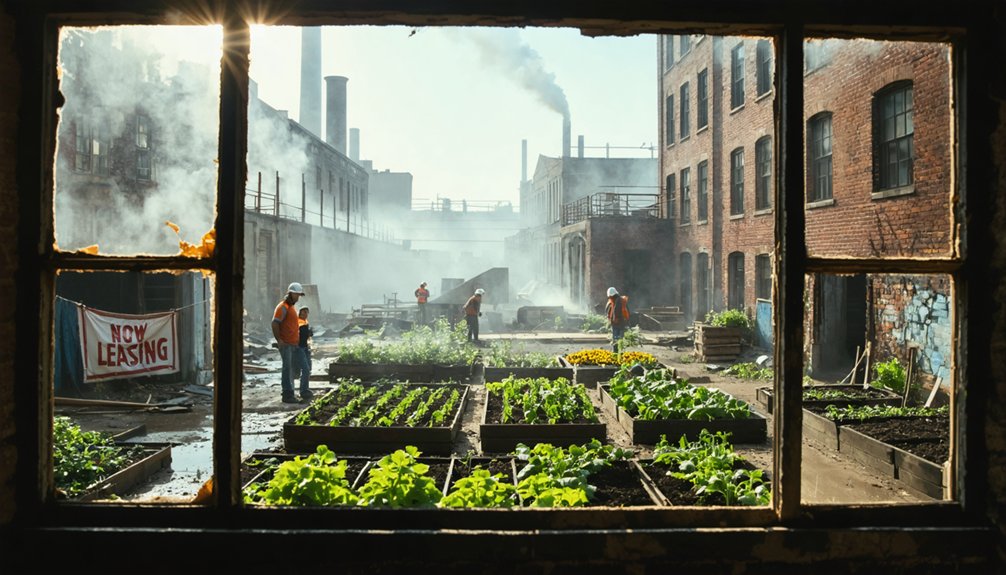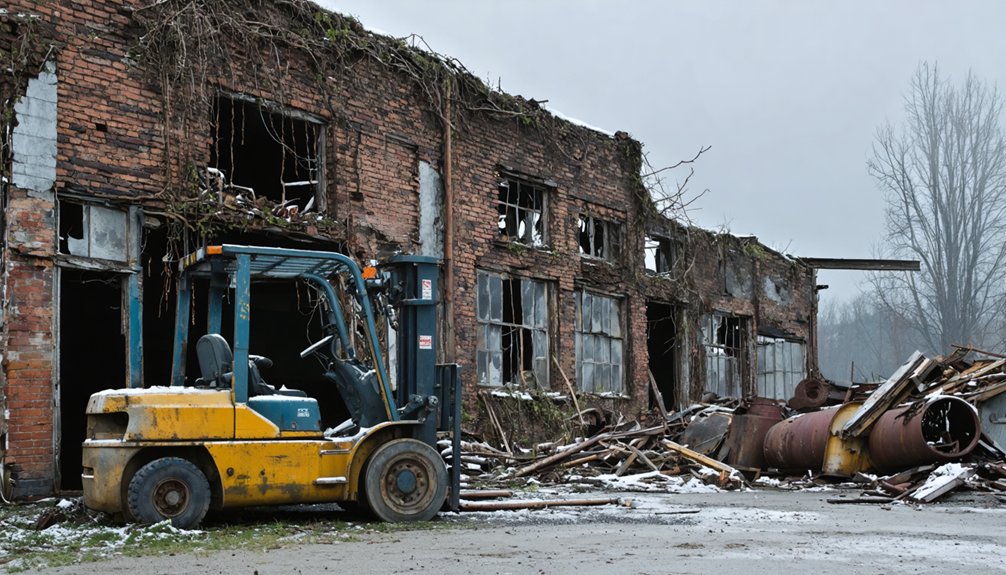
Rust Belt ghost towns preserve essential chapters of America’s industrial heritage through their decay. You’ll find architectural treasures amid these ruins—sawtooth roofs and overengineered steel structures that embody significant embodied carbon value. Beyond their historical significance, these abandoned spaces offer opportunities for economic revitalization through heritage tourism and museum conversions. Community-led documentation efforts, including digital mapping and 3D scanning, guarantee these industrial landscapes remain accessible for generations. The transformation of decay into cultural assets reveals surprising economic potential.
Key Takeaways
- Adaptive reuse of abandoned industrial buildings balances historical preservation with economic revitalization through museums and cultural tourism.
- Digital documentation through 3D scanning, drone photography, and GIS mapping preserves architectural heritage before structures deteriorate beyond repair.
- Community-led preservation initiatives engage local residents in documenting oral histories and cultural significance of post-industrial landscapes.
- Industrial buildings possess inherent sustainability features, with restoration saving 500-700 kg of embodied CO2 per square meter.
- Experiential events and heritage tourism transform deteriorating structures into economic assets while maintaining authentic historical narratives.
The Rise and Fall of Rust Belt Manufacturing Centers

While the American industrial landscape was still being defined in the late 19th century, the Rust Belt emerged as the nation’s manufacturing powerhouse, strategically positioned along the Great Lakes waterways with extensive transportation networks.
You’d have witnessed visionary industrialists like Carnegie and Ford transform the region through steel mills and assembly lines.
Cities specialized—Akron became the rubber capital with Goodyear and Firestone dominating production.
The abundance of natural resources including coal and iron ore fueled unprecedented industrial growth throughout the Great Lakes region.
The industrial heartland reached its peak when manufacturing represented the highest percentage of U.S. GDP in 1953 before declining.
This industrial nostalgia often obscures the harsh economic shifts that followed.
Architectural Treasures Amid Industrial Ruins
Despite the economic devastation that swept through America’s industrial heartland, the decaying structures left behind offer far more than nostalgic reminders of a bygone era.
These buildings embody remarkable engineering achievements and architectural treasures waiting for rediscovery through thoughtful restoration.
You’ll find these industrial structures possess inherent sustainability features that modern buildings struggle to replicate:
- Hand-laid brick with lime mortar designed to last centuries
- Overengineered steel members providing substantial structural capacity
- Sawtooth roofs engineered for perfect north light without glare
- Natural ventilation systems moving thousands of cubic feet of air without mechanical assistance
When you engage with industrial aesthetics, you’re connecting with sophisticated design principles that prioritized worker productivity and resource efficiency. Preserving these structures can save 500-700 kg of embodied CO2 per square meter compared to demolition and new construction.
Architectural restoration of these spaces preserves not just buildings, but the material memory and cultural identity that defines these once-thriving communities.
In places like Brownsville, buildings with significant architectural heritage have diminished due to neglect and abandonment, making preservation efforts even more critical for remaining structures.
Mapping the Forgotten: Documentation Efforts Across the Region
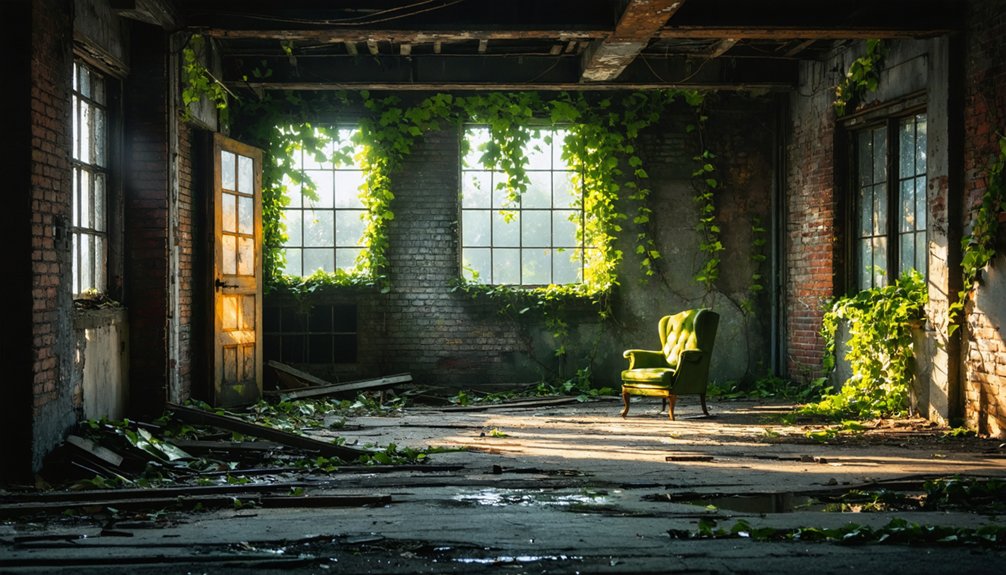
You’ll discover the Rust Belt’s systematic memory preservation through projects like Keweenaw National Historical Park’s participatory GIS mapping, where community members collaborate with researchers to document vanishing industrial landscapes.
Universities employ sophisticated digital archival methods, including drone photography and CityEngine modeling, to create thorough 3D temporal records of neighborhoods that have lost over 50% of their housing stock.
These preservation efforts extend beyond mere visual documentation into practical applications, integrating historical data with environmental hazard tracking to inform urban planning decisions while confronting challenges of limited funding and site accessibility. Similar to Brewer’s work, researchers use ArcGIS Pro to map abandoned settlements and create archaeological sensitivity areas for historical resources. Documentation techniques often include detailed interactive maps of historical sites, similar to those used in Nevada’s ghost town preservation projects.
Digital Archival Preservation Methods
As urban decay accelerates across former industrial centers, extensive digital documentation has emerged as a critical component of preservation efforts in the Rust Belt region.
Through digital preservation techniques, you’re witnessing the transformation of crumbling structures into permanent archival records that transcend physical deterioration.
Advanced technologies now form the backbone of these archival strategies:
- Terrestrial laser scanning and drone photogrammetry create high-resolution 3D models capturing architectural details and structural conditions
- GIS platforms integrate historical maps and field surveys to visualize abandonment patterns across time
- Digital twins and VR environments enable immersive exploration of inaccessible spaces
- OAIS Reference Model and PREMIS metadata standards guarantee long-term accessibility and authenticity
These methods don’t merely document—they democratize access to vanishing industrial heritage while establishing baselines for potential restoration efforts. The non-destructive characteristics of these digital preservation approaches are particularly valuable for monitoring fragile structures that may not withstand physical examination. Some abandoned structures like former factories and warehouses are finding new purpose as they’re converted into data centers that house modern digital infrastructure.
Community-Led Mapping Initiatives
While institutional digital archiving employs sophisticated technologies, a parallel grassroots movement has taken root across the Rust Belt. Community-led mapping initiatives begin with direct door-to-door engagement, establishing trust before documentation even starts.
You’ll find residents collaborating with nonprofits and universities to create detailed visualizations of abandonment patterns that inform preservation decisions.
These participatory mapping efforts thrive on consensus-building, especially in neighborhoods experiencing high vacancy rates. In 49 Rust Belt cities, where over 269 census tracts have lost more than half their housing stock, community engagement proves vital for accurate documentation. Emerging form-based codes help these initiatives prioritize the relationship between urban design and public spaces within shrinking neighborhoods.
Networks connecting cities like Pittsburgh, Cleveland, and Youngstown facilitate strategy-sharing while community land trusts guarantee local control over mapped areas. Organizations like PUSH Buffalo demonstrate the effectiveness of door-to-door outreach in gathering resident input on community needs and development priorities.
Through workshops and collaborative research, these initiatives empower residents to shape the narrative of their changing landscapes.
Technological Memory Safeguarding
Beneath the physical decay of abandoned factories and neighborhoods lies a different kind of erosion—the loss of collective memory.
You’re witnessing a revolution in digital memory preservation as technologies capture these fading landscapes before they vanish entirely.
Advanced documentation tools now safeguard urban storytelling through:
- High-resolution LiDAR and drone imagery creating detailed 3D models of deteriorating structures
- GIS platforms overlaying historical maps with current decay patterns, revealing spatial narratives
- Cloud-based repositories storing thousands of photographs transformed into navigable digital reconstructions
- Blockchain-authenticated archives ensuring the permanence of community memories
These digital preservation efforts transcend mere documentation—they’re creating interactive memory maps where collective experiences intersect with physical spaces.
Through metadata tagging and geolocated social media content, the emotional geography of these forgotten places remains accessible even as buildings crumble.
Economic Revitalization Through Heritage Tourism

You’ll find former manufacturing facilities across the Rust Belt transformed into interactive museums where visitors can witness firsthand the region’s industrial heritage while generating new revenue streams for struggling communities.
Mining towns like Jerome, AZ offer experiential events where tourists participate in simulated historical activities, creating employment opportunities while preserving authentic cultural narratives.
These adaptive reuse strategies balance historical preservation with economic necessity, following models that have successfully revitalized cities like Pittsburgh and Cleveland where cultural tourism now forms a cornerstone of post-industrial identity.
Museum Conversions
As abandoned structures fall into disrepair across America’s changing landscapes, innovative museum conversions have emerged as powerful catalysts for economic revitalization through heritage tourism.
You’ll witness the museum significance firsthand at Eastern State Penitentiary, where dark corridors and eerie cells immerse visitors in authentic history, or at Franklin County Historical Society, where a former jail now houses compelling exhibitions.
Visitor engagement strategies that drive these successful conversions include:
- Guided tours through historical dungeons featuring original regional artifacts
- Hands-on discovery opportunities with industrial machinery
- Heritage interpreter programs creating dynamic experiences
- Paranormal tourism leveraging rumored hauntings and ghost stories
These transformations aren’t merely preservation efforts—they’re economic engines.
From Pennsylvania’s prison architecture to Barkerville’s living museum model, these sites convert dereliction into distinctive cultural assets that attract tourism revenue while preserving authentic historical narratives.
Experiential Mining Events
Experiential mining events have transformed rust belt ghost towns from crumbling industrial relics into vibrant heritage tourism destinations that engage visitors in authentic underground adventures.
You’ll witness heritage preservation in action as these interactive experiences increase local visitor numbers by up to 30% while extending stays and boosting economic impact by 40% compared to conventional tours.
Beyond admission fees and equipment rentals, these events create platforms for sharing oral histories and strengthen community identity through experiential education.
The active use of mining sites maintains structural integrity while fostering local entrepreneurship through mining-related crafts and services.
You’ll appreciate how these immersive experiences tell complete stories of mining life that static displays can’t capture, while simultaneously creating jobs for skilled heritage conservation tradespeople and volunteerism opportunities that revitalize declining post-industrial communities.
Community-Led Preservation Initiatives
While traditional preservation efforts often focus on architectural landmarks with obvious historical value, community-led initiatives across the Rust Belt have redefined what’s worth saving by emphasizing the cultural significance of everyday structures and spaces.
Through community engagement and local partnerships, residents are actively shaping how their industrial heritage is preserved.
- Public participatory mapping projects document cultural identity in post-industrial regions
- Arts communities serve as catalysts by maintaining facades of former businesses
- Collaborative stakeholder efforts include local businesses, government, and educational institutions
- Heritage professionals partner with residents to develop conservation-focused strategies
You’ll find these grassroots approaches creating more authentic preservation outcomes than top-down planning models.
Challenges of Urban Decay: Safety and Infrastructure Concerns
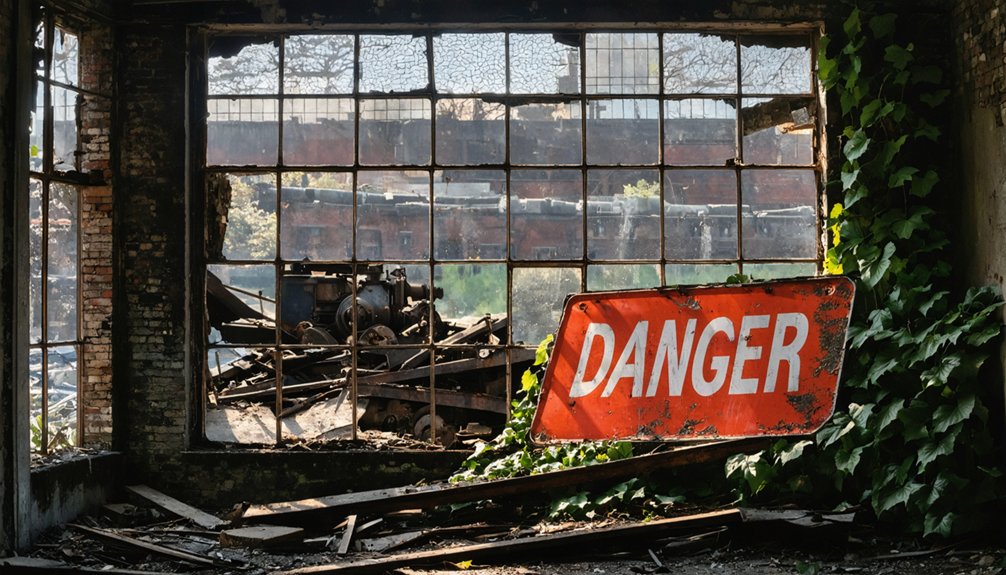
The preservation of decaying urban spaces creates a complex tension between cultural value and public safety concerns.
You’ll encounter numerous safety hazards in these environments—collapsing structures, hazardous materials like asbestos and lead, and areas that attract criminal activity due to limited surveillance.
Infrastructure neglect compounds these challenges. Water, sewage, and electrical systems designed for larger populations deteriorate without adequate maintenance, while shrinking tax bases limit funds for essential repairs.
You’re witnessing the consequences of severe population decline (often 40-50%), which fragments service coverage and weakens community cohesion.
The economic reality is stark: high unemployment rates and property abandonment create a cycle that overwhelms municipal resources.
While these spaces hold cultural significance, they simultaneously present legitimate dangers that preservation efforts must address responsibly.
Case Studies: Successful Ghost Town Transformations
Despite the formidable challenges of urban decay, numerous former industrial centers have engineered remarkable comebacks through strategic revitalization efforts.
You’ll find ghost town revitalization often succeeds through community engagement rather than top-down approaches. Cities like Pittsburgh have transformed from steel-dominated economies to thriving tech hubs, while Detroit has rebuilt through strategic demolition and construction projects.
revitalizing communities in rural Alabama is another example of how grassroots efforts can drive meaningful change. By fostering local leadership and investing in sustainable practices, these areas can create a new sense of identity and purpose for residents. As neighboring regions watch closely, the successes in Alabama may serve as a model for rural revitalization across the nation.
The most successful transformations include:
- Bottom-up investments prioritizing residents as leaders, not just recipients of aid
- Economic diversification creating multiple revenue streams beyond traditional manufacturing
- Affordable housing initiatives that leverage vacant properties and attract younger demographics
- Infrastructure renewal focused on accessible public spaces and transportation improvements
These community-led initiatives demonstrate that rust belt revival doesn’t require abandoning a city’s industrial heritage, but rather reimagining it for contemporary needs.
Frequently Asked Questions
Who Legally Owns Abandoned Buildings in Rust Belt Ghost Towns?
You’ll find property rights held by municipalities after tax foreclosure, though ownership disputes arise from unclear titles spanning generations, abandoned by original owners when taxes exceeded property value.
How Do Preservationists Balance Authenticity With Necessary Structural Repairs?
You’ll balance authenticity and structural needs by employing minimally invasive restoration techniques, documenting original features, engaging community involvement for cultural context, and integrating modern solutions discreetly while preserving visible historic elements.
What Environmental Contaminants Persist in Former Industrial Sites?
Just as toxins cling to these abandoned places, you’ll find persistent contaminant types including heavy metals, PFAS “forever chemicals,” PCBs, and hydrocarbon compounds—all requiring extensive site remediation before safe redevelopment becomes possible.
Can Individuals Purchase Entire Ghost Towns for Personal Restoration?
Yes, you can acquire complete ghost towns for personal restoration, but ghost town ownership is rare and fragmented, requiring substantial capital, maneuvering complex regulations, and addressing multiple property titles simultaneously.
How Do Preservation Efforts Address Racial Segregation History?
Like unearthing buried foundations, you’ll find most preservation efforts inadequately address segregation history. They’re often selective, prioritizing white narratives while underfunding projects that would center racial equity in the complete historical narrative.
References
- https://www.geotab.com/ghost-towns/
- https://whakestudios.com/us-ghost-towns/
- https://www.loveexploring.com/gallerylist/127789/then-and-now-us-rust-belt-cities-that-bounced-back
- https://en.wikipedia.org/wiki/Lists_of_ghost_towns_in_the_United_States
- https://247wallst.com/special-report/2017/11/15/30-american-ghost-towns/
- https://www.atlasobscura.com/lists/americas-best-preserved-ghost-towns
- https://www.youtube.com/watch?v=pUZtHpf-rEo
- https://www.industryweek.com/talent/article/22028380/the-abandonment-of-small-cities-in-the-rust-belt
- https://en.wikipedia.org/wiki/Rust_Belt
- https://www.youtube.com/watch?v=_Cvw5gENzQ8