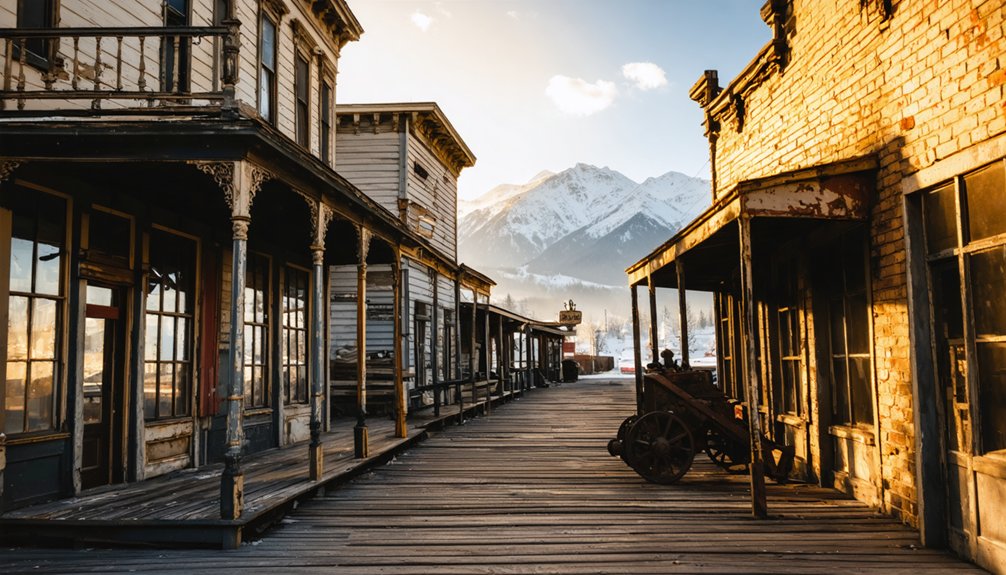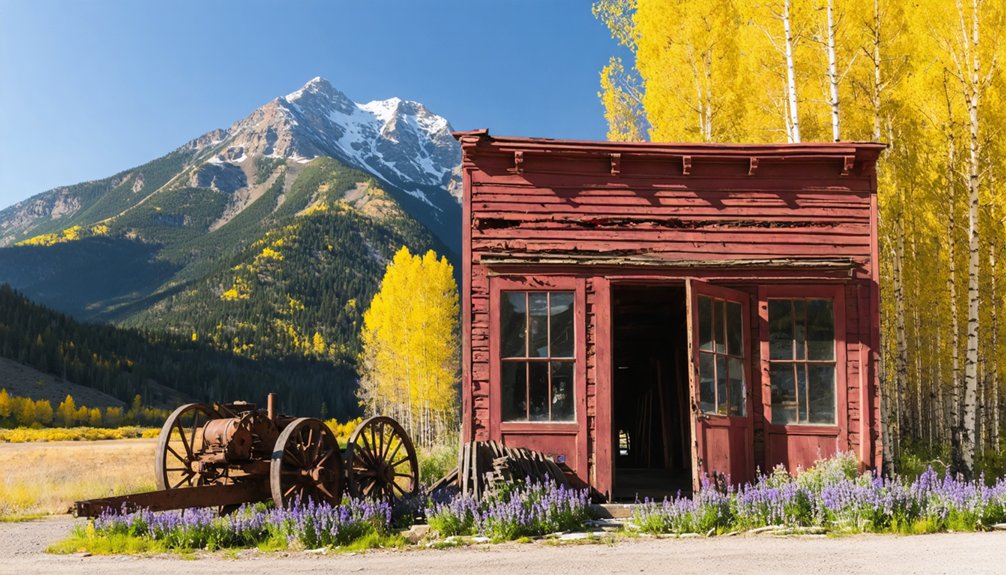
US ghost towns preserve Victorian mining heritage through careful restoration of period architecture and artifacts. You’ll find ornate wooden buildings, like those in Bodie, California, where nearly 100 structures from the 1880s gold rush remain in “arrested decay.” Preservation efforts balance authentic historical features with modern safety requirements, often using state grants and private investment. Communities like Jerome and Garnet showcase how tourism can revitalize these cultural treasures while maintaining their historical integrity.
Key Takeaways
- Victorian mining ghost towns preserve architectural treasures through careful restoration of original structures and mining equipment.
- Preservation societies balance authentic restoration with economic development to create sustainable tourist attractions.
- Adaptive reuse transforms historic buildings into galleries or museums while maintaining their historical integrity.
- Successful preservation requires documentation, stabilization techniques, and environmental remediation of mining contaminants.
- Community involvement and funding through grants, private investment, and tourism revenue are essential for sustainable preservation efforts.
The Rise and Decline of America’s Victorian Mining Boomtowns
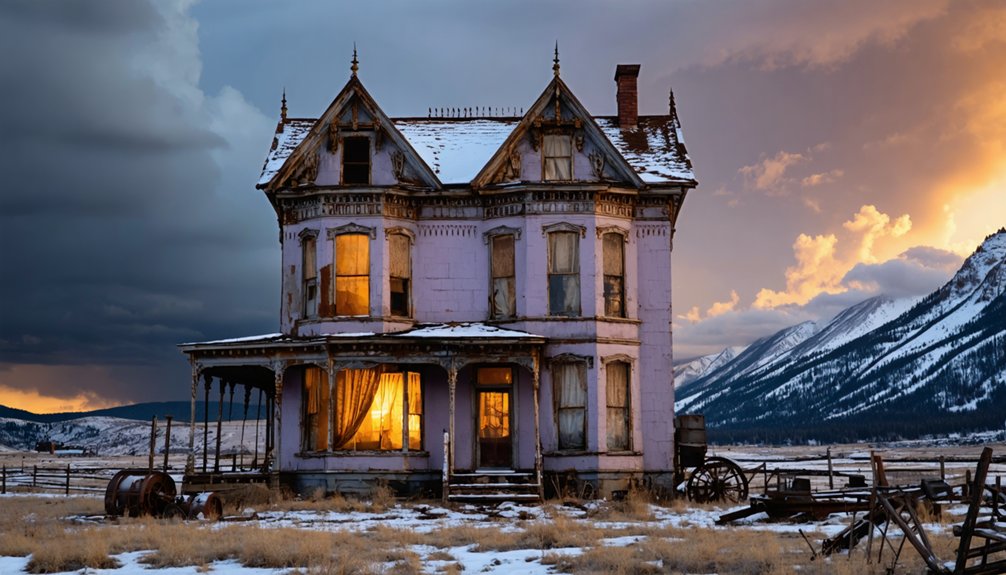
When James Marshall spotted those first glimmering flakes of gold at Sutter’s Mill in January 1848, he unknowingly triggered a transformation that would reshape America’s economic and social landscape. Within months, thousands rushed westward, establishing instant communities wherever precious metals surfaced.
You can trace this pattern across the West—from Colorado’s Pike’s Peak to Nevada’s Comstock Lode to the Black Hills of South Dakota.
These boomtowns reflected distinctive mining community dynamics: extreme gender imbalances with male-to-female ratios reaching 9-to-1, diverse ethnic populations until the 1882 Chinese Exclusion Act, and volatile social structures dominated by prospectors, engineers, and speculators.
Boomtown culture thrived on competition and tension between individual fortune-seekers and corporate interests that eventually monopolized deep-shaft operations. Environmental concerns were largely ignored as mining operations released poisonous gases and contaminated water sources with mercury. The financial panics of 1893 and 1907 severely impacted these mining communities, forcing many operations to close and accelerating their decline.
As surface deposits depleted and eastern capitalists gained control, many once-thriving settlements began their inevitable decline toward ghost town status.
Architectural Treasures: Victorian-Era Buildings in Western Ghost Towns
Ornate facades and elaborate woodwork stand as silent witnesses to America’s once-booming Victorian mining era, preserved in ghost towns scattered across the Western frontier.
Among these ghost towns of the Pacific Northwest, relics of ambition and dreams lie abandoned, telling stories of those who once sought fortune in the rugged wilderness. With crumbling buildings and overgrown streets, they evoke a sense of nostalgia while inviting adventurous spirits to explore their hidden histories. Each site offers a glimpse into the past, reminding us of the transient nature of prosperity and the enduring power of the landscape.
These architectural ghosts whisper stories of prosperity, ambition, and the fleeting nature of frontier fortune.
You’ll discover architectural treasures ranging from the three-story Mackay Mansion in Virginia City to humble utilitarian structures that adapted Victorian design principles to frontier necessities.
Garnet, Montana offers one of the most complete Victorian ghost town experiences, with about 30 original buildings still standing.
Meanwhile, South Pass City, Wyoming presents nearly two dozen restored Victorian structures.
When exploring these remnants, you’ll notice the predominant wooden frame construction, occasionally punctuated by more substantial brick and stone buildings that wealthy mine owners and civic leaders erected as symbols of permanence and prosperity.
The Douglas Mansion in Jerome, Arizona showcases the architectural grandeur with its vintage photo exhibits and detailed 3D models of the town’s underground mining tunnels.
Bodie, California preserves nearly 100 collapsing buildings that provide an authentic glimpse into the architectural style of a booming 1880s gold-mining town.
These architectural relics—from saloons to churches—tell the authentic story of America’s Victorian mining communities.
From Abandonment to Tourism: The Economic Revival of Historic Mining Sites

Once abandoned to decay and vandalism, Victorian mining towns across the American West have undergone remarkable economic transformations in recent decades.
You’ll find towns like Jerome, Arizona and Bodie, California—once doomed to oblivion—now thriving as cultural destinations that generate millions in tourism impact annually.
These revitalized towns offer you authentic glimpses into America’s industrial past while creating modern economic sustainability through hospitality jobs, art galleries, and heritage festivals.
Local preservation societies have masterfully balanced restoration with development, turning crumbling Victorian architecture into marketable attractions.
The transformation isn’t without challenges—infrastructure strain, commercialization risks, and seasonal fluctuations threaten long-term stability.
Yet communities like Chimney Rock and Colquitt demonstrate how thoughtful management of historical assets can breathe new life into these architectural time capsules without sacrificing their freedom-loving frontier spirit. These revival efforts embrace the concept of arrested decay as demonstrated in Bodie State Historical Park, preserving the authentic character while making sites accessible to visitors.
Nevada stands out with its over six hundred ghost towns, the highest number of any state in the country, offering abundant opportunities for heritage tourism and historical preservation.
Preservation Techniques and Challenges in Protecting Mining Heritage
While preservation efforts have made Victorian mining towns attractive tourist destinations, the technical challenges of maintaining these historic treasures require sophisticated approaches beyond mere cosmetic restoration.
You’ll find that proper documentation techniques form the foundation of successful preservation, with extensive photographic records and digital catalogs establishing baseline conditions for monitoring deterioration over time.
The complexity intensifies when balancing environmental remediation with historical authenticity. Abandoned mineshafts require stabilization without compromising their archaeological significance, while ornate Victorian architectural elements demand specialized expertise to maintain their character. The implementation of modern restoration techniques has revolutionized how these delicate historical structures are preserved for future generations.
Most successful projects incorporate community involvement throughout the process, ensuring that preservation priorities reflect local values while addressing safety concerns. Dutch Flat exemplifies this approach with over 50 historic buildings preserved despite the economic decline following the hydraulic mining ban of 1873. This multi-component approach safeguards both the physical structures and the cultural narratives embedded within these remarkable industrial landscapes.
Case Studies: Success Stories in Ghost Town Restoration
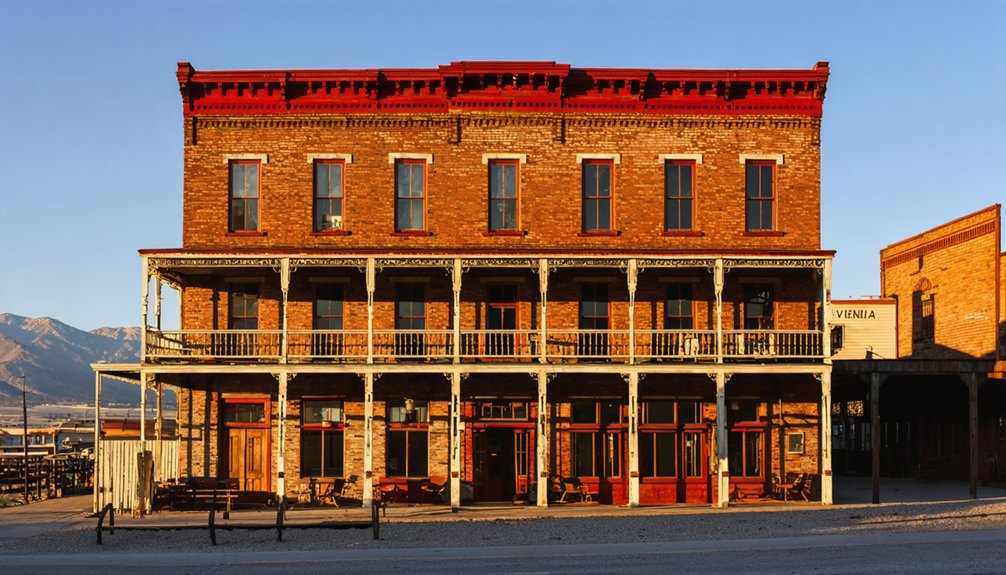
Examining several notable successes across the American West reveals how targeted restoration efforts have breathed new life into formerly abandoned Victorian mining towns.
In Animas Forks, Colorado, community engagement secured $330,000 in grants, enabling structural repairs that preserved architectural integrity while earning a National Preservation Honor Award. The site features nine preserved structures in an alpine meadow that showcase the region’s mining heritage.
Cerro Gordo, California demonstrates how private investment ($1.4 million) combined with volunteer labor can authentically rebuild historic structures like The American Hotel, incorporating period materials alongside modern safety features. The original town once contained 400 wooden buildings before fires and decay reduced it to just 20 remaining structures.
Montana’s Garnet stands out for maintaining its original wooden structures and mining equipment, while Terlingua, Texas exemplifies adaptive reuse by transforming mining buildings into artist spaces and galleries.
These diverse approaches to restoration funding—from state grants to tourism revenue—prove that preservation can simultaneously honor mining heritage while supporting local economies through carefully managed tourism opportunities.
Frequently Asked Questions
How Did Cultural Diversity Influence Mining Town Development and Architecture?
You’ll notice cultural influences shaped mining towns through ethnically-distinct neighborhoods, while architectural styles reflected the hierarchical society—from ornate Victorian homes for managers to modest dwellings for immigrant miners from diverse backgrounds.
What Roles Did Women Play in Victorian Mining Communities?
While often unrecognized, nearly 30% of mining town businesses were women-owned. You’ll find women’s roles extended beyond domesticity into entrepreneurship, education, healthcare, and community support, creating stability in volatile frontier settlements.
How Did Mining Towns Handle Waste and Environmental Impacts?
You’d find virtually no environmental regulations in mining towns. Waste management consisted of dumping refuse in ravines, burning trash, and discharging mine tailings directly into waterways with minimal concern for long-term impacts.
What Indigenous Histories Existed Before Mining Towns Were Established?
You’ll find rich indigenous cultures thrived before mining towns, with tribes stewarding these lands for millennia. Their historical significance includes spiritual practices, resource management systems, and territorial claims European settlers largely ignored.
How Accurate Are Ghost Town Portrayals in Films and Television?
Like Paramount Ranch’s removable church steeple, film accuracy in ghost town portrayals is often superficial. You’ll find they prioritize dramatic storytelling over ghost town authenticity, mixing time periods for visual impact rather than historical truth.
References
- https://hobblecreek.us/blog/entry/mining-towns-of-the-old-west
- https://visitvirginiacitynv.com/history/
- https://westernmininghistory.com/map/
- https://www.identecsolutions.com/news/mining-in-us-70-centuries-of-history
- https://allthatsinteresting.com/wild-west-mining-towns
- https://en.wikipedia.org/wiki/History_of_coal_mining_in_the_United_States
- https://www.detroitnews.com/story/travel/2025/08/04/treasured-us-mining-towns-you-can-still-visit-today/85445087007/
- https://socialwelfare.library.vcu.edu/organizations/labor/company-towns-1890s-to-1935/
- https://special.library.unlv.edu/boomtown/mining/
- https://www.ushistory.org/us/41a.asp