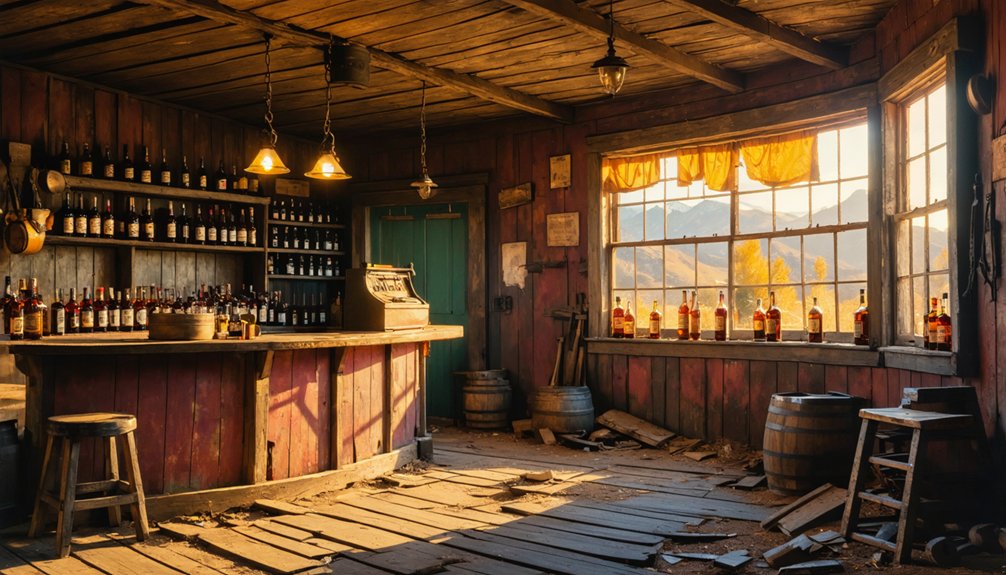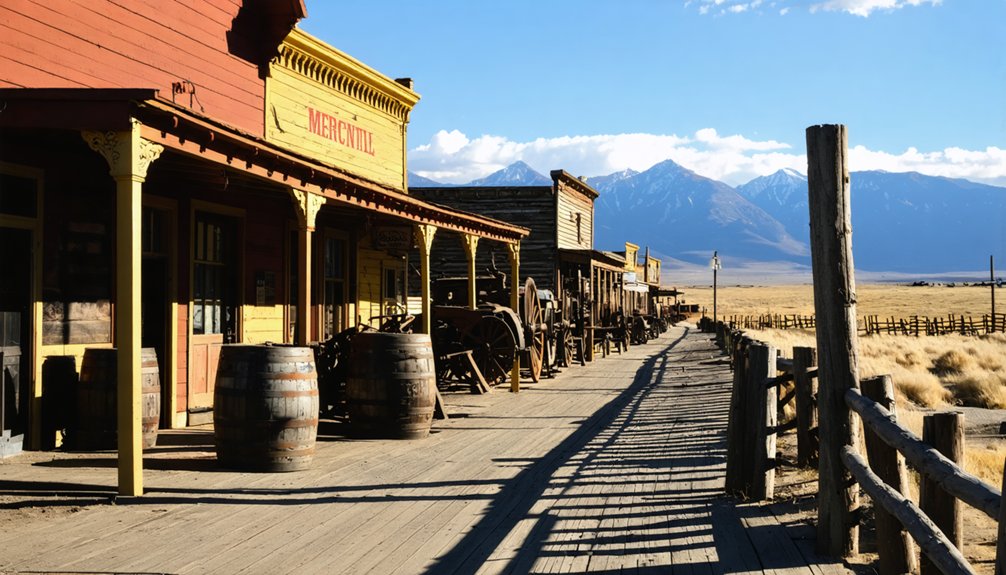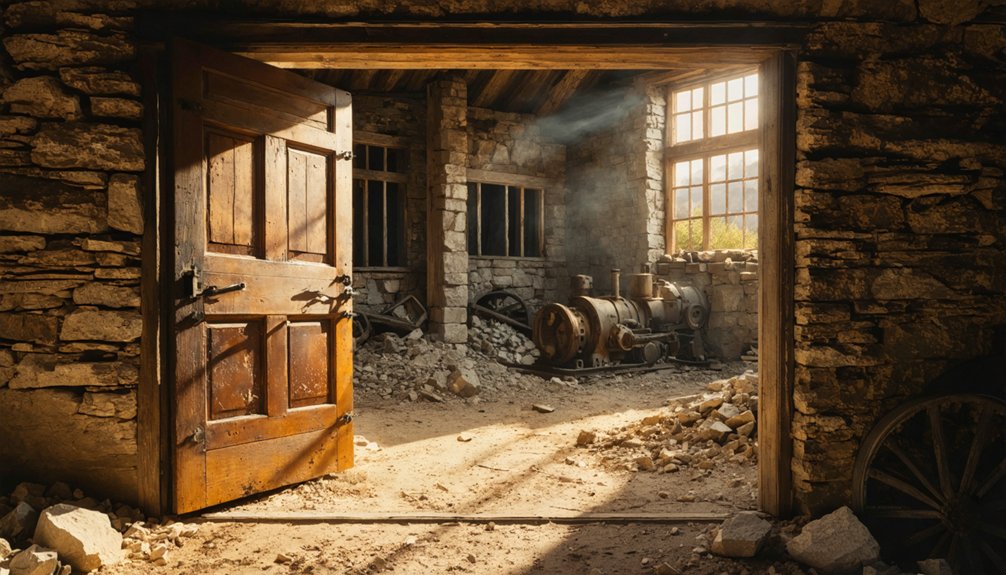
Quartzburg began as a temperance-focused settlement established by the Burns brothers in 1847 before gold discovery transformed it into a mining boomtown. You’ll find its history defined by strict moral codes, the economically essential Big Blue mine ($1.8 million in gold), and its rivalry with neighboring Kernville. After economic decline and a devastating 1931 fire, both communities now rest beneath Lake Isabella’s waters, with only the cemetery remaining as tangible evidence of this fascinating Gold Rush community.
Key Takeaways
- Quartzburg was a Gold Rush mining town established in 1847 that flourished after the discovery of gold on Burns’ property in 1849.
- The Big Blue mine became Quartzburg’s economic cornerstone, yielding $1.8 million in gold during its operation.
- Unlike neighboring Kernville, Quartzburg enforced a strict moral code including a complete ban on alcohol.
- Economic decline began in the mid-1800s, worsened by the 1883 Big Blue mine fire, with final abandonment following a 1931 blaze.
- Both Quartzburg and Kernville were submerged under Lake Isabella after dam construction, with only the cemetery remaining visible.
The Birth of a Mining Boomtown (1847-1851)
Three pivotal events shaped Quartzburg’s emergence as a mining settlement during California’s Gold Rush era. First, John and Robert Burns established a ranch in 1847, laying the foundation for future development.
Second, the 1849 gold discovery on their property transformed the quiet ranching outpost into a bustling mining camp.
Third, the change from placer mining to quartz mining in September 1850 cemented the settlement’s economic future. The focus on quartz deposits proved crucial to the region’s mineral wealth, mirroring developments that would later occur in Idaho.
As word spread about the rich quartz deposits near Quartzburg, a diverse population flocked to the area.
By 1851, infrastructure rapidly developed with stamp mills processing ore from regional ledges.
The establishment of a post office that same year marked Quartzburg’s evolution from informal camp to organized community, though it remained smaller than other Gold Rush boomtowns.
Similar to Trinidad’s prosperity during the Gold Bluff excitement, Quartzburg experienced economic growth as quicksilver mining techniques were implemented to separate fine gold from sand.
Gold Rush Prosperity and the Big Blue Mine
The Big Blue mine emerged as Quartzburg’s economic cornerstone, generating an impressive $1.8 million in gold during its early operational years and ultimately contributing notably to the Cove district’s estimated $8 million total yield.
You’d find approximately 200 workers employed at Quartzburg during peak mining periods, transforming the settlement into a thriving industrial hub between 1936 and 1943, despite intermittent operation following the devastating 1883 fire.
The mine’s prosperity directly stemmed from technological advancements, including an 80-stamp mill for ore processing and sophisticated Cornish pumps that enabled deeper shaft excavation to access valuable quartz veins. The area’s name change from Rogersville to Quartzburg reflected the abundance of quartz in the area that made mining operations so profitable. Similar to the Blue Gravel Mine in Redding, the mine faced numerous ownership disputes during its active years, creating legal complications that affected production schedules.
Mining Wealth Explosion
A remarkable economic transformation began in Quartzburg during the 1860s when the discovery of the Big Blue vein catalyzed unprecedented prosperity in this remote California settlement.
You would’ve witnessed advanced mining techniques revolutionizing the landscape as an 80-stamp mill processed ore while Cornish pumps battled groundwater in the 3,000-foot workings.
The economic impact was staggering—approximately $1.75 million in gold extracted from Big Blue alone, with the Cove district eventually yielding up to $8 million.
This wealth supported nearly 200 workers and sparked a dual-town economy as alcohol-free Quartzburg competed with saloon-friendly Kernville. The success mirrored earlier operations like the St. John mine in Sageland district which had produced about $700,000 in gold over its lifespan.
The Big Blue mine’s development was enabled by the area’s distinctive geology featuring metasediments and phyllites that contained the valuable gold-bearing quartz veins.
The prosperity continued uninterrupted until 1883 when underground fires destroyed essential infrastructure, marking the beginning of the end for this gold-fueled boomtown.
Mechanization Drives Production
Technological advancement stood at the heart of Quartzburg’s meteoric rise, with mechanization transforming the Big Blue Mine from a modest claim into a powerhouse of industrial production.
You’d have witnessed remarkable mechanization advancements: an 80-stamp mill processing gold-bearing quartz continuously, Cornish pumps dewatering the Sumner Shaft, and ore cart tracks facilitating efficient material transport underground.
These production efficiency improvements enabled extraction from deeper, more complex veins, supporting year-round operations despite challenging conditions.
The 1934 mill erection marked a pivotal modernization that sustained operations until 1943. Though fire destroyed equipment in 1883 and significant capital was required for maintenance, the mechanized systems ultimately contributed to $8 million in gold production from the Cove district, with Big Blue Mine alone generating $1,746,910 by 1933. For those researching similar ghost towns, it’s important to note that disambiguation pages help distinguish this Quartzburg from others with the same name.
Moral Order in a Lawless Era
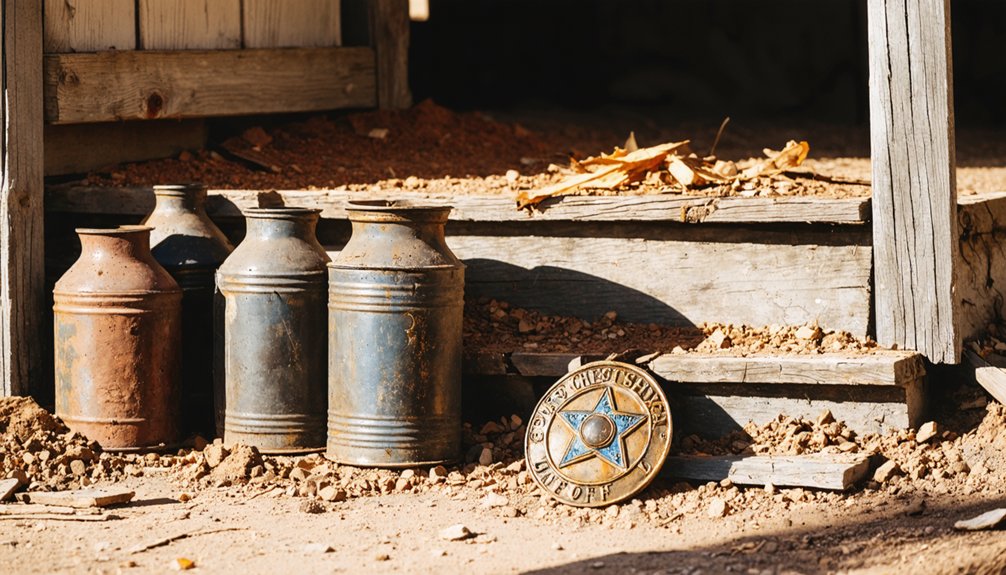
You’ll find that Quartzburg distinguished itself from other Gold Rush settlements through its strict moral code, particularly establishing a complete ban on alcohol to maintain social order.
This temperance stance forced saloon keeper Adam Hamilton to relocate his business a mile south, inadvertently creating the rival settlement of Kernville where saloons operated freely.
Quartzburg’s commitment to moral living extended to the systematic expulsion of undesirables—bandits, roughnecks, and gamblers—who subsequently established themselves in nearby Hornitos, creating a geographic separation between order and lawlessness. The town was established after quartz discoveries in 1850 and quickly developed its own social structure under Colonel Thomas Thorn’s influence. The Idaho ghost town was originally settled in 1867 with the development of the Gold Hill mine that would become a significant producer of precious metals.
Exploring Randsburg’s mining history reveals the rich tapestry of human endeavor and struggle that shaped the region. As prospectors flocked to the area in search of fortune, they forged a community driven by ambition and resilience, much like Quartzburg. The remnants of old mines and ghost towns stand testament to this vibrant past, inviting visitors to discover the stories embedded in the arid landscape.
Temperance Town Values
While gold rush settlements typically embraced saloons and gambling houses, Quartzburg distinguished itself through its embrace of temperance principles that swept through American communities in the late 19th century.
You would have found a community deeply influenced by the Woman’s Christian Temperance Union movement that introduced political activism across America in the 1870s.
Like San Bernardino and Riverside, Quartzburg established governance structures prohibiting alcohol sales within town limits. Property deeds likely contained clauses similar to those in Lompoc, explicitly forbidding liquor manufacture or sales.
This commitment to temperance principles wasn’t merely moral posturing—it represented practical community values aimed at reducing crime and creating orderly development.
Quartzburg’s founders, like their counterparts in Mound Bayou and Riverside, understood that sobriety promoted both safety and economic prosperity in an otherwise chaotic frontier environment.
Women in Quartzburg may have participated in the dramatic Woman’s Crusade tactics of marching into saloons while singing hymns to protest alcohol consumption.
Banishment of Troublemakers
Quartzburg’s commitment to temperance principles directly shaped its approach to maintaining social order through a distinctive system of community-enforced exile. In the absence of formal law enforcement, you’d have witnessed residents collectively identifying and physically removing those deemed disruptive to community values.
This social exclusion mechanism primarily targeted individuals associated with alcohol consumption, gambling, violence, or suspected banditry—particularly those with connections to Joaquin Murrieta’s outlaw network.
Community enforcement occurred through informal tribunals rather than legal proceedings, reflecting the town’s self-regulated justice system.
The consequences were twofold: internally, banishment reinforced Quartzburg’s moral identity and solidarity; externally, it created a regional pattern where exiled troublemakers often relocated to more permissive settlements like Hornitos, establishing a geographical segregation based on behavioral expectations.
The Quartzburg-Kernville Rivalry
Nestled in the rugged terrain of California’s gold country, the rivalry between Quartzburg and Kernville exemplifies how cultural values can shape the development of neighboring settlements. The cultural divide began when Adam Hamilton moved his saloon from temperance-based Quartzburg to what would become Kernville (originally Whisky Flat), establishing a fundamental ideological separation.
This division fueled intense economic competition between:
- Quartzburg’s mining-focused economy, centered around the $1.8 million-producing Big Blue mine
- Kernville’s service and hospitality industries that embraced alcohol sales
- Competing municipal services and infrastructure development
- Distinct demographic compositions shaped by differing social attitudes
- Divergent community priorities reflecting their opposing values
When the Big Blue mine burned in 1883, Quartzburg’s fortunes declined while Kernville’s diversified economy proved more resilient, demonstrating how cultural choices ultimately influenced economic sustainability.
Decline, Abandonment, and Submergence
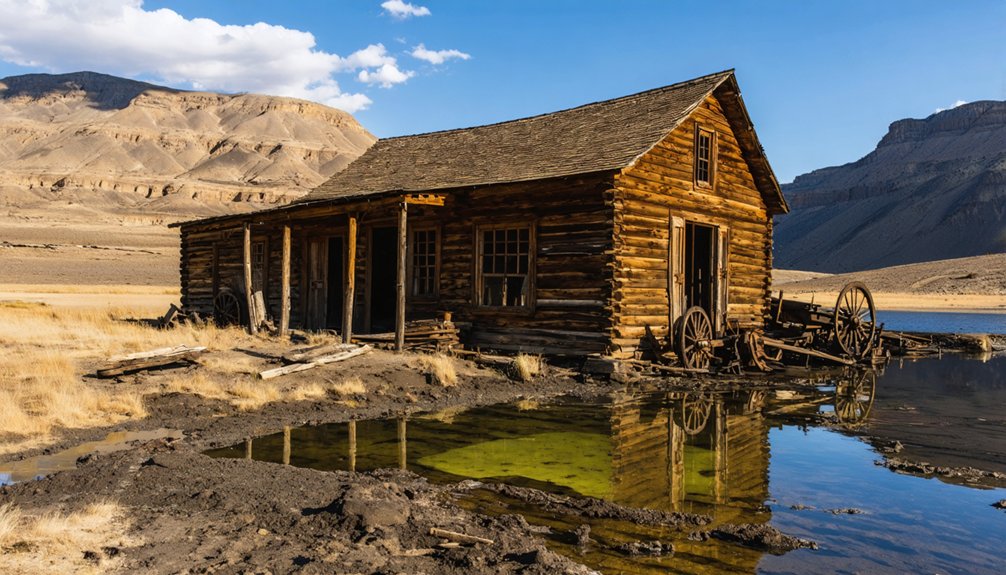
Despite its promising beginnings as a temperance-based mining settlement, Quartzburg faced a series of devastating blows that led to its eventual demise. You can trace its economic decline to the mid-1800s, with the 1883 Big Blue mine fire severely crippling production.
Mining continued at reduced capacity until around 1907 before operations ceased. Community fragmentation accelerated as residents migrated to nearby Kernville, drawn by its more relaxed alcohol policies.
Quartzburg’s fate was sealed by multiple fires, especially the 1931 blaze that destroyed most buildings. The post office closed in 1940, symbolizing formal abandonment after 78 years.
The final chapter came when both Quartzburg and old Kernville disappeared beneath Lake Isabella’s waters after dam construction. Unlike Kernville, which relocated to higher ground in 1951, Quartzburg simply vanished—a submerged monument to California’s boom-and-bust mining era.
Historical Legacy and Archaeological Remains
While the physical remnants of Quartzburg now rest beneath Lake Isabella’s waters, the historical legacy of this once-thriving gold mining settlement endures through scattered archaeological evidence and documented accounts. The town’s historical significance extends beyond its $1.8 million gold production to its role in California’s development.
- The cemetery remains the only tangible connection to Quartzburg’s past, featuring 19th-century tombstones.
- Archaeological preservation efforts focus primarily on this cemetery as the last physical evidence.
- Quartzburg’s connection to the pursuit of Joaquin Murrieta adds to its historical importance.
- The town’s strict moral code led to the founding of Kernville, shaping regional development.
- Cultural artifacts occasionally surface, providing glimpses into Gold Rush-era daily life.
You’ll find Quartzburg’s legacy preserved not in buildings but in regional folklore and historical narratives that continue to fascinate those seeking freedom in California’s storied past.
Frequently Asked Questions
What Happened to the Residents After Quartzburg’s Decline?
You’d be stunned by the massive residential migration that scattered Quartzburg’s people! After the 1883 Big Blue mine fire, they relocated to Kernville, Hornitos, or pursued new livelihoods elsewhere—the economic impact decimated their mining-dependent community.
Did Any Descendants of Original Settlers Remain in the Area?
You’ll find some settler lineage persists in nearby Hornitos, where displaced Mexican residents preserved family stories, though most original Quartzburg inhabitants dispersed after mining declined and Lake Isabella’s creation.
Were There Any Significant Women Pioneers in Quartzburg’s History?
90% of Gold Rush women’s pioneer stories remain undocumented. Historical records don’t specifically mention women’s contributions in Quartzburg, though they likely operated boardinghouses, worked as laundresses, and managed family businesses alongside men.
What Indigenous Peoples Inhabited the Area Before Settlement?
You’ll find the Karuk, Shasta, and Klamath peoples were the primary indigenous tribes inhabiting Quartzburg’s area, maintaining rich cultural heritage through village networks before settler encroachment disrupted their territories.
How Did Quartzburg’s Strict Policies Affect Racial or Ethnic Minorities?
You won’t find clear records of Quartzburg’s discrimination policies toward minorities. Historical documentation lacks specific evidence about community impact on racial groups beyond general Gold Rush-era prejudices that likely existed.
References
- https://www.ghosttowns.com/states/ca/kernville.html
- https://www.ghosttowns.com/states/ca/quartzsburg.html
- https://mercedcountytimes.com/planning-an-escape-to-hornitos-ghost-town-of-gold-rush-era/
- https://en.wikipedia.org/wiki/Quartzburg
- http://freepages.rootsweb.com/~gtusa/history/usa/ca.htm
- https://savethelandmarks.org/library/f/a-night-in-hornitos-california
- https://sierranevadageotourism.org/entries/hornitos-no-333-california-historical-landmark/68cfa6f9-8261-40dd-81b5-c4e52a2fb71e
- https://accessgenealogy.com/california/the-growth-of-quartz-mining-discoveries.htm
- http://www.sfmuseum.org/hist7/klamath.html
- https://westernmininghistory.com/1461/a-look-at-california-in-1851-two-years-into-the-gold-rush/