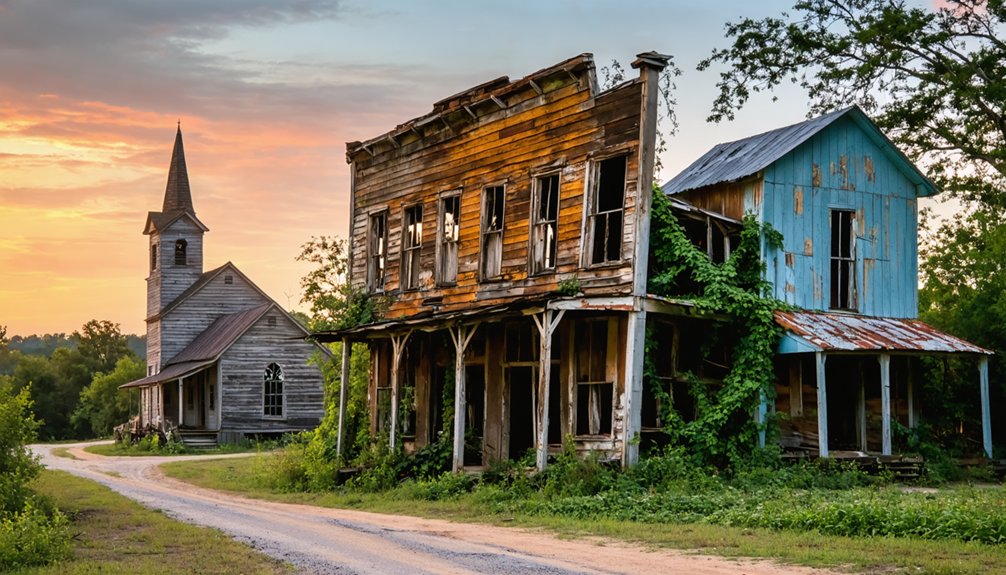
To rebuild a Southern ghost town, you’ll need to address five critical areas: verify property ownership and legal status, document historical significance, navigate complex land rights issues, secure preservation grants, and develop sustainable tourism models. Begin with thorough title searches and community engagement before pursuing funding through State Historic Preservation Offices or National Trust grants. Balance authentic restoration with modern infrastructure needs while incorporating local narratives. The extensive process transforms abandoned places into thriving heritage destinations with economic importance.
Key Takeaways
- Conduct comprehensive title searches to clarify ownership status and navigate fractured land rights typical in abandoned Southern communities.
- Assess historical significance by documenting surviving structures and connecting them to broader Southern cultural and economic patterns.
- Secure funding through state historic preservation grants, public-private partnerships, and specialized programs like the African American Cultural Heritage Fund.
- Develop restoration plans that balance authentic preservation techniques with practical infrastructure needs while honoring community narratives.
- Implement environmental remediation strategies to address hazardous materials common in former industrial Southern ghost towns before restoration begins.
Identifying Viable Ghost Town Candidates for Restoration

When identifying viable ghost town candidates for restoration in the American South, a thorough assessment of legal ownership status must serve as the foundation for any successful revitalization effort.
You’ll need to verify whether properties are privately held, public assets, or caught in legal disputes, as clear title is essential before proceeding.
Your property assessment should include infrastructure evaluation, examining existing utilities and identifying environmental hazards that could impede redevelopment.
Community engagement provides critical insight into local support—document evidence through public meetings and identify active stakeholders willing to participate in planning.
Simultaneously, research zoning regulations to confirm if adaptive reuse is permitted without extensive variance applications.
Look for candidates with accessible transportation routes and nearby essential services.
Abandoned buildings often become centers for illicit activity, so prioritize locations where restoration will help reduce crime rates and improve neighborhood safety.
When evaluating potential sites, consider using the Class 3 or Class 4 ghost town classification system to identify locations with standing structures that can be reasonably restored.
The most promising restoration projects combine clear ownership paths, enthusiastic community backing, and workable infrastructure challenges.
Assessing Historical Significance and Physical Remains
Evaluating a ghost town’s historical significance forms the cornerstone of any meaningful restoration effort, building upon the initial viability evaluation. Your approach must balance scholarly rigor with practical assessment methodologies to determine a site’s historical value.
When conducting your structural assessment, examine both above-ground remnants and archaeological potential.
- Document all surviving structures, industrial equipment, and landscape features through systematic mapping and photography.
- Evaluate integrity by distinguishing original materials from later modifications while noting subsurface archaeological deposits.
- Consider the site’s connection to broader historical patterns—mining booms, economic cycles, or cultural developments that transcend local importance.
Remember that fragmentary remains often possess significance beyond their apparent physical condition.
Your assessment should integrate cultural narratives with tangible heritage elements, creating a thorough understanding that informs authentic restoration practices.

You’ll encounter Byzantine ownership tangles when purchasing a ghost town, as title searches often reveal fragmented rights across multiple heirs or entities with competing claims.
Ancestral land rights carry particular weight in Southern communities, where properties may have passed through generations without formal documentation or where discriminatory practices historically undermined legitimate ownership.
Successful revitalization requires methodical resolution of these complex title issues through specialized legal counsel, engagement with descendants, and sometimes legislative remedies specific to fractional ownership problems. Texas’s Fractionalized Lot Act demonstrates how targeted legislation can address ownership fragmentation by enabling counties to collect data and consolidate properties for development. Buyers must navigate zoning regulations that may restrict development plans and limit how the property can be used for revitalization purposes.
Untangling Title Complexities
Despite appearing abandoned and forgotten, ghost towns present formidable legal challenges when it comes to property ownership and land rights. Conducting thorough title searches becomes your first imperative, as ownership verification often reveals complex legal discrepancies stemming from decades of neglect.
Abandoned records frequently create gaps in the chain of title that make obtaining title insurance nearly impossible without specialized legal intervention.
- Trace ownership through county deed archives and historical records to identify all potential heirs and claimants
- Address parcel consolidation challenges by negotiating with multiple owners across different jurisdictions
- Navigate escheat laws that may have reverted abandoned properties to state control
Zoning compliance presents another layer of complexity, as many ghost towns carry historical designations that restrict development. The absence of essential utilities often makes true redevelopment impossible without significant infrastructure investment. Texas has witnessed 511 ghost towns emerge throughout its history, each presenting unique challenges for potential revitalization efforts.
Legislative solutions exist, but you’ll need to collaborate with local officials to implement them effectively.
Ancestral Claims Matter
Ancestral claims to land in Southern ghost towns exist in a complex historical tapestry that demands rigorous acknowledgment and ethical consideration.
When you’re rebuilding or reclaiming these spaces, you must investigate Indigenous displacement, African American safe havens, and marginalized communities whose stories remain absent from conventional records.
Additionally, reviving interest in utopian communities can offer insights into alternative ways of living that challenge the status quo. By examining the successes and failures of these enclaves, we can uncover valuable lessons about resilience and sustainability. This exploration not only enriches our understanding of history but also inspires contemporary movements towards more equitable and harmonious societies.
Your research should prioritize oral histories alongside formal documentation, recognizing that ancestral rights often supersede modern legal frameworks.
Burial grounds and sacred sites deserve particular attention as you navigate overlapping jurisdictions of tribal, federal, and state law. Cultural preservation isn’t merely ethical—it’s essential for legitimate restoration work.
Don’t perpetuate historical erasures through hasty development. Instead, consult with tribal authorities, local historians, and descendants to identify ancestral claims before proceeding with any rehabilitation efforts, especially where eminent domain previously disrupted continuous land stewardship.
Government actions like NASA’s land acquisition for the John C. Stennis Space Center created ghost towns by displacing entire rural communities, leaving behind contested claims that must be addressed in any restoration plan.
Communities like Rodney demonstrate how economic decline significantly impacted ownership patterns when the Mississippi River’s course changed in 1870, forming a sandbar that devastated the town’s commercial viability.
Securing Funding Through Grants and Public-Private Partnerships
Securing adequate funding represents perhaps the most significant challenge for communities working to revitalize southern ghost towns. Yet numerous financial pathways exist through strategic grant applications and innovative partnership structures.
Revitalization requires resources, but creative financing and strategic partnerships offer viable paths forward for forgotten southern communities.
The National Park Service‘s Historic Preservation Grants Division offers substantial opportunities, with over $1 billion distributed since 1968 to qualifying projects.
When developing your grant application strategy, consider:
- Targeting state-specific programs through your State Historic Preservation Office for tax incentives and technical assistance
- Exploring National Trust Preservation Funds with grants ranging from $2,500-$5,000, with three annual deadlines
- Leveraging public-private partnerships to combine federal funds with private investment
The partnership benefits extend beyond financial resources, potentially including tax incentives, land swaps, or shared ownership models that can transform abandoned properties into viable community assets. Understanding the complex dynamics between institutional versus local perspectives is crucial when developing revitalization proposals that honor community histories while securing necessary funding. Communities with African American historical significance should explore the African American Cultural Heritage Action Fund which provides substantial grants between $50,000 and $150,000 for preservation activities.
Creating a Historically Accurate Restoration Blueprint
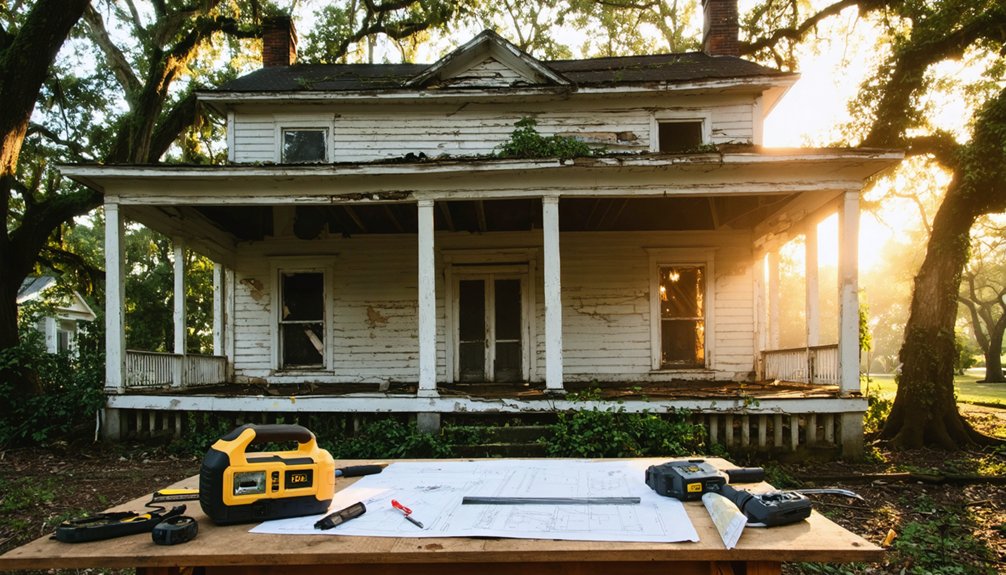
While establishing a historically accurate restoration blueprint requires painstaking research and attention to detail, this foundational step ultimately determines the authenticity and integrity of any ghost town revitalization project.
Begin by sourcing original architectural plans from historical societies and analyzing period photographs to identify authentic architectural styles.
You’ll face restoration challenges as you balance preservation techniques with practical considerations.
Involve community elders to capture historical narratives that inform your decisions and create compelling interpretive signage. Conduct archaeological surveys to uncover forgotten elements, then source local materials that match original components.
Employ traditional craftsmanship methods like hand-hewing and mortise-and-tenon joinery.
Always adhere to preservation guidelines while documenting your process.
This meticulous approach not only preserves history but also creates unique funding opportunities through organizations that value authentic historical reconstruction.
Environmental Assessment and Contamination Remediation Strategies
Environmental assessment and contamination remediation represent foundational challenges you’ll face when restoring Southern ghost towns—particularly those with industrial or mining histories.
Initial site evaluation must include property records review, soil screening, and hydrological modeling to identify contamination sources and predict migration patterns.
Your assessment strategy should prioritize:
- Conducting UAV survey mapping to collect detailed environmental impact data across the site
- Implementing sequential groundwater monitoring to track actual contaminant movement over time
- Performing soil sampling to identify elevated levels of hazardous materials like lead, arsenic, and mercury
The hazard ranking framework evaluates ten critical factors including human exposure risk and ecological impacts.
For abandoned mine sites, which frequently cause acid drainage and metal contamination, your remediation plan must address groundwater, soil, and air quality impairment through systematic prioritization methodology.
Balancing Modern Infrastructure With Historical Authenticity
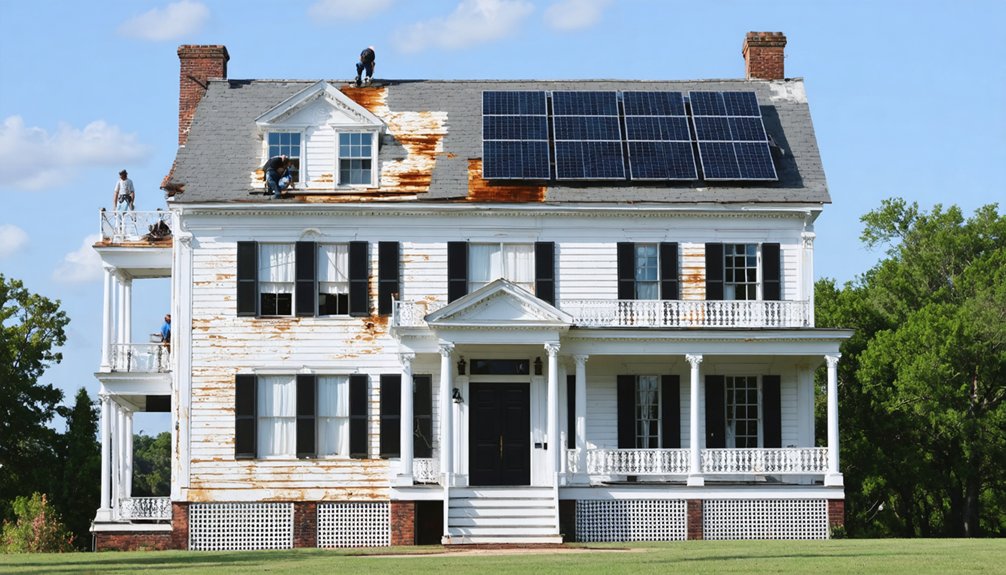
Balancing the integration of essential modern utilities with preservation of authentic historical character presents perhaps the most complex challenge you’ll face when revitalizing Southern ghost towns.
Implement water solutions through chemical pumps capable of vertical transport without disrupting historical aesthetics. Leverage existing cell towers for internet connectivity while maintaining minimal utility footprints.
Infrastructure integration must remain invisible—chemical pumps for water, existing towers for connectivity—preserving the historical aesthetic while delivering modern convenience.
Historical preservation succeeds through strategic adaptive reuse—converting original structures into hospitality facilities and cultural centers without wholesale reconstruction.
You’ll find arrested decay methodologies particularly valuable for maintaining authentic deterioration states while preventing further degradation.
Mobilize community engagement through volunteer networks and pro bono professional services. This goodwill-based approach not only reduces capital expenditures but strengthens regional economic ties.
When retrofitting safety systems, prioritize integration within existing walls and foundations, satisfying both modern codes and preservation standards without compromising the site’s historical integrity.
Developing Sustainable Tourism and Economic Models
You’ll find that successful ghost town revitalization hinges on developing authentic, non-replicable experiences that connect visitors to the distinct cultural heritage of Southern communities.
Research demonstrates that generic entertainment venues fail to create sustainable tourism, whereas locally-rooted crafts, traditions, and historical narratives generate recurring visitor engagement and spending.
Your economic strategy should extend beyond seasonal tourism revenue by integrating complementary industries such as digital infrastructure for remote workers, artisanal manufacturing, and agri-tourism to stabilize local economies throughout the year.
Authentic Experiences Matter
When examining the revitalization of southern ghost towns, authentic experiences emerge as the cornerstone of sustainable tourism development. The projected growth of dark tourism to USD 38.64 billion by 2030 underscores the economic potential of creating genuine, immersive experiences that connect visitors with local history and culture.
To develop compelling authentic storytelling opportunities:
- Involve community members as guides and narrators to preserve historical accuracy while creating meaningful connections between visitors and place.
- Create multi-sensory, immersive experiences such as guided ghost tours, historical reenactments, and hands-on workshops.
- Balance preservation with accessibility, ensuring historical integrity while making sites navigable for visitors.
Your investment in authenticity pays dividends—couples represent nearly 42% of dark tourism revenue, demonstrating that evocative, story-rich experiences attract key demographics willing to spend on meaningful travel experiences.
Beyond Seasonal Revenue
Southern ghost towns can’t achieve sustainable revitalization through seasonal tourism alone, as evidenced by the striking contrast between successful models like Wuzhen—generating 1.784 billion yuan in annual revenue—and failed ventures that become financial sinkholes despite substantial initial investment.
You’ll need to diversify revenue streams through strategic integration of real estate development, service-based industries, and renewable energy projects.
Consider how community engagement in economic development initiatives can capture spillover tourism while fostering local partnerships with private investors. Towns experiencing 30% revenue declines despite stable visitor numbers demonstrate the vulnerability of one-dimensional economies.
Avoid the standardized design trap that’s created market saturation across similar communities.
Instead, establish year-round economic resilience by emphasizing your town’s unique cultural attributes while developing complementary income channels that withstand seasonal fluctuations and changing consumer spending patterns.
Engaging Former Residents and Descendants in Rebuilding Efforts

Revitalizing abandoned ghost towns in the South requires more than physical reconstruction; it necessitates reconnecting with the human fabric that once gave these communities life.
Through community storytelling initiatives and genealogical collaboration with local historical societies, you’ll identify former inhabitants and their descendants using census records, property deeds, and social media outreach.
To effectively engage these vital stakeholders:
- Build trust through transparent communication about your vision, hosting informational sessions that honor their connection to the place.
- Create meaningful engagement opportunities via heritage events, restoration volunteer work, and advisory roles.
- Address emotional sensitivities related to displacement while managing expectations with realistic timelines.
This human-centered approach guarantees your rebuilding efforts remain authentic to the town’s cultural heritage while fostering sustainable community ownership.
Marketing Your Revitalized Ghost Town as a Heritage Destination
To effectively market your revitalized ghost town as a heritage destination, you’ll need to construct authentic historical narratives that distinguish your site from competing attractions through meticulous research and compelling storytelling.
Your success depends on crafting immersive visitor experiences that balance educational components with interactive elements, such as period-accurate reenactments or augmented reality displays that reconstruct vanished structures.
Implementing an extensive digital promotion strategy that incorporates virtual tours, location-based mobile applications, and strategic partnerships with regional tourism networks will extend your reach beyond traditional visitor demographics.
Authentic Historical Narratives
Authentic historical narratives serve as the cornerstone of successful heritage tourism for revitalized ghost towns, creating a distinctive identity that transcends mere physical restoration.
Through meticulous historical storytelling, you’ll establish a unique selling proposition that differentiates your destination while preserving cultural legacy.
To develop compelling community narratives:
- Conduct thorough archival research while collecting oral histories from longtime residents to guarantee factual accuracy and depth
- Engage diverse community voices through workshops and forums to capture multiple perspectives and foster local ownership
- Integrate multimedia elements including period photographs, artifacts, and interpretive signage for immersive visitor experiences
This approach attracts heritage tourists seeking authentic connections while stimulating your local economy through increased visitation.
Crafting Visitor Experiences
Successful heritage destinations transcend mere preservation of physical structures, instead crafting extensive visitor experiences that engage multiple senses and create lasting emotional connections.
Your revitalization strategy should prioritize interactive storytelling through guided tours with knowledgeable interpreters who breathe life into historical narratives.
Develop immersive environments utilizing period-appropriate settings, ambient lighting, and atmospheric soundscapes that transport visitors to your ghost town’s heyday.
Implement participatory workshops where guests can practice traditional crafts or skills, deepening their personal connection to the site’s cultural significance.
Partner with local businesses to create detailed visitor packages and establish Instagram-worthy photo opportunities that encourage organic social media promotion.
Consider hosting seasonal events aligned with regional folklore to capitalize on peak interest periods while establishing your ghost town as an authentic heritage destination.
Digital Promotion Strategy
While crafting exceptional visitor experiences forms the foundation of your ghost town’s revival, even the most enchanting historical destinations remain undiscovered without strategic digital promotion.
Your promotion strategy must leverage authentic differentiators through digital storytelling that resonates with heritage-seeking travelers.
- Develop a consistent visual identity and messaging across platforms, ensuring your ghost town’s unique narrative permeates every digital touchpoint.
- Implement geolocation-based technologies like AR-enhanced self-guided tours that bring historical scenes to life while collecting valuable visitor engagement data.
- Cultivate social engagement by encouraging user-generated content and collaborating with travel influencers who appreciate historical preservation.
Optimize your online presence through SEO techniques targeting heritage tourism keywords, while maintaining an informative website featuring downloadable resources, virtual tours, and regularly updated content about restoration progress and upcoming events.
Frequently Asked Questions
How Do You Manage Paranormal Tourism and Ghost Stories Ethically?
You’ll manage paranormal tourism ethically by prioritizing community engagement in decision-making, implementing transparent ethical storytelling practices, limiting visitor impact, and reinvesting revenue locally while avoiding exploitation of sensitive histories.
What Legal Liabilities Exist When Visitors Explore Partially Restored Structures?
Like floppy disks in the digital age, you’ll face significant liabilities if visitors are injured on unstable structures. You must obtain liability insurance, require visitor waivers, and still maintain premises safety despite these precautions.
How Can We Prevent Overtourism From Damaging Fragile Historic Sites?
You’ll mitigate overtourism’s impact by implementing visitor caps, sustainable tourism practices, timed-entry systems, and thorough visitor education programs that instill appreciation for preservation while distributing economic benefits throughout local communities.
When Should Reconstruction Be Prioritized Over Preserving Authentic Ruins?
Prioritize reconstruction when authentic ruins present safety hazards, lack economic viability, or cannot fulfill community needs. Your reconstruction criteria should always include meaningful community involvement to guarantee authentic cultural preservation while enabling sustainable growth.
How Do You Resolve Conflicts Between Historical Accuracy and Community Needs?
You’ll resolve these competing imperatives by implementing transparent community engagement processes while establishing flexible historical preservation standards. Carefully balance authenticity with contemporary needs through stakeholder forums that empower residents to determine their community’s future direction.
References
- https://www.carvercountyhistoricalsociety.org/ghost_towns.php
- https://styleblueprint.com/everyday/ghost-towns-in-the-south/
- https://www.blueridgeoutdoors.com/go-outside/southern-ghost-towns/
- https://en.wikipedia.org/wiki/Ghost_town
- https://www.youtube.com/watch?v=qRVelHci92k
- https://theforgottensouth.com/ghost-towns/
- https://www.britannica.com/topic/ghost-town
- https://www.arizonahighways.com/article/arizona-ghost-towns
- https://www.nps.gov/slbe/learn/historyculture/ghosttowns.htm
- https://www.vims.edu/cbnerr/roundtable/members/habitat-restoration-steering-committee/restoration-resources/restoration-site-selection-criteria—cbnerr-va—june-2021.pdf