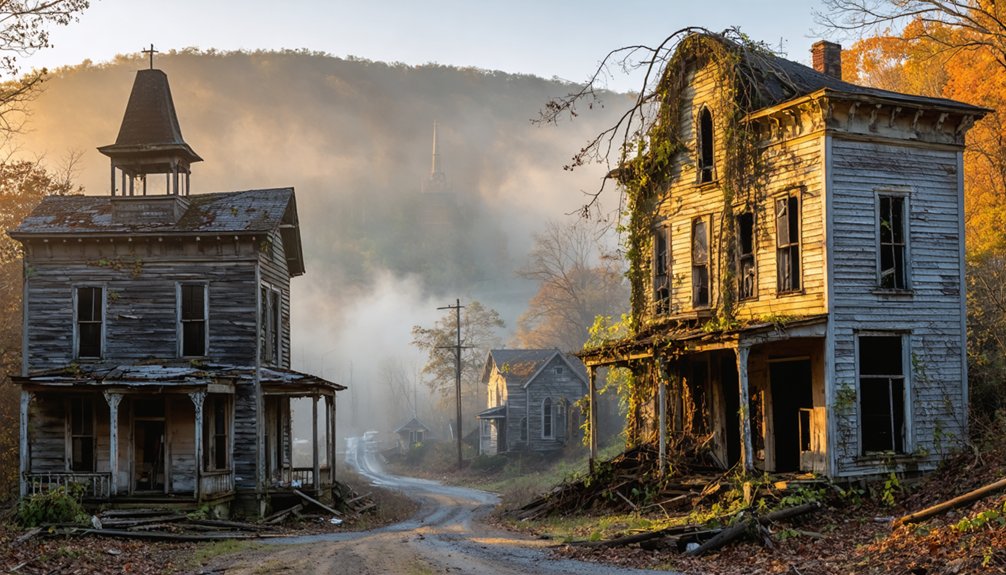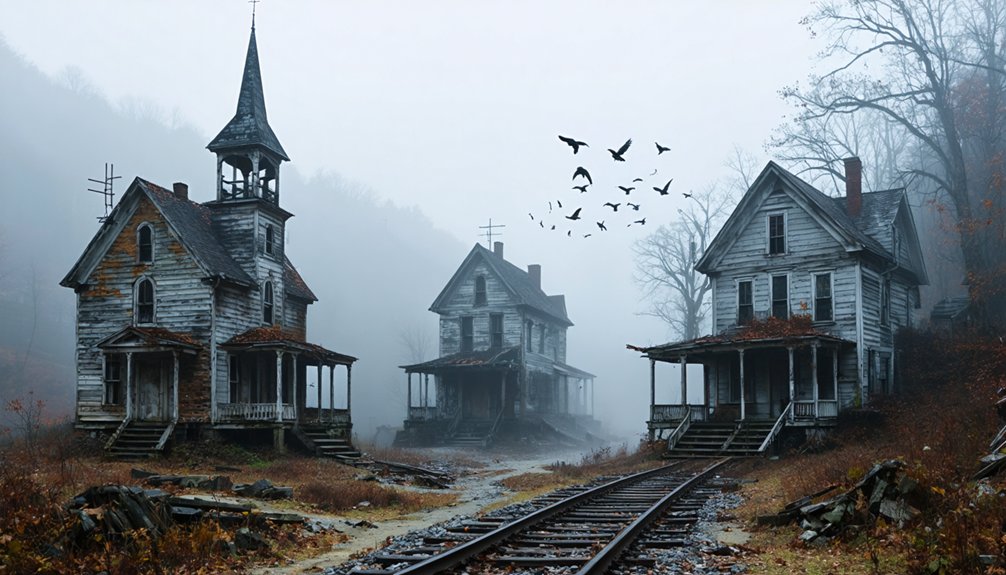
Exploring Appalachian ghost towns connects you to vanished communities shaped by industrial booms, forced relocations, and economic decline. You’ll discover settlements submerged beneath lakes, abandoned mining camps, and historic districts like Elkmont. When visiting, respect these fragile sites through ethical documentation and following conservation principles. Communities like Lost Cove offer compelling narratives of moonshining and resilience against hardship. The hidden stories of Appalachia’s abandoned settlements await your thoughtful discovery.
Key Takeaways
- Visit ghost towns like Lost Cove, Blue Heron, and Elkmont Historic District through established trails and access points.
- Document historical sites ethically by obtaining permission, practicing leave-no-trace principles, and collaborating with historical societies.
- Explore submerged communities that occasionally reveal themselves during lake drainages, showcasing hidden Appalachian heritage.
- Support conservation initiatives like the RECLAIM Act and organizations preserving oral histories of displaced communities.
- Learn about economic cycles that created ghost towns, from coal mining booms to moonshine operations during Prohibition.
Submerged Communities: Towns Beneath Appalachian Lakes
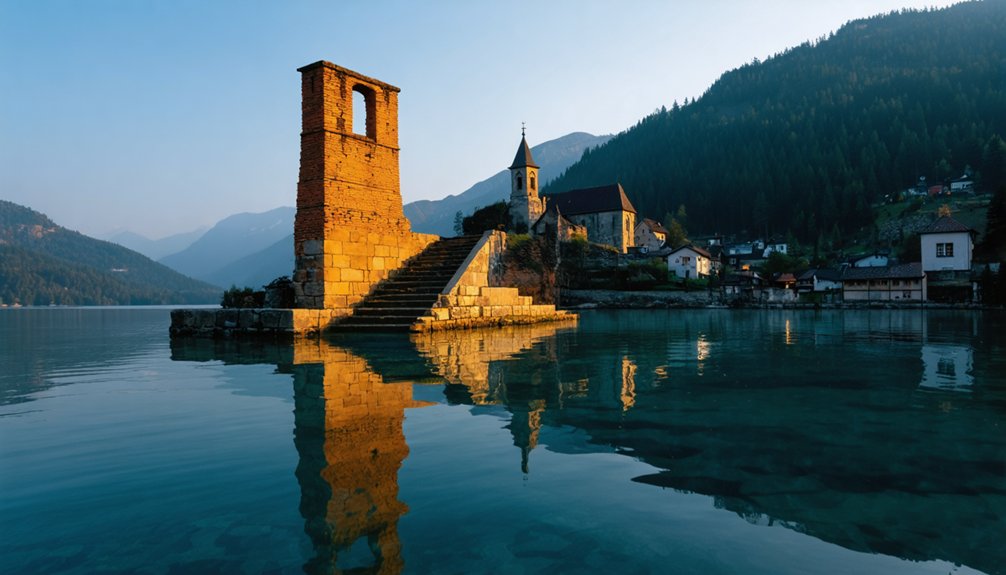
While the Appalachian Mountains are known for their misty ridges and ancient valleys, beneath several of their pristine lakes lie the remnants of once-thriving communities, sacrificed in the name of progress.
You’ll find Gad, West Virginia—the “Appalachian Atlantis”—submerged beneath Summersville Lake’s clear waters, where divers regularly explore its underwater history. Similarly, Proctor, North Carolina rests beneath Fontana Lake, while Loyston, Tennessee disappeared under Norris Lake in 1936.
These communities weren’t simply abandoned; they were deliberately flooded for flood control, hydroelectric power, and water supply infrastructure. When the Army Corps of Engineers completed Summersville Lake on September 3, 1966, Gad’s history was officially sealed underwater.
The human cost was profound. Families were forcibly relocated, ancestral farms submerged, and cemeteries moved. Lake Jocassee in South Carolina contains the historical Attakulla Lodge which remarkably resisted bulldozers during the valley’s flooding.
Today, these submerged towns occasionally reveal themselves during lake drainages, offering fleeting glimpses into a heritage that refuses to be forgotten beneath the waters.
Mining Boom and Bust: The Economic Cycle of Ghost Towns
Throughout the heart of Appalachia, the rise and fall of coal mining has sculpted a landscape dotted with ghost towns, each telling the story of America’s complex relationship with fossil fuels.
When you explore these abandoned communities, you’re witnessing the aftermath of an industry that once transformed the region from agricultural to industrial in the late 19th century. Appalachia’s economic vulnerability stems from its historical position as the primary U.S. producer of coal since the early 19th century.
Coal’s peak in 1947 at 511 million tonnes marked Appalachia’s zenith, but subsequent decades brought devastating economic decline.
By 2020, production had plummeted 65% from 2005 levels, with Central Appalachia suffering an 80% collapse.
Many of these abandoned towns were once thriving company towns where corporations controlled every aspect of miners’ lives, from housing assignments to purchasing options through scrip currency.
Despite community resilience, many company towns couldn’t survive as mines closed.
Today, these ghost towns stand as evidence to the boom-bust cycle, with abandoned infrastructure reflecting the challenges of shifting from single-industry dependence.
Accessing Remote Mountain Settlements: Visitor Information

Reaching these fascinating remnants of Appalachia’s industrial past requires careful planning and knowledge of often challenging mountain terrain.
You’ll find varying levels of accessibility among these sites of urban decay—Lost Cove demands a strenuous hike through Pisgah National Forest, while Blue Heron offers convenient train access from Stearns, Kentucky.
For historical preservation enthusiasts with mobility concerns, Elkmont Historic District provides walking paths near Gatlinburg’s popular campground, featuring intact structures including the restored Spence Cabin.
The Ravensford Tract, situated along Cherokee’s Oconaluftee River, connects visitors to lands once inhabited by the Cherokee tribe.
Meanwhile, Mortimer Ghost Town can be explored via multiple hiking routes from Mortimer Campground, where you’ll discover ruins preserved within the national forest setting—testament to nature’s reclamation of once-thriving communities.
Thurmond in West Virginia allows visitors to experience a well-preserved coal mining town that was once the most popular stop on the Chesapeake & Ohio Railroad during the early 20th century.
The Historic District of Elkmont: A Preserved Mountain Community
Nestled within the verdant landscape of Great Smoky Mountains National Park lies Elkmont Historic District, one of Appalachia’s most compelling ghost towns that chronicles the region’s change from industrial outpost to recreational haven.
You’ll discover a settlement born from W.B. Townsend’s logging operation in 1908, where Elkmont architecture reflects both its utilitarian origins and later vacation community development.
The district’s fascinating Elkmont history unfolds through preserved structures that once housed 1,500 residents before evolving into an exclusive retreat for Knoxville’s elite.
After the national park’s establishment in 1934, residents sold their properties at half-value to retain lifetime leases.
When these agreements expired in 1992, the community became frozen in time—recognized on the National Register of Historic Places and offering you a tangible connection to Appalachia’s complex past. Today, visitors can explore the partially restored Daisy Town area, where ongoing preservation efforts showcase the district’s cultural significance.
The Little River Railroad, which initially served for log transportation, later became instrumental in bringing wealthy tourists to experience the natural beauty of the Smokies.
Lost Cove: North Carolina’s Hidden Moonshine Legacy
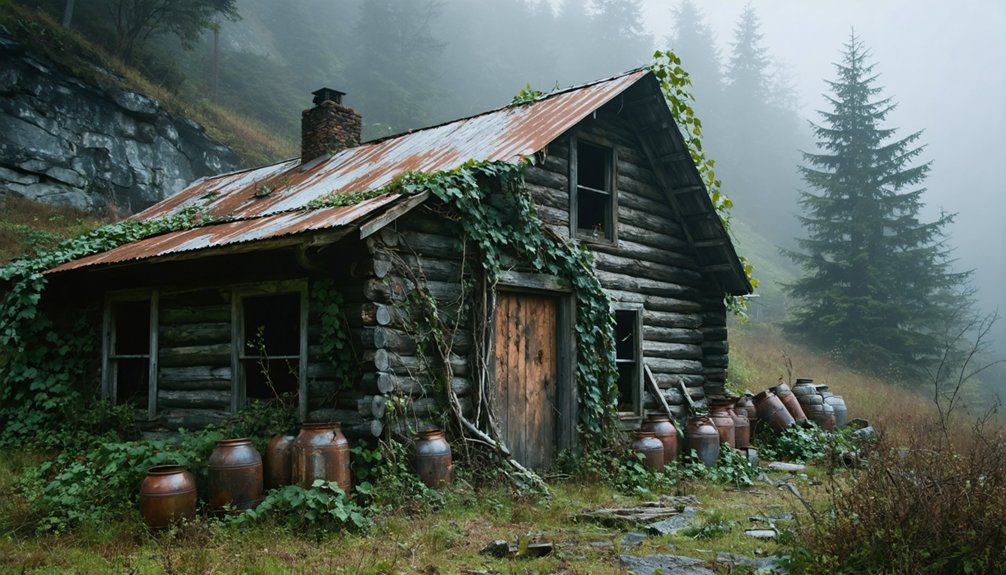
If you’re venturing to Lost Cove, you’ll follow the precarious trails once used by moonshiners who established their mountain refuge during the Civil War era.
The settlement’s inaccessibility—bordered by steep mountains and the Nolichucky River gorge—created an ideal hideout for distillers seeking to evade revenue agents, especially during Prohibition.
Your hike along these treacherous paths traces the footsteps of families like the Baileys, Tiptons, and Millers, who balanced their illicit trade with subsistence farming and community life in this isolated Appalachian enclave. The CC & O Railway played a crucial role in connecting this remote community to outside markets until its eventual abandonment in 1957. Today, conservation efforts led by the Southern Appalachian Highlands Conservancy have preserved 95 acres of this historical settlement, protecting its cultural heritage for future generations to explore.
Moonshiner’s Mountain Refuge
Deep within the rugged terrain where North Carolina meets Tennessee, Lost Cove emerged as a legendary moonshiner’s haven during the Civil War era.
You’ll find the essence of moonshine culture in this remote settlement, where production began as early as 1898 and thrived in the jurisdictional ambiguity between state borders.
This hidden history reveals a community that masterfully exploited geography for freedom. Residents concealed stills in mountain hollows while using the nearby railroad to distribute their spirits in bulk.
The boundary dispute created a perfect sanctuary from revenue agents, allowing Lost Cove’s distillers to perfect their craft undisturbed.
When you explore these abandoned homesteads today, you’re walking through the remnants of a self-sufficient society that valued independence above all, preserving Appalachian traditions while creating their own economic lifeline.
Treacherous Trail Access
Lost Cove’s isolation wasn’t merely geographical—it was strategic. You’ll find no roads leading into this remote gorge nestled within Pisgah National Forest. The only path to this moonshiner’s haven requires traversing rugged terrain that descends sharply from surrounding mountain tops.
These trails present formidable challenges with their steep drops, dense undergrowth, and rocky landscape. Even determined law enforcement agents historically avoided these treacherous routes. The natural hazards further deterred unwanted visitors—black bears and rattlesnakes patrolled the wilderness surrounding Lost Cove.
This inaccessibility wasn’t accidental but advantageous. Positioned along the disputed North Carolina-Tennessee border, moonshiners exploited jurisdictional confusion while the cove’s physical barriers provided protection for their illicit operations.
The railroad eventually offered a lifeline, but reaching Lost Cove remained an act of determination and courage.
Thurmond: Railroad Heritage Along New River Gorge
Nestled in the dramatic landscape of West Virginia’s New River Gorge, Thurmond stands as a remarkable tribute to Appalachia’s railroad heritage. Founded in 1873 when Captain William Thurmond received 73 acres for surveying work, this strategic location quickly became the C&O Railway‘s highest revenue generator, outperforming major cities like Cincinnati.
You’ll discover a town that once buzzed with fifteen daily passenger trains and shipped world-famous New River Smokeless Coal from 26 regional mines. Coal barons patronized Thurmond’s banks—then the richest in West Virginia.
Despite this prosperity, Thurmond’s decline began in the 1930s as diesel locomotives replaced steam engines and mines closed. The shift from rail to automobile transportation further diminished its importance, transforming this once-thriving hub into a preserved historic district now protected within New River Gorge National Park.
Photographic Opportunities in Abandoned Appalachian Settlements

As you explore Appalachia’s abandoned settlements, the interplay of light on decaying structures creates compelling visual narratives, especially during golden hour when shadows accentuate textural details and architectural remnants.
Your photographic approach should adapt to seasonal changes, as winter reveals structural elements hidden by summer foliage while autumn provides dramatic color contrasts against weathered materials.
When documenting these fragile historical sites, practice non-invasive techniques—never moving artifacts for composition, maintaining respectful distance from unstable structures, and researching local permissions before venturing onto protected lands.
Light and Structure Play
The photographer’s craft truly comes alive within the skeletal remains of Appalachian ghost towns, where five distinct lighting conditions transform abandoned settlements into compelling visual narratives.
You’ll find golden hour tones most rewarding, as early morning and late afternoon light accentuates the texture of weathered wood and oxidized metal. Capture structural decay through directional side lighting, which emphasizes architectural collapse and peeling surfaces.
For more nuanced light dynamics, shoot during overcast days when diffused illumination reveals subtle details without harsh shadows.
Position yourself to utilize natural framing elements—doorways revealing interiors, windows framing landscapes—creating layered compositions that tell stories of abandonment.
Consider how shadows from broken rafters create geometric patterns across floors, or how backlighting transforms mundane ruins into dramatic silhouettes against glowing skies.
Seasonal Shooting Considerations
Each Appalachian ghost town transforms dramatically with the changing seasons, offering photographers distinct visual narratives throughout the year.
Winter strips away concealing foliage, revealing structural elements while snow creates stark contrast against weathered materials. The low winter sun casts extended shadows across abandoned town layouts, perfect for ghost town photography.
Spring and summer bring accessibility advantages with extended daylight hours and safer working conditions, though early morning shoots help avoid modern human presence.
Autumn delivers exceptional seasonal light—crisp air clarity reduces haze while dimensional shadows accentuate architectural textures.
Throughout the year, golden hour remains invaluable; warm light enhances natural features surrounding settlements while softening shadows on deteriorated surfaces.
Night photography opportunities expand in winter with longer darkness periods ideal for star field compositions and light painting techniques.
Ethical Documentation Practices
Ethical documentation of abandoned Appalachian settlements requires photographers to balance their artistic vision with preservation responsibilities that extend beyond mere image creation.
Embrace ethical storytelling by obtaining written permission from property owners before entering sites and prioritizing narratives that honor the cultural heritage of these forsaken communities.
Your documentation approach should adhere to leave-no-trace principles—never moving objects or disturbing the site’s integrity.
When sharing your work, consider limiting location details to prevent overcrowding and subsequent degradation of fragile structures.
Responsible exploration means researching local history to accurately represent why communities were abandoned.
Collaborate with historical societies to guarantee your photographs contribute to preservation efforts rather than exploitation.
Through this mindful approach, you’re not just capturing compelling images but helping preserve Appalachian heritage for future generations.
Conservation Efforts Protecting Mountain Ghost Towns
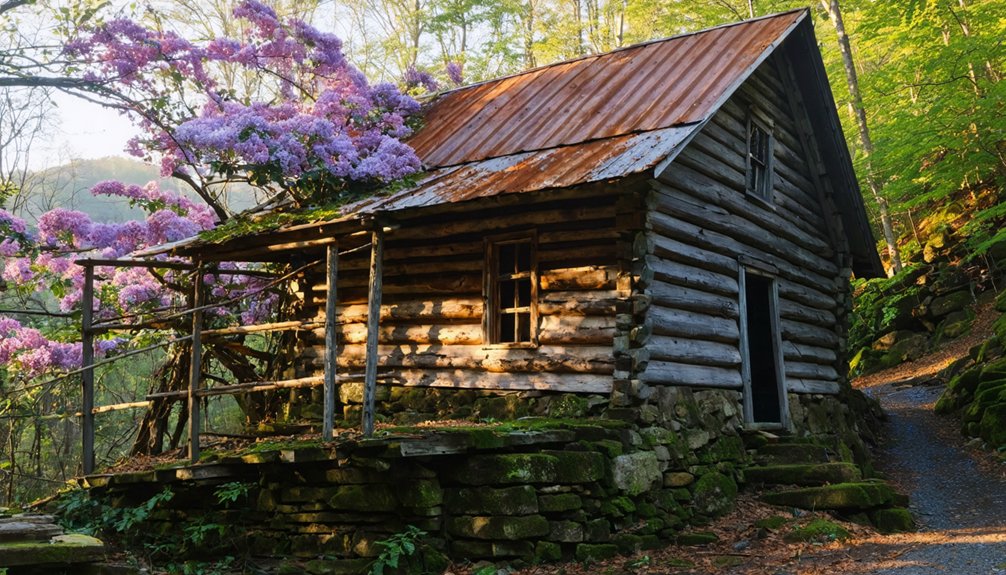
Throughout Appalachia’s rugged terrain, conservation initiatives have emerged as essential safeguards for the region’s endangered ghost towns, balancing historical preservation with environmental restoration.
You’ll find organizations like the Southern Appalachian Highlands Conservancy leading community engagement through guided hikes and protection of remote historical assets. The National Register of Historic Places designation has saved structures like Elkmont’s ghost town, with 19 buildings targeted for preservation by 2025.
Beyond buildings, these efforts address environmental wounds—remediation of abandoned mine lands, invasive species removal, and native ecosystem restoration.
Heritage tourism benefits from these interconnected approaches, creating sustainable economic opportunities while the Cumberland Forest Project’s 253,000-acre initiative demonstrates conservation’s transformative potential.
The RECLAIM Act promises additional bipartisan support for these critical preservation endeavors.
Cultural Stories: The People Who Called These Towns Home
When you explore Appalachia’s ghost towns, you’ll encounter the complex cultural tapestry woven through moonshining traditions that once served as both economic necessity and cultural resistance.
These mountain communities preserved family traditions through generations until displacement by industrial decline, reservoir projects, and economic hardship severed longstanding connections to ancestral lands.
Oral histories now stand as vital repositories of community memory, capturing the voices of those who maintained vibrant social lives amid company stores, coal camps, and seasonal celebrations despite economic volatility.
Moonshining Mountain Legacies
Hidden deep within the cultural fabric of Appalachia’s abandoned towns lies the complex legacy of moonshining, an enterprise that transcended mere illegal alcohol production to become an essential economic lifeline and symbol of mountain resilience.
As you explore these ghost towns, you’ll discover remnants of a moonshine economy that sustained entire communities during the Great Depression. Natural caves and secluded hollows where you now hike once sheltered clandestine stills producing spirits based on ancient Scottish and Irish recipes.
This underground industry created crucial supply chains extending to Chicago’s speakeasies.
The cultural folklore surrounding these sites tells stories of fierce independence—tales of mountaineers outwitting revenuers and protecting their livelihoods.
Today, places like Forbidden Caverns in Tennessee preserve this contested heritage, honoring both the economic ingenuity and rebellious spirit of your Appalachian ancestors.
Displaced Family Traditions
Why were so many Appalachian families torn from their ancestral homes with little more than hastily packed suitcases and fading memories? Government initiatives and corporate interests forced entire communities to relocate with minimal notice or compensation, fracturing the region’s cultural backbone.
As dams submerged towns and mines closed, families watched their churches, schools, and gathering places disappear—along with the displaced traditions they housed.
Places like Proctor, NC, where even promised access to family cemeteries went unfulfilled, illustrate the severing of ancestral connections.
The ripple effects continue generations later. Children growing up disconnected from mountain heritage struggle to maintain cultural identity.
Yet resistance persists through organizations like Children of Shenandoah and annual homecomings, where displaced families work to preserve oral histories and reclaim their cultural memory before it vanishes entirely.
Oral Histories Preserved
The voices of Appalachia’s vanished communities echo through carefully preserved oral histories, creating a living memorial more enduring than the crumbling foundations of abandoned homes.
You’ll find these community narratives captured through meticulous documentation methods—interviews with elders, digitized recordings, and collaborative heritage storytelling projects that resist erasure.
These preserved accounts combat reductive stereotypes by revealing Appalachia’s true diversity, including Indigenous histories, Black communities, and growing Latinx populations.
Each recorded voice contributes essential threads to a complex cultural tapestry that transcends simplified portrayals.
When you explore these oral histories, you’re not merely encountering the past but connecting with living traditions that continue through intergenerational gatherings where names of ancestors are spoken aloud, ensuring these mountain voices remain heard despite the physical towns’ disappearance.
Seasonal Considerations for Ghost Town Exploration
When planning your expedition to Appalachian ghost towns, seasonal timing becomes perhaps the most vital factor determining both accessibility and overall experience quality.
Fall emerges as the best season, offering stable weather, reduced foliage for better structural visibility, and minimal seasonal wildlife encounters.
Winter’s leaf-off conditions enhance ruin visibility but introduce hazardous snow and ice on remote roads.
Spring brings muddy trails and swollen streams alongside wildflowers, while summer’s dense vegetation obscures historical features and increases tick exposure.
Weather preparedness remains essential year-round in mountain environments where conditions change rapidly.
Consider that visitor services, including guided tours to sites like Lost Cove, operate seasonally—typically spring through fall—leaving winter explorers to navigate with greater self-sufficiency and advance planning.
Frequently Asked Questions
Are Paranormal Investigations Permitted in Appalachian Ghost Towns?
You’ll find paranormal regulations vary widely across Appalachian ghost towns. Permission depends on property ownership, preservation ordinances, and established ghost tour policies. Always secure proper authorization before conducting investigations.
Exploring abandoned buildings in West Virginia can reveal rich histories and haunting tales often hidden from public view. Each structure may hold unique artifacts and stories that contribute to the area’s eerie allure. When planning your visit, remember to consider the safety of these sites, as many may be unstable or hazardous.
What Archaeological Artifacts Can Visitors Legally Collect From These Sites?
Like precious gems in sunlight, legal collection of artifacts requires respect for preservation laws. You can’t remove items from federal or state lands—only from private property with explicit owner permission.
How Did Native American Communities Interact With These Now-Abandoned Settlements?
Native Americans shared these lands before they became settlements, engaging in cultural exchanges with early settlers before facing displacement. You’ll find their historical significance embedded in the landscape you’re exploring today.
Are There Underwater Diving Tours Available for Submerged Appalachian Towns?
Like diving into a liquid time capsule, you’ll find underwater exploration opportunities at Summersville Lake and Lake Jocassee, where guided tours reveal submerged history through clear waters ideal for witnessing these preserved communities.
Which Ghost Towns Have Wheelchair-Accessible Paths or Viewing Areas?
You’ll find accessible trails in Ashcroft and Garnet along their main thoroughfares, while Fontana Dam offers wheelchair-accessible scenic viewpoints. Elkmont provides accessible campsites but limited historic building access for mobility-impaired visitors.
References
- https://www.thewanderingappalachian.com/post/the-underwater-towns-of-appalachia
- https://www.blueridgeoutdoors.com/go-outside/southern-ghost-towns/
- https://albiongould.com/ghost-towns-to-visit-in-the-states/
- https://www.youtube.com/watch?v=4oHlJFXbrCk
- https://appalachianmemories.org/2025/10/16/the-lost-towns-of-appalachia-the-forgotten-mountain-communities/
- https://en.wikipedia.org/wiki/Lists_of_ghost_towns_in_the_United_States
- https://www.geotab.com/ghost-towns/
- https://www.thewanderingappalachian.com/post/underwater-ghost-towns-of-appalachia
- https://wvtourism.com/did-you-know-there-is-an-underwater-ghost-town-in-west-virginia/
- https://7feetnorth.com/2018/04/16/the-underwater-ghost-town/