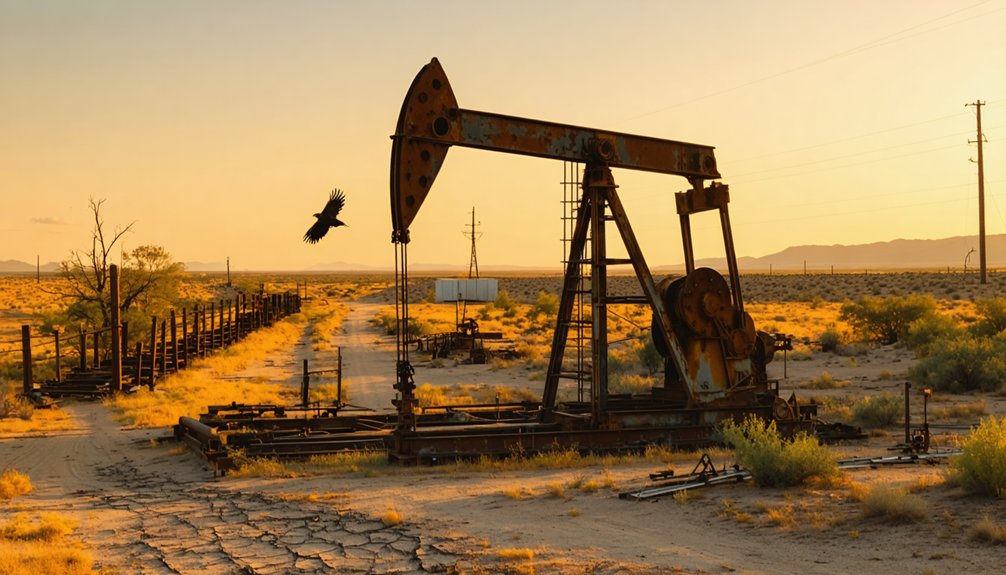
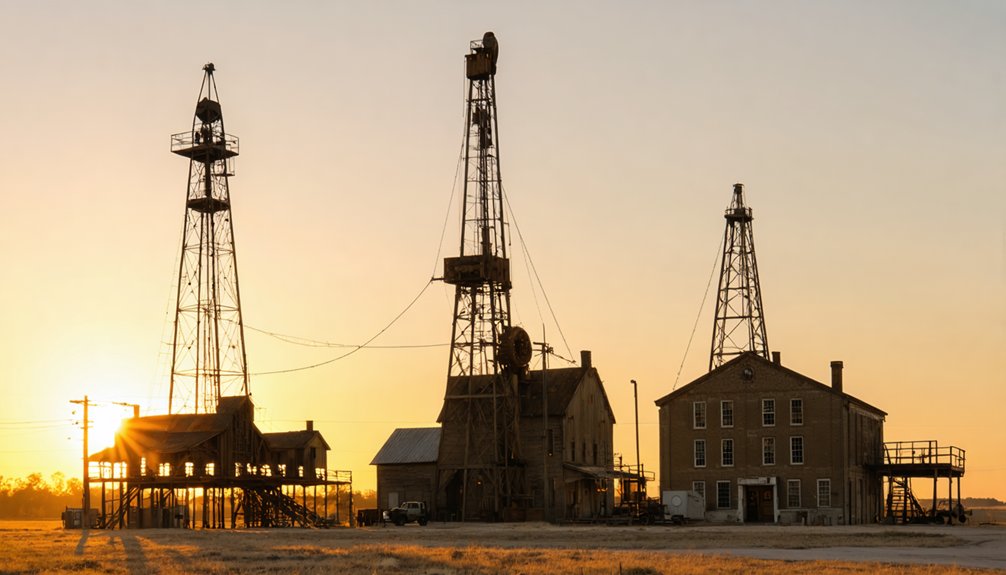
America’s abandoned oil towns tell a dramatic boom-bust story, beginning with discoveries like Spindletop in 1901 that transformed sleepy villages into bustling boomtowns overnight. When wells inevitably declined, these communities faced economic collapse, leaving behind environmental hazards from unplugged wells and deteriorating infrastructure. Today, you’ll find efforts to transform these sites through conservation and heritage tourism, balancing ecological remediation with historical preservation. The rusted derricks and empty streets hold powerful lessons about resource dependency and environmental legacy.
Key Takeaways
- American oil boomtowns like Beaumont, Texas experienced dramatic population surges followed by economic collapse when oil production declined.
- Over 430,000 abandoned oil well sites across America pose significant environmental hazards including groundwater contamination and methane emissions.
- Former oil towns face lasting environmental impacts with unplugged wells contaminating hundreds of acres for decades after abandonment.
- Conservation efforts are transforming abandoned petroleum sites into cultural and heritage tourism assets through remediation and repurposing.
- Revitalization initiatives face challenges including remediation costs, historic preservation restrictions, and the need to balance ecological healing with commemorating history.
The Rise and Fall of America’s Black Gold Communities

When American oil discovery first occurred in 1859 with Drake’s well in Titusville, Pennsylvania, it triggered a nationwide phenomenon that would transform quiet rural landscapes into frenzied centers of industry and commerce.
Within months, these settlements exploded with humanity—Beaumont, Texas swelled from 8,500 to 50,000 residents in just a year after Spindletop gushed in 1901.
The oil rush transformed sleepy towns overnight, with populations multiplying sixfold as fortune-seekers flooded these instant cities.
You’ll find the social dynamics of these boomtowns were as volatile as the petroleum they extracted. High wages mixed with gambling, makeshift housing, and a transient workforce created distinctive cultural patterns.
In Oklahoma, the momentous discovery of the Nellie Johnstone Number One well in 1897 established Bartlesville as one of the first major oil-boom towns after the Kansas railway arrived in 1899 to transport crude.
The Spindletop discovery led to a dramatic drop in oil prices and fueled the industrial revolution, transforming the United States into a global economic power.
As quickly as they rose, many communities fell when wells ran dry. Pithole, Pennsylvania vanished within a decade, leaving a cultural legacy preserved today only in museums and historical markers.
These settlements embodied America’s boom-and-bust relationship with natural resources—brief explosions of prosperity followed by abandonment.
When the Wells Run Dry: Economic Collapse in Petroleum Boomtowns
As oil wells begin producing less and eventually stop yielding petroleum altogether, the economic foundations of boomtowns crumble with alarming speed.
You’ll find these communities experience catastrophic economic decline when oil prices plummet, with rig counts dropping by 50% in a single year.
The workforce migration that follows is devastating. Tens of thousands of oil workers lose high-paying jobs, while supporting businesses from restaurants to housing developments collapse.
Property values plunge, leaving behind half-finished neighborhoods and soaring vacancy rates.
What remains are the ghosts of prosperity: unplugged wells that threaten environmental damage, food banks serving triple their normal clients, and states facing billion-dollar cleanup bills.
Many former oil industry jobs paying $100,000 annually have been replaced by minimum wage positions, forcing families into financial hardship.
The tax base that once supported thriving schools and services evaporates, leaving communities struggling to provide even basic necessities for those who can’t afford to leave.
Statistical models predict an additional 13,000 wells may be abandoned in coming years, further burdening these already devastated communities.
Ghost Infrastructure: The Abandoned Skeleton of Oil Empires

Long after the oil companies depart, the physical remains of petroleum extraction become a haunting symbol to industrial abandonment across former boomtowns.
You’ll find over 430,000 old well sites scattered across the landscape, their deteriorating infrastructure creating a skeleton of America’s oil empire.
These abandoned wells aren’t merely eyesores—they’re environmental hazards that threaten your community’s safety:
- Cement plugs from pre-1950s wells fail over time, allowing toxic chemicals to contaminate groundwater
- Unplugged wells release methane, with single sites venting 97,100 tons into the atmosphere
- Forgotten infrastructure erupts with chemical-infused liquid, creating contaminated lakes
- Documentation gaps mean homes and schools are unknowingly built atop deteriorating well sites
In the Osage Nation, approximately 2,300 orphaned wells exist, with some estimates suggesting the actual number could be as high as 16,000.
In Texas alone, there are nearly 8,900 orphan wells with Pecos County containing the highest concentration at over 600 abandoned sites.
The physical remnants haunt these ghost towns decades after the last drop of profitable oil was extracted.
the ghost towns along the east coast tell stories of prosperity turned to desolation. Once bustling with life, these areas now stand silent, inviting curious explorers to uncover their forgotten histories. Nature slowly reclaims the land, intertwining with the remnants of human ambition and dreams long abandoned.
Beyond Natural Disasters: Environmental Factors in Town Extinction
Natural disasters aren’t the only environmental forces that wipe communities off the map—systemic pollution from abandoned oil infrastructure creates equally devastating extinction events for towns across America.
While hurricanes capture headlines, ghost towns birthed by oil’s toxic legacy tell America’s forgotten environmental tragedies.
You’ll find places like Times Beach, Missouri, completely abandoned after toxic contamination rendered it uninhabitable. When oil companies leave without properly plugging wells, they create deadly legacies—methane emissions, carcinogenic gases, and saltwater leaks that poison aquifers for generations.
These environmental collapses occur slowly but inexorably. A single well can contaminate hundreds of acres over decades, turning soil barren and water undrinkable. Texas alone has over 1.5 million oil and gas-related holes that contribute to this widespread problem.
Entire communities face impossible choices: stay despite deteriorating community health conditions or abandon multi-generational homes. The approximately 3.7 million abandoned wells across the US represent ticking time bombs for surrounding towns.
The industry’s failure to remediate, coupled with regulatory negligence, transforms once-thriving towns into ecological sacrifice zones, their residents becoming environmental refugees in their own country.
Preserving Petroleum’s Past: Conservation Efforts and Heritage Tourism

While many abandoned petroleum sites represent ecological tragedies, a growing movement seeks to transform these industrial relics into valuable cultural assets through strategic conservation and heritage tourism.
The intersection of cultural preservation and community revitalization creates opportunities for meaningful engagement with America’s petroleum past. These sites often require extensive remediation to address methane emissions and other environmental hazards before they can be safely repurposed. Orphaned wells particularly threaten Indigenous heritage sites when left unaddressed near culturally significant areas.
You’ll find these efforts taking various forms:
- Federal-Tribal partnerships protecting sensitive areas like Chaco Culture and Bears Ears from further development
- Community-led initiatives prioritizing cleanup sites, contributing “sweat equity” toward revitalization
- Brownfield Revitalization programs shifting focus beyond environmental cleanup to community redevelopment
- Repurposing of industrial artifacts for educational tourism experiences
These projects face significant challenges—from prohibitive remediation costs to historic preservation restrictions—yet collaborative efforts between government agencies, Tribal communities, and local organizations continue to balance ecological healing with historical commemoration.
Frequently Asked Questions
What Happened to the Residents After Towns Were Abandoned?
Like moths to a brighter flame, you’ve witnessed scattered resettlement patterns. You’ll find those who left experienced stronger financial health while facing economic challenges, but enjoyed increased credit limits and fewer delinquencies.
Did Any Oil Towns Successfully Transition to Sustainable Economies?
Yes, you’ll find Garfield County and Los Angeles implemented sustainable practices through economic diversification. The Southern Ute Tribe created investment funds, while Gujarat and Ethiopia developed green industry frameworks that preserved freedom.
How Did Racial Segregation Impact Oil Boom Town Development?
You’d think oil wealth meant opportunity for all, but racial dynamics created separate worlds—white residents controlled industry jobs and profits while Black communities built parallel economies under severe economic disparities, often excluded from boom town prosperity.
Were There International Equivalents to American Oil Ghost Towns?
Yes, you’ll find international oil ghost towns across Africa, the Middle East, and Latin America where boom-bust cycles, resource depletion, and political instability created abandoned settlements similar to America’s petroleum ghost towns.
What Role Did Women Play in Oil Boom Town Societies?
In 1947, 100% of Desk and Derrick members were women. You’ll find women’s roles spanned domestic management, clerical work, community support, and occasionally entrepreneurship—sustaining oil towns through invisible yet essential labor.
References
- https://www.okhistory.org/publications/enc/entry?entry=GH002
- https://aoghs.org/petroleum-pioneers/pithole-creek/
- https://www.youtube.com/watch?v=eyOASXxAmMI
- https://en.wikipedia.org/wiki/Ghost_town
- https://www.epa.gov/mo/town-flood-and-superfund-looking-back-times-beach-disaster-nearly-40-years-later
- https://mix931fm.com/texas-ghost-towns-history/
- https://money.howstuffworks.com/10-boom-towns-that-went-bust.htm
- https://savingplaces.org/guides/ghost-towns-on-route-66
- https://www.okhistory.org/publications/enc/entry?entry=PE023
- https://drillers.com/spindletop-oil-discovery/