Revitalizing Rust Belt towns requires multi-pronged strategies focused on education and innovation. You’ll see greater success by investing in workforce development, as areas with higher educational attainment show 3% more employment growth per decade. Combine this with tech-focused “Brain Belt” initiatives, affordable housing policies, and equity-centered development to prevent displacement. Communities like Buffalo demonstrate how green development zones can create sustainable jobs while maintaining neighborhood affordability. These all-encompassing approaches yield the most promising outcomes.
Key Takeaways
- Educational investments and workforce development programs address skills gaps critical for post-industrial economic recovery.
- Public-private partnerships drive community involvement in redevelopment while leveraging resources for sustainable growth.
- Focus on affordable housing mandates and anti-displacement policies prevents gentrification during revitalization efforts.
- Tech-focused economic transitions through Tech Hubs and the CHIPS Act create new high-skill employment opportunities.
- The “15-minute city” model improves quality of life while reducing environmental impact in former manufacturing centers.
The Legacy of Deindustrialization: Understanding the Decline

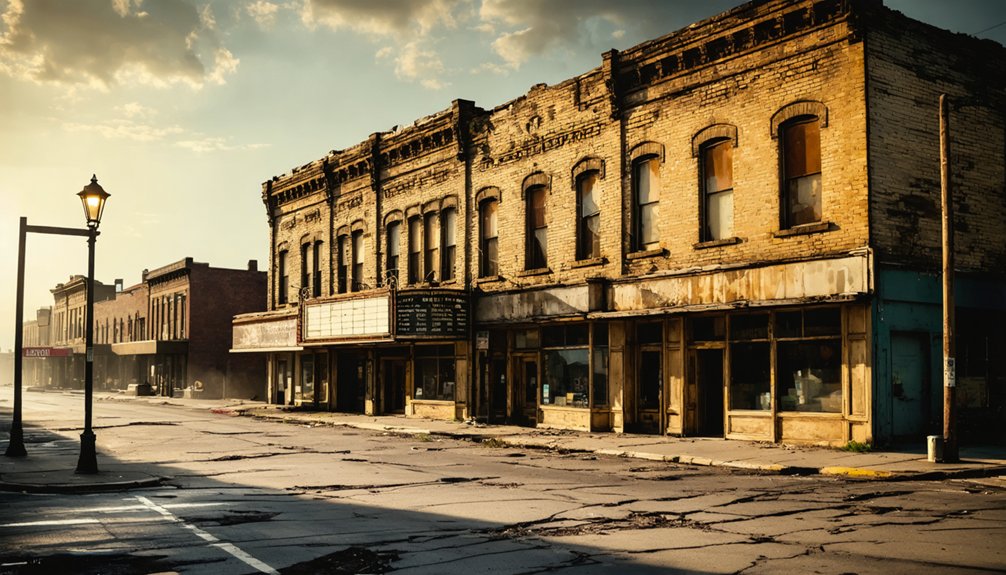
While the narrative of American industrial decline is familiar to many, the statistical evidence reveals a more precise picture of deindustrialization’s devastating impact.
From 1969 to 1996, manufacturing employment in the Rust Belt plummeted by 32.9%, triggering massive job displacement and urban decay.
Areas with higher manufacturing concentration suffered disproportionately—each 16.1 percentage point increase in manufacturing share led to a 2.7% per decade employment growth decline.
Overall, the region’s share of economy-wide jobs dropped 28% between 1950-1980, with manufacturing jobs declining 34%.
The consequences weren’t uniform; surprisingly, 34% of former manufacturing hubs maintained or grew employment despite these headwinds.
This heterogeneity suggests that while structural factors created broad challenges, local conditions and policy responses markedly influenced outcomes, offering important lessons for today’s revitalization efforts.
The study shows that only 17% of US manufacturing hubs recovered to prior employment levels, compared to nearly half of German hubs experiencing successful recovery.
Cities like Detroit saw population losses of over 30% from 2000 to 2020, further complicating economic recovery efforts.
Education as the Foundation for Economic Rebirth
Although deindustrialization devastated manufacturing communities across the Rust Belt, data consistently shows that a region’s educational attainment has been the decisive factor in economic rebirth.
Cities in the top quartile of educational attainment experienced growth while others declined. The evidence is compelling:
- Only 17% of US manufacturing hubs recovered, compared to nearly 50% in Germany where educational investment was prioritized.
- A mere 1% increase in college-educated workers yields 3% employment growth per decade.
- College graduates earn more than double their non-degree counterparts in today’s Rust Belt.
- Only counties in the top third of educational attainment improved quality of life after manufacturing losses.
Research indicates that a 1 standard deviation increase in initial manufacturing share resulted in a 2.7% per decade decrease in total employment growth after peak manufacturing years.
Studies by Glaeser and Saiz emphasized that education level directly correlates with city growth and productivity across America’s evolving economic landscape.
Workforce development creates measurable divergence between communities that thrive and those that stagnate after deindustrialization.
Innovative Approaches to Urban Redevelopment

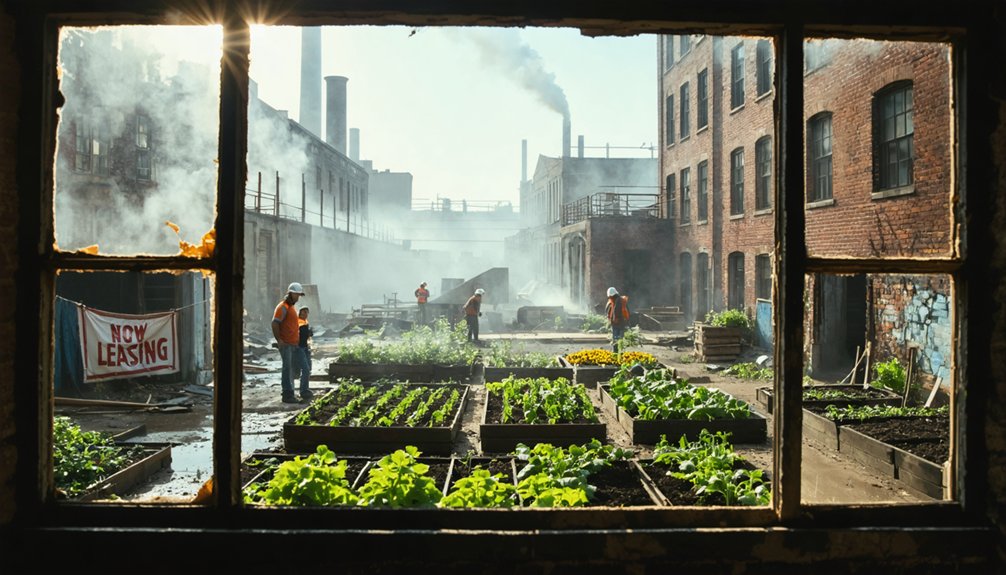
Building upon strong educational foundations, urban redevelopment strategies have emerged as powerful engines for reinvention in former manufacturing hubs.
You’ll find tax code reforms and regulatory updates dismantling barriers to revitalization, creating space for small-scale manufacturing that aligns with sustainable practices.
The affordability advantage of Rust Belt cities attracts entrepreneurs and residents seeking freedom from coastal market constraints.
This migration fuels public-private partnerships where community involvement shapes the reclamation of brownfields into productive spaces. Multi-lingual signage throughout revitalized areas promotes cultural inclusivity for diverse populations moving into these communities.
The “15-minute city” model reduces environmental impact while enhancing quality of life.
A $20 million EDA investment in Allentown demonstrates how federal support catalyzes local transformation. These cleaner manufacturing operations create vibrant neighborhood storefronts that generate foot traffic and economic activity.
Creating the “Brain Belt”: Technology and Advanced Manufacturing
The Rust Belt’s transformation into a “Brain Belt” marks a paradigm shift in America’s manufacturing landscape, where eleven federally designated Tech Hubs now concentrate innovation in advanced manufacturing, quantum computing, and energy storage technologies.
America’s industrial heartland reinvents itself through tech innovation, establishing new centers of excellence across manufacturing’s next frontier.
This manufacturing renaissance leverages regional strengths while creating high-skill jobs and stimulating local economies. These developments are supported by robust infrastructure investment that has significantly enhanced freight and rail access throughout the region. The CHIPS and Science Act has enabled critical federal investments in transitioning industrial heartland communities toward tech-driven economies.
Key tech innovation drivers include:
- Minnesota MedTech Hub 3.0 advancing medical technology across Wisconsin and Minnesota
- Missouri’s Critical Minerals Hub specializing in advanced energy tech processing
- Michigan’s Materials Advancement Consortium supporting semiconductor production
- NY SMART I-Corridor enhancing semiconductor manufacturing while prioritizing underserved communities
You’ll find these initiatives supported by CHIPS Act funding, with operational costs below national averages.
Regional universities cultivate skilled talent pools while federal loan guarantees, like the $4.9 billion Grain Belt Express approval, strengthen energy infrastructure essential for manufacturing growth.
Addressing Social Equity in Rust Belt Revitalization

While efforts to revitalize former manufacturing hubs show promising economic returns, these initiatives frequently exacerbate existing racial and economic inequities across the Rust Belt region.
The haunted legends of Michigan’s ghost towns offer a glimpse into the state’s rich and often forgotten history. As these eerie tales resurface, they attract tourists eager to explore the hidden narratives behind abandoned structures. This growing interest not only highlights the cultural significance of these sites but also raises questions about how to address the socioeconomic issues faced by surrounding communities.
Urban greening projects often trigger green gentrification, pushing low-income Black and Latinx residents out through rising rents and increased evictions. Consider Buffalo, where African-American neighborhoods report median household incomes of just $20,047 (2016), while experiencing severe housing pressure. City data shows that rents have increased by 8 to 13 percent annually over the past decade, intensifying displacement concerns.
You’ll need targeted policies to prevent community displacement: mandatory inclusionary zoning requiring 30% affordable units, community land trusts, and tax exemptions for affordable housing developers.
PUSH Buffalo’s Green Development Zones offer a proven model worth expanding, creating sustainable construction jobs for local residents while preserving neighborhood affordability. Cities like Youngstown, Ohio exemplify the devastating impact of failing to adapt to economic changes, with entire communities abandoned when single industries collapsed.
Without equity-focused interventions, revitalization will continue widening the already significant racial wealth gap in these deeply segregated cities.
Frequently Asked Questions
How Do Environmental Cleanup Costs Affect Redevelopment of Brownfield Sites?
You’ll face significant barriers as cleanup financing costs ($50,000-$10M+) and regulatory challenges directly impact your ROI, creating uncertainty that deters investment despite potential tax revenue generation opportunities.
What Role Do Immigrant Populations Play in Revitalizing Declining Neighborhoods?
Like phoenix communities, immigrants breathe new life into declining areas. You’ll see their cultural diversity driving housing demand while their economic contributions increase property values by 9.6%, reversing population decline and stabilizing tax bases.
How Can Communities Preserve Industrial Heritage While Promoting New Development?
You’ll balance heritage tourism with adaptive reuse by incentivizing developers who preserve 30% of industrial structures. Cultural preservation generates 2.5x economic returns while allowing communities freedom to determine their authentic redevelopment path.
What Financing Models Work Best for Housing Rehabilitation in Low-Value Markets?
Like a key opening forgotten treasures, CDFIs offer the best financing for low-value markets. You’ll need community partnerships and grant funding to maximize revolving loan funds for sustainable housing rehabilitation.
How Do Weather Patterns and Climate Change Impact Revitalization Efforts?
You’ll need to prioritize climate resilience investments, as extreme weather damages already-fragile infrastructure. Declining tax bases limit weather adaptation capacity, while one-third of Americans already relocate due to climate factors.
References
- https://schoolofcities.utoronto.ca/neighbourhood-abandonment-in-the-american-rust-belt/
- https://www.clevelandfed.org/publications/economic-commentary/2013/ec-201306-urban-decline-in-rust-belt-cities
- https://commentaries.cberdata.org/1308/the-birth-and-death-of-rustbelt-cities
- https://marginalrevolution.com/marginalrevolution/2025/05/manufacturing-went-south.html
- https://en.wikipedia.org/wiki/Rust_Belt
- https://amfg.ai/2024/05/15/the-future-of-manufacturing-in-the-rust-belt/
- https://cardinalnews.org/2025/06/02/if-manufacturing-grows-those-new-jobs-probably-wont-be-where-the-old-one-were-heres-why-and-what-that-means-for-virginia/
- https://coastapp.com/blog/manufacturing-belt-rust-belt/
- https://www.pcma.org/rust-belt-cities-reinvent-innovation-hubs-knowledge-economies/
- https://eml.berkeley.edu/~moretti/rust.pdf