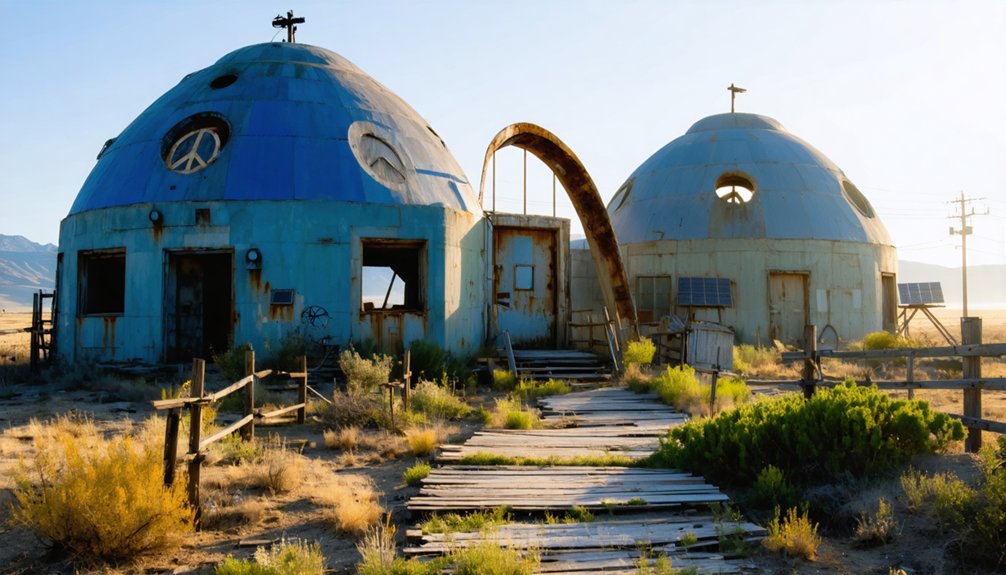
You’ll find success in reviving abandoned utopian communities by balancing historical preservation with modern viability. Implement diverse revenue streams beyond agriculture, establish polycentric governance structures, and create robust risk management protocols. Focus on adaptive reuse that honors original designs while accommodating contemporary functions. Communities like Hancock Shaker Village and Amana Colonies demonstrate how cultural tourism can sustain these historic spaces while maintaining their philosophical integrity. Further exploration reveals surprising sustainability strategies.
Key Takeaways
- Establish polycentric governance structures that distribute decision-making authority to prevent the concentration of power common in failed utopian experiments.
- Implement diversified revenue streams beyond agriculture, including tourism, crafts, and digital enterprises to ensure economic sustainability.
- Create comprehensive insurance and risk management policies to protect against catastrophic losses that historically devastated communities.
- Balance historical preservation with adaptive reuse strategies that honor original designs while accommodating contemporary functions.
- Develop transparent communication channels with surrounding communities to avoid isolation and build mutually beneficial relationships.
The Historical Rise and Fall of American Utopian Settlements

While America was still forging its national identity in the early 19th century, a remarkable social phenomenon emerged across its landscape: the utopian community movement.
These communal experiments sprang from diverse ideological foundations—religious groups like the Shakers and Rappites, secular socialist models inspired by Owen and Fourier, and transcendentalist visions at Brook Farm.
The rich tapestry of American utopian communities reflected the nation’s intellectual diversity, from spiritual seekers to social reformers.
Historical patterns reveal that most communities followed similar trajectories: initial enthusiasm under charismatic leadership, productive economic activity through crafts or agriculture, and eventual decline. Many of these utopian communities represented a nostalgic response to the rapid shift from a pre-capitalist culture to a market economy after 1815.
Few survived beyond several decades. The challenges proved consistent: internal conflicts over governance and social practices, external hostility from mainstream society, and economic difficulties. The Constitution’s freedom of religion guarantee attracted many persecuted European groups seeking to establish their ideal societies away from urban centers.
Communities like Oneida evolved into different organizational structures, while others like the North American Phalanx collapsed after specific crises.
Lessons From Financial Failures of Past Communities
You’ll need robust insurance coverage to prevent catastrophic losses like those experienced at Brook Farm, where fire destruction without insurance directly led to financial collapse.
Diversifying revenue streams beyond agricultural production can protect your community from the vulnerabilities faced by settlements like La Réunion, which failed when their primary income sources proved unsustainable.
Creating contingency funds and establishing multiple economic activities will shield your intentional community from the financial instability that historically forced utopian experiments to rely on wealthy patrons or face dissolution when facing unexpected expenses. Consider developing specialized crafts or manufacturing operations similar to how the Oneida Community achieved success through their silverware production business.
The cyclical nature of forming and dissolving communities throughout American history demonstrates that most utopian settlements only lasted a few years before economic hardships forced their decline.
Building Insurance Safeguards
Despite the idealism that propelled historic utopian experiments, their repeated financial collapses offer significant lessons for contemporary community revitalization efforts.
Your revival project must establish thorough insurance policies covering property, liability, and catastrophic loss—protections especially absent from historical communities like Ruskin Colony, which collapsed after uninsured fire damage.
Implement formal risk assessment protocols identifying environmental, financial, and operational vulnerabilities before they threaten your community’s existence.
This requires establishing transparent governance structures with qualified financial oversight committees rather than the informal leadership that undermined past utopian ventures. The lessons from Octagon City demonstrate how isolation and environmental challenges can quickly destroy even the most idealistic communities when proper financial planning is absent.
You’ll need professional insurance advisors familiar with cooperative organizations, unlike isolated historical communities that lacked access to tailored financial products. Creating a contingency fund modeled after Bellamy’s concept of national trust management could provide additional financial security for community infrastructure.
Diversifying Revenue Streams
Historical evidence from failed utopian experiments demonstrates that financial sustainability requires multiple, complementary revenue sources rather than dependency on a single economic activity.
New Harmony’s limited success with its tourist hotel and Oneida’s initial prosperity through steel trap manufacturing highlight the vulnerability of narrow economic models.
When reviving abandoned communities, you’ll need to establish diverse alternative income streams that can withstand market fluctuations.
Consider developing cooperative ventures across different sectors—agriculture, crafts, education, and tourism—to create economic resilience.
Brook Farm and Northampton’s capital shortages serve as cautionary tales of what happens when communities lack diversification.
Unlike your predecessors who underestimated capital requirements, acknowledge that your community must actively participate in external markets while maintaining internal values—a delicate balance that demands strategic economic planning from the outset.
Examining the economics of successful communities shows that wealthy patrons and philanthropy for funding have historically been crucial for establishing initial infrastructure and weathering early financial challenges.
The high attrition rates of intentional communities, comparable to the 90% failure rate of business startups, emphasizes the need for sound financial management alongside idealistic visions.
Balancing Idealism With Practical Sustainability
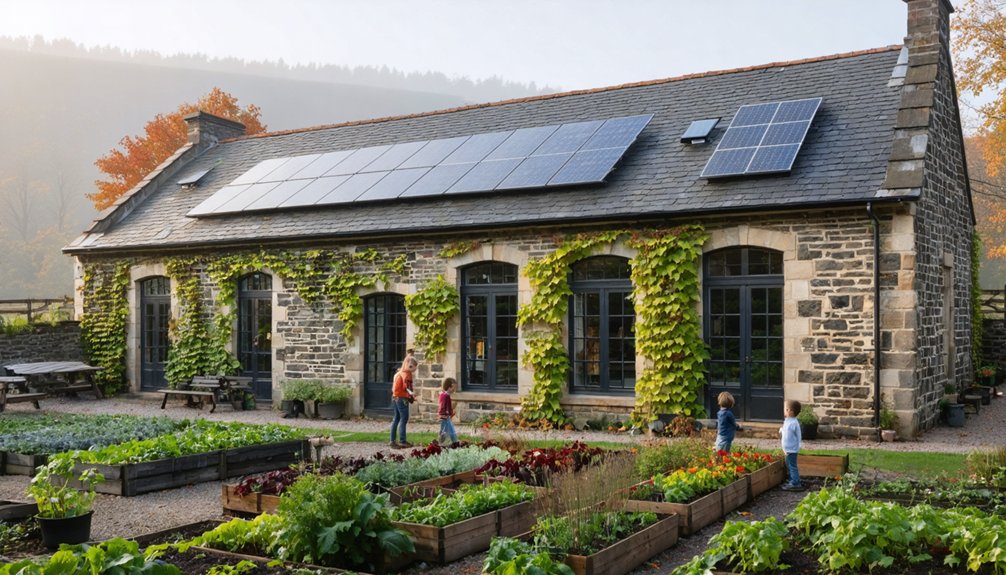
When examining the failures of America’s utopian experiments, a clear pattern emerges that reveals the fundamental tension between idealistic vision and practical sustainability.
You’ll find that communities like Brook Farm and New Harmony collapsed primarily when ideological commitments weren’t balanced with financial acumen.
To avoid these pitfalls, you must establish robust communal resource management systems that address both production and consumption.
Historical evidence shows that idealistic sustainability requires acknowledging economic realities—insurance coverage for buildings, diversified income sources beyond tourism, and clear accountability for members’ contributions.
Your modern communal experiment will need to reconcile the tension between supporting non-productive members and maintaining economic viability.
Unlike the Owenites whose cooperation “nigh killed” them, you’ll need pragmatic governance structures that preserve idealistic principles while ensuring financial stability.
Many settlements floundered because members had little to no agricultural experience, as seen in Fruit Hills where the laborers’ lack of farming knowledge contributed to the commune’s dissolution within seven years.
In examining the broader implications of such communal failures, one can uncover the histories of rust belt ghost towns that echo similar tales of struggle and abandonment. These towns, once thriving centers of industry, now stand empty, their stories often forgotten yet rich with lessons about economic resilience and the importance of adaptive skill sets. As we explore these remnants, we gain insight into the socio-economic factors that led to their decline and the potential pathways for revitalization.
Transcendentalists like Emerson and Thoreau emphasized the importance of environmental spirituality in creating harmonious communities, a principle often overlooked in failed experiments that focused solely on economic structures.
Adaptive Governance Models for Modern Communal Living
You’ll need to establish governance structures that guarantee all community members maintain meaningful input while preserving coherent direction toward collective goals.
Distributing decision-making authority across polycentric leadership models prevents the concentration of power that plagued many historical utopian experiments.
These adaptive systems must incorporate continuous feedback loops where community voices actively shape evolving policies, thereby balancing the tension between unified vision and democratic participation.
Balancing Voice With Vision
Although utopian communities often begin with inspiring visions, their sustainability depends on developing governance structures that balance collective idealism with individual agency.
You’ll need to implement responsive decision-making processes that can adapt as your community evolves, ensuring visionary leadership doesn’t overshadow community engagement.
Consider establishing iterative policy adjustment cycles—Plan-Do-Review-Adapt—that integrate continuous learning while maintaining strategic agility. This approach allows you to respond effectively to emerging challenges without bureaucratic delays.
Develop inclusive participatory structures that value insights from all members, not just community leaders.
The most resilient communities maintain organizational redundancy and diversity, enabling them to absorb shocks while preserving essential functions.
Your governance model should distribute decision-making across multiple levels, recognizing that communities possess inherent self-organization capacity when properly structured.
Preventing Power Concentration
The concentration of power represents one of the most persistent threats to utopian communities, often undermining their foundational egalitarian principles.
You’ll need to implement distributed decision-making structures that deliberately disperse authority across multiple roles and organizational levels.
Establish polycentric leadership models that enable governance equity through shared responsibility and reduced hierarchical imbalances.
Your community should formalize participatory engagement mechanisms by creating advisory groups and ensuring marginalized voices receive representation in governance structures.
For sustainable power sharing, embed iterative learning processes where feedback continuously reshapes policies.
Build capacity through leadership development workshops focused on adaptive governance, while directing resources toward community self-organization initiatives.
Institutionalize flexibility by updating bylaws to accommodate emerging challenges and maintaining diverse organizational structures that can absorb unexpected disruptions without defaulting to centralized control.
Preserving Cultural Heritage While Embracing Change
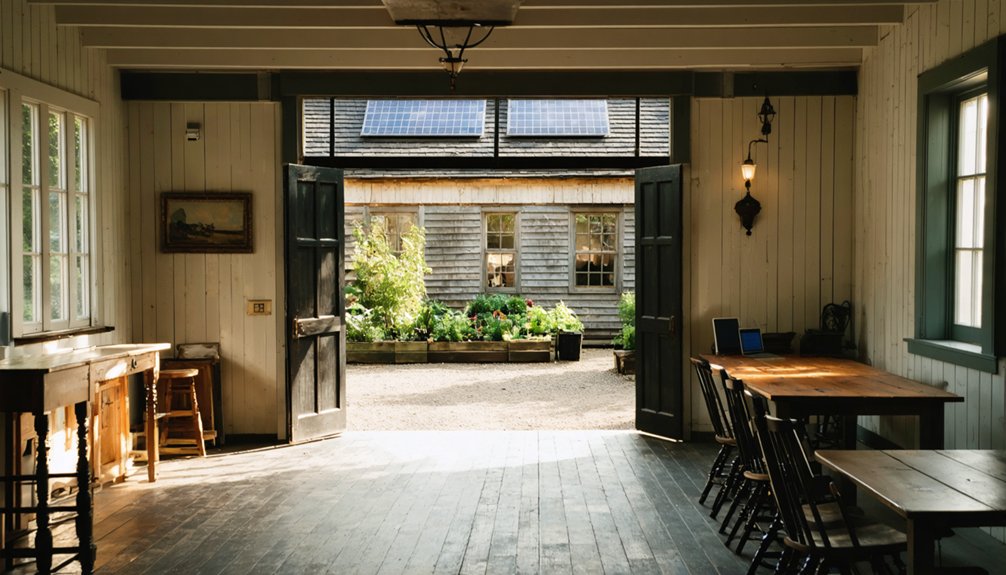
While preserving the physical remnants of utopian communities presents formidable challenges, it’s equally important to maintain the delicate balance between historical authenticity and contemporary relevance.
When you engage with sites like Hancock Shaker Village or New Harmony, you’re connecting with America’s complex social experiments through cultural preservation efforts that transcend mere building conservation.
Community engagement proves essential in this process—volunteer programs, educational partnerships, and digital archives extend access beyond physical locations.
Engaging communities transforms utopian sites from historical artifacts into accessible, living educational resources.
You’ll find that successful preservation incorporates adaptive reuse strategies that honor original designs while accommodating modern functions.
Unlike the rigid ideologies that contributed to many utopian communities’ downfall, today’s preservation approaches emphasize flexibility and inclusivity.
The dialogue between historians, local residents, and stakeholders guarantees that these sites remain living representations of alternative visions of society rather than static monuments to failed dreams.
Economic Diversification Strategies for Community Resilience
Economic diversification represents perhaps the most critical foundation for revitalizing abandoned utopian settlements in today’s fluctuating economic landscape. Your restoration efforts must avoid overdependence on single industries by establishing multiple revenue streams that build resilience against market volatility.
Consider implementing community agriculture initiatives that shift from conventional farming to organic production and agritourism experiences. Establish cooperative marketing networks that connect your settlement’s goods with regional markets, reducing individual risk while expanding collective reach.
Develop value-added processing facilities that transform raw materials into premium products worth substantially more.
Don’t overlook digital infrastructure investments enabling remote work opportunities and e-commerce participation. Additionally, leverage your utopian community’s unique historical narrative for tourism development, creating immersive experiences that attract visitors year-round while preserving your settlement’s distinctive philosophical heritage.
Building Bridges Between Utopian Spaces and Mainstream Society

Successfully reintegrating abandoned utopian communities into mainstream society requires intentional bridge-building strategies that transcend physical separation and ideological differences.
You’ll need to establish transparent communication channels through regular community events and collaborative governance structures that include representatives from both worlds.
Effective outreach initiatives should avoid neocolonial dynamics, instead focusing on mutual trust building through educational programs and environmental collaborations.
Cultural exchanges—such as art exhibitions and music festivals—can dismantle misconceptions while celebrating diverse traditions.
Social services and mutual support networks create tangible benefits for all participants.
By sharing resources like community centers and implementing joint emergency response systems, you’ll develop interdependence rather than isolation.
Media representation matters: community-led campaigns can reshape narratives, while partnerships with local outlets increase visibility and foster positive relationships, transforming perception from “alternative” to “valuable contributor.”
The Role of Technology in Reimagined Communal Living
When reimagining abandoned utopian communities for contemporary living, technology serves not merely as an additive element but as a transformative foundation that can either amplify or undermine communal values.
You’ll find that America’s long-standing belief in technological solutions presents both opportunity and caution for communal innovation.
Unlike earlier utopian experiments with their kitchenless houses and underground passages, today’s technology integration must balance efficiency with genuine human connection.
The digital infrastructure you implement should dissolve hierarchies rather than reinforce them, creating self-empowered residents who aren’t merely consumers of technology but co-creators of communal systems.
Remember that technological utopias historically promised cleanliness, efficiency, and harmony—ideals worth preserving—while avoiding the techno-deterministic belief that advancement necessarily equals progress.
Your reimagined community must harmonize technology with the human-scale values that first inspired these utopian visions.
Case Studies: Successful Modern Revivals of Historic Communities

Several historic utopian communities have undergone remarkable transformations from abandoned relics to vibrant cultural institutions, offering instructive frameworks for contemporary revival efforts.
Hancock Shaker Village and the Oneida Community Mansion House exemplify successful nonprofit models, where preservation efforts combine with educational programming to create sustainable cultural tourism destinations.
New Harmony’s integration of museums and galleries alongside the Working Men’s Institute demonstrates how historic infrastructure can support modern intellectual pursuits.
The Amana Colonies represent a commercial approach, attracting over one million annual visitors through a blend of cultural heritage and entrepreneurship.
Historic Rugby’s revival through the Rugby Restoration Association showcases effective community engagement through guided tours and heritage festivals.
These case studies reveal a common pattern: successful revivals balance authentic preservation with adaptive reuse while fostering community engagement and developing sustainable cultural tourism models.
Frequently Asked Questions
How Do Modern Zoning Laws Impact Revival of Historic Utopian Communities?
You’ll face significant zoning restrictions that prohibit communal living arrangements, mixed-use buildings, and high-density housing typical of historic utopian models, severely constraining your community development aspirations despite their historical precedents.
Can Non-Religious Groups Successfully Revive Historically Religious Utopian Settlements?
Coincidentally, you’ll find your success depends largely on community engagement balancing cultural preservation with secular purpose. Non-religious groups can thrive when they honor heritage while establishing new communal values that transcend religious foundations.
What Legal Structures Protect Communal Property From Individual Claims?
You’ll need LLCs, irrevocable trusts, and community association structures to shield communal property rights from individual claims, while implementing detailed CC&Rs that clearly define the boundaries of collective ownership.
How Do Revived Communities Handle Healthcare and Aging Populations?
Like a tapestry woven with diverse threads, you’ll establish community healthcare through volunteer clinics, traditional practices, and cooperative financing models, while creating aging support networks that integrate home-based care with communal responsibility systems.
Are There Tax Incentives Available for Restoring Historic Utopian Sites?
Yes, you’ll find both federal and state tax credits for historic preservation, offering up to 20-25% of rehabilitation expenses when restoring income-producing utopian community sites on the National Register.
References
- https://historycollection.com/10-american-utopian-communities-rose-perfection-dramatically-collapse/
- https://open.baypath.edu/his114/chapter/utopian-communities/
- https://www.nps.gov/articles/000/secular-utopias-in-america.htm
- https://fee.org/articles/the-dark-side-of-paradise-a-brief-history-of-americas-utopian-experiments-in-communal-living/
- https://en.wikipedia.org/wiki/List_of_American_utopian_communities
- https://guides.loc.gov/chronicling-america-early-utopian-communities
- https://www.britannica.com/story/american-utopias
- https://www.yesmagazine.org/health-happiness/2022/06/01/american-communes-failed-experiment
- https://www.legendsofamerica.com/ah-utopias/
- https://study.com/academy/lesson/utopianism-definition-communities.html