Reviving abandoned utopian communities in the US requires balancing historical preservation with sustainable transformation. You’ll need to address the original causes of failure—leadership struggles, economic instability, and ideological rigidity—while implementing ecological restoration strategies. Successful revivals like Hancock Shaker Village and New Harmony demonstrate the importance of community involvement, diverse funding sources, and educational programming. These living laboratories of alternative social arrangements offer valuable insights for contemporary community-building efforts.
Key Takeaways
- Historical utopian communities failed due to leadership struggles, economic unsustainability, ideological rigidity, social dynamics issues, and external pressures.
- Successful preservation transforms abandoned sites into cultural heritage destinations through National Historic Landmark status and adaptive reuse.
- Sustainable revival requires integrating ecological restoration with community engagement and diverse funding sources.
- Establishing demonstration sites showcases restoration techniques and inspires broader community participation in revitalization efforts.
- The design-build-maintain model ensures long-term sustainability by consolidating planning, implementation, and ongoing stewardship.
The Rise and Fall of America’s Historical Utopian Experiments
While America has been widely celebrated for its individualistic ethos, the nation’s history also contains a rich tapestry of communitarian experiments seeking to build alternative social structures outside mainstream society.
You’ll find these utopian communities emerged in distinct waves, from the religious communes like the Shakers and Harmony Society to secular socialist experiments inspired by Robert Owen and Charles Fourier. Their historical significance lies not merely in their existence but in how they challenged prevailing economic and social paradigms.
Communal ideals manifested differently across groups—the celibacy and craftsmanship of religious communities versus the intellectual pursuits of transcendentalist experiments like Brook Farm. The Fruitlands community, though lasting only seven months in 1843-1844, represented an ambitious transcendentalist vision led by Amos Alcott focused on self-reliance and spiritual cultivation. Many of these communities were direct responses to the dramatic economic transformations that shifted America from an agricultural society to a market economy after 1815.
Despite their eventual decline, these communities reveal America’s paradoxical relationship with collectivism, as most failed due to tensions between idealistic visions and practical economic realities.
Learning From Failure: Why Past Communities Collapsed
Although utopian communities have historically embodied humanity’s most noble aspirations for social harmony, their consistent pattern of collapse reveals fundamental flaws in their implementation rather than their ideals.
You’ll find that internal power struggles and leadership challenges frequently undermined community cohesion, as evidenced by Oneida’s deterioration after leadership changes.
Economic sustainability proved elusive when communities like Brook Farm failed to generate sufficient agricultural income or lacked industrial expertise.
Ideological rigidity often drove members away, creating factionalism as seen when Brook Farm shifted from transcendentalism to Fourierism.
Social dynamics deteriorated under strict exclusionary practices and contradictory governance models. Helicon Home Colony exemplified this problem by explicitly barring Black applicants from joining their supposed utopian experiment.
External pressures, including disease outbreaks, hostile neighbors, and environmental difficulties, further strained these fragile experiments.
Communities without effective governance structures collapsed into disorder, demonstrating that utopian ventures require both practical foundations and flexible idealism to survive.
Many communal experiments attracted eccentric individuals and misfits seeking escape from conventional society rather than committed idealists capable of sustaining the hard work of community building.
Modern Preservation Efforts: Turning Ruins Into Cultural Heritage Sites
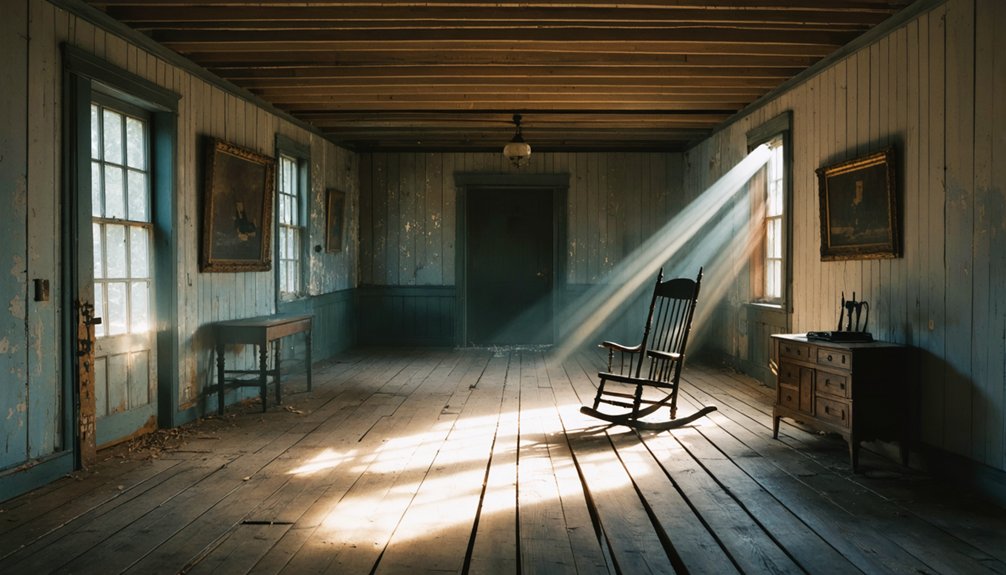
Despite their historical failures, many utopian communities have experienced remarkable afterlives through preservation efforts that transform their ruins into cultural heritage sites.
Among these efforts, reviving ghost towns in the Midwest offers a unique opportunity to reconnect communities with their past. Such restoration projects not only highlight historical significance but also promote tourism, drawing visitors eager to experience a slice of forgotten American history. As these towns come back to life, they can serve as vibrant hubs for cultural exchange and local economies.
The ghosts of utopias past live on in carefully preserved ruins, speaking to our enduring fascination with alternative futures.
Formal recognition through National Historic Landmark status and Register listings has preserved the cultural significance of sites like Brook Farm, New Harmony, and The Ardens.
You’ll find communities adapting in unexpected ways: Armsmear became a retirement home, while Lutheran churches repurposed Brook Farm buildings as orphanages.
The ongoing preservation of Coltsville through National Park designation demonstrates how community engagement transforms industrial history into living heritage. Samuel Colt created a utopian village for his factory workers that included parks and social clubs.
Archaeological efforts face challenges—Nashoba’s memorial succumbed to vandalism, and Llano del Rio lost nearly everything to scavenging neighbors. Registered as California Historical Landmark No. 933, Llano del Rio’s remaining ruins serve as a testament to early socialist experimentation in America.
Yet these preservation efforts, however imperfect, guarantee that utopian experiments remain accessible as living laboratories of alternative social arrangements rather than forgotten footnotes.
Case Studies: Successful Transformations of Abandoned Utopian Spaces
The transformation of abandoned utopian spaces into vibrant cultural landmarks offers compelling evidence that idealistic visions can find new life beyond their original collapse. Hancock Shaker Village exemplifies how meticulous restoration techniques have preserved authentic 19th-century communal architecture while generating sustainable tourism revenue.
Similarly, New Harmony’s educational programming has revitalized Owenite buildings into research destinations that illuminate social experimentation history.
Community involvement proves essential in these revivals. Bishop Hill maintains cultural coherence despite industrial absorption, with locals embracing their collectivist heritage. The vibrant community has preserved its heritage despite the dissolution in 1861 when the commune disbanded its collective ownership structure.
Ephrata Cloister’s preservation since its 1934 closure demonstrates how sustained local interest prevents historical erasure. Even Ripon’s deteriorating longhouse, now converted to apartments, shows adaptive reuse possibilities. The Icarian colony in Nauvoo, Illinois has become an important historical site showcasing how income-sharing communities attempted to create egalitarian societies in the mid-nineteenth century.
These transformations do more than preserve structures—they create living laboratories where you can experience alternative social organizations that once challenged mainstream American individualism.
Blueprint for Revival: Strategies for Sustainable Community Restoration

Sustainable revival of abandoned utopian communities requires more than architectural preservation—it demands a thorough framework integrating ecological, economic, and social dimensions.
You’ll need to incorporate Traditional Ecological Knowledge alongside modern restoration science, respecting both the land’s history and its potential future.
Secure diverse funding through federal programs like the Bipartisan Infrastructure Law while building multi-sector partnerships with tribal organizations, non-profits, and local governments.
This collaborative approach amplifies your restoration impact while ensuring community engagement remains central to decision-making processes.
Implement evidence-based ecological restoration practices that address invasive species while promoting native habitats.
Establish demonstration sites that inspire local participation and build capacity through knowledge sharing and practical training.
Consider joining the global movement of Ecosystem Restoration Communities which has successfully restored over 65,750 hectares across more than 30 countries.
The comprehensive design-build-maintain model can consolidate planning, implementation, and long-term stewardship efforts, ensuring continuity throughout the community revival process.
Frequently Asked Questions
Can Modern Utopian Revivals Exist Without Religious or Spiritual Foundations?
Like seeds in fallow ground, modern utopias can flourish without religious roots when anchored in secular motivations like environmental stewardship, economic justice, and robust community engagement that satisfies our innate need for belonging.
How Do Revived Communities Handle Conflicts Over Historical Interpretation?
You’ll resolve historical narrative conflicts through community dialogue, democratic processes, and external scholarship. Councils curate contested accounts while facilitated mediation integrates multiple perspectives into your evolving communal identity and governance structures.
What Legal Structures Best Protect Revived Communities From Commercialization?
While zoning regulations control external threats, your strongest protection lies in land trusts coupled with robust community governance structures that embed anti-commercialization covenants directly into ownership deeds and operational bylaws.
Do Revived Utopian Communities Attract Diverse Populations?
You’ll find contemporary revived communities attract more diverse populations than historical predecessors, though demographic trends vary widely. Cultural inclusivity efforts now deliberately counter the homogeneity that limited many original utopian experiments.
How Do Revived Communities Balance Historical Authenticity With Modern Sustainability?
Over 75% of revived communities use dual approaches—you’ll find historical preservation zones maintaining authenticity while sustainable innovation flourishes in designated areas, creating a dynamic balance that honors tradition without sacrificing ecological progress.
References
- https://open.baypath.edu/his114/chapter/utopian-communities/
- https://www.nps.gov/articles/000/secular-utopias-in-america.htm
- https://fee.org/articles/the-dark-side-of-paradise-a-brief-history-of-americas-utopian-experiments-in-communal-living/
- https://en.wikipedia.org/wiki/List_of_American_utopian_communities
- https://www.britannica.com/story/american-utopias
- https://guides.loc.gov/chronicling-america-early-utopian-communities
- https://www.yesmagazine.org/health-happiness/2022/06/01/american-communes-failed-experiment
- https://fclir.org/seminar/fall-2023-19th-century-american-utopian-societies/
- https://mrmcarthur.weebly.com/utopian-communities-in-america-1240-lexile.html
- https://www.ic.org/paradisenow/