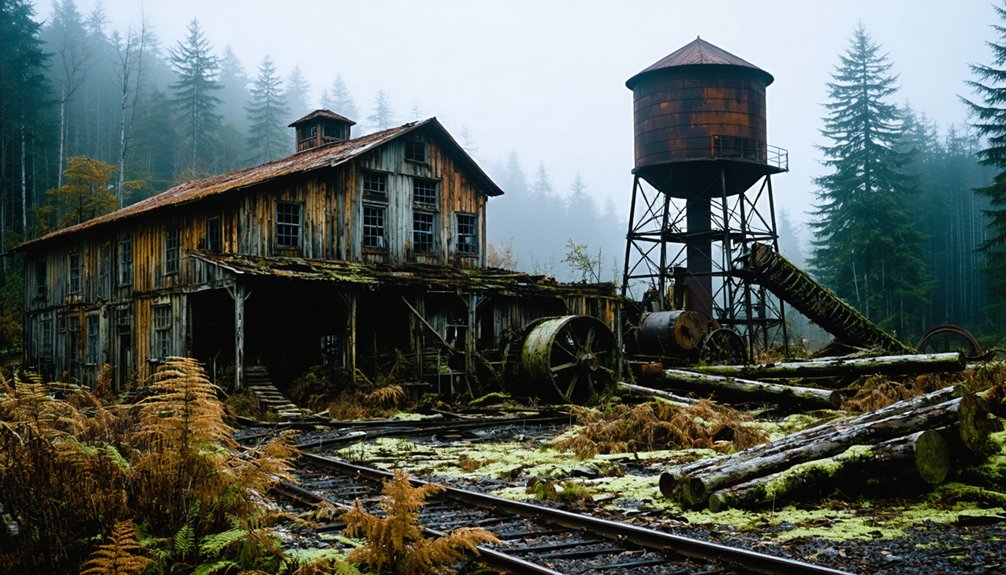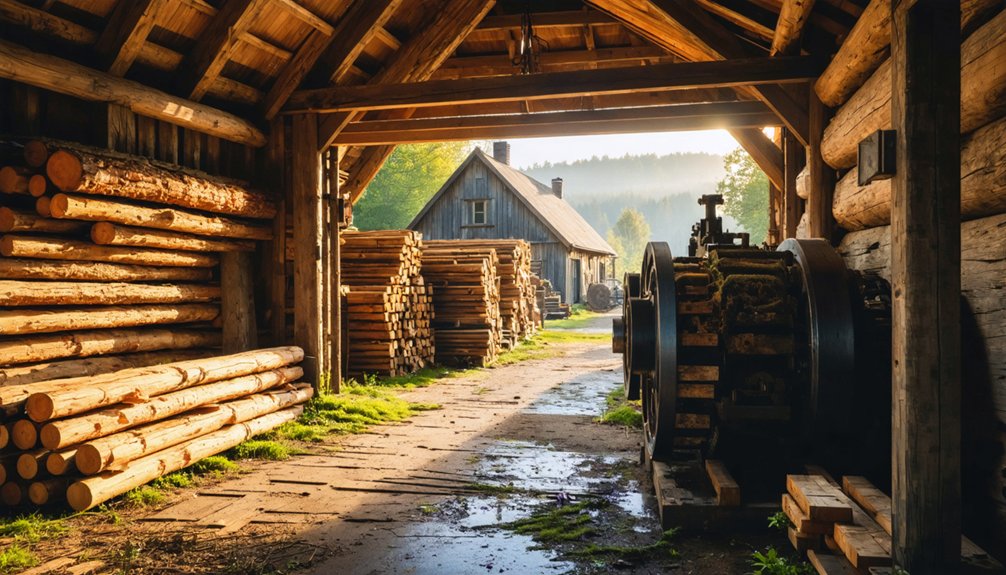
You’ll find new life emerging in America’s abandoned woodcutting villages through environmental restoration, heritage preservation, and economic revitalization efforts. These forgotten timber communities now offer opportunities for sustainable forestry practices, cultural tourism, and community rebuilding. By combining ecological recovery with historical documentation and modern timber management, local groups are transforming these sites while honoring their timber legacy. Discover how these ghost towns are becoming thriving hubs once again.
Key Takeaways
- Historical preservation efforts document tools, machinery and cultural artifacts to safeguard woodland community heritage for future generations.
- Ecological restoration addresses soil compaction, waterway contamination, and reforestation to heal environmental damage from past logging practices.
- Sustainable forestry creates economic opportunities through selective logging, value-added wood products, and repurposing abandoned infrastructure.
- Cultural tourism leverages historical sites for reenactments, guided tours, and archaeological exploration to generate revenue for revitalization.
- Community engagement initiatives rebuild social fabric through volunteer projects, nonprofit partnerships, and infrastructure improvements in former timber towns.
The Rise and Fall of America’s Timber Communities

As the European settlers established their presence across the American frontier in the 1600s, timber quickly emerged as the cornerstone of colonial economic development.
You can trace our timber history from simple pit-sawing operations to revolutionary water-powered sawmills that transformed production efficiency.
These early water-powered facilities emerged by the late 1600s and revolutionized how colonists processed lumber.
By the 1840s, the industry had shifted westward, with Minnesota’s forests yielding to over 20,000 lumberjacks during the golden era of logging.
As ax met pine in the northern wilderness, Minnesota’s timber frontier roared to life with 20,000 strong.
Your ancestors built entire communities around this booming trade, with sawmills employing thousands and timber shipping ports like Bangor, Maine becoming global hubs.
But this prosperity couldn’t last forever.
The Navigation Acts restricted trade with European countries but made exceptions for timber, allowing lucrative exports to Spain, Portugal, and Caribbean islands.
The very resource that built these communities ultimately disappeared as 13.5 million acres of Minnesota’s forests vanished, leaving behind a legacy of community resilience and abandoned villages waiting to be reborn.
Ecological Recovery in Former Logging Territories
While many abandoned logging villages stand as reminders of America’s timber history, the forests themselves tell a remarkable story of renewal. The lands surrounding these ghost towns are undergoing forest regeneration, with many East Coast forests now in their second century of recovery after the logging boom ended around 1920.
You’ll find these recovering ecosystems at different stages—some showing old-growth characteristics after 120 years, while others struggle with soil compaction from heavy machinery. However, these recovery patterns are increasingly threatened as climate change creates warmer and drier conditions that inhibit natural forest regeneration.
Ecological restoration efforts are critical, especially where repeated harvesting has created monocultures lacking biodiversity. This is particularly important in the Southeast, where 90% of wooded land is privately held with minimal protective regulations.
These recovering forests aren’t just scenery; they’re carbon warehouses. The mature federal forests in the West alone store 10.6 gigatons of CO2.
Heritage Preservation of Logging Industry Artifacts
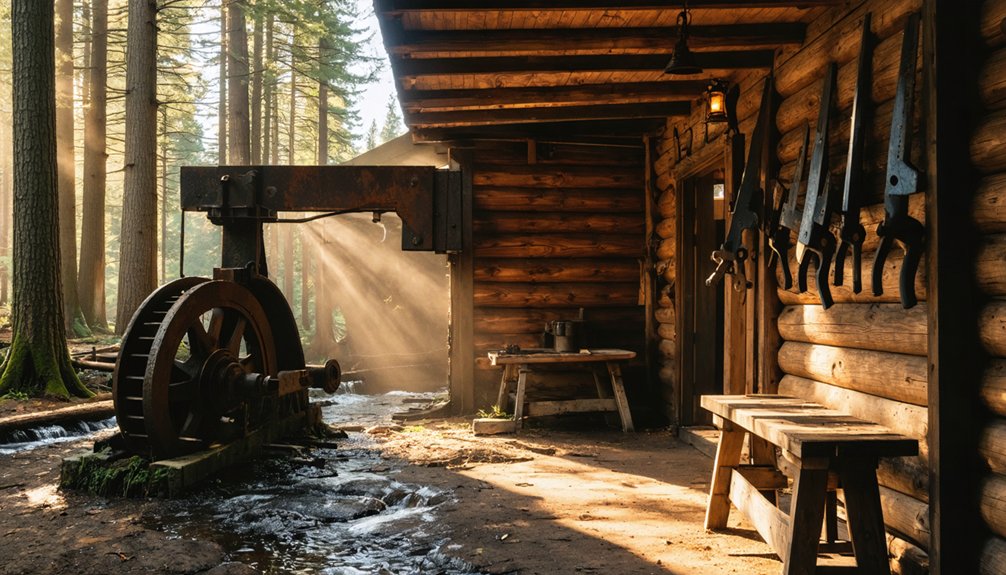
You’ll find critical preservation opportunities in documenting the everyday tools and specialized machinery that defined woodcutting communities.
When cataloging these artifacts, prioritize both the massive sawmill equipment and the hand tools that tell the complete story of logging operations. Implement proper shelter solutions to prevent deterioration, as outdoor storage of these artifacts accelerates damage from environmental factors including moisture, temperature fluctuations, and biological agents. Regular preservation maintenance through inspections and treatments will extend the lifespan of these historical items.
Your preservation efforts should incorporate local knowledge from former industry workers who can explain how these mechanical systems functioned and their significance to the community’s economic foundation.
Documenting Material Culture
The heritage preservation of logging industry artifacts begins with five essential documentation processes that safeguard our woodland community history.
When you discover items in abandoned villages, document them through photographs, drawings, and written descriptions to capture their artifact significance within larger cultural narratives.
GPS mapping connects physical objects to their spatial context, revealing how your ancestors organized their lives around the forest economy.
- Tools and machinery fragments tell stories of technological adaptation
- Personal items reveal daily life beyond the workday
- Building remnants show community structure and social hierarchies
- Oral histories fill gaps where physical evidence has deteriorated
Don’t forget to catalog each item with unique identifiers and metadata—this grassroots documentation creates a foundation for community-led preservation that keeps your logging heritage alive for generations. For items containing pigments, be aware that exposure to light may cause oxidation processes that permanently alter their appearance and chemical composition.
Preserving Sawmill Machinery
Ancient sawmill machinery stands as the beating heart of woodland communities, requiring specialized preservation techniques to maintain both its historical significance and functional capabilities.
When you’re preserving these industrial treasures, focus on routine lubrication of moving parts and rust removal to maintain mechanical integrity. Joining preservation clubs and attending workshops can foster valuable connections with like-minded individuals who share expertise in antique machinery restoration.
Apply automotive wax and custom-fabricated breathable covers to protect metal surfaces from moisture and corrosion. You’ll want to store components in climate-controlled environments to prevent decay of wooden elements. The successful restoration of Hope Mill demonstrates how community organizations can maintain historic turbines and saw equipment for educational demonstrations.
During machinery restoration, prioritize repair over replacement, maintaining original wear patterns while ensuring parts remain distinguishable from modern additions.
Creating operational exhibits isn’t just about preservation—it’s about education.
Economic Opportunities Through Sustainable Forestry
You’ll find that modern timber management practices now utilize GPS and satellite monitoring to sustainably track tree growth cycles while maintaining up to 90% of forest biodiversity.
Your community can generate substantial economic value by implementing selective logging and reforestation programs that reduce wildfire risk by 40% through controlled thinning.
With value-added wood products like cross-laminated timber commanding 10-20% price premiums in both domestic and international markets, your abandoned village’s infrastructure can be repurposed for modern sustainable wood processing.
Many abandoned locations across America have fascinating stories similar to ghost towns that once thrived with bustling communities before their eventual decline.
In particular, ghost towns in the western United States offer a glimpse into a forgotten era, with remnants of old structures and artifacts telling tales of their past. Visitors to these sites can experience the eerie silence that hangs in the air, often imagining the bustling life that once filled the streets. Each ghost town has its own unique history, shaped by the booming industries and harsh realities that ultimately led to their abandonment.
Modern Timber Management Practices
Modern timber management has evolved dramatically from simplistic clear-cutting practices to sophisticated, technology-driven approaches that maximize both forest health and economic returns.
You’ll find sustainable practices now integrate cutting-edge timber technology that empowers rural communities while preserving natural resources.
When revitalizing your woodcutting village, consider these advancements:
- GIS and drone mapping to identify ideal harvest areas while protecting sensitive ecosystems
- Reduced Impact Logging techniques that minimize soil disturbance and preserve future growth
- Data analytics for precision harvest scheduling that prevents overcutting
- Variable Retention harvesting that mimics natural forest cycles
Value-Added Wood Products
Beyond raw timber production, the economic backbone of revitalized woodcutting villages rests in value-added wood products that can transform struggling communities into thriving manufacturing hubs.
You’ll discover robust economic potential in specialized sectors like custom furniture, cabinets, and engineered wood composites.
With over 800 facilities employing 20,000 workers in Wisconsin alone, value added innovation creates significant opportunities for your community.
Small-to-medium operations generating $1-5 million annually demonstrate viable growth paths for rural entrepreneurs.
Don’t overlook low-grade wood markets—70-80% of harvested timber volume in some regions.
These materials fuel market expansion in biomass, pellets, and specialty products while simultaneously improving forest health through proper management.
Your community can capture $3 billion in economic impact by developing these interconnected forest product industries.
Cultural Tourism and the Ghost Towns of Timber’s Past

As abandoned woodcutting villages scatter across America’s landscape like forgotten time capsules, they’ve become unlikely treasures for cultural tourism in the 21st century.
You’ll discover authentic experiences walking through history as nature reclaims these once-bustling centers of industry.
Communities seeking economic renewal through ghost town exploration can tap into visitors’ fascination with industrial heritage:
Rural economies find new life through industrial ruins, transforming forgotten history into sustainable tourism opportunities.
- Original buildings and machinery frozen in time create compelling opportunities for historical reenactments
- Guided tours sharing socioeconomic conditions and environmental impacts connect past to present
- Wildlife interactions add ecological dimensions to cultural experiences
- Archaeological evidence reveals complex abandonment patterns telling human stories of adaptation
These timber ghost towns aren’t just relics—they’re assets for rebuilding local economies while preserving the independent spirit that built these communities in the first place.
Rebuilding Community in Abandoned Rural Spaces
The revitalization of abandoned woodcutting villages moves past mere tourism potential toward extensive community rebuilding.
You’ll find community engagement begins with establishing vibrant centers where both longtime residents and newcomers can reconnect, fostering essential social cohesion.
Volunteer-driven beautification projects don’t just improve aesthetics—they rebuild pride and ownership in these forgotten places.
When you partner local residents with nonprofits and municipal leaders, you create governance structures that last.
Infrastructure improvements are non-negotiable.
Upgrading utilities, broadband internet, and transportation links transforms isolated villages into connected communities where freedom-seekers can thrive.
The most successful revivals balance honoring timber heritage with creating mixed-use spaces that attract diverse populations and businesses.
Remember that community-building isn’t just about places—it’s about creating the social fabric that makes people want to stay.
Environmental Justice and Remediation Efforts
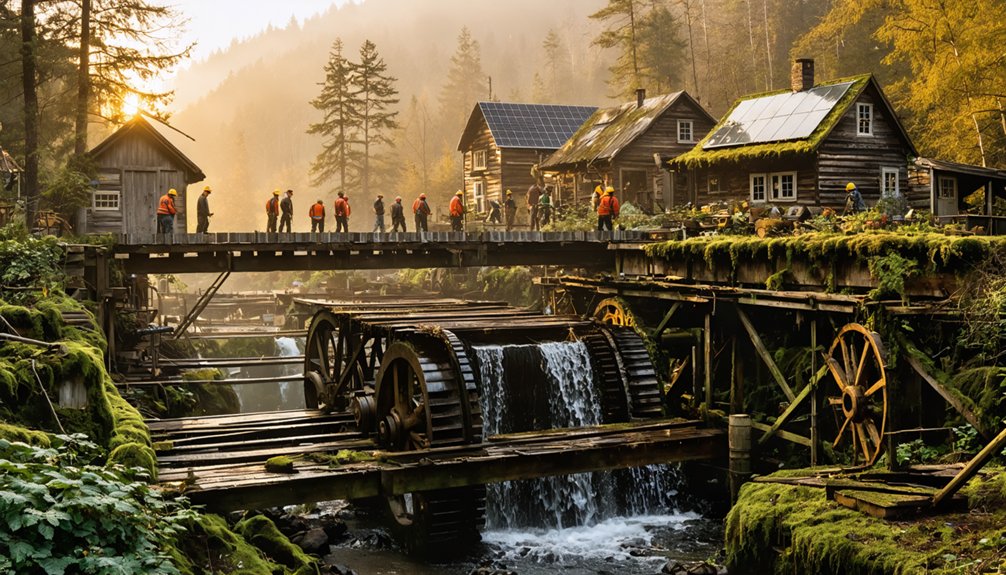
Environmental justice stands at the heart of successful woodcutting village remediation, where decades of industrial activity have left contaminated soils and waterways in their wake.
You’ll find communities reclaiming their environmental heritage through innovative approaches that address both ecological and social impacts.
Current remediation efforts tackle these challenges through multi-faceted strategies:
- Treatment systems removing acidic contaminants from local watersheds, allowing native trout to return to streams once declared dead
- Regrading and erosion control projects that prevent further contamination while creating opportunities for community renewal
- Wood utilization programs converting restoration by-products into sustainable building materials
- Partnerships leveraging the Good Samaritan Act to protect volunteer groups from liability during cleanup projects
These community-driven solutions guarantee environmental justice reaches the rural communities most affected by industrial abandonment, creating pathways to ecological and economic revival.
Case Studies: Successful Revival Models Across Regions
Across rural landscapes where environmental remediation has taken root, distinctive revival models now offer blueprints for communities seeking to breathe new life into abandoned woodcutting villages.
You’ll find remarkable transformation in places like Mullan Village, where private investment restored derelict buildings and converted an abandoned factory into a thriving business. This approach celebrates timber heritage while creating multifunctional spaces that blend work, living, and community connection.
Indigenous models demonstrate community resilience through collaborative forest management. The Wood for Life partnership exemplifies this approach—reducing wildfire risk while providing essential resources to Navajo and Hopi communities.
Indigenous knowledge creates sustainable solutions where ecological health and community needs intertwine rather than compete.
By reintroducing traditional practices like cultural burning, these projects honor ancestral knowledge while addressing modern needs.
Miller’s Rustic Sawmill shows how innovation in small-town timber businesses can revitalize local economies without sacrificing rural identity.
Frequently Asked Questions
Were Woodcutting Villages Racially Integrated or Segregated?
Woodcutting villages were mostly segregated. You’ll find that racial dynamics varied by region—Southern towns maintained strict segregation while Northern communities allowed limited integration in schools and community interactions despite segregated housing.
What Happened to Workers When Timber Resources Were Depleted?
You’d think timber workers found greener pastures, but you’ve actually faced harsh economic decline when resources vanished. You’ve experienced layoffs, struggled with job changes, and often had to relocate your families entirely.
Did Any Indigenous Communities Participate in Commercial Logging Economies?
Yes, you’ll find numerous indigenous logging operations nationwide. The Menominee, Navajo, Warm Springs, and White Mountain Apache tribes all created successful economic participation through sustainable forestry enterprises.
How Did Women Contribute to Woodcutting Village Economies?
While men swung axes, women’s roles shaped village prosperity through direct woodcutting labor, skilled trades like blacksmithing, business management, and support work—creating substantial economic impact that kept communities thriving.
What Religious Practices Emerged in Isolated Timber Communities?
You’ll find that isolated timber communities developed unique spiritual gatherings blending indigenous ceremonies, Christian practices, and occupational rituals. These faith traditions fostered community resilience while honoring both ancestral connections and forest relationships.
References
- https://www.thetravel.com/us-ghost-towns-that-are-still-abandoned/
- https://en.wikipedia.org/wiki/History_of_the_lumber_industry_in_the_United_States
- https://crowcanyon.org/ResearchReports/WoodsCanyon/Text/wcpw_abandonment.php
- https://www.srs.fs.usda.gov/pubs/gtr/gtr_srs257.pdf
- https://www.americanforests.org/article/north-american-forests-in-the-age-of-man/
- https://pmc.ncbi.nlm.nih.gov/articles/PMC8106319/
- https://communityprogress.org/blog/how-vacant-abandoned-buildings-affect-community/
- https://ourworldindata.org/deforestation
- https://www.mnhs.org/foresthistory/learn/timeline
- https://www.cherryoutlet.net/history-of-the-logging-industry-in-the-united-states/