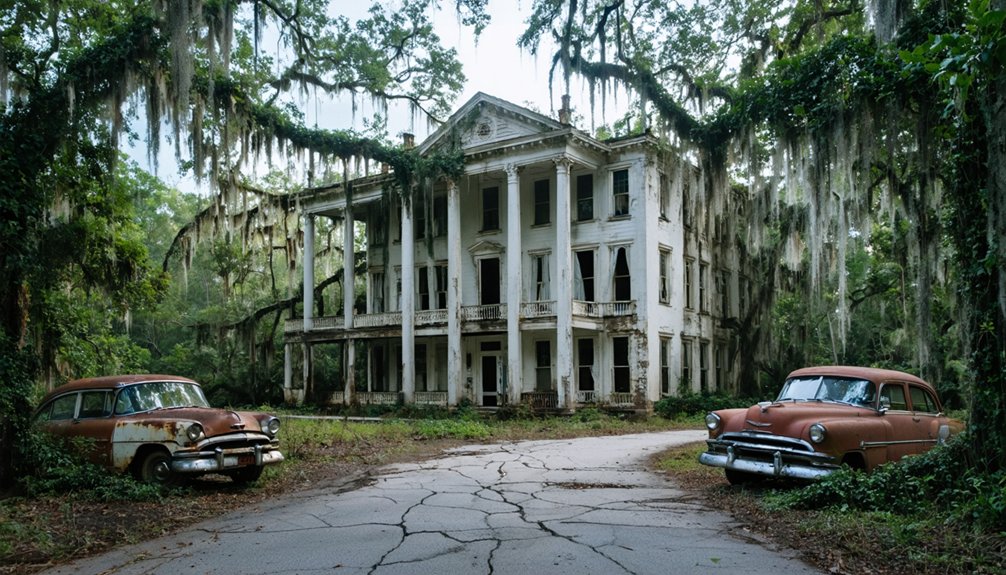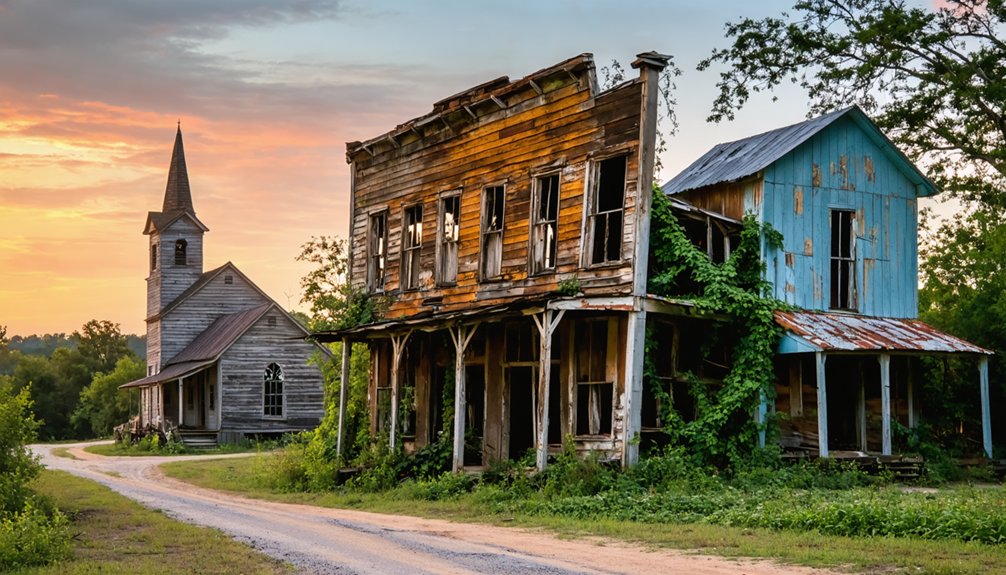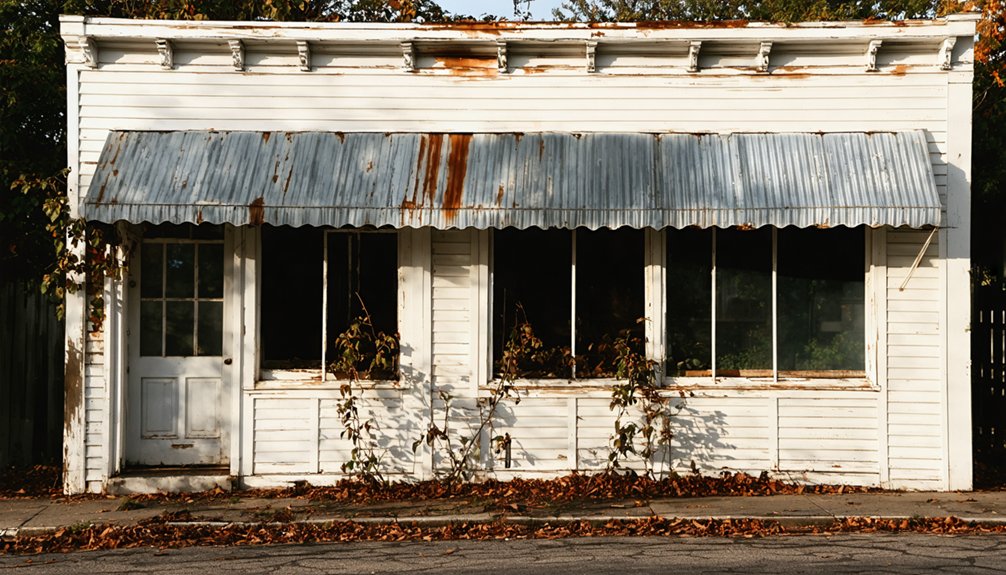
To revive a forgotten Southern ghost town, you’ll need to identify sites with historical significance and physical remains worth preserving. Assess infrastructure needs and untangle complex property ownership issues before securing funding through historic preservation grants and tax credits. Develop heritage tourism strategies that connect visitors with authentic experiences while implementing community engagement initiatives that guarantee economic sustainability. Your restoration project’s success hinges on balancing historical authenticity with practical economic development—the following guide offers the blueprint for your journey.
Key Takeaways
- Identify ghost towns with intact structures, historical significance, and accessibility to major highways for tourism potential.
- Address fragmented property ownership through thorough title searches and navigate historic preservation requirements.
- Secure funding through federal programs like the Historic Preservation Fund and tax credits for restoration projects.
- Develop immersive heritage tourism experiences with themed tours and connections to nearby natural attractions.
- Build community engagement through historical reenactments, local entrepreneurship support, and inclusive decision-making processes.
Identifying Ghost Towns With Restoration Potential

Identifying abandoned settlements with authentic restoration potential requires a methodical approach that balances historical significance, physical condition, and practical considerations.
Begin your assessment by researching census records, local archives, and historical markers that verify the town’s existence and importance in regional development. Towns tied to major industries like mining or railroads typically offer richer historical significance for preservation efforts.
Next, evaluate the visible structural evidence on-site. Locations with standing buildings, intact foundations, or a discernible town layout provide tangible assets for restoration. The quantity and condition of these structures will directly impact feasibility.
Towns with preserved architectural features or a recognizable main street merit priority consideration. Remember that accessibility matters too—proximity to highways and natural attractions can transform a forgotten settlement into a viable heritage tourism destination. Be aware that many towns have lost buildings to fire hazards, particularly those with predominantly wooden structures. Consider towns that can be maintained in a state of arrested decay, which preserves their authentic historical appearance while ensuring visitor safety.
Assessing Infrastructure and Property Ownership Challenges
While undertaking a ghost town restoration project, you’ll inevitably confront the dual challenges of deteriorated infrastructure and convoluted property ownership situations that can greatly impede progress.
Infrastructure decay manifests in multiple systems—water lines, sewage treatment, and electrical grids typically require complete overhauls, with rehabilitation costs often reaching millions.
The cost of reviving ghost town utilities often exceeds expectations, with basic services requiring total reconstruction.
Property fragmentation presents equally formidable obstacles. You’ll encounter unclear titles, abandoned deeds, and properties with multiple heirs—complications that necessitate extensive legal research before restoration can commence. The dramatic economic decline experienced in places like Waynesburg illustrates how communities can transform from vibrant centers to near-ghost towns when top-down regulations hollow out essential industries. The rise in housing vacancies across Sunbelt cities now mirrors patterns previously only seen in Rustbelt regions, creating new challenges for restoration efforts.
Exploring abandoned places in Ohio unveils stories of past prosperity and lost potential, emphasizing the urgent need for revitalization. These locations often serve as stark reminders of economic shifts, where once-thriving communities face uphill battles against decay. Restoring these sites could not only preserve history but also spark new growth and opportunities for local residents.
Local regulations compound these difficulties, as zoning ordinances and historic preservation requirements may restrict development options. Environmental remediation mandates further increase costs, particularly in former industrial sites.
Before committing resources, conduct thorough infrastructure assessments and title searches.
Consider forming stakeholder coalitions to navigate regulatory hurdles and resolve ownership disputes collectively, as fragmented approaches rarely succeed.
Securing Funding Through Grants and Public-Private Partnerships
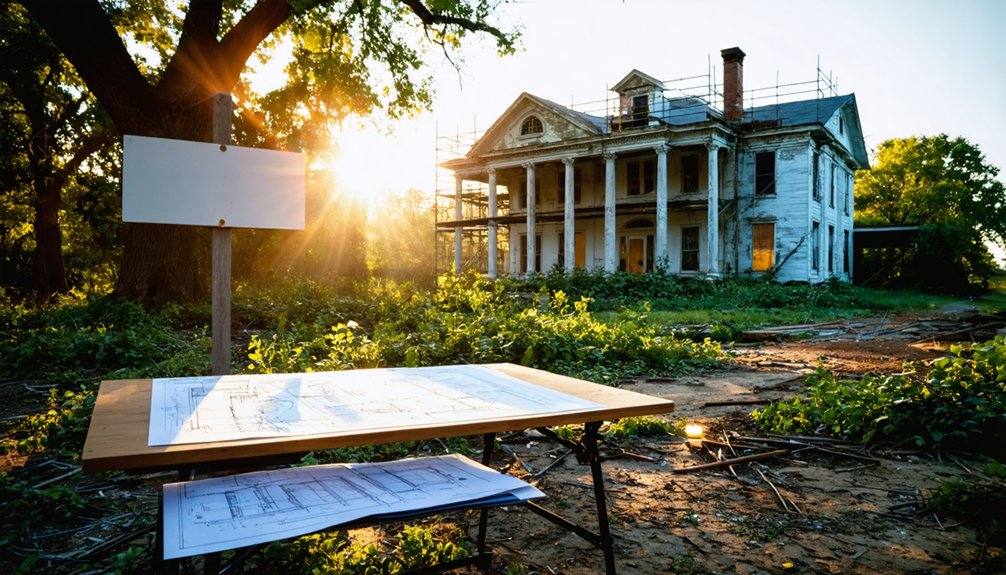
Once you’ve navigated the complex landscape of infrastructure challenges and property ownership disputes, funding becomes the key element of any successful ghost town restoration project.
The Historic Preservation Fund (HPF) represents your primary federal funding source, having distributed over $1 billion nationwide since 1968.
Your grant application should target programs specifically designed for heritage preservation. The Save America’s Treasures program offers competitive grants for historically significant sites, while the Underrepresented Community Grant Program funds projects serving marginalized populations.
Consider exploring the Abandoned Mine Land Economic Revitalization (AMLER) program, which has allocated $122.5 million to transform legacy coal mining sites into economically viable assets.
Form public partnerships with State Historic Preservation Offices, which serve as primary administrators for federal preservation grant distribution. Look to successful projects like the Electric Works development in Indiana, which created a $286 million public-private partnership focused on community impact. Consider joining HistoricFunding.com’s database for access to over 8,000 funding sources specifically curated for preservation projects.
The Federal Historic Tax Credit program can also provide vital financial support through public-private collaboration.
Implementing Heritage Tourism and Economic Development Strategies
After securing adequate funding, your focus must shift toward implementing thorough heritage tourism and economic development strategies that transform dormant ghost towns into vibrant destinations.
Begin by inventorying and documenting all historic assets, from architectural remnants to oral histories, ensuring authentic heritage preservation forms your foundation.
Heritage preservation begins with meticulous documentation—every artifact, structure, and story becomes the authentic foundation upon which revival stands.
Develop immersive experiences through themed walking tours, interpretive signage, and digital platforms that showcase both tangible structures and intangible cultural elements. Embrace the shift from passive sightseeing to participatory learning experiences that engage visitors in hands-on historical activities.
Create bundled itineraries connecting heritage sites with natural attractions to extend visitor stays. Mining tourism can provide exceptional opportunities to explore the historical industrial features that shaped these communities’ identities and economies through guided underground tours. Implement local procurement policies to maximize economic multipliers, recognizing overnight visitors generate up to 80% of regional benefit.
Strategically enhance infrastructure with visitor centers and digital connectivity while maintaining historical integrity.
Establish data collection systems to measure tourism strategies’ effectiveness, allowing for nimble adjustments based on quantifiable outcomes and community feedback.
Building Community Engagement for Long-Term Sustainability

The heartbeat of any successful ghost town revitalization lies in meaningful community engagement that transcends initial enthusiasm to establish sustainable momentum.
You’ll need to articulate measurable objectives that honor local heritage while tracking progress against defined benchmarks.
Foster inclusivity through stakeholder collaboration that welcomes diverse voices and accessible spaces.
Empower residents through community workshops that build skills and transfer ownership of projects to local leaders. Drawing from expertise in developing systems that generate community revenue, these workshops can establish foundations for long-term economic sustainability.
Deploy varied engagement tactics—from historical reenactments to social media campaigns—while implementing feedback mechanisms that demonstrate you’re genuinely responsive to community input. Create shared experiences through community events to foster stronger connections among participants and build lasting relationships.
Frequently Asked Questions
How Long Does a Typical Ghost Town Revitalization Project Take?
Time is of the essence in ghost town timelines. You’ll face revitalization challenges spanning 5-15 years, with early planning taking 1-3 years and construction requiring 3-7 years to complete.
Can Residents Claim Abandoned Properties Through Adverse Possession Laws?
Yes, you can claim abandoned properties through adverse possession if you meet legal requirements including continuous occupation, hostility, openness, and payment of taxes for the state-mandated period (5-20 years).
What Environmental Hazards Are Most Common in Southern Ghost Towns?
Standing in freedom’s shadow, you’ll face a lethal trinity: dioxin and heavy metals in soil contamination; sinkholes and flooding from unstable geology; and toxic releases from abandoned infrastructure like chemical plants.
How Do You Manage Wildlife That Has Reclaimed Abandoned Areas?
You’ll need to implement strategic wildlife management with minimal intervention, focusing on habitat restoration that preserves natural reclamation while selectively controlling hazardous interactions between humans and wildlife through professional assessment.
Are There Tax Incentives Specific to Ghost Town Restoration Projects?
Like a phoenix rising from forgotten ashes, you’ll discover substantial tax credits through federal historic preservation programs, state-level incentives, local tax abatements, and complementary funding sources specifically targeting historic property rehabilitation projects.
References
- https://www.theglobalstatistics.com/abandoned-places-in-us/
- https://www.tpr.org/economy-and-labor/2024-11-14/texas-uneven-population-boom-is-creating-ghost-towns-in-many-rural-counties
- https://247wallst.com/housing/2024/04/11/americas-modern-ghost-towns-2/
- https://www.youtube.com/watch?v=hS27BhfMojc
- https://www.mentalfloss.com/geography/wanderlust/creepiest-ghost-towns-united-states
- https://www.geotab.com/ghost-towns/
- https://www.youtube.com/watch?v=odbOj8W4V9o
- https://travelnoire.com/reviving-ghost-towns-sustainable-tourism-in-abandoned-places
- https://www.popularmechanics.com/home/a34632324/bought-ghost-town/
- https://grokipedia.com/page/Ghost_town