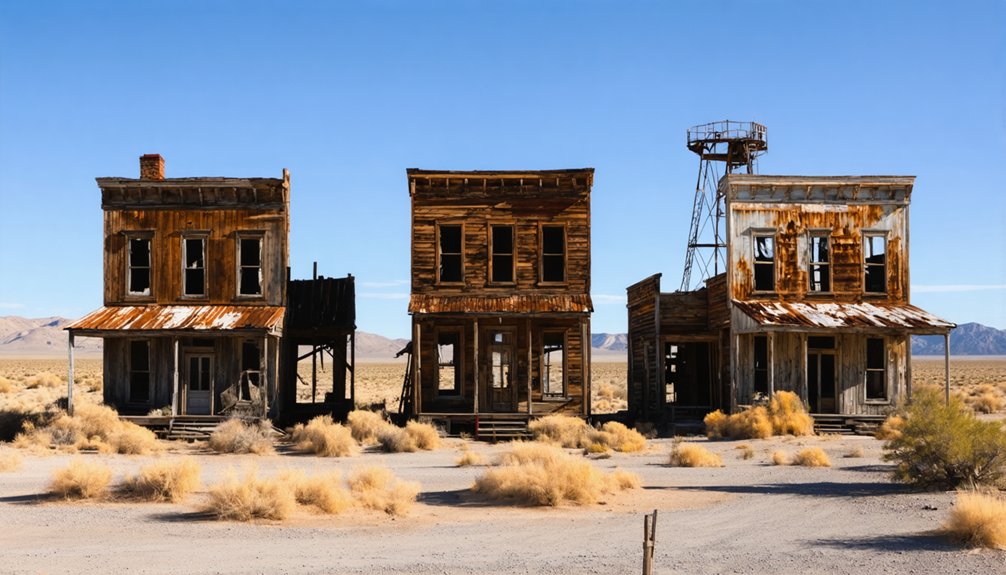
To revive Nevada’s abandoned mining towns, you’ll need to target locations with preserved structures and continuous habitation patterns, like Belmont and Goldfield. Secure funding through EPA Brownfields grants while maneuvering claim filing requirements and environmental remediation challenges. Form robust stakeholder coalitions involving federal, local, and tribal organizations. Implement sustainable tourism models with self-guided tours and visitor centers. The path forward combines historical preservation with strategic economic development to breathe new life into these forgotten treasures.
Key Takeaways
- Identify towns with preservation potential like Goldfield and Belmont that show continuous habitation patterns or substantial structural remains.
- Conduct thorough historical assessment using interdisciplinary methods that combine archaeological evidence with archival research.
- Secure funding through EPA Brownfields grants and state resources since Nevada lacks access to certain federal infrastructure funds.
- Navigate legal requirements for claim acquisition and comply with Nevada’s reclamation legislation and environmental remediation standards.
- Build stakeholder coalitions involving federal, local, and tribal organizations while developing sustainable tourism models that preserve authenticity.
Identifying the Most Promising Ghost Towns for Revival
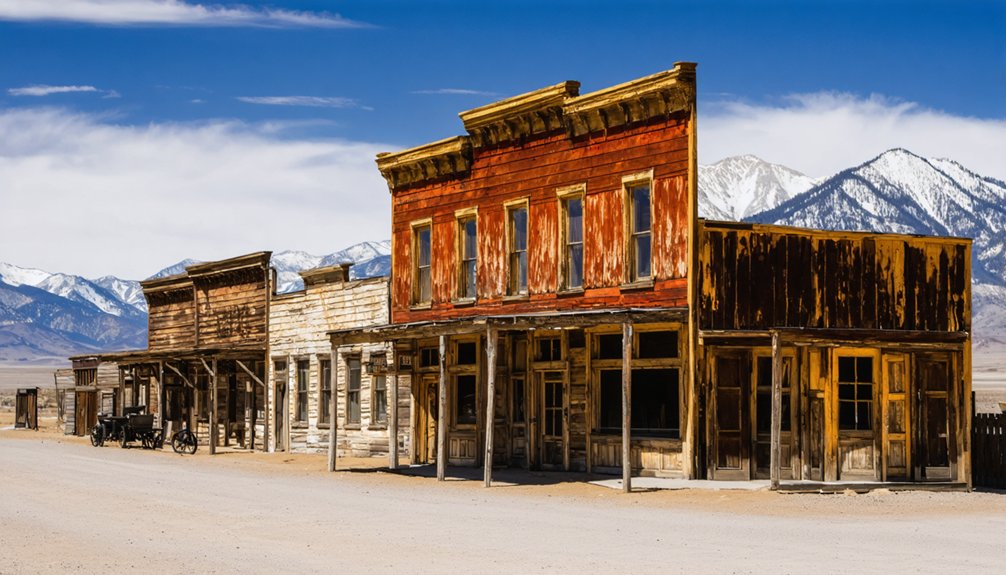
Analysis of ghost town demographics reveals that Belmont and Jarbidge stand apart with continuous habitation patterns, providing existing community frameworks essential for sustainable revival.
Tonopah and Pioche demonstrate how mining heritage preservation can anchor economic sustainability through their living town status.
Rhyolite presents exceptional potential with its substantial structural remains and tourism appeal as Nevada’s most photographed ghost town.
Similarly, Goldfield’s preserved courthouse, hotel, and history of supporting 30,000 residents indicate robust infrastructure capacity.
For strategic investment, prioritize locations between Las Vegas and Reno that combine accessible geography with preserved structures.
The most promising candidates feature a combination of standing historical structures, documented economic potential, and established visitor interest or existing population bases.
These abandoned sites offer visitors unique opportunities to witness the haunting atmosphere that characterizes Nevada’s mining era while exploring remnants of once-thriving communities.
Virginia City offers a successful revival model with its numerous historic buildings and active tourism industry in Storey County.
Historical Assessment and Documentation Techniques
While the revival of Nevada’s ghost towns presents compelling economic opportunities, the process must begin with rigorous historical assessment and documentation techniques to guarantee authentic preservation.
Authentic revival demands methodical investigation before economic considerations can take center stage.
You’ll need to employ interdisciplinary methods that combine archaeological evidence with archival research to reconstruct these settlements’ narratives accurately. Historical mapping using GIS technology creates spatial context while artifact analysis reveals daily life patterns and economic activities. The Comstock Lode discovery in 1859 created numerous mining settlements that now represent important historical sites for preservation efforts.
- Cross-reference mining records with physical evidence to validate site authenticity
- Deploy drone photography and 3D scanning for thorough structural documentation
- Examine ore samples and tailings to understand the geological foundations of each settlement
- Conduct stratigraphic analysis to establish clear occupation timelines
- Create digital databases integrating archaeological findings with historical photographs and documents
For towns like Bonnie Claire with poorly documented history, researchers must rely heavily on physical evidence such as mill foundations and stone structures to piece together the settlement’s evolution.
Securing Funding and Resources for Restoration Projects

To effectively restore Nevada’s abandoned mining towns, you’ll need to navigate a complex landscape of funding opportunities that present both significant challenges and strategic possibilities.
Exploring forgotten mining towns in Nevada can reveal hidden historical treasures and untapped potential for tourism. These towns, rich in stories of the past, offer a unique opportunity for revitalization and economic development. By investing in their restoration, we can breathe new life into these once-thriving communities, attracting visitors eager to experience their heritage.
Unlike coal mining states, Nevada can’t access the $11.3 billion Bipartisan Infrastructure Law‘s AML funds, forcing reliance on limited state resources from mining claim fees.
Your funding strategies should target the EPA’s Brownfields grants, which support assessment and cleanup of contaminated sites.
Consider Multipurpose Brownfields Grants offering up to $800,000 for extensive projects.
Prepare competitive grant applications for the underfunded Abandoned Hardrock Mine Reclamation program, which receives only $5-7 million annually.
Partner with Nevada’s economic development resources, including regional development corporations and the Governor’s Office of Economic Development, to maximize access to available federal assistance.
With an estimated 400 million dollars needed to seal all of Nevada’s hazardous abandoned mines, restoration projects must carefully prioritize the most critical sites.
Nevada is among several states explicitly excluded from eligibility for the coal reclamation funding program that distributes $725 million annually to qualifying jurisdictions.
Building Stakeholder Coalitions and Community Support
Successful revitalization of Nevada’s abandoned mining towns hinges considerably on your ability to forge robust stakeholder coalitions and cultivate genuine community support throughout the restoration process.
You’ll need to employ extensive stakeholder engagement strategies that integrate federal entities, local governments, tribal representatives, and grassroots organizations. The Nevada Division of Environmental Protection’s methodical outreach framework provides an exemplary model for systematically identifying and involving essential participants.
Effective stakeholder coalitions require integration of federal, local, tribal and grassroots entities using proven methodical frameworks.
- Implement virtual engagement tools such as video tours and dedicated websites to reach dispersed rural populations
- Conduct vision-setting workshops that capture authentic community priorities
- Establish transparent communication channels addressing environmental and safety concerns
- Form collaborative forums similar to the Animas River Stakeholders Group
- Deploy community surveys to document local needs while preserving historical integrity
Your community outreach efforts must balance preservation of rural character with economic revitalization—a delicate equilibrium that respects residents’ autonomy while securing their investment in the transformation process. As demonstrated in Lovelock, Nevada, effective engagement can double participation rates when featuring community leaders in promotional materials and utilizing grassroots advertising approaches. The Vision 2 Action process offers a proven methodology for community outreach and engagement that connects residents with the entire brownfield reuse process from assessment to final development.

Maneuvering the intricate legal landscape surrounding Nevada’s abandoned mining towns requires your thorough understanding of multiple statutory frameworks that govern claim acquisition, abandonment determination, and reclamation processes.
When relocating abandoned lode claims, you’ll need to establish new monuments, file duplicate certificates, and submit two copies of your claim map with the county recorder within 90 days.
Legal compliance hinges on recognizing that tailings left unworked for 10 consecutive years constitute prima facie evidence of abandonment under NRS 517.115.
Your regulatory navigation must account for NDOM’s oversight of the Abandoned Mine Lands program.
Whether working on public or private lands, you’re subject to different coordination requirements.
Be aware that each claim filing requires payment of specific filing fees to the county recorder, who then transfers portions of these fees quarterly to the Division of Minerals.
Any reclamation plan you develop must comply with Nevada’s reclamation legislation that has been in place since 1989, establishing rigorous standards for restoring mined lands.
Environmental Remediation and Safety Measures
If you’re planning to revitalize an abandoned mining site in Nevada, you’ll need to implement extensive contamination cleanup methods addressing heavy metals and acid mine drainage through capping, containment, or removal of hazardous materials.
Mine shaft safety requires immediate attention through securing open shafts, stabilizing compromising structures, and installing proper drainage systems to prevent environmental contamination.
The effectiveness of your remediation efforts will depend on thorough site assessment, appropriate technology selection, and ongoing monitoring to guarantee long-term environmental and public safety.
Contamination Cleanup Methods
The environmental remediation of Nevada’s abandoned mine sites presents complex challenges that require tailored cleanup approaches to address widespread contamination issues.
When you’re tackling these sites, you’ll need to employ various remediation technologies targeted at specific contamination sources. Federal funding remains limited at $5-7 million annually, despite the $3 billion authorization in the Bipartisan Infrastructure Act.
- Capping mining waste prevents erosion and limits exposure to toxic materials
- Redirecting stream flows away from tailings minimizes water contamination
- Installing drainage systems at adits controls acidic, metal-laden discharge
- Removing waste rock and tailings reduces long-term contamination risks
- Implementing low-cost, low-maintenance water treatment systems for impacted sources
Your remediation strategy should prioritize sites based on human exposure risk, environmental impact, and economic viability—balancing immediate hazard reduction with long-term sustainability goals.
Mine Shaft Safety
Addressing the lethal hazards of Nevada’s abandoned mine shafts requires extensive safety measures to mitigate numerous life-threatening risks.
You’ll encounter unstable rock formations that collapse without warning, decayed timber supports barely holding their weight, and water-filled pits with slippery walls that have claimed countless lives through drowning.
When implementing safety precautions, prioritize securing shaft openings with steel grates that prevent access while allowing bat migration.
Install robust warning signage and fencing that withstands vandalism.
Be vigilant about identifying winzes—hidden vertical shafts within horizontal tunnels—as these concealed drops create deadly traps for unwary explorers.
Remember that mine shaft hazards extend beyond structural concerns to include unstable explosives that detonate from minor vibrations and environmental dangers from wildlife inhabitants and chemical residues.
Developing Sustainable Tourism and Economic Models
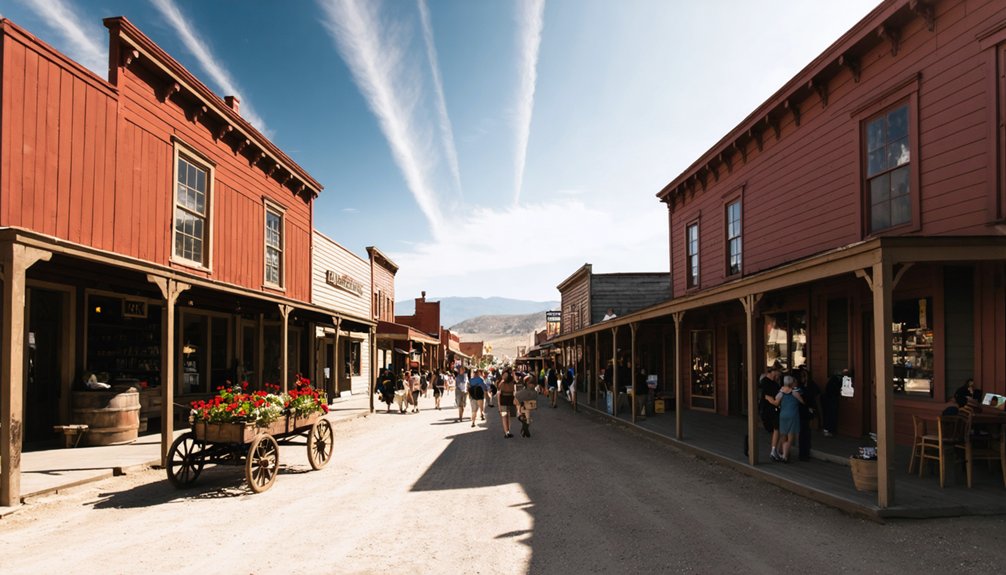
While Nevada’s abandoned mining towns stand as evidence to bygone boom-and-bust cycles, they now represent untapped economic potential through carefully structured heritage tourism initiatives.
You’ll discover multiple pathways to economic viability when implementing heritage conservation strategies alongside targeted tourism marketing approaches.
- Establish self-guided tours with nominal entry fees ($1-5) that maintain accessibility while generating consistent revenue
- Develop seasonal operation schedules aligned with desert climate conditions (May-September peak seasons)
- Create combination attractions pairing ghost town experiences with nearby natural features or artistic installations
- Implement visitor centers that distribute maps and historical information without requiring extensive infrastructure
- Foster local ownership models that preserve authenticity while protecting structures from deterioration
These sustainable models allow you to monetize historical assets while preserving their intrinsic cultural value—balancing economic development with preservation imperatives.
Frequently Asked Questions
How Do Seasonal Weather Patterns Affect Ghost Town Restoration Timelines?
You’ll encounter significant weather impacts throughout Nevada’s seasons—extreme summer heat, winter snow/ice, and spring/fall flooding all create restoration challenges that force scheduling adjustments and require strategic project planning.
What Technology Best Documents Deteriorating Structures Before They Collapse Completely?
LiDAR technology offers your most thorough solution, combining precise 3D scanning with photogrammetry while drones surveying enables access to otherwise hazardous structures, creating digital twins before inevitable structural failure occurs.
Do Revived Ghost Towns Qualify for Special Tax Incentives?
Yes, your revived ghost town may qualify for federal historic tax credits, Nevada property tax abatements, and STAR bonds—all powerful instruments for economic revitalization of these historically significant frontier settlements.
How Much Authentic Mining Equipment Typically Remains in Abandoned Sites?
You’ll typically find varied equipment remnants depending on site remoteness and historic preservation efforts. Equipment conservation challenges mean most sites retain only 10-30% of original machinery in deteriorated conditions.
Can Indigenous Cultural Claims Impact Revival Projects?
Yes, indigenous cultural heritage claims greatly impact your revival projects through legal disputes, necessitating consultation processes and potentially altering or halting development when sites hold sacred or historical significance to tribal communities.
References
- https://www.legendsofamerica.com/nv-ghosttowns/
- https://en.wikipedia.org/wiki/List_of_ghost_towns_in_Nevada
- https://www.rainesmarket.com/other-nevada-mining-towns.html
- https://savingplaces.org/stories/explore-wild-west-mining-history-in-nevada-ghost-towns
- https://westernmininghistory.com/state/nevada/
- https://www.nevadaghosttownsandmininghistory.com
- https://travelnevada.com/ghost-town/
- https://nvtami.com
- https://forgottennevada.org/sites/newlist.html
- https://www.smithsonianmag.com/sponsored/nevadas-living-and-abandoned-ghost-towns-180983342/