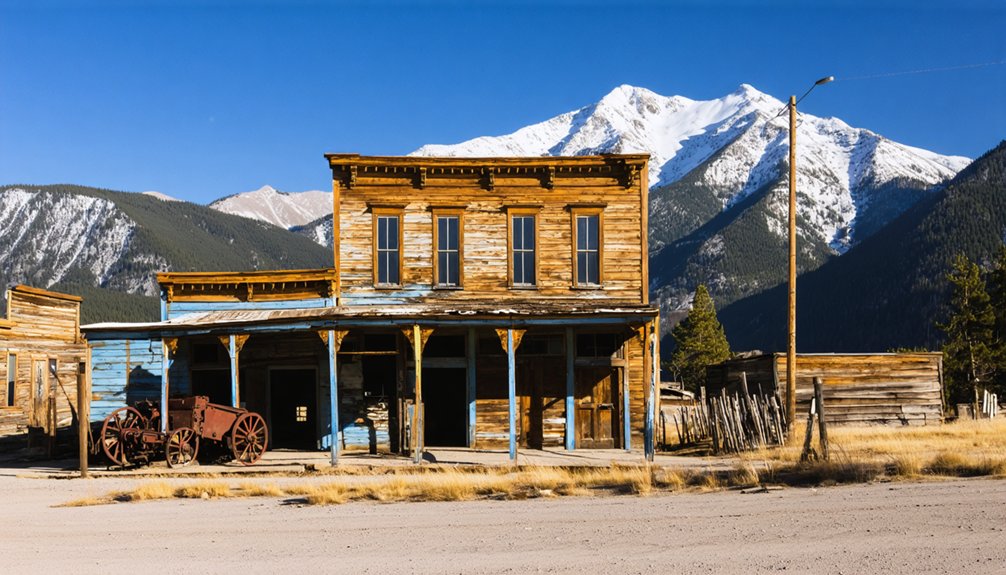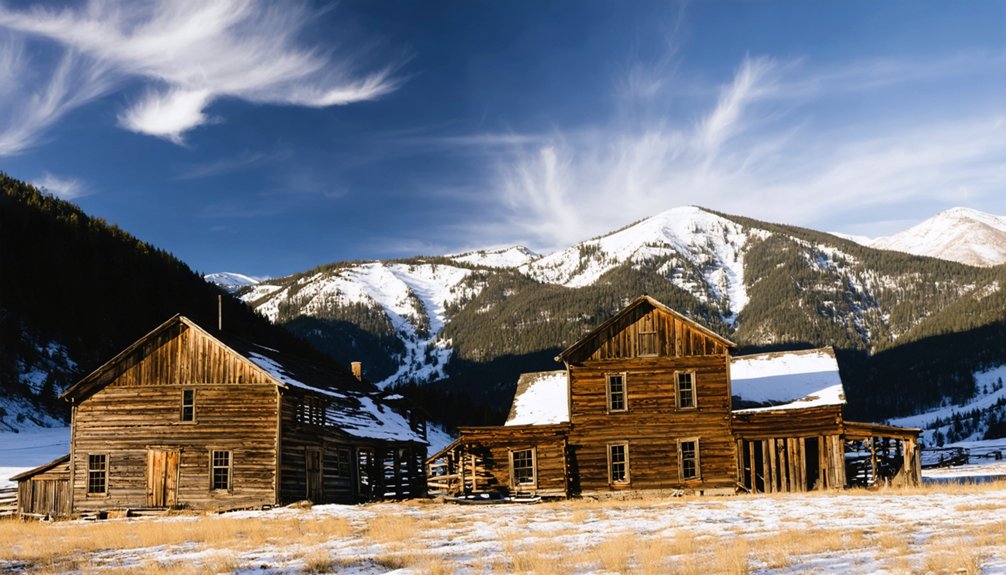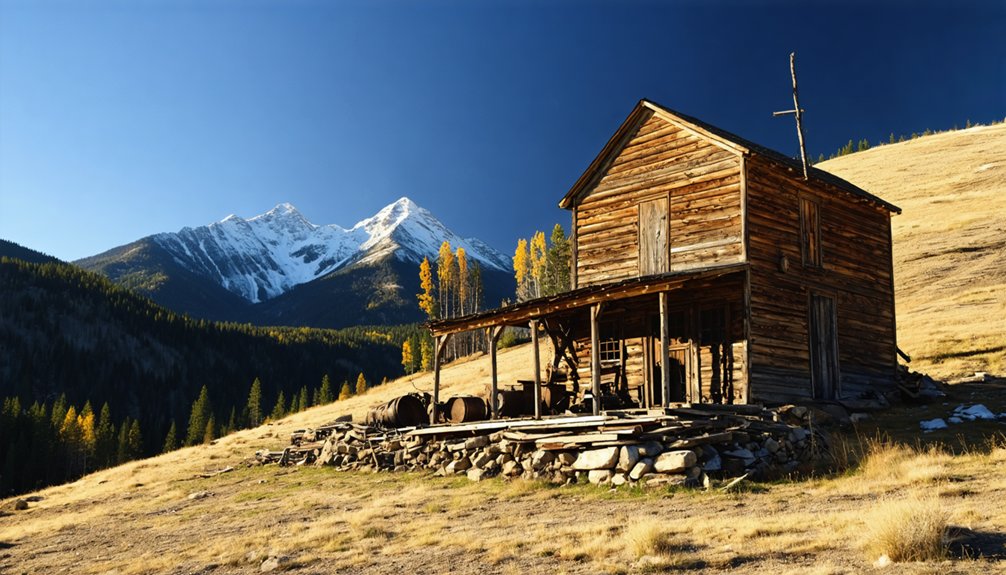
You’ll discover Russell Gulch just outside Central City, Colorado—a genuine ghost town born from William “Green” Russell’s 1858 gold strike. Once home to 2,500 residents and producing $35,000 weekly in gold, the town thrived until placer deposits vanished by 1863. Today, weathered buildings, abandoned mine shafts, and a historic cemetery await your exploration at 9,150 feet elevation. The town’s progressive stance on women’s mining rights adds a unique dimension to its golden legacy.
Key Takeaways
- Russell Gulch was established after William Russell’s 1858 gold discovery, becoming a boomtown with 2,500 residents by 1860.
- The town produced $35,000 weekly in gold with miners extracting 1.25 million ounces by 1865 before resources depleted.
- Visitors can explore remnants including a brick schoolhouse, IOOF Hall, abandoned mineshafts, and a cemetery with Continental Divide views.
- Russell Gulch was uniquely progressive as the city of “Equal Opportunity,” where women could legally own mining claims.
- Best visited between late spring and fall, the ghost town now features a disc golf course amid historic ruins.
The Golden Discovery: William Russell’s Mining Legacy
While the mountains of Colorado stood silent for millennia, it took the keen eye and determined spirit of William Greeneberry “Green” Russell to reveal their golden secrets. Born in 1818, Russell’s gold prospecting skills were honed in California before he ventured to Colorado’s untamed frontier.
In 1858, after nearly three weeks of searching, Russell and Sam Bates struck gold near Little Dry Creek—a 20-ounce find worth about $380 that ignited the Pike’s Peak Gold Rush. His marriage to a Cherokee woman provided valuable connections that informed his exploration of the South Platte basin. You can trace his legacy to June 1859, when his discoveries led to Russell Gulch, a boomtown that quickly swelled to 2,500 residents. Though Russell and his rival John Gregory both made significant discoveries in the region, historical accounts suggest they never acknowledged each other when their paths crossed.
Beyond simple discoveries, Russell pioneered mining innovations through his Fall River Company, bringing essential water infrastructure that transformed isolated strikes into organized industry.
From Boom to Bust: The Rise and Decline of a Mining Town
As you wander the quiet slopes of Russell Gulch today, you’re treading ground where 2,500 souls once scrambled for fortune in 1860, with weekly gold production reaching an astonishing $35,000 during peak operations.
The town’s meteoric rise couldn’t withstand the rapid depletion of its placer gold deposits, which were largely exhausted by 1863, forcing miners to attempt costlier underground operations or simply move on to more promising districts like Leadville. This pattern of migration was common during the Pikes Peak Rush, when prospectors like William Green Russell led expeditions throughout Colorado’s promising mining regions. The rush began in 1859 when thousands of gold seekers flocked to the region with golden dreams painted on their wagons and hearts.
Women enjoyed unusual equality in this mountain community, though such progressive social structures weren’t enough to prevent Russell Gulch’s eventual fade into the ghostly silence that now envelops its remaining weathered structures.
Gold Rush Legacy
When William Green Russell struck gold in the gulch that would bear his name in June 1859, he ignited a feverish rush that would transform this quiet Colorado valley into a bustling frontier boomtown.
Within months, nearly 900 prospectors were chasing dreams in the dirt, collectively pulling $35,000 in gold weekly from the earth.
The mining community swelled to 2,500 residents by 1860, establishing a proper town with schools, lodges, and all the trappings of civilization.
These “Fifty-Niners” extracted an astonishing 1.25 million ounces of gold by 1865, forever altering Colorado’s destiny.
Though the gold rush impacts were powerful, they proved fleeting.
By 1863, most placer deposits were exhausted.
Russell’s discovery was part of what ultimately led to Colorado becoming an official US territory in 1861, setting the foundation for eventual statehood.
The remnants of pioneer life still stand with original IOOF Hall and other structures marking where this vibrant community once thrived.
Today, you’ll find only ghosts and disc golfers where fortune seekers once scrambled, a quiet reflection of freedom’s fleeting promise.
Mining Town Echoes
The rise and fall of Russell Gulch echoes across time like an old miner’s pickaxe striking stone. You can almost hear the rush of water through sluice boxes fashioned from wagon parts as prospectors chased their fortunes in 1859.
The town’s community structure developed rapidly around mining techniques that evolved with necessity. When placers yielded $35,000 weekly, Russell Gulch thrived with 2,500 residents by 1860.
As surface gold vanished by 1863, hydraulic mining briefly sustained the dream. You’d have witnessed a town offering remarkable opportunities, even for women—unusual freedom for the era.
But like many boom towns, Russell Gulch couldn’t outlast its gold. By 1875, only seasonal operations remained, leaving behind the ghost town you might explore today, where mining echoes still linger.
Life at 9,150 Feet: Geography and Living Conditions
Standing at Russell Gulch’s 9,150-foot elevation, you’d be rewarded with panoramic Rocky Mountain vistas, but you’d also face the harsh realities of subarctic winters where temperatures plunged below zero even indoors.
You’d need to haul water from distant mountain meadows and stockpile coal for heating, essential preparations for survival in this high-altitude settlement.
Despite these challenges, miners persisted in their quest for gold, adapting to thinner air and extreme weather as they carved their existence from the unforgiving mountainside. By September 1859, nearly 900 men were mining in Russell Gulch despite the difficult living conditions.
The settlement was surrounded by numerous mining operations, with the Ada Group of Mines located just half a mile away from the town center.
Breathtaking Views, Brutal Winters
Perched at a breathtaking 9,150 feet above sea level, Russell Gulch presents visitors with a dramatic contrast between its stunning alpine vistas and punishingly harsh living conditions.
As you gaze across the rugged Rocky Mountain terrain, it’s easy to forget the brutal reality faced by those who called this place home.
Winter survival here meant enduring temperatures plummeting below -20°F inside homes, hauling water from distant springs through deep snow, and maintaining coal supplies as a matter of life or death.
The “Oh My God Road” wasn’t named without reason.
Yet the same elevation that created such hardship offers spectacular panoramas to those on scenic hikes today. Modern visitors are often required to complete CAPTCHA challenges as part of the online reservation process for guided tours of the historic mining sites.
The disc golf course attracts summer visitors, but they depart before October’s early snows arrive—a stark reminder of the freedom and peril this mountain sanctuary represents.
Mining Under Mountain Conditions
While most mining camps struggled with harsh conditions, Russell Gulch’s extreme 9,150-foot elevation transformed ordinary challenges into life-threatening obstacles. Nestled in the Rocky Mountains, miners battled thin air while employing increasingly sophisticated mining techniques – evolving from simple panning that yielded $241,918 by 1867 to complex quartz vein extraction requiring dynamite and coal-powered drills.
You’d find nearly 900 men working these mountains by late 1859, with the population swelling to 2,500 just a year later.
The environmental impacts remain visible today – streets paved with tailings and abandoned machinery scattered near mineshafts. Hydraulic mining operations blasted hillsides with high-pressure water, forever altering the landscape.
Despite extracting millions in gold, substantial reserves remain untapped, locked away by prohibitive recovery costs.
Pioneering Equal Opportunity in the Wild West
Among the rough-and-tumble mining towns that dotted Colorado’s landscape in the 1800s, Russell Gulch stood apart with a reputation that defied frontier norms. Known as the city of “Equal Opportunity,” this mining community embraced women’s empowerment when most Western towns restricted female independence.
You’d find something remarkable here that existed almost nowhere else—women could legally purchase and operate mining claims. This mining equality provided economic freedom at a time when female property rights were severely limited elsewhere. The progressive stance attracted diverse settlers and fostered an unusually egalitarian culture. Located just east of Russell Gulch, the productive Frontenac mine became one of the highest producing operations in the Central City district during the 1880s.
The town’s legacy lives on in historical archives and local lore, with census records and claim documents confirming what oral histories celebrate.
Russell Gulch’s pioneering approach to gender equality remains an influential chapter in Colorado’s narrative of social progress.
What Remains: Exploring Today’s Ghost Town Remnants
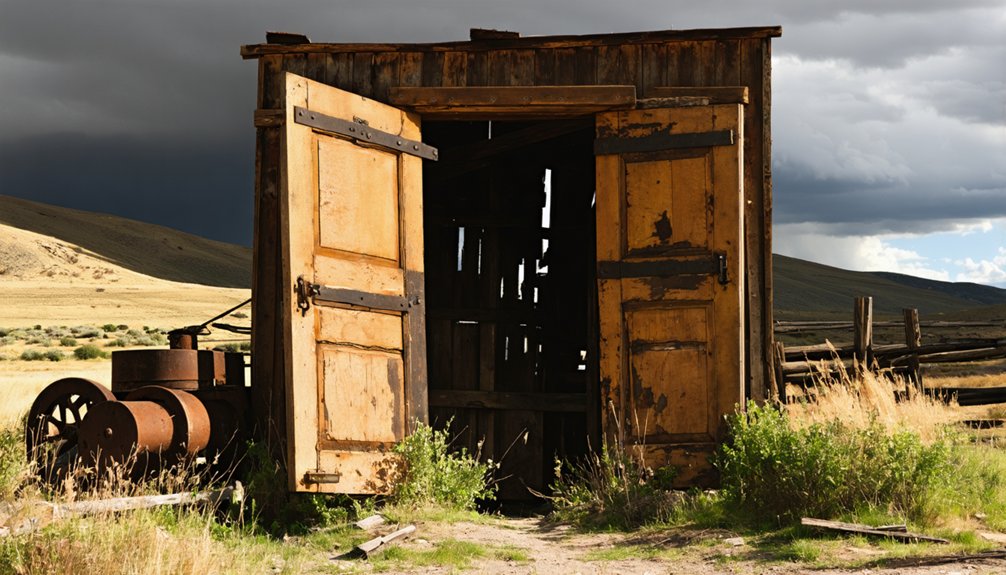
The ghost town of Russell Gulch today offers a haunting window into Colorado’s mining past, with its weathered buildings and forgotten pathways telling stories from over a century ago.
At 9,150 feet elevation, you’ll find the brick schoolhouse standing proudly alongside the IOOF Hall and old mule barn—silent sentinels of a once-thriving community.
Your ghost town history exploration will reveal mineshafts with scattered tools, an abandoned railcar, and empty commercial buildings that housed assay offices and general stores.
The cemetery provides a somber reminder of those who sought fortune here.
Modern touches include an art gallery and disc golf course winding through the remnants.
Though only a handful of residents remain today, these tangible relics, just minutes from Central City, preserve Russell Gulch’s golden legacy.
Beyond the Mines: Recreation and Tourism in Russell Gulch
Russell Gulch’s past extends far beyond its abandoned mines and silent machinery, offering modern visitors a surprising array of recreational opportunities amid its historic remains.
Since 2003, the town’s unique disc golf course has woven through weathered cabins and mineshafts, creating one of America’s most unusual playing experiences where you’ll toss discs past the ghosts of Colorado’s gold rush.
For those seeking panoramic vistas, scenic drives like the aptly named Oh-My-God Road and nearby Peak to Peak Byway deliver breathtaking mountain landscapes.
Visit between late spring and fall when roads are most accessible. You’ll need to bring supplies—there are no services in Russell Gulch itself—but the cemetery’s Continental Divide sunset views and the town’s artistic renaissance make every self-sufficient journey worthwhile.
Frequently Asked Questions
Are There Any Paranormal or Ghost Stories From Russell Gulch?
Yes, you’ll find numerous ghost sightings around Russell Gulch’s haunted locations, from shadowy figures near the schoolhouse to disembodied voices in abandoned mines. Cold spots and mysterious lights await your paranormal exploration.
How Did Residents Access Healthcare in Early Russell Gulch?
You’d think pioneer medicine would have been sophisticated, but you’d rely on self-care, fellow miners’ aid, and home remedies. Healthcare access meant traveling to Central City when desperate, braving mountain trails.
What Happened to Russell Gulch During Prohibition?
You’d find Prohibition effects revitalized your dying mining town. Former miners transformed abandoned shafts into thriving bootlegging operations, creating an underground economy that sustained Russell Gulch when gold no longer could.
Did Russell Gulch Have Any Famous or Notable Residents?
Like gold nuggets scattered in a stream, famous residents of Russell Gulch shine through history. You’d recognize Green Russell himself, the Simoni family, Cornish miners like Richard Gregor, and the notorious murderer Azel Galbraith.
Is Camping Allowed in Russell Gulch Today?
No, you can’t camp directly in Russell Gulch. Today’s camping regulations prohibit it, unlike during mining days when camping was part of the area’s rich camping history. Nearby designated sites exist instead.
References
- https://www.uncovercolorado.com/ghost-towns/russell-gulch/
- https://coloradosghosttowns.com/Russell Gulch Colorado.html
- https://westernmininghistory.com/towns/colorado/russell-gulch/
- https://en.wikipedia.org/wiki/Russell_Gulch
- https://gilpincounty.colorado.gov/explore-gilpin/the-history-of-gilpin-county
- https://kids.kiddle.co/Russell_Gulch
- https://www.youtube.com/watch?v=oBvnJvLv1xs
- https://www.atlasobscura.com/places/ghost-town-disc-golf
- https://en.wikipedia.org/wiki/William_Greeneberry_Russell
- https://freepages.rootsweb.com/~piercescga/genealogy/william_green_russell.html