Scheelite, California boomed after tungsten ore’s 1913 discovery by prospectors Vaughn and Beauregard. This once-thriving mining town produced critical scheelite for military manufacturing during both World Wars, with underground operations reaching 600 feet deep. You’ll find abandoned mining equipment, deteriorating structures, and toxic tailings today. The town’s rapid rise and fall mirrors California’s boom-and-bust mining legacy, revealing a complex story of strategic minerals and harsh frontier conditions.
Key Takeaways
- Scheelite, California rose to prominence in the early 1900s following tungsten discoveries by prospectors Billie Vaughn and Arch Beauregard.
- The town developed around scheelite mining operations with infrastructure including deep shafts, processing facilities, and worker camps.
- Tungsten from Scheelite played a critical strategic role during both World Wars for military manufacturing.
- The post-war tungsten market collapse led to mine closures, labor migration, and the town’s eventual abandonment.
- Today, visitors can explore deteriorating structures and mining equipment remnants while observing safety precautions due to structural hazards.
The Discovery of Scheelite: Birth of a Tungsten Boomtown
While gold and silver discoveries often dominated California’s mining lore, the story of scheelite reveals a different mineral pursuit that emerged in the early 20th century.
You’ll find the first traces of this tungsten discovery in 1913, when scheelite appeared during small-scale gold-placer operations in the Tungsten Hills of Inyo County.
Commercial interest truly ignited in 1916 when prospectors Billie Vaughn and Arch Beauregard identified scheelite and molybdenum outcrops near Pine Creek.
The pivotal 1916 discovery by Vaughn and Beauregard near Pine Creek transformed California’s mineral landscape, launching an industrial tungsten boom.
This find revitalized a region previously dismissed after disappointing 1890s gold assays. Mining techniques focused on extracting the valuable mineral from shear zones where limestone and granite intrusions met, creating ideal conditions for scheelite formation. The mineral scheelite was named after Carl Wilhelm Scheele, who first identified tungstic acid in tungsten ore in 1781.
The value of tungsten increased fivefold during World War I as military demand surged for this critical material.
As World War I increased demand for tungsten’s steel-hardening properties, Tungsten City emerged as workers flocked to these remote deposits despite harsh conditions and limited transportation.
Mining Operations and Infrastructure in the Early 1900s
Although tungsten wasn’t as glamorous as gold or silver, the mining operations that sprouted in Scheelite during the early 1900s required substantial infrastructure and technological investment.
You’d find a complex network of underground workings at these mines, with vertical shafts extending up to 600 feet deep and multiple levels branching outward. The mining techniques evolved from simple picks and shovels to air-powered drills and steam hoists as operations expanded. The Palomar Scheelite Mine was particularly notable for producing tungsten-bearing ore that would be processed in Lindsay, California.
Water management became essential, with elaborate pumping systems preventing flooding of the deeper workings. This was particularly important after incidents like the one at American Girl Mine where flooding in 1914 halted production for four months.
Labor conditions were notoriously harsh, with miners enduring 10-12 hour shifts in dangerous conditions. The workforce, sometimes numbering in the hundreds, established camps nearby that grew into small communities.
Despite the difficult environment, these operations formed the economic backbone of Scheelite’s brief but intense prosperity.
Strategic Importance During World War I
When World War I erupted across Europe in 1914, Scheelite’s significance transformed virtually overnight from an obscure mining outpost to a site of national strategic importance. The tungsten supply derived from scheelite became essential for manufacturing hardened steel used in armor, artillery, and machine tools.
As European imports were severed, the U.S. government designated tungsten as a critical war material. You would have witnessed frantic activity as mining technology advanced to meet wartime demands. California’s remote desert towns boomed as operations expanded, with Scheelite miners working round-the-clock. The mineral’s distinctive bright blue fluorescence under ultraviolet light made it easier for miners to identify high-quality ore deposits during nighttime operations.
The government offered lucrative contracts to incentivize production, bringing unprecedented prosperity to the region. During peak operations, the workforce swelled to include up to 4,000 miners. By war’s end, domestic tungsten production had increased tenfold, with Scheelite at the heart of this strategic industry that helped secure American military capabilities.
The Geology Behind Atolia’s Mineral Wealth
Beneath the arid surface of Atolia lies a geological treasure trove that explains the region’s meteoric rise as a mining center. Unlike the Sierra Nevada deposits near Bishop, Atolia’s scheelite formed through distinct geological formations involving contact metamorphism where granitic intrusions transformed limestone into tactite.
When you examine these rocks, you’ll find scheelite (CaWO4) occurring as fine grains averaging 0.01 inches in diameter, disseminated through tactite zones rich in calcite, quartz, garnet, and amphibole. These minerals often fluoresce under ultraviolet light, a property shared with their associated powellite.
The mineral exploration success in this area relied on understanding how late-stage mineralization filled cracks and favorable beds in the host rock. The tungsten deposits formed at temperatures between 200-500°C, creating the unique conditions that made Atolia’s wealth possible, with scheelite concentrated in structurally advantageous locations. Like Pine Creek’s historical significance, Atolia’s deposits were crucial for producing strategic tungsten alloys during both World Wars.
Daily Life in a California Tungsten Camp
Life in Atolia’s tungsten camps reflected a meticulously structured social hierarchy based on one’s position within the mining operation. Your housing assignment at Scheelite or Rovana directly corresponded to your production role, with vacant houses quickly reassigned as worker status changed.
Daily routines revolved around the mine’s demanding schedule. Before 1918, you’d witness mule teams maneuvering treacherous switchbacks with specialized swivel packsaddles carrying 30-foot poles. The Scheelite mine in San Bernardino County was once a significant tungsten producer for California. The mine produced scheelite ore that displayed distinctive fluorescent properties under ultraviolet light.
By 1937, you might encounter dog teams delivering essential supplies during harsh weather. Community gatherings centered around the school established by 1943, providing education for workers’ children while fostering social cohesion.
The wartime economy transformed these settlements, with Pine Creek becoming America’s largest tungsten producer by 1942, sustaining operations for 54 years until Chinese imports forced its closure in 2001.
World War II Revival and Peak Production
The strategic value of tungsten skyrocketed during World War II, transforming Scheelite and surrounding mining operations into critical national assets. As the government implemented fixed pricing and guaranteed contracts, tungsten production reached unprecedented levels, with the Pine Creek Mine becoming America’s largest tungsten producer by 1942.
You would’ve witnessed remarkable wartime innovation as miners tackled the region’s harsh terrain. New tramways and improved roads replaced primitive mule transport, though dangerous practices persisted—workers sometimes rode ore buckets to save time climbing the steep canyons.
The workforce expanded dramatically, extracting approximately 40,000 units of WO3 from 45,000 tons of scheelite ore in the Darwin Hills alone. While most tungsten operations collapsed after the war, Pine Creek continued operating for decades, finally succumbing to Chinese competition and environmental regulations in 2001.
Decline and Abandonment of the Mines
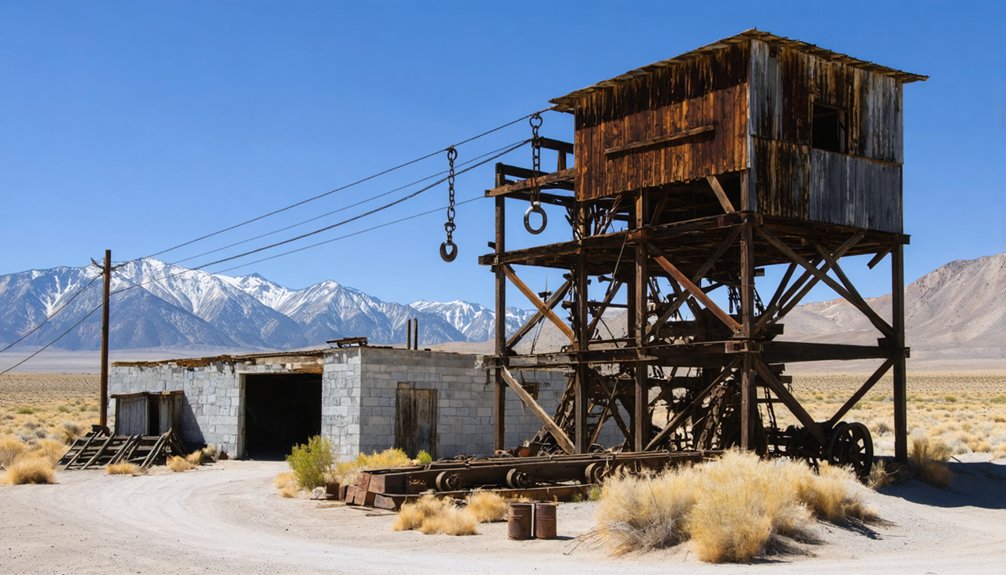
In the years following World War II, the tungsten market collapsed precipitously, forcing Scheelite’s once-thriving mines to cease operations as prices plummeted below profitable extraction thresholds.
Increasingly stringent environmental regulations of the 1950s and 1960s further complicated any prospects of revival, imposing costly compliance requirements on mining companies already struggling with declining ore grades and aging infrastructure.
Today, you’ll find only weathered ruins of the mill foundations, abandoned mineshafts, and scattered mining equipment that silently chronicle the boom-and-bust cycle of this forgotten tungsten mining community.
Post-War Market Collapse
Following the Allied victory in World War II, Scheelite’s mining operations crumbled under the weight of plummeting tungsten prices, triggering a cascade of closures throughout the region.
By late 1943, even companies like Gran Oeste and El Fenómeno had abandoned their efforts, unable to extract profit from the area’s low-grade ore containing merely 0.25-0.3% WO3.
The economic repercussions devastated the local workforce.
Thousands of miners faced unemployment as operations ceased permanently by the mid-1950s.
You’d have witnessed significant labor migration as skilled workers either sought opportunities in distant mining districts or abandoned the industry altogether.
Mining towns withered without employment, while equipment and mills were sold off or left to rust.
The brief resurrection attempts between 1954-57 proved futile against cheaper imported tungsten and technological stagnation.
Environmental Regulations Impact
While Scheelite’s mining operations had already faced substantial decline from post-war tungsten market collapse, California’s stringent environmental regulations delivered the final blow to any prospects of revival.
The 2002 adoption of emergency backfill regulations created insurmountable regulatory challenges for metallic mineral operations like Scheelite.
Environmental impacts that triggered increasingly strict oversight included:
- Acid mine drainage contaminating local water sources
- Toxic tailings requiring expensive containment systems
- Mercury and arsenic contamination from historic mining practices
- Surface disturbances requiring complete restoration to near-original conditions
Mine operators confronting these regulatory hurdles found compliance costs prohibitive, especially when combined with Title 27 water quality mandates.
The complex web of federal restrictions near protected lands further complicated mining activities, effectively rendering operations economically unfeasible and accelerating Scheelite’s transformation into a ghost town.
Ruins Tell Stories
The crumbling remains of Scheelite’s once-bustling mining operations tell a complex story of decline that began long before the final closures. As you explore these ghostly echoes, you’ll witness how depleting scheelite ore grades made profitable extraction increasingly difficult by the 1930s.
The ruins reflect multiple challenges: labor disputes, competition for dwindling resources, and technological limitations all contributed to the town’s downfall. World War II delivered another blow when mining was deemed non-essential, diverting workers elsewhere.
Though some operations resumed post-war, they never regained their former scale. Physical deterioration accelerated abandonment—fires destroyed critical infrastructure, while harsh desert conditions eroded what remained.
These mining memories reveal how economic downturns, geological challenges, and wartime regulations transformed a thriving community into the ghost town you see today.
What Remains Today: Exploring the Ghost Town
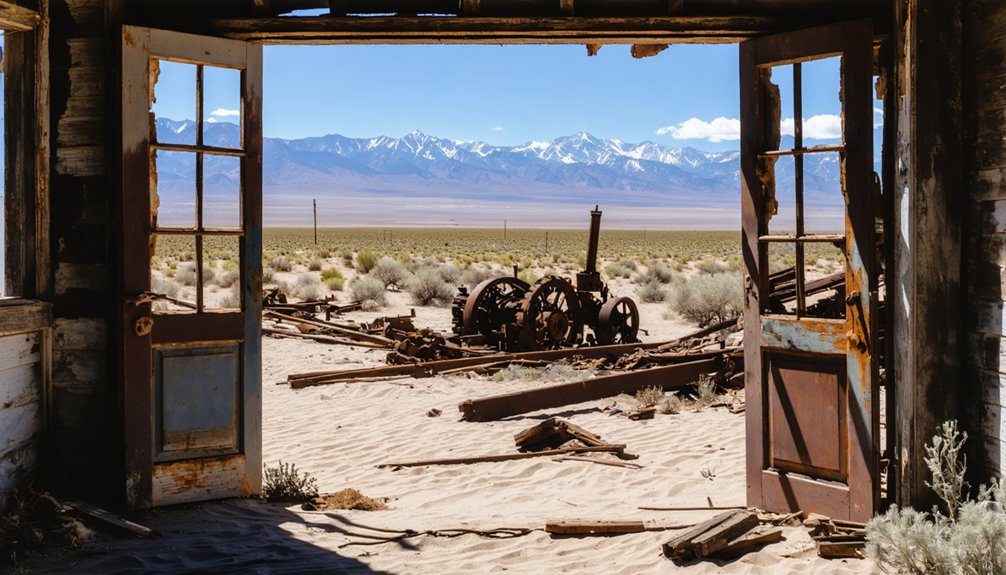
Today’s visitors to Scheelite encounter scattered mining equipment, deteriorating roofless structures, and distinctive light blue tailings piles that mark the landscape of this once-thriving tungsten production center.
You’ll find accessible ruins extending up adjacent trails, including remnants of the Brownstone Mine, though the main Pine Creek Mine site remains privately owned with a watchman restricting public access.
When exploring the visible foundations and geological features from established hiking routes like the Gable Lakes trail, you must exercise caution due to structural instabilities, sharp metal debris, and potentially hazardous mineral tailings that characterize this mothballed industrial complex.
Visible Mining Infrastructure
Rusting metal beams and weathered wooden frames stand as silent sentinels of Scheelite’s once-thriving mining operations. As you explore, you’ll discover remarkable mining relics scattered throughout the landscape—foundations of ore crushers and remnants of the Tungstar Mine’s processing facilities.
The scale of infrastructure preservation is astounding, with underground workings extending 1,250 feet deep—equivalent to the Empire State Building without its antenna.
Four major mining infrastructure elements remain visible:
- Wooden frame structures near mine entrances, once housing offices and equipment
- Stone and concrete foundations from mill buildings along Pine Creek trails
- Ore crusher building remnants and processing equipment ruins
- Timbered mine shaft entrances surrounded by distinctive blue-tinged tailings piles
These engineering marvels reveal humanity’s determination to extract wealth from unforgiving mountain terrain.
Accessible Ruins Today
While numerous ghost towns in California have been consumed by time, Scheelite’s accessible ruins offer visitors a remarkably preserved glimpse into America’s tungsten mining history.
When exploring the site today, you’ll encounter foundations and partial walls scattered throughout the landscape, with distinctive light blue tailings marking former processing areas.
Your ghost town experience is defined by what’s visible from public trails—roofless structures, equipment fragments, and mining debris that tell Scheelite’s story from a respectful distance.
In addition to these remnants, exploring schwaub ghost town history reveals the personal stories of those who once inhabited the area. By piecing together archival materials and local folklore, a richer understanding of their daily lives and struggles comes to light. These insights deepen the connection to the past, making each visit to the town a journey through time.
Access remains challenging due to rugged terrain and private property restrictions. A watchman monitors the former mine site, limiting direct exploration of certain ruins.
Nevertheless, the surrounding Pine Creek Canyon trails provide strategic vantage points where you can observe the remnants of this once-thriving mining operation while enjoying spectacular seasonal foliage.
Hazards and Precautions
Scheelite’s enchanting ruins demand vigilance from every explorer venturing into this historic mining site. The remote location lies beyond cellular range, creating significant risks should emergencies arise.
Mercury contamination persists at toxic levels throughout the area, with monomethyl mercury presenting serious neurological hazards to unsuspecting visitors.
Essential safety measures include:
- Wear sturdy boots and protective gloves to prevent injuries from exposed metal debris
- Travel with companions and share your itinerary with someone outside your group
- Bring ample water, emergency supplies, and first aid equipment
- Respect posted warnings and avoid entering unstable structures
Visitor awareness of structural collapse risks can’t be overstated, as California recorded 37 ghost town fatalities between 2000-2021.
The area’s isolation dramatically extends emergency response times, transforming minor injuries into potentially life-threatening situations.
Environmental Legacy of Tungsten Mining
Although largely abandoned today, Scheelite’s tungsten mining operations have left an enduring environmental footprint on California’s landscape.
You’ll find tungsten contamination persisting in local groundwater and soils, with concentrations reaching alarming levels of up to 400 mg/L in surrounding waterways. This contamination extends far beyond the immediate mining zone due to tungsten’s high mobility in the environment.
The ecological impact continues decades after operations ceased, as tungsten compounds accumulate in sediments and disrupt aquatic ecosystems.
Legacy mine waste steadily leaches this emerging contaminant into water sources, potentially affecting both wildlife and human health. Environmental agencies now monitor these sites closely, implementing remediation strategies like scheelite precipitation to address the persistent challenge.
Despite these efforts, the complexity of tungsten chemistry makes full restoration a difficult, ongoing process.
Preserving Scheelite’s Place in California Mining History
You’ll find extensive historical documentation of Scheelite’s mining operations preserved through archived company records, government surveys, and oral histories collected from former workers since the 1950s.
Several mining artifacts recovered from the site, including tungsten ore specimens, specialized extraction equipment, and workers’ tools, have been carefully catalogued for display at the Eastern California Museum in Independence and the Laws Railroad Museum near Bishop.
Local preservation groups have established guided tour routes of remaining mining structures and implemented interpretive signage that chronicles Scheelite’s contribution to California’s industrial heritage and wartime resource production.
Historical Documentation Efforts
The rich historical legacy of Scheelite has been preserved through multiple documentation efforts that began during the town’s operational years and continue into the present.
Archival research into mining district records has uncovered essential details about claim ownership and tungsten production during wartime booms, while community engagement with descendants of miners has filled significant narrative gaps.
You’ll find Scheelite’s story documented through:
- Topographical maps and production logs detailing mining operations and yields
- Photographic surveys capturing ruins, equipment, and environmental impacts
- Oral histories collected from former residents and mining families
- Academic studies by geological and historical institutions maintaining specimen collections
These preservation efforts form a thorough tapestry of evidence, ensuring that Scheelite’s contribution to California’s tungsten production history isn’t lost to time.
Museum-Worthy Mining Artifacts
Scattered across Scheelite’s weathered landscape, museum-worthy mining artifacts tell the compelling story of California’s tungsten mining heritage.
You’ll find equipment remnants like ore bins, chutes, and grizzlies—early sorting devices that revolutionized tungsten processing technology. The light blue tailings piles contain scheelite, which fluoresces brilliantly under UV light, a property modern museum practices leverage for educational displays.
Foundations of the Tungstar Mine and abandoned tunnels reaching 1,250 feet underground represent the industrial scale of operations during wartime tungsten demand.
Contemporary preservation efforts focus on stabilizing wooden tramway remains while cataloging metallic artifacts like pack mule gear. These objects aren’t merely historical curiosities—they’re tangible connections to California’s strategic role in providing tungsten for steel alloys during both World Wars.
Community Preservation Initiatives
Since Scheelite’s rediscovery by preservationists in the late 20th century, extensive initiatives have transformed this forgotten tungsten mining site into a documented historical treasure.
Following established California Desert Conservation Area frameworks, Scheelite gained recognition as an “abandoned site” with standing structures but no permanent population.
Community engagement efforts have focused on four primary preservation strategies:
- Archaeological records research establishing baseline data on Scheelite’s cultural resources
- Documentation of claim notices through San Bernardino County courthouse archives
- Site mapping using standardized methodologies for National Register eligibility assessment
- Heritage education programs connecting visitors to tungsten mining’s economic significance
You’ll find Scheelite’s preservation follows the Bodie Historic State Park model, balancing BLM’s multiple-use mission with cultural resource management responsibilities while maintaining the authentic character of this early 20th century mining landscape.
Frequently Asked Questions
Is Scheelite Safe to Visit or Are There Dangerous Mine Hazards?
Treading on thin ice, you’ll face significant mine safety hazards in Scheelite. Abandoned shafts, structural collapses, and toxic materials demand serious visitor precautions. It’s not safe without specialized training.
Were Any Famous People Associated With the Atolia Mining Operations?
No famous miners were associated with Atolia’s operations. The town’s founders—Atkins and Degolia—and Thomas McCarthy (who discovered tungsten in 1905) remain historically significant but not nationally renowned personalities.
What Happened to the Tungsten Miners After the Mines Closed?
After tungsten mine closures, you’d find miners scattered to nearby silver operations, relocated to military industries during war years, or abandoned mining altogether for agricultural work and urban opportunities.
Are There Any Remaining Artifacts Worth Collecting at Scheelite?
Like a thief robbing our shared heritage, you’d harm historical significance through artifact collection. Don’t remove items—they’re protected. Photographing these treasures preserves their context while respecting federal protection laws.
Did Native Americans Use Scheelite Mineral Before European Prospectors Arrived?
No, there’s no evidence Native Americans used scheelite before Europeans. Native uses focused on steatite and chert for their practical properties, not scheelite’s mineral significance as a tungsten ore.
References
- https://www.destination4x4.com/atolia-san-bernardino-california-ghost-town/
- https://www.nps.gov/deva/learn/historyculture/rhyolite-ghost-town.htm
- https://rural-ruin.livejournal.com/726310.html
- https://en.wikipedia.org/wiki/Atolia
- http://explorehistoricalif.com/ehc_legacy/nov2014.html
- https://www.jawbone.org/rand-mining-district/
- https://digital-desert.com/a/atolia/
- https://www.atlasobscura.com/places/pine-creek-tungsten-mine
- https://www.nanoslicklubricants.com/tungsten-history/
- https://www.mtnmouse.com/california/sng11_pine_creek_mine_story_blog.html