Servilleta is a ghost town in Taos County, New Mexico, roughly 21 miles northwest of Taos along US 285. It started as a farming and ranching community before the D&RGW railroad transformed it into an active siding hub in the 1880s. Its post office operated from 1913 to 1949, marking its slow decline. Today, you’ll find little physical evidence remaining at the site, and there’s more to uncover about what shaped and ultimately silenced this high desert community.
Key Takeaways
- Servilleta is a ghost town in Taos County, New Mexico, located approximately 21 miles northwest of Taos along US 285.
- The community grew around a D&RGW railroad siding established in 1880/85, transforming it from a farming settlement into a railroad hub.
- Its post office operated from 1913 to 1949, with its closure marking the beginning of the town’s decline.
- No surviving structures are officially documented; physical remnants are limited and require local inquiry to confirm.
- Visitors should verify land ownership with Taos County offices and respect private property boundaries before exploring the site.
Farming, Ranching, and Railroad: What Servilleta Once Was
Servilleta once functioned as a farming and ranching community situated along US 285, roughly 21 miles northwest of Taos, but its growth accelerated when the D&RGW railroad arrived in 1880/85 and established a siding there.
Servilleta grew from quiet ranching roots into a railroad hub when the D&RGW arrived in the 1880s.
The railroad didn’t just bring commerce — it reshaped the settlement’s identity. You can trace that shift through whatever historical architecture survives along the old corridor, structures that reflect both Spanish colonial roots and railroad-era practicality.
Local legends likely preserve details that written records don’t, particularly around the community’s Catholic heritage and its ties to La Madonna de la Servilleta.
The post office operated from 1913 to 1949, confirming sustained activity well into the 20th century.
When you visit, you’re walking through layers of agricultural, cultural, and industrial history compressed into a small stretch of high desert terrain.
Where Exactly Is Servilleta, New Mexico?
You’ll find Servilleta in Taos County, New Mexico, roughly 21 miles northwest of Taos along US 285 and the old D&RGW railroad corridor.
The site sits within a 2WD-accessible grid route, making it reachable without specialized off-road equipment.
If you’re planning a visit, local inquiry is your best resource for confirming what physical remains still exist on the ground.
General Location Overview
Tucked into Taos County, New Mexico, Servilleta sits roughly 21 miles northwest of Taos along US 285 and the old Denver & Rio Grande Western railroad corridor. You’ll find it in a region shaped by farming, ranching, and railroad expansion.
Historical preservation efforts in the area help document what local folklore often keeps alive in memory.
Three location markers help orient your research:
- Highway access — US 285 provides the primary route to the site.
- Railroad corridor — The old D&RGW line defined the town’s original footprint.
- County placement — Taos County situates Servilleta within a broader zone of Spanish colonial and railroad-era settlement.
Cold winters define the climate, and the terrain reflects the high desert character typical of northern New Mexico.
Nearby Landmarks And Roads
When you’re steering to Servilleta, US 285 serves as your primary road reference, placing the site about 21 miles northwest of Taos along a corridor that also traces the old D&RGW railroad line. The railroad’s 1880s construction shaped this stretch considerably, leaving physical and cultural influences embedded in the landscape you’ll pass through.
The route follows a 2WD grid classification, meaning you won’t need specialized equipment to reach the area. The old railroad corridor itself functions as a secondary landmark, orienting you toward where the village once grew around a railroad siding.
Local legends tied to the region’s Spanish colonial past add historical weight to an otherwise quiet road. Cross-referencing US 285 with the railroad grade gives you the most reliable fix on Servilleta’s position.
Getting There Today
Servilleta sits roughly 21 miles northwest of Taos, New Mexico, in Taos County, accessible via US 285 along the old D&RGW railroad corridor. The route carries a 2WD classification, so you don’t need specialized equipment to reach it.
Before you go, keep these practical points in mind:
- Inquire locally about any remaining historical architecture, since documented physical details are sparse.
- Respect private property — some land surrounding ghost towns is privately held, limiting independent exploration.
- Prepare for cold winters if you’re visiting outside summer months, as the climate can shift quickly.
Local legends tied to La Madonna de la Servilleta add cultural depth worth researching beforehand.
You’ll travel with better context and fewer surprises if you do your homework first.
What Does the Name Servilleta Mean?
When you look at the name Servilleta, you’ll find it comes from a Spanish word meaning “napkin” or “flat plain.”
The name first belonged to Sevilleta Plaza, an old Spanish settlement on the Rio Tusas in Rio Arriba.
When the railroad was built in 1880/85, workers transferred the name to the new siding, and the village grew from there.
Spanish Word for Napkin
Consider these documented connections:
- The name first belonged to Sevilleta Plaza in Rio Arriba, an old Spanish settlement on the Rio Tusas.
- When the D&RGW railroad built its siding around 1880–1885, the name transferred to the new location.
- The title La Madonna de la Servilleta, linked to a Murillo painting, added religious dimension to the word’s regional meaning.
You’re looking at a place name that moved across geography, absorbed spiritual connotations, and ultimately anchored a railroad-era community in northern New Mexico.
Origins in Rio Arriba
Before the railroad siding existed, the name Servilleta already carried history. You can trace it back to Sevilleta Plaza in Rio Arriba, an old Spanish settlement positioned along the Rio Tusas. That earlier community established the name’s regional identity long before any locomotive passed through the area.
When researchers dig into New Mexico’s colonial past, they often uncover local legends tied to these forgotten plazas, along with historic artifacts that confirm sustained Spanish settlement patterns.
The name moved from that original Rio Arriba location to the railroad siding when construction advanced in 1880. Understanding this transfer matters because it shows you that Servilleta wasn’t invented by railroad developers. It inherited a documented identity rooted in Spanish colonial geography, giving the ghost town a layered origin most travelers overlook.
Name Transferred by Railroad
The name Servilleta carries a straightforward Spanish meaning—”napkin” or “flat plain”—and it didn’t originate at the railroad siding. It belonged first to Sevilleta Plaza, an old Spanish settlement on the Rio Tusas in Rio Arriba.
When the D&RGW railroad pushed through in 1880/85, the name transferred to the new siding, and the village grew around it. Cultural influences from Spanish colonial settlement shaped the identity, while economic shifts driven by railroad expansion redirected where community life actually took root.
Three key facts anchor this transfer:
- The original site was a farming and ranching plaza in Rio Arriba.
- Railroad construction created the siding that drew settlers away from the older location.
- The name carried forward, preserving colonial linguistic heritage within a railroad-era settlement.
The Spanish and Catholic History That Named Servilleta
Nestled in northern New Mexico’s layered colonial past, Servilleta carries a name rooted in both Spanish language and Catholic devotion. “Servilleta” translates from Spanish as “napkin” or “flat plain,” and it first identified a plaza in Rio Arriba—an old Spanish settlement along the Rio Tusas.
The cultural influences shaping this name don’t stop at geography. Scholars connect the title to La Madonna de la Servilleta, a Catholic devotional reference inspired by a Murillo painting. That religious association added deeper historical significance to the word before the railroad ever arrived and borrowed it.
You’re looking at a name that moved through Spanish colonial settlement, Catholic tradition, and railroad expansion—each layer compressing centuries of cultural identity into a single word still attached to this quiet ghost town.
How the Railroad Built the Village of Servilleta
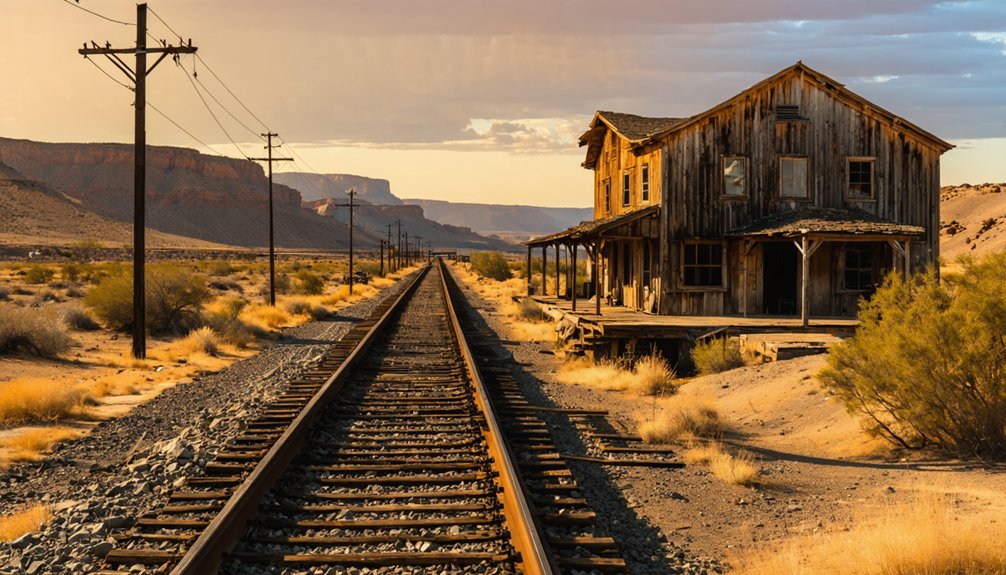
When the D&RGW railroad pushed through the region in 1880–85, it didn’t just pass through Servilleta—it created it. The railroad siding anchored a village that grew around economic shifts tied directly to rail access.
The D&RGW didn’t just pass through Servilleta in 1880–85—it built it from the ground up.
Cultural influences from earlier Spanish settlements shaped who settled here, but the railroad determined where.
Three developments defined Servilleta’s railroad-era growth:
- A siding established the physical location along US 285, giving ranchers and farmers a shipping point.
- A post office opened in 1913, confirming sustained community activity built on railroad-era momentum.
- The name transferred from the older Rio Tusas settlement to the new siding, linking colonial heritage to industrial infrastructure.
You can trace Servilleta’s entire existence back to one decision: where the tracks ran.
Servilleta’s Post Office Years and Why They Matter
Servilleta’s post office operated from 1913 to 1949—a 36-year run that’s more meaningful than it might first appear. A post office signals more than mail delivery; it confirms federal recognition of a functioning community.
When you trace those dates, you’re identifying a window of sustained activity, not just a settlement that briefly appeared along a railroad siding.
The 1949 closure marks a turning point worth noting for historical preservation efforts. Once postal services end, institutional memory tends to scatter quickly.
Local folklore often becomes the only surviving record of daily life after official documentation stops.
If you’re researching Servilleta, treat those postal dates as anchors. They don’t tell you everything, but they give you a reliable frame for understanding when the community was active and when it began fading.
How and When Did Servilleta Become a Ghost Town?
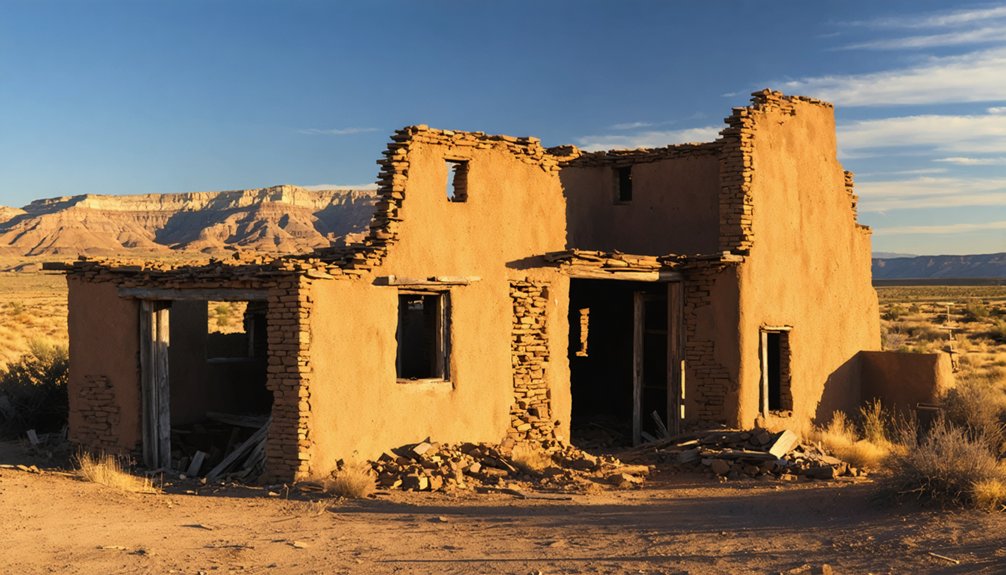
The 1949 post office closure gives you a reliable endpoint for Servilleta’s active community life, but pinning down exactly when it became a ghost town is harder than it sounds. No single documented event marks its abandonment. Instead, you’re looking at a gradual unraveling tied to three compounding factors:
- The D&RGW railroad’s declining regional role reduced economic traffic.
- Rural consolidation pushed farming and ranching families toward larger service centers.
- Without postal infrastructure, local legends and historical architecture lost institutional anchors.
Sources don’t specify surviving structures, so you’d need to inquire locally about remaining historical architecture.
What’s clear is that Servilleta’s ghost-town status reflects a slow fade rather than a dramatic collapse—a pattern common across New Mexico’s railroad-era communities.
What Little Survives at the Servilleta Site Today
Because available sources don’t specify surviving structures at Servilleta, you’re working with an incomplete physical inventory from the start. Ghost-town documentation acknowledges the site but directs you to inquire locally for any remaining physical evidence. That gap matters if you’re researching historical artifacts or trying to verify what still stands along the old D&RGW railroad corridor near US 285.
Local legends likely carry details that written records don’t preserve, making community conversations a practical research tool. The post office closed in 1949, and no source confirms standing buildings beyond that point.
Respect private property boundaries if you visit. What you’ll find, if anything, exists within a landscape shaped by farming, ranching, and railroad activity—context that frames whatever physical traces remain on the ground today.
How to Visit the Servilleta Site Without Trespassing
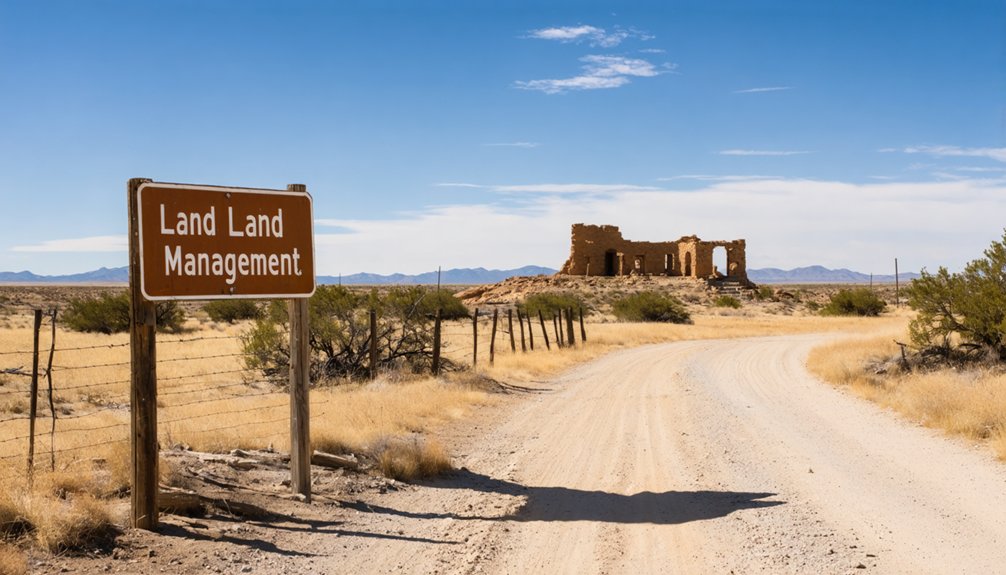
Visiting Servilleta responsibly starts with confirming land ownership before you arrive. Much of the land along US 285 near old D&RGW railroad corridors is privately held. Trespassing undermines your freedom to explore legally and jeopardizes access for others.
Before you visit, confirm who owns the land—trespassing puts your access and others’ at risk.
Follow these steps before heading out:
- Contact Taos County offices to verify current land status and any posted access restrictions.
- Check weather conditions before departing, since cold winters in this region can make rural roads hazardous without warning.
- Observe local wildlife from established roadsides rather than cutting across unfenced land, protecting both the habitat and your legal standing.
If physical remains exist, locals familiar with the area can point you toward publicly accessible viewpoints without requiring you to cross private boundaries.
Frequently Asked Questions
What New Mexico County Is the Servilleta Ghost Town Located In?
You’ll find Servilleta in Taos County, New Mexico. It’s a documented ghost town where you can explore nearby attractions and observe local wildlife while analyzing this historically rich, freedom-evoking landscape shaped by railroad and ranching heritage.
How Cold Do Winters Typically Get Near the Servilleta Site?
Like a ghost itself, warmth vanishes fast here — you’ll face cold winters at Servilleta’s site. The seasonal climate brings harsh winter temperatures to this high desert valley, so you’ll want to prepare accordingly.
Was Servilleta Ever a Mining Town Like Other New Mexico Ghost Towns?
You won’t find mining history tied to Servilleta — it developed as a farming, ranching, and railroad community. Ghost town preservation records document its roots in agriculture and D&RGW railroad expansion, not mineral extraction like other New Mexico ghost towns.
Who Was the Spanish Artist Murillo Connected to Servilleta’s Catholic History?
You’d never expect Spanish art to shape a ghost town’s soul, but Murillo’s influence did just that — the Baroque master Bartolomé Esteban Murillo inspired La Madonna de la Servilleta’s Catholic devotional title.
Can Servilleta Be Reached by a Standard Two-Wheel-Drive Vehicle?
You can reach Servilleta in a standard two-wheel-drive vehicle, so you don’t need off-road adventures or specialized equipment. Still, prioritize vehicle maintenance before traveling, as rural New Mexico roads can challenge even prepared drivers.
References
- https://www.newmexico.org/places-to-visit/ghost-towns/
- http://www.ghosttowns.com/states/nm/servilleta.html
- https://www.tripadvisor.ca/Attractions-g28952-Activities-c47-t14-New_Mexico.html
- https://www.youtube.com/watch?v=yfu1BHLzrDA
- https://www.newmexicomagazine.org/blog/post/100th-anniversary-why-we-love-new-mexico-our-ghost-towns-contain-multitudes/
- https://en.wikipedia.org/wiki/List_of_ghost_towns_in_New_Mexico
- https://www.ghosttowns.com/states/nm/nmalphabetical.html
- https://sites.rootsweb.com/~nma/GhostTowns/ghost_townsnm.html
- https://en.wikipedia.org/wiki/Category:Ghost_towns_in_New_Mexico
- https://www.youtube.com/watch?v=32q-tzVPzcU