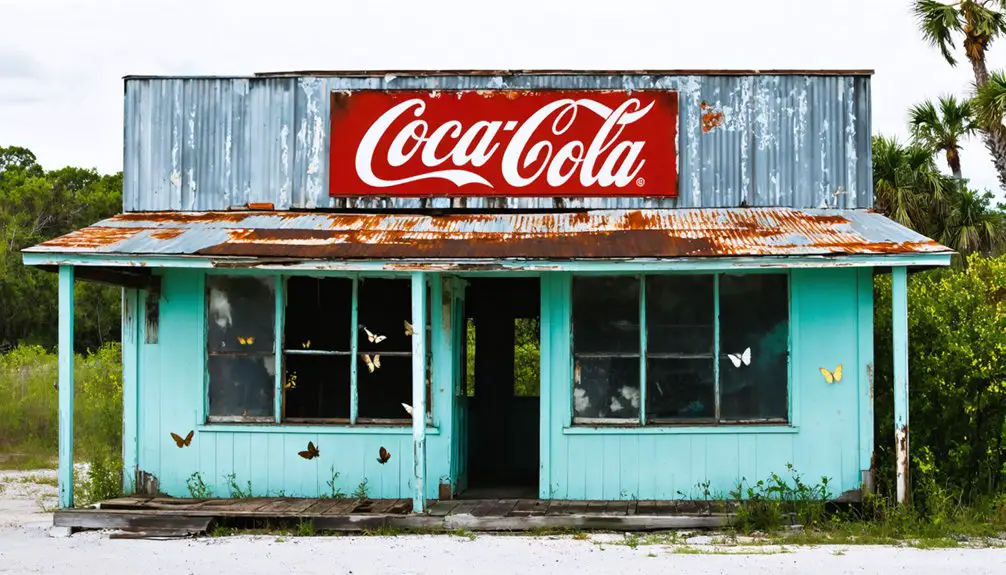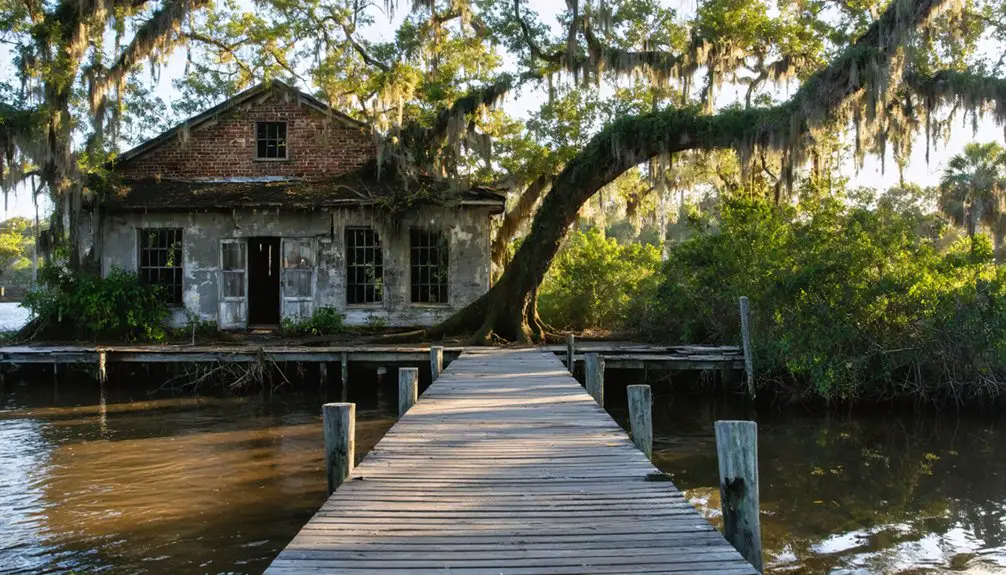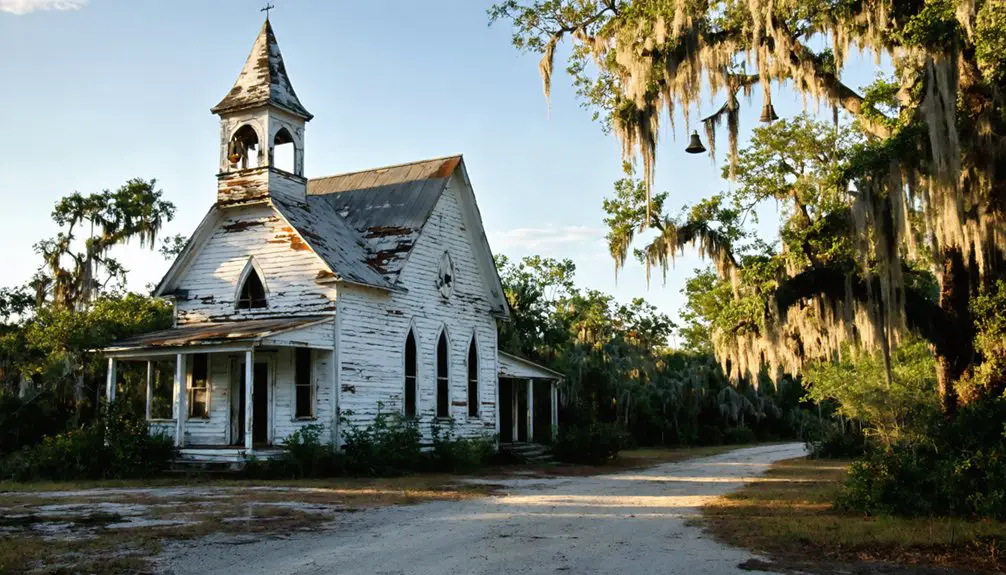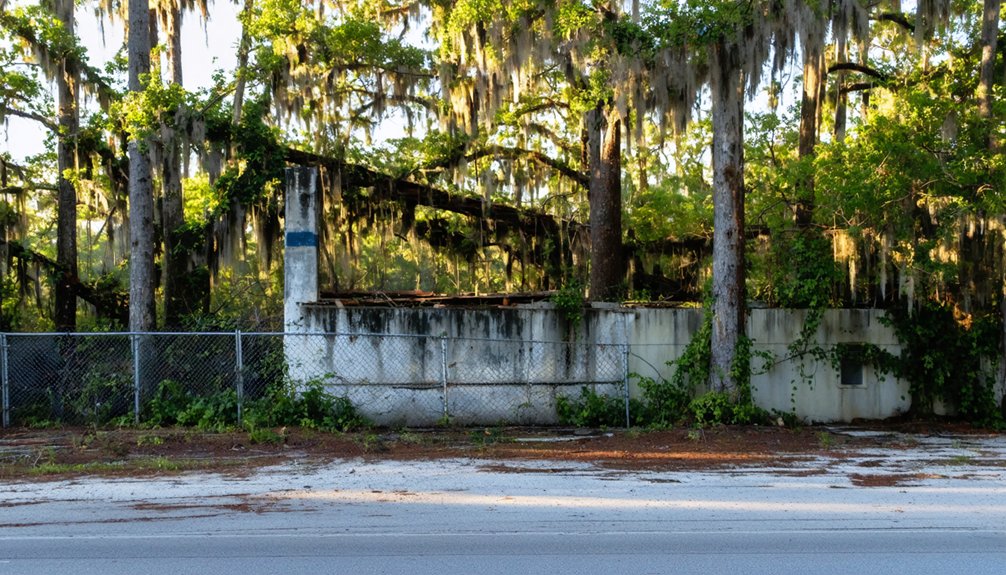
Silver Palm was a South Dade frontier settlement named for its distinctive silver-backed palm trees, where homesteaders built a thriving agricultural community around William “Popp” Anderson’s general store at the intersection of SW 157th Avenue and SW 232nd Street. The 1913 citrus canker outbreak and catastrophic 1928 hurricane that killed over 2,500 people ultimately destroyed this once-prosperous farming town. Today, you’ll find only scattered concrete foundations and crumbling canal markers hidden beneath palmetto scrub, their exact locations jealously guarded by locals who know where to look.
Key Takeaways
- Silver Palm was a Florida frontier settlement named after distinctive silver-backed palm fronds that served as natural territorial landmarks.
- William “Popp” Anderson established the community’s foundation with a general store at the strategic intersection of SW 157th Ave and SW 232nd St.
- The 1913 Citrus Canker outbreak devastated the agricultural economy, requiring $2.5 million in decontamination and widespread tree destruction across 26 counties.
- A 1928 Category 4 hurricane caused Lake Okeechobee to overflow, killing 2,500 people and rendering 15,000 families homeless with complete crop destruction.
- The community was permanently abandoned after the hurricane, leaving only concrete foundations and drainage markers hidden beneath palmetto scrub.
The Birth of a Frontier Settlement
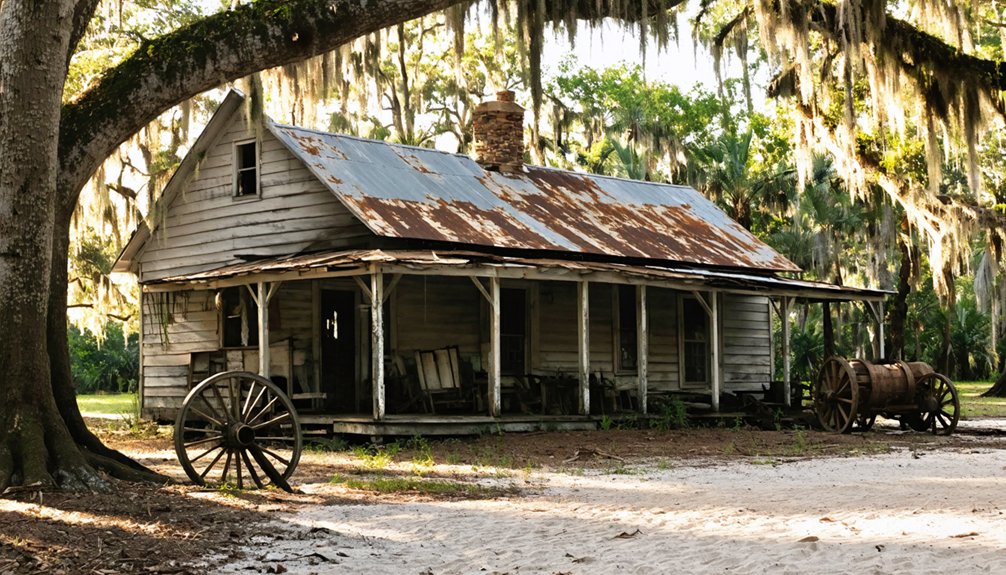
Around 1900, a small band of homesteaders ventured into the dense pine forests of South Dade, staking their claims on high ground approximately twelve miles southwest of Cutler. You’d find these pioneers drawn by promises of rich agricultural soil and abundant natural resource utilization opportunities.
The settlement took its name from distinctive silver-backed palm fronds that shimmered throughout the piney woods, creating an unmistakable silvery sheen when breezes stirred the vegetation.
Settler demographic profiles revealed families willing to endure mosquito-infested conditions and geographic isolation. They carved trails through thick forests, built chicken coops, and excavated wells for drinking water.
Anderson’s Corner: Where It All Began
In 1911, William “Popp” Anderson purchased five acres from Lilburn R. Nixon and constructed a general store at the crossroads of what would become SW 157th Avenue and SW 232nd Street—the precise midpoint of Silver Palm Drive’s logging road.
Before establishing his storefront, Anderson, a former railroad worker under Henry Flagler who’d migrated from Indiana, drove a commissary cart along the area’s dirt roads to reach isolated homesteaders. Collaborating with fellow settler Charles Gossman, he transformed this strategic intersection into “Anderson’s Corner,” the only commercial establishment for miles in the undeveloped Homestead frontier.
First General Store Established
William “Popp” Anderson purchased five acres from Lilburn R. Nixon in 1911, establishing what would become the commercial heart of Silver Palm. You’ll find his two-story wood-frame general store at the crossroads of SW 157th Avenue and SW 232nd Street, strategically positioned midway along Silver Palm Drive—the crucial logging road connecting the Everglades to Black Point’s shipping port.
The architectural significance of this white-painted structure lies in its functional design: retail operations hummed below while Anderson’s family lived upstairs. You could buy anything from dynamite to lace, eliminating grueling supply trips for homesteaders across South Miami-Dade.
Today’s historic preservation efforts recognize this building’s importance. It earned National Register listing in 1977 and became Miami-Dade County’s first designated historic site in 1981.
Early Settler William Anderson
Behind every frontier outpost stands a figure whose determination shapes the settlement’s destiny. William “Popp” Anderson arrived from Indiana in the early 1900s, transforming Silver Palm’s wilderness into a thriving community hub. His homestead legacy began with one of the area’s first land claims in 1900, eventually establishing Anderson’s Corner at SW 157 Ave and SW 232nd Street.
Anderson’s family life contributions defined Silver Palm’s character:
- Built two-story wood structure housing ground-floor general store and second-floor family residence
- Married Atka Vandora Newlan in 1912, raising nine children total
- Donated 10 acres for Redland Farm Life School in 1916
- Operated commissary car for Drake Lumber Company
- Lived at the corner until death at age 83
You’ll find his corner designated historic in 1981, cementing his pioneering spirit.
The Silver Palm Tree Legacy
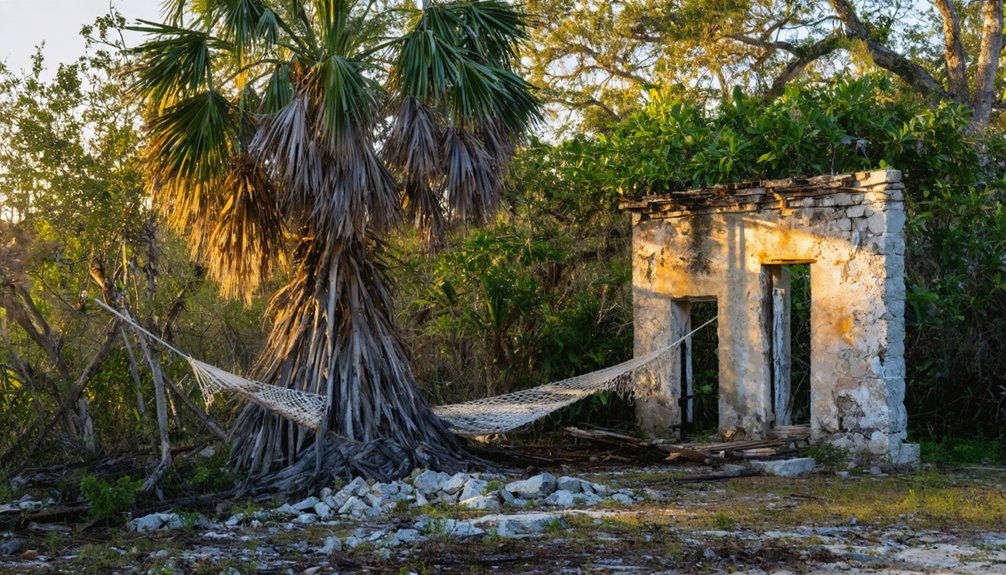
You’ll find the town’s identity rooted in the distinctive silver palm trees that once dominated this landscape, setting it apart from neighboring settlements in early 20th-century South Florida. These native palms, with their characteristic silvery-green fronds, grew so abundantly along what became Silver Palm Drive that early settlers saw no other fitting name for their community.
The trees weren’t just scenery—they served as natural landmarks that defined territorial boundaries and gave residents a sense of place in the otherwise uniform flatlands stretching from Perrine to Florida City.
Naming the Settlement
Although the settlement that would become Silver Palm emerged from the dense subtropical wilderness of South Florida in the early 1900s, it took its name from the distinctive silver palm trees that flourished throughout the area. These naming conventions reflected practical pioneer thinking—you’d identify your homestead by natural landmarks anyone could recognize.
The historical significance of this botanical nomenclature became evident through:
- Charles Gossman and William Anderson establishing their general store at the settlement’s core
- Local residents dubbing the area “Anderson’s Corner” near the schoolhouse
- Silver Palm Drive and Newton Road intersection serving as the definitive naming point
- The trees distinguishing this settlement from surrounding developments
- Homesteaders formalizing the Silver Palm identity through consistent usage
You’ll find this straightforward approach typical of frontier communities carving independence from untamed land.
Native Palm Tree Significance
The silver palm (*Coccothrinax argentata*) that gave this settlement its identity stands as one of South Florida’s most distinctive native species, distinguished by leaves bearing dark blue-green upper surfaces and striking silver undersides that shimmer in coastal breezes. You’ll find these slow-growing palms reaching just 6–15 feet, thriving in rocky, calcareous soils where saw palmetto and cabbage palmetto dominate. Their species conservation status remains threatened in Florida, though NatureServe lists them as Apparently Secure globally.
Early settlers recognized these palms’ resilience—salt-tolerant, drought-resistant, requiring minimal care. Today’s landscape design applications include specimen plantings and rock gardens, though you’ll need licensed native nurseries for sourcing. The largest U.S. stand persists at Bahia Honda State Park, a living reminder of what once characterized this ghost town’s landscape.
Boom Years and Agricultural Prosperity
At the turn of the 20th century, pioneer families began carving homesteads from the pine woods and palmetto scrub that characterized Florida’s frontier south of Cutler.
From untamed wilderness to productive farmland, determined settlers transformed Florida’s southern frontier one homestead at a time.
You’ll find that agricultural production transformed this wilderness into thriving farmland, with settlers like Will Anderson claiming 160-acre parcels and C.W. Hill establishing tomato operations along Farmlife Road.
The community’s economic diversification created remarkable opportunities:
- Tomatoes cultivated for lucrative northern markets
- Pineapple fields flourishing near Cutler
- Innovative financing arrangements allowing farmers to improve their claims
- Rich soil supporting diverse crop experimentation
- Strategic positioning between Coconut Palm Drive and Silver Palm Drive
Despite the railroad bypassing the area for Princeton and Florida City, you’d witness Silver Palm’s independent agricultural prosperity through cooperative ventures and self-reliant farming operations.
The Citrus Canker Catastrophe of 1913
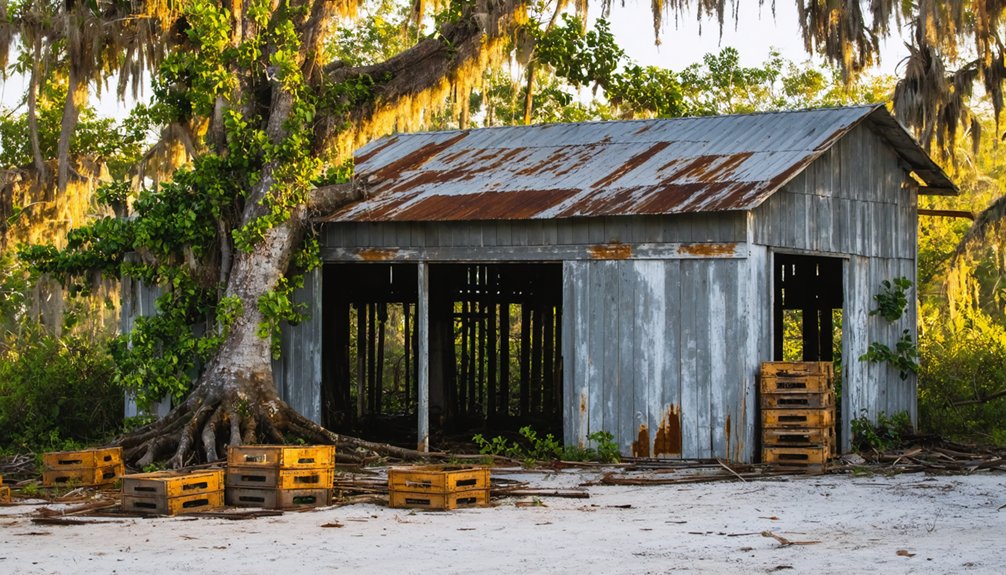
Just as Silver Palm’s farmers were establishing their agricultural foothold, a microscopic invader threatened to destroy Florida’s entire citrus industry. In 1913, officials confirmed Xanthomonas citri bacteria in Manatee County, triggering what you’d witness as the “Canker War.”
The extent of quarantine measures proved unprecedented—inspectors burned 257,745 grove trees and 3,093,110 nursery trees across 26 counties, destroying both infected and healthy stock. You couldn’t escape the decontamination protocols that followed every inspection.
The long term agricultural impact devastated Florida’s economy: $2.5 million spent (equivalent to $28 million in 2000 dollars) before eradication in 1933. For Silver Palm’s citrus growers, watching 3.3 million trees burn statewide meant confronting government power’s reach into private property—a bitter lesson in bureaucratic control.
Natural Disaster and Economic Collapse
On September 16, 1928, meteorological fury swept across Palm Beach County as a Category 4 hurricane roared ashore from Boca Raton to Jupiter, transforming Silver Palm’s agricultural landscape into a watery graveyard. Lake Okeechobee’s overflow drowned the region in twenty feet of water, killing at least 2,500 souls whose bodies disappeared into swamp wilderness.
The devastation you’d witness was absolute:
- 150 tractors damaged, all crops destroyed around the lake
- 15,000 families rendered homeless across Palm Beach County
- Houses ripped from foundations, smashed against debris
- State authorities requesting boats for recovery efforts
- Bodies swept into Everglades, many never recovered
This catastrophe triggered permanent displacement of entire communities. Silver Palm’s economy, already weakened by citrus canker, couldn’t survive nature’s assault. You’d find no reconstruction—only abandonment.
What Remains: A Walking Tour of Silver Palm
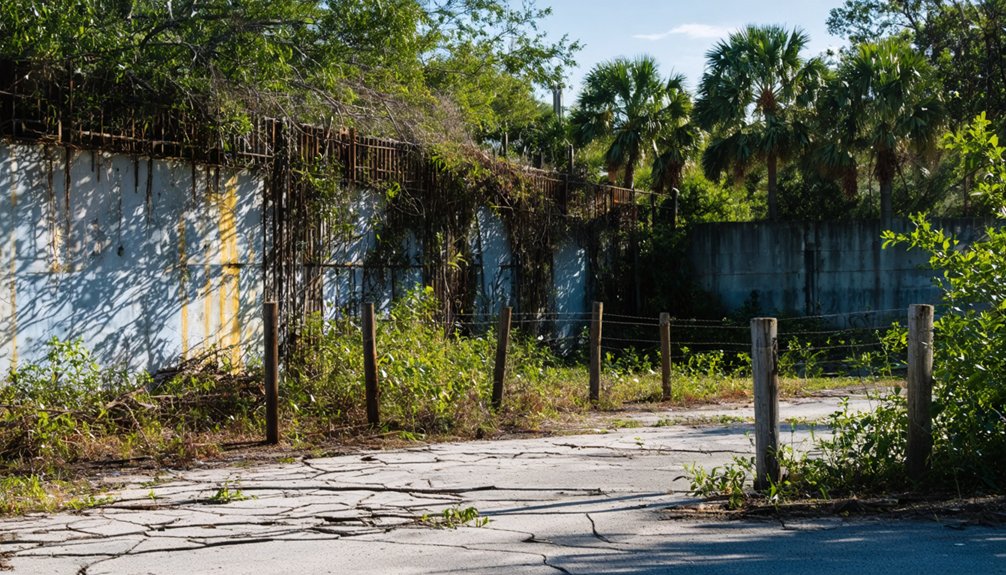
Since Hurricane Katrina devastated the Louisiana coast in 2005, I’ve tracked dozens of abandoned communities across the American South, but Silver Palm’s erasure proves more complete than most. You’ll find precious few remnants of once thriving community here—just concrete foundations disappearing beneath palmetto scrub and a crumbling drainage canal marker. The ghost town walking tour details are sparse because there’s barely anything left to tour.
I stood where the post office once served farmers, now just rutted limestone beneath my boots. You’re looking at urban development’s appetite, not nature’s wrath. The few locals who remember Silver Palm’s exact location guard it jealously. If you’re seeking freedom in forgotten places, you’ll need patience, county records, and willingness to bushwhack through private property.
The Silver Palm Historic District Today
The Silver Palm Schoolhouse stands transformed at the heart of what little remains historically designated—a modest single-family home now, though Metro Dade County’s Historic Preservation Board recognized its significance in 1986, followed by National Register placement in July 1987.
Once a schoolhouse, now a private home—historically recognized yet thoroughly transformed by the decades between then and now.
You’ll find architectural integrity compromised by decades of updates:
- 1970s-80s aluminum awning windows replacing originals
- Modified porch posts and cement additions
- Bell tower removed after final classes
- Modern kitchens and wood paneling installations
- Second-story porch preserving exposed rafters and wooden floors
The broader district encompasses Anderson’s General Store (1912), Redland District Lion’s Club (1934), and Kelly store site. Meanwhile, community governance structure evolved separately—Silver Palms Community Development District formed October 2003, operating through elected supervisors managing bond assessments. Historic preservation and modern administration exist parallel, rarely intersecting.
Visiting the Ghost Town: Location and Access
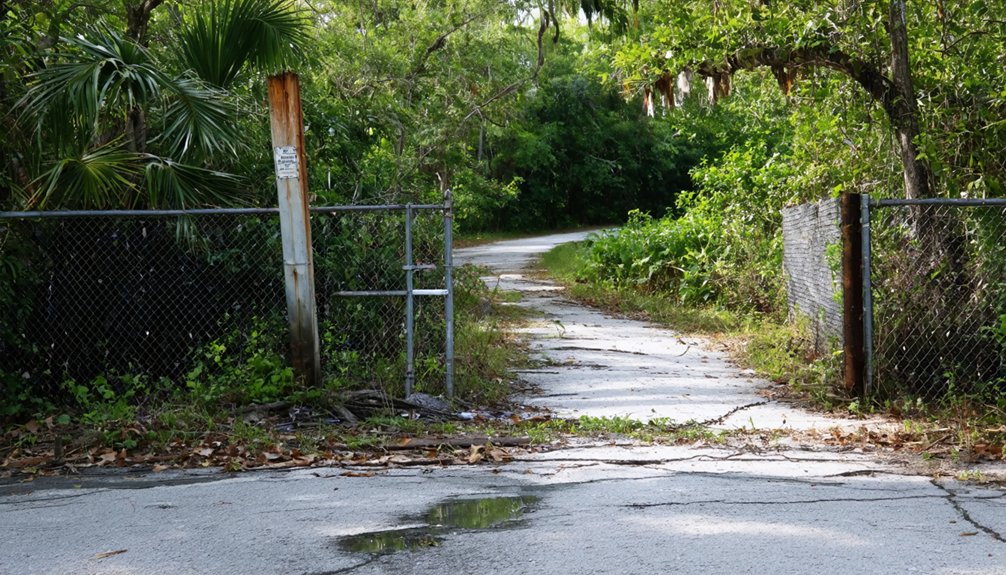
Finding Silver Palm requires precision—GPS coordinates place this inhabited ghost town at 25.564388° N, -80.435332° W in Miami-Dade County, where SW 232nd Street intersects SW 157th Avenue near Homestead. You’ll navigate through agricultural landscape that still defines this southern Florida corridor, passing fields that connect directly to the settlement’s farming origins. A historical marker at this intersection confirms you’ve reached the site, distinguishing it from Silver Springs in Marion County or West Palm Beach’s urban sprawl forty miles north.
The location remains accessible without restrictions, making day trips from Miami straightforward. You’ll find the ghost town’s inhabited status means nearby neighborhoods blend seamlessly with historic boundaries—modern development hasn’t erased the district’s character. TerraFly mapping confirms point-specific coordinates for exact navigation.
Frequently Asked Questions
Are There Any Ghost Sightings or Paranormal Activity Reported in Silver Palm?
No documented ghost sightings exist for Silver Palm. Unlike nearby locations with legends of ghostly apparitions and mysterious disappearances, this abandoned town’s paranormal activity remains unrecorded in archival documentation, though you’re free to explore and form your own conclusions.
What Happened to the Original Residents After the Town Declined?
You’ll find former farmers fled following devastating crop losses. Reasons for resident relocation included total economic collapse—canker, hurricanes, Depression combined destroyed livelihoods. The impact on local economy was catastrophic, forcing families toward Perrine and Florida City seeking survival and independence.
Can You Enter the Remaining Historic Buildings or Just View Exteriors?
You can’t access interiors—there aren’t self-guided tours or guided group tours available. The schoolhouse remains privately occupied, while Anderson’s Corner sits abandoned and condemned. You’re limited to viewing exteriors from public roads near the historic marker.
Were There Any Notable Crimes or Tragedies in Silver Palm’s History?
No documented crimes mar Silver Palm’s history—just economic catastrophes and natural disasters. You’ll find no records of unsolved disappearances or reports of strange noises in archival documentation, despite the town’s eerie abandonment following agricultural collapse and Depression-era hardship.
How Does Silver Palm Compare to Other Florida Ghost Towns?
You’ll find Silver Palm’s story mirrors typical Florida ghost towns—economic decline from citrus canker and hurricanes parallels other settlements. However, environmental factors like drainage and agricultural boom-bust cycles created uniquely preserved structures, unlike completely vanished lumber towns.