Smyrna, California is an authentic ghost town established as a water stop along the Tonopah and Tidewater Railroad in the late 19th century. You’ll find it located at coordinates 35°55′16″N 117°54′10″W, accessible via unpaved county roads. Named after an ancient Turkish city by engineer Lewis Kingman, it flourished briefly before automobiles and new rail routes rendered it obsolete by the 1940s. The desert now reclaims its sun-bleached wooden structures, revealing tales of isolation and resilience.
Key Takeaways
- Smyrna was a late 19th century railroad stop providing water for steam locomotives along routes connecting Amboy, Cadiz, and Essex.
- Named after an ancient Turkish city by engineer Lewis Kingman, Smyrna followed classical naming conventions common in California ghost towns.
- The town served as a crucial hub for borax transportation and essential supplies, creating small pockets of community around railroad section houses.
- Economic decline occurred when newer rail routes bypassed Smyrna and automobile travel gained popularity in the 1920s.
- Today, sun-bleached ruins including a partially collapsed depot, general store, and scattered artifacts remain at coordinates 35°55′16″N 117°54′10″W.
The Hidden Railroad Stop in the Mojave Desert
Nestled within the unforgiving expanse of the Mojave Desert, Smyrna emerged as an important yet inconspicuous railroad stop during the late 19th century when steam locomotives dominated western transportation.
You’ll find it was primarily established to provide essential water supplies for thirsty engines traversing the harsh landscape.
Like its sister stations Amboy, Cadiz, and Essex, Smyrna formed part of a critical network supporting desert railroad history, offering not just water but also crew rest points and maintenance facilities. Many locations along this railway route, including Smyrna, were named by Lewis Kingman, a railroad locating engineer.
These humble outposts were lifelines in an otherwise inhospitable environment.
The stop’s infrastructure likely included basic elements: a water tower, modest depot, and maintenance buildings designed specifically for desert operations. Similar to the abandoned structures at Halloran Summit, much of Smyrna’s original buildings have fallen into disrepair over time.
Though small, Smyrna played a significant role in connecting remote mining districts to larger economic centers, enhancing desert transportation across the American West.
Origins of Smyrna’s Unusual Name
While the desert outpost served a practical purpose in railroad operations, Smyrna’s curious name reveals another dimension of western settlement patterns.
You’ll find this pattern repeated across California’s ghost towns, where classical naming conventions were deliberately employed to evoke prestige and civilization.
The name Smyrna derives from an ancient Turkish city of commercial significance. During the 19th and early 20th centuries, railroad officials and surveyors frequently borrowed such classical references when establishing new stops along expanding rail lines.
Railroad pioneers scattered classical names like Smyrna across the American West, lending prestige to humble outposts along iron pathways.
Though no definitive documentation explains why this particular Mojave Desert whistle-stop received the name, it aligns with the era’s tendency to use memorable, easily pronounced names with historical gravitas. Similar to many California ghost towns, Smyrna’s story reflects how mining and commerce contributed to both the establishment and eventual abandonment of these historic settlements.
Unlike some towns named after founders or local landmarks, Smyrna’s designation likely came from a distant railroad official’s decision rather than any connection to the original Mediterranean city. Similar naming patterns can be seen in ghost towns like Randsburg and Bodie, where historical legacies continue to draw visitors interested in California’s mining heritage.
Life Along the Tonopah and Tidewater Line
As you rode the Tonopah and Tidewater Line through Smyrna in the early 1900s, you’d witness railroad workers battling scorching desert conditions while maintaining essential tracks that connected isolated communities.
The T&T’s steam locomotives transported everything from mining equipment and fresh water to mail and groceries, serving as desert dwellers’ lifeline to the outside world.
Initiated by Francis Marion Smith, the railroad primarily hauled borax from mines near Death Valley while also serving crucial community needs.
The line ran through several remote stations including Death Valley Junction, creating a vital transportation corridor for the region’s mining operations.
Railroad section houses dotted the line at regular intervals, creating small pockets of community where workers and their families formed tight-knit social bonds despite the harsh surroundings.
Railroad Workers’ Daily Life
Living along the Tonopah and Tidewater Line required extraordinary fortitude from railroad workers who endured some of the harshest conditions imaginable.
You’d rise before dawn, work 12-hour shifts performing track maintenance in temperatures swinging from freezing nights to 120°F days. The Class II railroad status of T&T did little to improve working conditions for its laborers. Freight operations consumed your existence—loading borax, lead, and clay with little more than manual strength. After its completion in October 30, 1907, the railroad became the lifeline for communities dotting the desert landscape.
Your home: a cramped bunkhouse with minimal privacy. Your meals: simple stews and beans from the mess hall, with strictly rationed water. Fresh produce rarely appeared on your plate.
When not working, you’d gather with fellow laborers for card games or music. Mail delivery became your lifeline to the outside world.
Despite these hardships, you’d maintain the essential desert railway, ensuring America’s resources continued flowing through this unforgiving landscape.
Isolation and Community
Despite being strung along the 169-mile Tonopah and Tidewater rail line, Smyrna and neighboring settlements existed in profound isolation amid the unforgiving Mojave Desert landscape.
Geographic constraints shaped daily existence, as harsh terrain and minimal road networks left residents entirely dependent on scheduled train arrivals for survival.
You’d find these small communities forged by necessity—railroad workers, miners, and their families building resilient social structures despite transience. The railroad facilitated crucial transport of ore and supplies to these remote mining communities, sustaining their fragile existence.
Their collective identity centered around depot activities, with the railroad schedule dictating the rhythm of life. Community resilience manifested through mutual support networks that helped inhabitants withstand extreme conditions and limited resources.
The T&T wasn’t just transportation—it was Smyrna’s lifeline to the outside world, connecting these isolated outposts to larger rail systems and enabling vital communication, supply delivery, and occasional escape from desert confinement.
Transporting Desert Necessities
The Tonopah and Tidewater Railroad transformed the Mojave Desert into a navigable commercial corridor when operations began in 1907, establishing essential supply chains for settlements that would otherwise remain uninhabitable.
You’d find the T&T’s lifeline function most evident in its water transportation systems, delivering this precious resource to parched outposts dependent entirely on rail service for survival.
Mining supplies, equipment, and workers flowed into previously inaccessible terrain, while valuable ores—borax, lead, clay, and feldspar—moved outward to processing facilities in California and New Jersey.
When you connected to the broader network via the Atchison, Topeka and Santa Fe at Ludlow or the Los Angeles and Salt Lake Railroad at Crucero, you’d gained access to a transportation web that defeated the desert’s isolation despite challenging terrain and harsh conditions.
Rise and Fall of a Desert Railroad Town
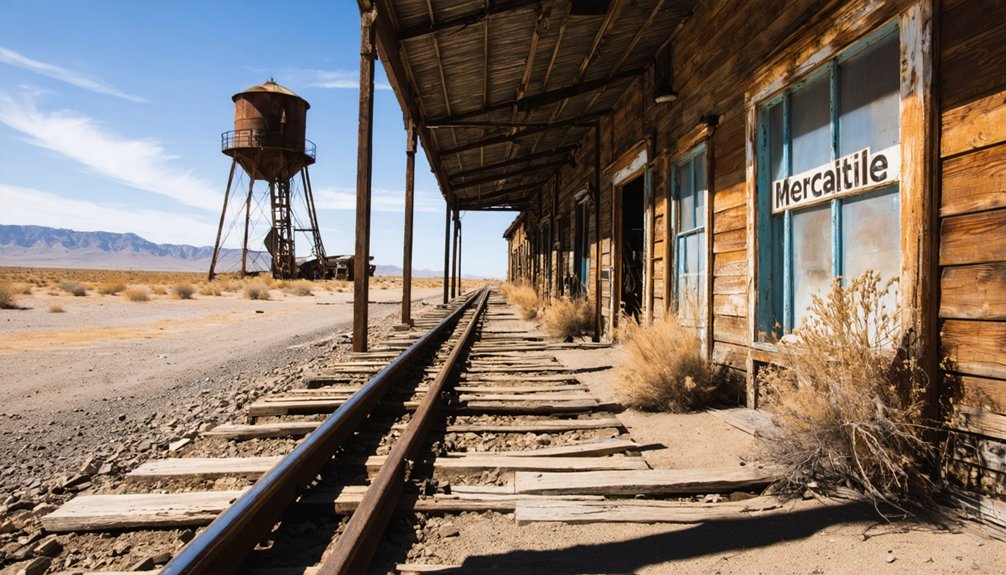
Nestled along the scorching California desert plains, Smyrna emerged as a essential railroad outpost in the late 19th century when Southern Pacific Railroad expanded its operations through the arid terrain.
The town’s strategic position transformed it into a critical hub where Smyrna’s economy thrived on servicing locomotives, housing railroad workers, and facilitating trade between isolated desert settlements.
Railroad connections to Los Angeles and Phoenix created unprecedented growth as merchants, saloons, and hotels sprang up to accommodate travelers and workers alike. Similar to how Sierra Railway facilitated the development of lumber towns like Standard and Tuolumne, Smyrna’s rail infrastructure supported surrounding industries and settlements.
By 1910, the community had established a small but vibrant commercial district.
Yet Smyrna’s prosperity proved fleeting. As newer rail routes bypassed the settlement and automobile travel gained popularity in the 1920s, the town’s significance diminished.
Drought and economic depression delivered the final blows, leaving only scattered ruins by 1940.
What Remains: Exploring the Ghost Town Today
Wandering through Smyrna’s sun-bleached ruins today, you’ll encounter a haunting tableau of desert reclamation where nature steadily consumes what humans abandoned.
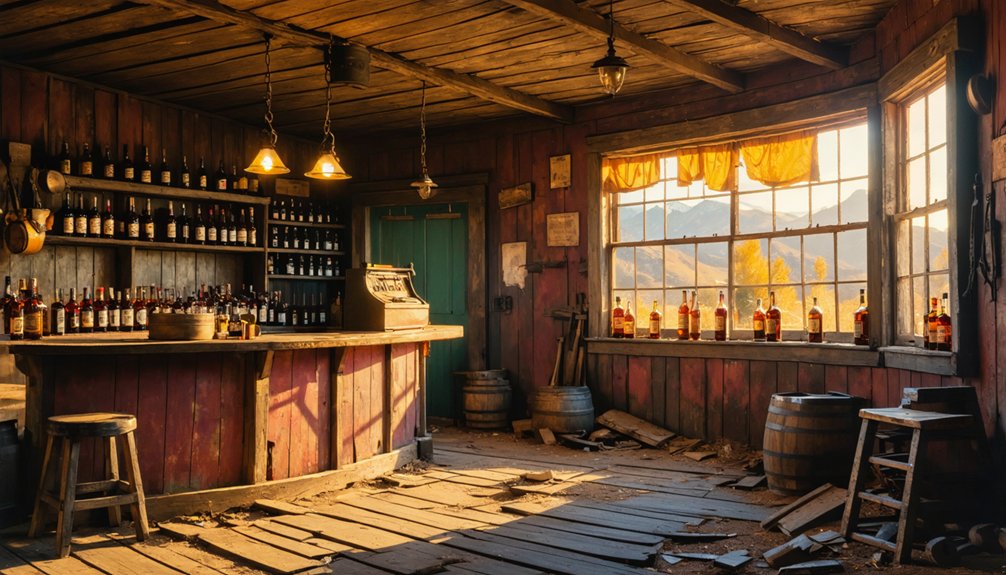
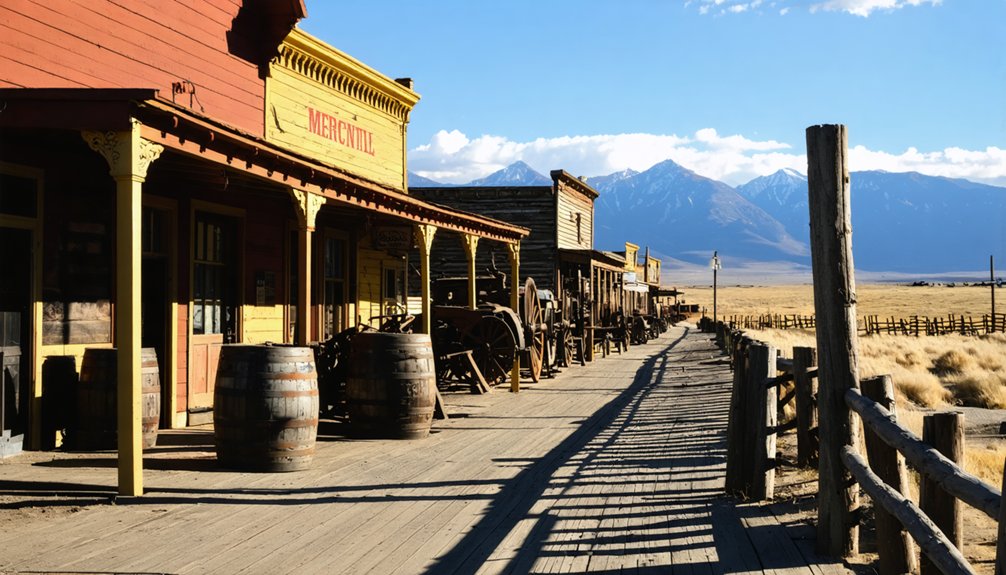
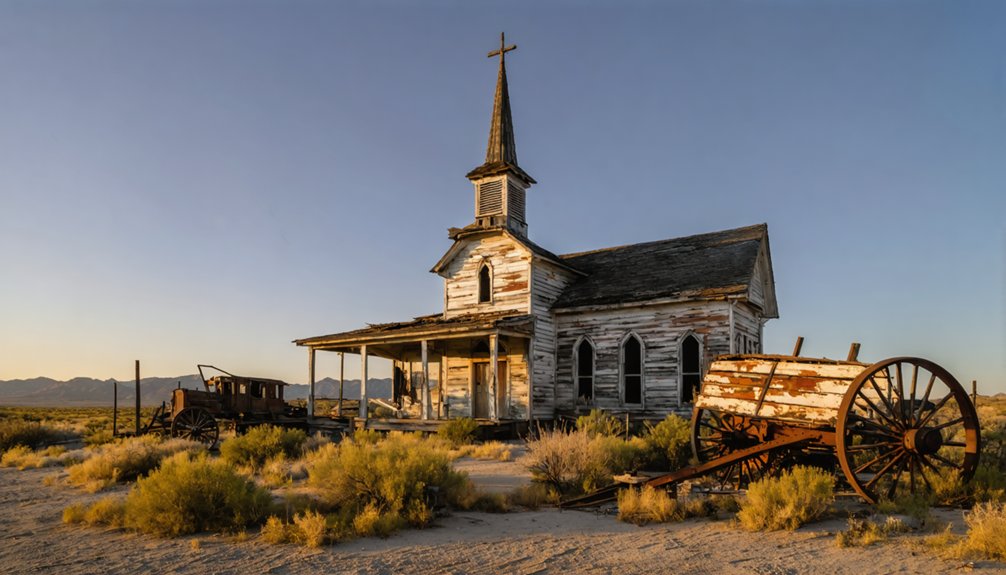
Smyrna’s architecture reveals itself through weathered wooden structures—a tilting general store, post office, and several homes slowly surrendering to the elements. The partially collapsed railroad depot stands as a silent monument to the town’s former liveliness.
What you’ll find at Smyrna:
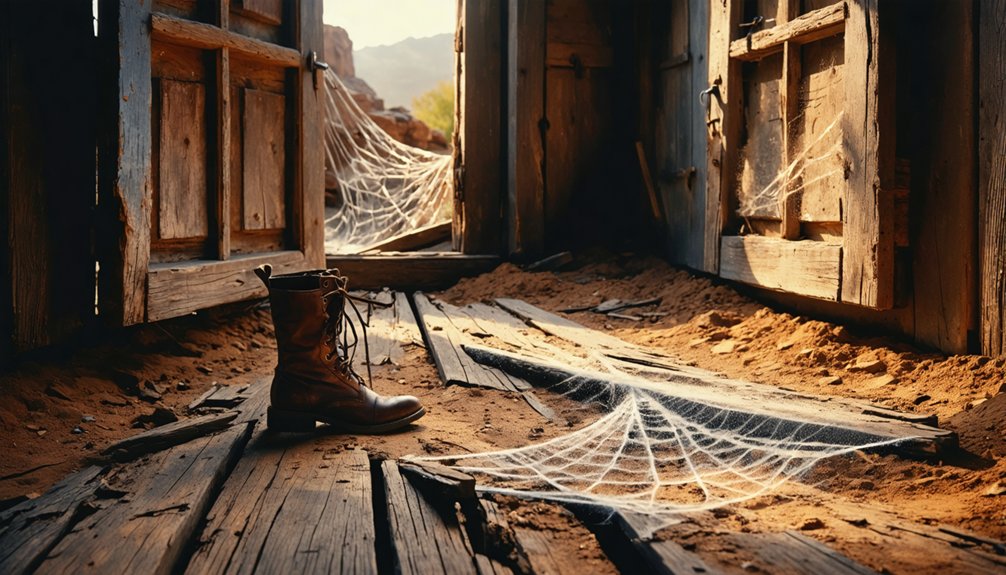
- Scattered artifacts including rusted mining tools, broken household items, and railroad remnants
- Foundations and skeletal remains of the schoolhouse and bunkhouse, now home to desert wildlife
- Unpaved access roads requiring high-clearance vehicles, with no visitor amenities or protection from ghost town legends that echo through crumbling walls
The Desert Reclaims: Natural Environment of Smyrna

Beyond the decaying structures and scattered artifacts, Smyrna’s true story unfolds through its relentless natural environment—a harsh desert ecosystem that has both shaped the town’s fate and now reclaims its remains.
The Mojave’s extreme conditions continuously transform Smyrna’s landscape. Sparse ghost town vegetation—primarily creosote bush, brittlebush and desert saltbush—pushes through cracked foundations. These hardy plants, requiring minimal water, gradually destabilize remaining structures.
Desert ecology operates on extended timelines here, with seasonal flash floods carving new channels through abandoned streets.
You’ll notice wildlife has adapted too. Kangaroo rats, sidewinders, and kit foxes now inhabit buildings once filled with miners. As temperatures rise with climate change, this desert reclamation accelerates, writing the final chapter in Smyrna’s evolution from boomtown to barren wilderness.
Photographing Smyrna’s Abandoned Structures
As you approach Smyrna’s skeletal remains, a photographer’s paradise unfolds through your viewfinder—a hauntingly beautiful canvas of decay captured best during the golden hours of dawn and dusk.
Abandoned photography here rewards patience, revealing stories through weathered textures and haunting silhouettes against California’s desert backdrop.
Your ghost town exploration requires thoughtful equipment choices for capturing Smyrna’s scattered remnants:
- Bring wide-angle lenses for contextual shots of buildings within their desert environment
- Pack a tripod for low-light situations when shooting mine entrances or during golden hour
- Consider macro lenses to document intimate details of rust patterns, weathered wood, and remnants of the past
Visiting Tips: Finding and Accessing This Remote Location

Where exactly is the enigmatic ghost town of Smyrna hidden among Kern County’s vast desert landscape?
You’ll find it at coordinates 35°55′16″N 117°54′10″W, accessible via unpaved county roads branching from Routes 14 or 178.
Navigation challenges abound—cellular service disappears as you approach, making offline maps and GPS essential tools for your journey.
Wandering into Smyrna means embracing digital isolation—download those maps before signal bars fade to nothing.
For successful exploration, visit during spring or fall to avoid extreme temperatures and potential road washouts.
Your vehicle should have good clearance or 4WD capability to navigate the rugged terrain.
Before setting out, verify land access permissions, as ghost town preservation efforts sometimes restrict entry.
Always travel prepared: bring abundant water, emergency supplies, and inform someone of your plans.
The remoteness demands self-sufficiency and respect for both historical structures and the surrounding environment.
Frequently Asked Questions
Were There Any Notorious Incidents or Crimes in Smyrna’s History?
You’ll find Smyrna’s history lacks documented murders or robberies. Available research doesn’t reveal infamous incidents, leaving this aspect of the ghost town’s chronological timeline conspicuously absent from California’s criminal records.
Did Any Famous or Notable People Ever Live in Smyrna?
Looking for famous residents in forgotten corners of history? No notable historical figures ever lived in Smyrna. The town’s brief mining existence didn’t attract celebrities or generate notable events worth documenting in historical records.
What Indigenous Tribes Occupied the Area Before Smyrna’s Establishment?
Yokuts tribes primarily occupied your area before Smyrna’s establishment. Their Native Tribes’ Historical Significance included establishing 63 distinct villages with sophisticated social structures, subsisting on salmon, acorns, and local game.
Are There Any Local Legends or Ghost Stories Associated With Smyrna?
Silent shadows tell no tales; you won’t find documented ghostly apparitions or haunted locations at Smyrna. Unlike Bodie or Calico, this forgotten town lacks specific paranormal legends in historical records.
What Happened to Smyrna’s Residents When the Town Was Abandoned?
You’d find Smyrna’s residents faced resettlement challenges when mines closed, scattering to Barstow, Victorville, and Los Angeles. Families split apart, community bonds dissolved, and local folklore gradually disappeared as they sought new livelihoods.
References
- https://patch.com/california/banning-beaumont/13-ghost-towns-explore-california
- https://usghostadventures.com/haunted-places/bodie-ghost-town/
- https://www.californist.com/articles/interesting-california-ghost-towns
- https://www.youtube.com/watch?v=4abnhupnLac
- https://en.wikipedia.org/wiki/List_of_ghost_towns_in_California
- https://www.staxupstorage.com/blogs/exploring-ghost-towns-near-homeland-california/
- https://www.islands.com/1977075/bagdad-siberia-california-ruins-route-66-abandoned-ghost-towns/
- https://npshistory.com/publications/moja/hsr-kelso-depot.pdf
- http://cali49.com/mojave
- https://www.youtube.com/watch?v=U6QDIFuYFm8