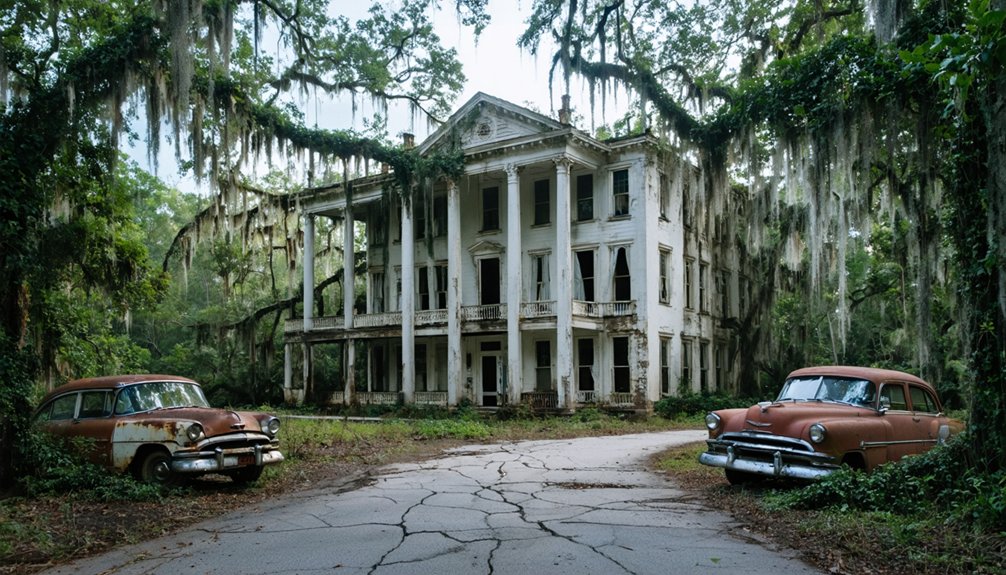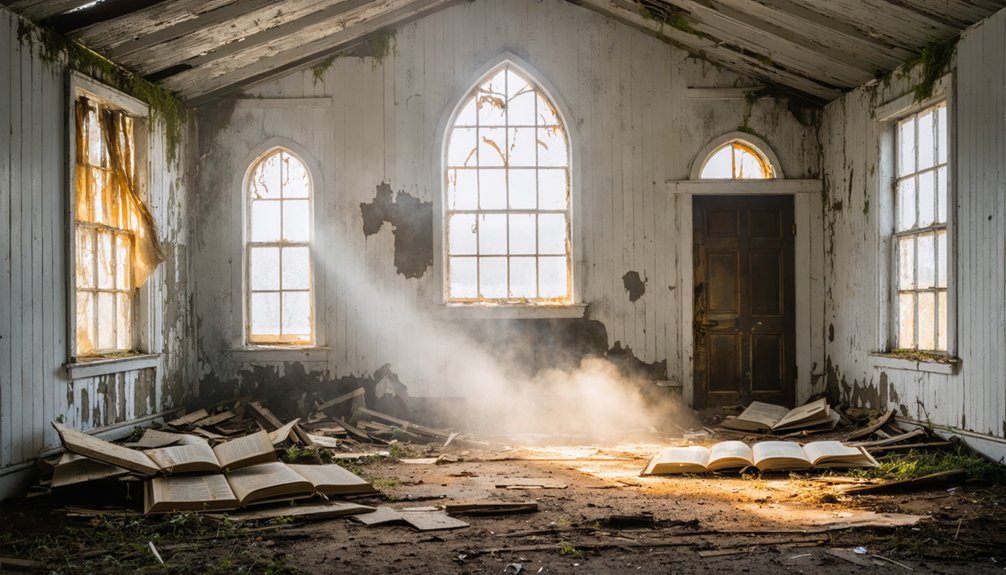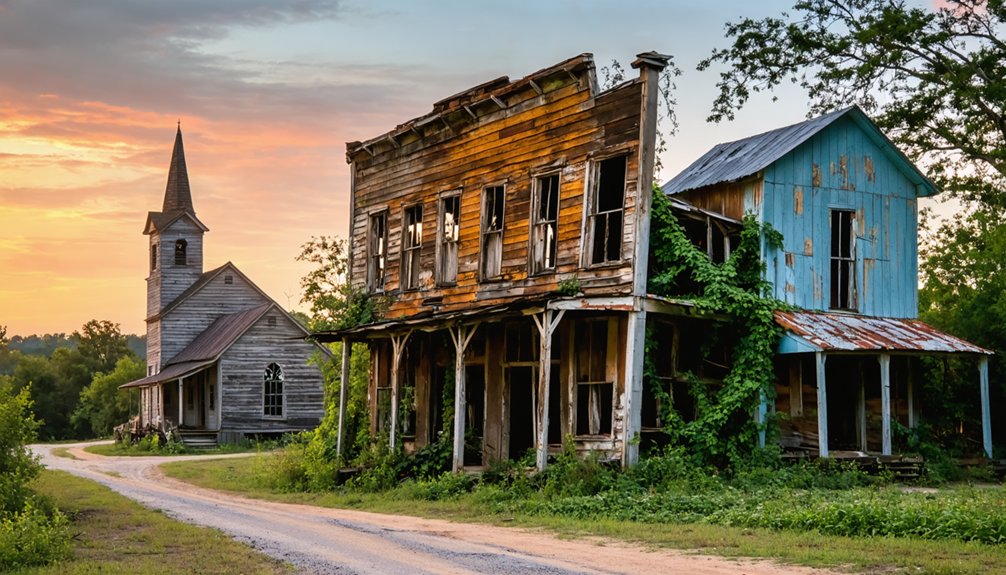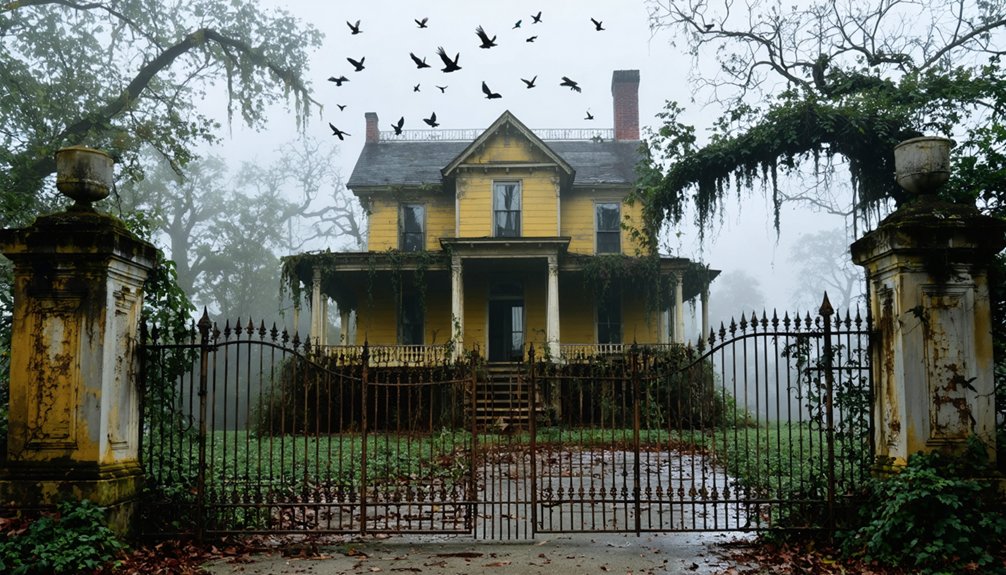
You’ll find Southern ghost towns emerged from various causes: mining booms that went bust, failed infrastructure projects, and devastating environmental disasters. The 2008 housing crisis created modern suburban ghost towns with foreclosed homes and empty streets across the South. Many abandoned communities now serve as heritage tourism destinations, where preservation efforts compete with development pressures. Explore these haunting remnants to discover how economic collapse, natural forces, and human decisions shape our landscape.
Key Takeaways
- Failed infrastructure projects like railroad diversions and decommissioned military bases created numerous ghost towns across the Southern states.
- Economic collapse from resource depletion, speculation, and the 2008 housing crisis transformed vibrant Southern neighborhoods into abandoned areas.
- Environmental disasters including flooding, sinkholes, and contamination forced evacuation of communities like Bayou Corne and Times Beach.
- Many Southern ghost towns are preserved as heritage tourism destinations, offering guided tours and interpretive exhibits.
- Water-related disasters have been particularly devastating to Southern communities, causing abandonment through floods, erosion, and river changes.
Boom to Bust: The Life Cycle of Mining Ghost Towns
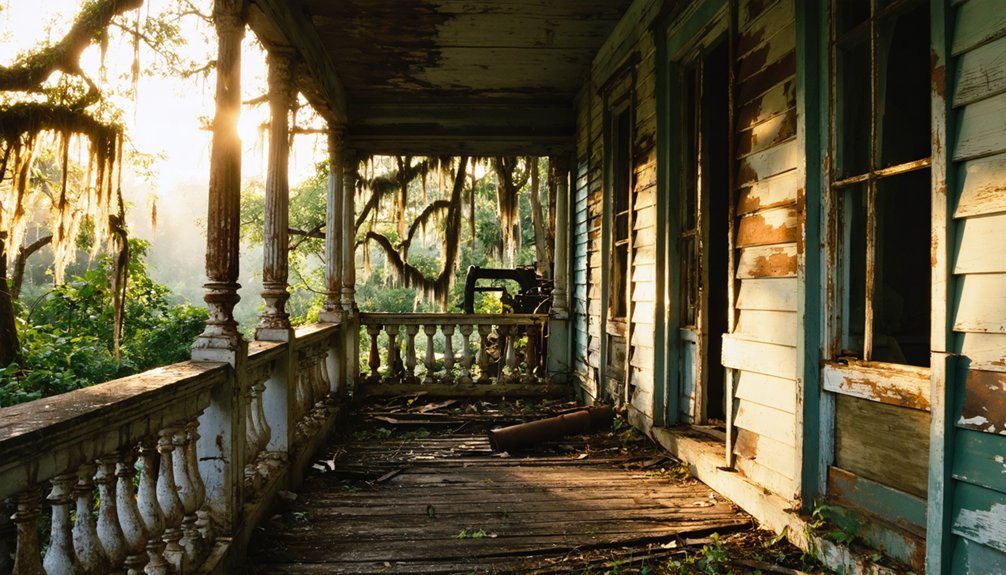
While the picturesque ruins of ghost towns often evoke nostalgia today, their existence follows a predictable life cycle that begins with remarkable growth and inevitably ends in abandonment.
You’ll find this pattern repeated throughout the American West, where towns like Bodie, California exploded from nothing to 10,000 residents within years of mineral discovery, only to dwindle to 128 people by 1920. Bodie’s decline was largely due to mining stock speculation outpacing the actual output of the mines.
The cycle begins with a mineral discovery, followed by rapid population influx within a five-mile radius. As mining techniques advanced, these communities flourished temporarily, supporting various businesses.
The discovery of minerals sparked instant communities, their brief prosperity riding the wave of innovation until resources vanished.
However, economic sustainability proved elusive. When resources depleted or became unprofitable, exodus followed. Federal regulations during WWII often accelerated abandonment, leaving behind the haunting shells you can visit as historic parks today. Many of these towns became abandoned after the reason for being no longer existed, whether that was profitable mining operations or supporting infrastructure.
Forgotten Infrastructure: Towns Built Around Failed Projects
Beyond the ghost towns created by mining booms and busts, you’ll discover a different category of abandoned communities throughout the American South: those built around infrastructure projects that never materialized or failed to sustain themselves.
These forgotten places were often victims of ambitious plans—railroad expansions rerouted around towns like Vicksburg, Mississippi, triggering economic stagnation; decommissioned military bases leaving behind empty housing and utilities; half-finished highways that displaced residents for roads never completed; industrial parks with buildings no businesses would occupy; and resort communities that failed to attract visitors or residents. Like many Rust Belt cities, these towns maintain oversized infrastructure costs despite dramatically reduced populations.
Today, you’ll find physical remnants of these failed infrastructure projects scattered across the landscape: abandoned rail beds, vacant government buildings, ghost neighborhoods with empty streets, and extensive utility systems built for populations that never arrived—all indicators of development dreams unfulfilled. Minnesota’s Forestville declined similarly after being bypassed by the railroad development, transforming from a thriving settlement to a preserved historical site.
Lawless Legends: The Cultural Identity of Wild Western Settlements

Unlike the abandoned Southern towns built around failed infrastructure projects, the cultural identity of Wild Western settlements evolved from a complex interplay of lawlessness, isolation, and self-governance.
You’ll find these frontier communities developed distinct identities rooted in self-reliance, with cultural narratives glorifying individualism and personal freedom.
With traditional law enforcement scarce, vigilante justice became commonplace. Citizens formed committees to address crime, often bypassing formal legal processes. Wealthy individuals often hired private lawmen and posted substantial rewards to pursue justice outside official channels.
The line between lawmen and outlaws frequently blurred, as some peace officers engaged in criminal activities themselves.
Though murder rates were high relative to population, they were actually lower than in eastern cities. Contrary to popular belief, bank robberies were exceptionally rare with only eight documented cases from 1859 to 1900.
The enduring myth of the lawless frontier persists despite evidence of community self-regulation, perpetuated by dime novels and later Hollywood films that romanticized this complex chapter of American history.
Economic Collapse and the Rapid Exodus
As the housing bubble burst in 2008, Southern suburban communities experienced an unprecedented economic collapse that transformed vibrant neighborhoods into virtual ghost towns almost overnight.
You witnessed mass economic migration as families fled in search of employment, leaving behind empty streets and foreclosed homes.
- South Florida produced 23,000 condo units (2003-2007), most sitting vacant after the market crashed.
- Phoenix and other Sunbelt cities saw vacancy rates rivaling those of Rustbelt communities.
- Banks sometimes bulldozed unfinished developments rather than maintain them.
- Entire blocks stood abandoned as housing instability forced families to relocate.
- Remote developments faced bleaker prospects than those near metropolitan areas.
Similar to the mining towns of the 1880-1940 period, these suburban areas experienced rapid decline due to resource depletion – in this case, financial capital rather than mineral wealth.
The exodus left behind aging populations, shuttered businesses, and crumbling infrastructure—concrete monuments to an economic dream that evaporated as quickly as it formed. Census data revealed a staggering 18,700 vacant units across the country as the recession deepened.
Preserved in Time: Notable Southern Ghost Town Remains

Five remarkably preserved ghost towns across the Southern United States offer windows into different historical periods and industries that once thrived in these now-abandoned communities.
These towns, much like the failed utopian communities in the US, showcase the visions and ambitions of their founders, only to be met with hardship and decline. Each site tells a story of dreams that did not materialize, reflecting broader social and economic challenges throughout American history. The remnants of these once-thriving neighborhoods serve as reminders of both human aspiration and the realities of sustainability.
Ruby, Arizona showcases the Montana Mine‘s ghostly architecture, while Gleeson’s original jail and hospital stand as evidence to early 1900s life.
In Tennessee, Elkmont’s historic cabins remain under National Park Service protection, with restoration plans underway.
Thurmond, West Virginia preserves its coal town identity through intact railroad depots and general stores, earning a spot on the National Register of Historic Places.
Buffalo City, North Carolina’s historical remnants include the old schoolhouse and homes within the Alligator River Wildlife Refuge.
These preserved sites allow you to experience America’s boom-and-bust cycles firsthand, with many locations offering guided tours and interpretive exhibits explaining their significance. Charleston stands as a reminder of Tombstone’s silver industry, where it once processed ore with around 40 buildings including bakeries and blacksmith shops by 1879. Similar to Ani in Turkey, these southern ghost towns have been transformed into museum villages that protect their historical significance.
Natural Disasters and Environmental Impacts
Water devastation has shaped the South’s ghost town landscape, with towns like Rodney, Mississippi and Valmeyer, Illinois falling victim to river changes and catastrophic flooding.
You’ll find that seismic activity created similar abandonment patterns, as evidenced by Port Royal’s devastation following the 1886 earthquake and subsequent hurricanes.
The combined threats of subsidence, sinkholes, and powerful storm systems have rendered numerous communities uninhabitable, including Bayou Corne with its massive 2012 sinkhole and Moringo’s near-destruction by a 2004 F4 tornado.
Fire’s Destructive Legacy
Devastating environmental catastrophes have transformed once-thriving communities into abandoned landscapes across America’s southern suburbs.
The toxic legacy of industrial negligence has forced entire populations to abandon their homes, particularly when fire safety concerns became unmanageable. You’ll find places like Centralia, Pennsylvania—where underground coal seams continue burning since 1962—serving as stark reminders of humanity’s precarious relationship with nature.
- Carbon monoxide seepage through sinkholes created uninhabitable air conditions
- Congressional intervention required $42 million to relocate residents from danger zones
- Lead and zinc mining tailings contaminated groundwater across entire communities
- Dioxin exposure in Times Beach prompted complete evacuation and demolition
- Asbestos particulates from mining operations caused catastrophic health impacts in workers
These abandoned towns stand as monuments to environmental disasters that permanently altered the American landscape.
Water Wreaks Havoc
Natural forces related to water have rendered numerous Southern communities uninhabitable, creating ghost towns through various mechanisms of destruction.
You’ll find Easonville’s remnants beneath Logan Martin Lake—a community sacrificed to dam construction, with only chapel structures occasionally visible during low water levels. Residents were forced to relocate to nearby Eustis after officials demolished structures and exhumed cemetery remains.
Water pollution devastated Times Beach, Missouri, where dioxin-contaminated oil sprayed on roads combined with catastrophic flooding in 1982.
The Meramec River’s 14-foot surge spread toxic chemicals throughout the town, accelerating evacuation decisions and complicating remediation efforts.
Coastal vulnerabilities plague communities like Shishmaref and Newtok, Alaska, where erosion and rising sea levels make long-term habitation impossible as climate change eliminates traditional ice barriers that once protected these settlements.
Military Influence and Wartime Repurposing
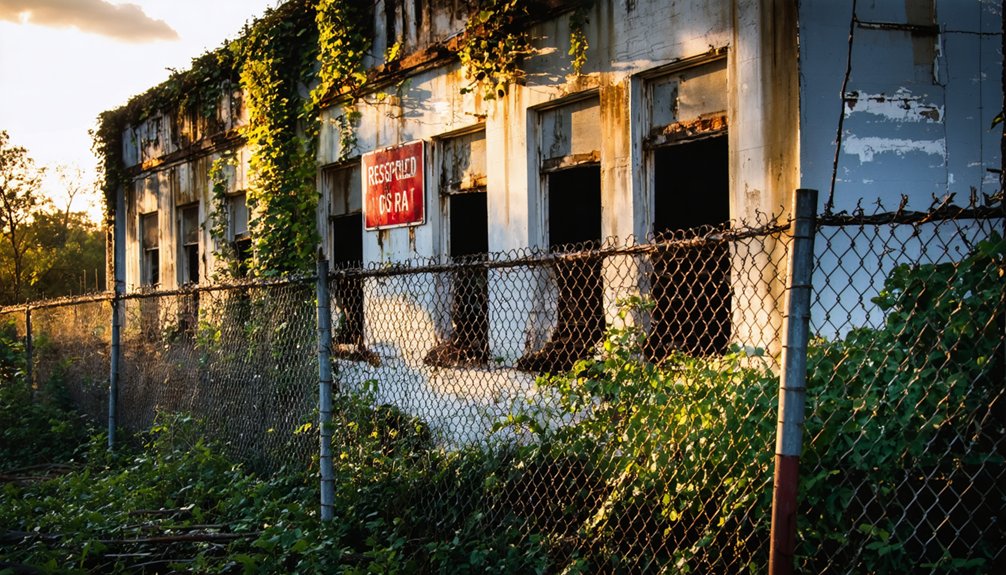
Throughout the American Southwest, military establishments profoundly shaped the development and ultimate abandonment of numerous settlements. Fort Bowie’s 32-year operation (1862-1894) exemplifies this military strategy, protecting water sources while facilitating indigenous displacement—notably after Geronimo’s 1886 surrender when Chiricahua Apaches were forcibly relocated to southeastern territories.
- Fort installations secured mining operations and supply routes, enabling economic development.
- Camp Noble’s brief existence protected mining interests during the Owens Valley Indian War.
- Castle Morgan prison camp repurposed Cahawba during the Civil War, holding 3,000 Union soldiers.
- Confederate seizure of Cahawba’s railroad tracks for wartime purposes accelerated its decline.
- Post-conflict abandonment transformed military sites into historical landmarks of regional heritage.
The historical significance of these military installations extends beyond their operational years, revealing how governmental priorities transformed landscapes and communities before ultimately rendering them obsolete.
From Ruin to Tourist Attraction: The Modern Afterlife
You’ll find a dramatic transformation in many Southern ghost towns as preservation efforts compete with suburban development pressures for these historical spaces.
Marketing strategies have evolved to promote these sites as heritage tourism destinations, with Texas and California leveraging their abundant ghost towns to attract visitors seeking both educational and paranormal experiences.
Well-preserved locations like St. Elmo and Bodie demonstrate how maintaining structural integrity and authentic period details can generate sustainable tourism revenue that supports local economies.
Preservation vs. Development
While abandoned communities throughout the South have faced the inevitable deterioration that comes with desertion, a striking tension has emerged between preservation efforts and development pressures.
You’ll find this preservation-development conflict playing out across the region, where both government agencies and community organizations navigate complex challenges.
- National Park Service maintains historic structures in places like Thurmond, West Virginia, while development interests eye potential real estate.
- Community-led initiatives in Eatonville and Charleston have created models for balancing preservation with economic needs.
- The Abandoned Buildings Tax Credit has rehabilitated over 2,200 structures, generating $385 million in investments.
- Local zoning ordinances provide critical protection for historic suburbs like Olmsted’s Druid Hills.
- Preservation South Carolina’s conservation easements protect 45 properties across 21 counties from development pressures.
Tourist Marketing Strategies
How have abandoned southern communities transformed from forgotten ruins into thriving tourist destinations? The resurrection of these ghost towns stems from strategic digital marketing campaigns that leverage compelling historical narratives alongside paranormal appeal.
Tour operators collaborate with local historical societies to craft experiences that balance entertainment with authenticity, while municipalities invest in preservation to capitalize on tourism’s economic potential.
You’ll find these destinations prominently featured across social media platforms through influencer partnerships that showcase atmospheric visuals and firsthand experiences.
Mobile apps and dedicated paranormal tourism websites have democratized access to these once-forgotten locales. Public-private partnerships fund infrastructure improvements while themed events and festivals create seasonal draws.
This collaborative approach between tourism boards, local businesses, and online communities has given southern ghost towns their most valuable asset: a second life through strategic visibility.
Frequently Asked Questions
Did Ghost Town Residents Leave Personal Belongings When Abandoning Their Homes?
Yes, you’ll find residents left numerous abandoned possessions in ghost towns, including personal artifacts in homes, business inventory, and institutional equipment—suggesting hasty departures rather than methodical relocations.
What Role Did Women Play in Southern Ghost Town Communities?
Picture women’s worn hands building community resilience. You’ll find they operated businesses, served as postmasters, managed properties, established schools and churches, while sometimes working in marginalized roles like prostitution out of necessity.
How Did Children’s Education Continue in Declining Mining Towns?
Your children’s education persisted through basic education methods focusing on essential literacy, with schoolhouses doubling as union centers where community support prioritized survival skills over advanced learning while older children typically entered the workforce.
Were There Attempts to Relocate Entire Communities Rather Than Abandon?
Yes, you’ll find numerous instances of community migration, with both government-mandated and economically-driven relocation efforts replacing abandonment, as seen in Ellenton, South Carolina and post-flood Pattonsburg, Missouri.
How Did Railroad Companies Influence Ghost Town Formation and Abandonment?
Like once-sturdy train trestles collapsing, you’ve witnessed how railroad companies created boom towns through expansion, then triggered ghost towns through service discontinuation, rerouting, or economic decline when profitability waned along their iron pathways.
References
- https://www.visittucson.org/blog/post/8-ghost-towns-of-southern-arizona/
- https://www.blueridgeoutdoors.com/go-outside/southern-ghost-towns/
- https://www.mentalfloss.com/geography/wanderlust/creepiest-ghost-towns-united-states
- https://www.youtube.com/watch?v=qRVelHci92k
- https://styleblueprint.com/everyday/ghost-towns-in-the-south/
- https://www.explore.com/travel/25-ghost-towns-around-us-and-history-behind-them/
- https://www.geotab.com/press-release/american-ghost-towns/
- https://en.wikipedia.org/wiki/Lists_of_ghost_towns_in_the_United_States
- https://whakestudios.com/us-ghost-towns/
- https://www.youtube.com/watch?v=UujbImwiLfA