America’s most haunted farmsteads include Tennessee’s Bell Family Farm, site of the notorious Bell Witch hauntings, and Iowa’s Villisca Ax Murder House, where eight victims’ spirits reportedly linger. You’ll find spectral encounters at Boone Hall Plantation‘s slave cabins and unexplained phenomena at North Carolina’s Haunted Farm. Historical tragedies anchor these manifestations to specific locations, transforming ordinary agricultural land into supernatural landscapes. The soil of America’s rural past holds darker secrets than mere crop rotations.
Key Takeaways
- The Villisca Ax Murder House in Iowa harbors childlike apparitions and unexplained phenomena after eight people were brutally killed in 1912.
- Bell Family Farm in Tennessee became infamous for the Bell Witch haunting, featuring violent attacks and the supernatural death of John Bell.
- Myrtles Plantation hosts spirits of former slaves, particularly the legendary ghost Chloe, representing unresolved trauma of slavery.
- Boone Hall Plantation’s original slave cabins serve as paranormal hotspots, with Cabin 11 known for chills and electronic disturbances.
- North Carolina’s Somerset Place reports shadowy figures and rattling chains, while the state’s commercial “Haunted Farm” capitalizes on the historic Lively-Tate feud.
The Ghostly Legacy of Boone Hall Plantation

While Boone Hall Plantation presents itself as a picturesque Southern estate near Charleston, South Carolina, its haunted reputation stems from a darker historical reality dating back to the late 1600s.
You’ll encounter haunted history concentrated around the original slave cabins and brickyard ruins, where countless enslaved people suffered under brutal conditions.
The plantation’s spectral encounters include a pale young girl with hair obscuring her face, enslaved children’s spirits near the brick kilns, and a woman in ragged clothing making repetitive gestures by the creek. The plantation was established in 1681 by Elizabeth Boone and has witnessed centuries of suffering that continues to manifest spiritually. Similar to the Brick Kiln Ruins at Brickyard Plantation, witnesses report seeing an apparition of a woman in dark, tattered clothing passing through solid objects at dusk.
Cabin 11 remains a notable paranormal hotspot where visitors experience sudden chills and electronic disturbances.
These manifestations reflect the site’s continuous operation from cotton plantation to tourist attraction, preserving not just structures but apparently the spirits of those who couldn’t escape their earthly torment.
Bell Family Farm: Whispers of the Bell Witch
Among the most documented supernatural phenomena in American folklore, the Bell Witch haunting traces its origins to the seemingly ordinary farmstead of John Bell in Robertson County, Tennessee.
When the family settled there in 1804, they could hardly anticipate the terror that would begin in 1817.
The Haunted Farm became infamous as escalating disturbances progressed from strange noises to violent physical attacks, particularly targeting Bell’s daughter Betsy. Hundreds of curious onlookers camped on the property hoping to witness the paranormal activities firsthand.
Local lore attributes the Bell Witch to Kate Batts, a neighbor allegedly wronged in a land deal, though alternative theories exist.
The vengeful spirit of Kate Batts remains the prevailing explanation, though scholars continue debating the Bell Witch’s true origins.
Following John Bell’s mysterious death in 1820—for which Tennessee uniquely recognizes a supernatural cause—the phenomena largely subsided.
Today, the Bell Witch Cave and preserved artifacts continue attracting those seeking evidence of this enduring mystery that once reportedly deterred even Andrew Jackson. Visitors can experience this chilling tale through guided tours of a replica Bell house and access to the infamous cave for approximately $20.
Murderous Echoes: The Villisca Ax Murder House

In 1912, the quiet farming town of Villisca, Iowa became infamous when eight people, including six children, were brutally murdered with an axe as they slept in the Moore family home.
You’ll find that despite numerous suspects and investigations, the crime remains one of America’s most disturbing unsolved mysteries, with the killer’s identity lost to history.
The restored farmhouse, now listed on the National Registry of Historic Places, draws visitors who report encounters with childlike apparitions and unexplained phenomena that seemingly echo the tragic events of that June night. One chilling detail that continues to haunt visitors is that all mirrors were covered by the killer with blankets or clothing throughout the house after the murders. The property was originally built in 1868 as a modern farmhouse for George Loomis before becoming the scene of the horrific crime.
Unsolved Eight-Person Massacre
The Villisca Ax Murder House stands as a chilling monument to one of America’s most notorious unsolved mass murders. In the early hours of June 10, 1912, eight people—six members of the Moore family and two visiting girls—were bludgeoned to death with an ax while they slept.
The Villisca Mystery deepened when investigators discovered peculiar scene elements: covered mirrors, a piece of bacon leaning against a wall, and a bowl of bloody water in the kitchen. Bloodhounds were sent from Nebraska to track potential suspects, adding another layer to the increasingly complex investigation. What makes this case particularly haunting is that the murderer may have hid in a closet for hours before committing the heinous crime.
Despite multiple suspects, including Reverend George Kelly and F.F. Jones (Moore’s former employer), two trials, and extensive investigation, the case remains officially unsolved.
This Murder Legacy continues to fascinate historians and paranormal enthusiasts alike, with the restored farmhouse—now listed on the National Registry of Historic Places—serving as both historical archive and haunting reminder of that fateful night.
Lingering Child Spirits
Visitors who spend time at the Villisca Ax Murder House often report encounters with what many believe to be the spirits of six children who met violent ends there in 1912. The four Moore children and two Stillinger girls, all under twelve years old, were brutally murdered in their beds, with only Lena showing signs of resistance.
Historical accounts suggest these tragic circumstances created ideal conditions for what paranormal enthusiasts term “residual hauntings.” Investigators document childlike whispers, footsteps, and unexplained temperature drops in bedrooms where the murders occurred.
Electronic recordings capture what some interpret as voices during what paranormal researchers call “spectral playdates.” Recent investigations using spirit boxes have reportedly captured phrases like “Release me” during paranormal sessions at the house.
While these phenomena have solidified the farmstead’s reputation as a haunted location, they exist primarily within the framework of oral tradition and subjective experience, raising questions about the interplay between tragic history and psychological suggestion.
John Bell Farm’s Monstrous Apparitions
When John Bell encountered an unidentifiable creature with a dog’s body and rabbit’s head in his cornfield in 1817, he unwittingly inaugurated one of America’s most notorious hauntings.
The supernatural manifestations quickly escalated from mere knockings to violent physical assaults targeting Bell and his daughter Betsy.
You’ll find the Bell Witch case uniquely documented among American hauntings, with multiple credible witnesses reporting phenomena from disembodied voices to physical attacks.
The entity’s malevolence culminated in John Bell’s death in 1820, when a mysterious black liquid was found beside his deathbed—a cursed legacy that haunts the property to this day.
The farm remains active with paranormal activity, drawing investigators who report voices, apparitions, and unexplained touches—phenomena that continue to defy rational explanation two centuries later.
During the height of the haunting, the entity was known for singing hymns and whispering voices that could be heard throughout the Bell family homestead.
Shadowed Fields: Agricultural Hauntings Across America

Agricultural landscapes across America harbor spectral entities far beyond the infamous Bell Witch case, with working farms and rural homesteads becoming focal points for paranormal manifestations.
You’ll encounter these haunted harvests at locations like Dead Man’s Farm in Tennessee, where extreme corn mazes and theatrical staging create immersive terror experiences amid seasonal pumpkin patches.
In Pennsylvania’s Haunted Hollow, five distinct agricultural nightmares await, including the Dead End Cornfield where spectral scarecrows mightn’t be mere decorations.
The Headless Horseman Hayrides in New York transform a 250-year-old farm’s natural terrain—woods, ponds, and orchards—into a mile-long theatrical journey through agricultural dread.
These properties leverage their working agricultural heritage to manifest supernatural narratives, suggesting America’s farmlands contain psychological horrors deeply rooted in our collective agrarian past.
The Haunted Farm: North Carolina’s Blood-Soaked Soil
Nestled in the rural Fruitland community outside Hendersonville, North Carolina, the aptly named Haunted Farm has transformed local tragedy into commercial terror, operating seasonally since 2011 on soil allegedly saturated with generations of blood spilled during the Lively-Tate feud.
You’ll find that historians remain divided on whether the Lively Family’s reputation stems from actual events or frontier superstition. What’s documented is that Missy Mae Lively’s disappearance into the Cursed Woods catalyzed numerous subsequent vanishings.
No evidence substantiates these claims beyond oral traditions, yet the attraction capitalizes on this ambiguous history, earning recognition as North Carolina’s premier haunted destination.
The site’s commercial success—featuring “chicken runs” for overwhelmed visitors—demonstrates how rural communities monetize their macabre heritage, converting ancestral trauma into seasonal entertainment while preserving fragments of Appalachian folklore.
Plantation Poltergeists: Southern Spirits Among the Crops
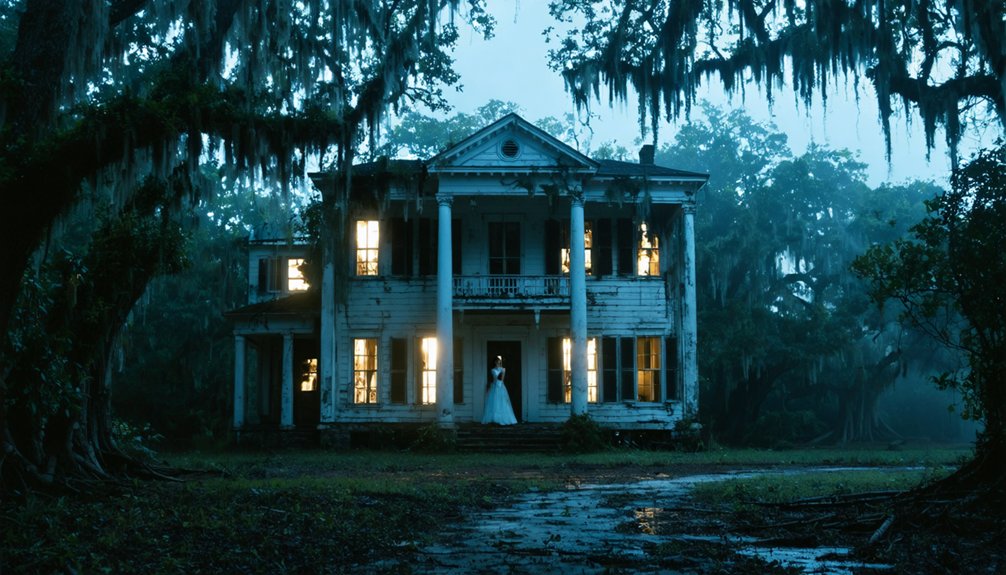
You’ll find tales of former slaves haunting plantation fields throughout the American South, with Myrtles Plantation’s legend of Chloe being perhaps the most notorious example.
While historical records rarely corroborate these spectral narratives—only one murder is verified at Myrtles—the persistence of such accounts reflects the unreconciled trauma of slavery.
The shadowy figures reportedly glimpsed among cotton fields at dusk represent a cultural memory that transcends factual verification, serving as persistent reminders of America’s brutal agricultural past.
Slave Spirits Linger
The haunting legacy of America’s darkest institution manifests beyond historical records in what many claim are the restless spirits of the enslaved.
You’ll find these haunting memories most pronounced at sites like Myrtles Plantation in Louisiana, where the spirit of Chloe reportedly wanders the grounds, and Somerset Place in North Carolina, where witnesses describe shadowy figures and the unmistakable sound of rattling chains.
These restless souls often manifest through consistent phenomena: chain rattling echoing through former quarters, apparitions of children playing where they once labored, and unexplained footsteps across worn floorboards.
Historical tragedies—drownings, murders, and unnatural deaths—anchor these hauntings to specific locations. The violent circumstances of plantation life seemingly prevent these spirits from finding peace, keeping them bound to lands where they once suffered.
Shadowy Cotton Fields
Countless Southern cotton fields harbor ghostly remnants of America’s plantation era, where paranormal phenomena allegedly manifest in direct correlation with historical trauma.
Among spectral plantations, the blue light racing across Franklin Property Fields supposedly represents a young servant who fell to his death while carrying a lantern—a tragedy now embedded in local folklore.
At Myrtles Plantation, where “haint blue” porch ceilings were painted to ward off spirits, visitors report encountering child ghosts playing amid Spanish moss-draped oaks.
The infamous photograph of Chloe, a murdered servant girl, captures what appears to be a semi-transparent figure in period clothing.
These haunted harvests continue at Isaac Franklin Plantation, where the ghost of Victoria Franklin, a six-year-old who died in the house, reportedly touches visitors before vanishing into the plantation’s shadowy history.
In the aftermath of the Civil War, many families fled their homes, leaving behind the remnants of their lives in ghost towns after the civil war. These abandoned places now serve as eerie reminders of the past, where whispers of history linger in the abandoned structures. Once vibrant communities are now haunting locations that echo the stories of those who lost everything.
Kleinbauer Farm: Pennsylvania’s Paranormal Agricultural Mystery
Nestled in the once-densely wooded landscape near Reider’s Ferry, Pennsylvania, Kleinbauer Farm represents one of America’s most peculiar agricultural enigmas dating back to 1817.
The German immigrant family’s settlement quickly succumbed to what contemporary accounts describe as an unnatural crow infestation—thousands of birds descending upon crops, ultimately driving the family toward financial ruin and psychological distress.
The foreign settlers watched helplessly as blackened skies delivered an avian plague that devoured their dreams alongside their harvest.
The Kleinbauer hauntings emerged from this agricultural catastrophe, as Cole Kleinbauer’s desperate construction of “Vogelscheuchen” (scarecrows) in 1818 failed to deter the relentless avian siege.
Crow folklore in the region subsequently incorporated these events, attributing supernatural significance to the birds’ behavior.
The property’s transformation—from failed farmstead to clear-cut wasteland to modern horror attraction—reflects America’s pragmatic repurposing of historical trauma.
Today’s Terror Farm Horror Plex capitalizes on this legacy, commercializing the psychological and environmental devastation that once befell this Pennsylvania homestead.
Tragic Harvests: When Death Visits American Farmlands

You’ll discover that American agricultural lands harbor darker histories than their pastoral appearances suggest, with properties like the Myrtles Plantation and Daniel Lady Farm preserving evidence of violent deaths that transcend ordinary explanations.
The documented phenomena at these sites—from bloodstains that resist removal to apparitions of former servants—challenge conventional historical narratives while representing the intersection of trauma and memory within specific geographic locations.
These agricultural spaces, whether grand plantations or modest family homesteads, function as physical repositories of America’s complex relationship with violence, servitude, and unresolved justice.
Blood-Soaked Fields
Behind the romanticized visions of American farm life lies a stark reality: America’s farmsteads have witnessed staggering amounts of death and injury over generations.
The fields that yield America’s bounty also harvest tragedy at an alarming rate—five times higher than the national average. Tractors, particularly overturns, transform these haunted harvests into deadly scenes, accounting for nearly 40% of farm fatalities.
You’re witnessing a pattern that persists despite technological advances. Men over 55 disproportionately fall victim to these agricultural dangers, their final moments often spent alone among ghostly crops.
While fatality numbers have declined somewhat, the risk remains undiminished for those working smaller operations, where OSHA reporting requirements don’t apply.
This historical context reveals an uncomfortable truth: American agriculture continues extracting a blood toll largely unseen by the urban population it feeds.
Undying Servant Spirits
While American folklore often romanticizes the rugged independence of farm life, a closer examination of mortality statistics reveals a troubling reality: agricultural workers face death at nearly five times the rate of other occupations.
Behind every haunted harvest lies the spectral laborers of agriculture’s grim reality—predominantly older men who succumb to equipment designed for efficiency rather than safety.
- Tractors claim 38% of documented farm fatalities, with overturns being the primary killer
- Men account for over 90% of agricultural deaths, with workers over 55 comprising 40% of victims
- Peak activity periods like planting and harvest see the highest concentration of fatalities
You’re witnessing a historical pattern where self-employed workers and family members silently vanish from rural landscapes.
The seasonal rhythm of agriculture masks a darker cycle of preventable tragedy, one that remains largely invisible to urban consciousness.
Vengeful Family Hauntings
Throughout America’s agricultural heartland, the vengeful spirits of family tragedies have seeped into the soil alongside the blood of those who worked it. The haunting phenomena at Tennessee’s Bell Witch farm, where a malevolent entity tormented John Bell until death, exemplifies how rural isolation amplifies supernatural terror.
Family curses proliferate across our landscape—from the Arnold Estate in Rhode Island where the Perron family endured Bathsheba Sherman’s wrath, to Kansas’s Sallie House with its violent physical attacks.
The Amityville murders spawned contested tales of paranormal vengeance, while Louisiana’s Myrtles Plantation bears the spectral imprint of Chloe, an executed enslaved woman whose turban-clad apparition still wanders the grounds.
These legends persist not merely as ghost stories but as psychological manifestations of America’s complicated relationship with land ownership, family dynamics, and historical violence.
Investigating America’s Most Haunted Rural Properties
The systematic investigation of America’s most haunted rural properties requires maneuvering a complex landscape where folklore meets documented history.
When you explore these haunted landscapes, you’ll discover that properties like Myrtles Plantation in Louisiana and the Villisca Axe Murder House in Iowa represent the intersection of tragedy and spectral agriculture.
Methodical research reveals patterns across these sites—Civil War connections, unresolved violent deaths, and persistent generational narratives.
- The Lively-Tate Farm’s decades-long blood feud and woman in white apparition exemplify how family conflicts manifest paranormally.
- Ghost towns like Bara-Hack and Bannack preserve collective trauma through reported apparitions.
- Former plantation sites demonstrate how places of historical oppression often generate the most consistent paranormal claims.
Frequently Asked Questions
Can Visitors Take Photographs of the Apparitions at These Locations?
You can’t photograph apparitions in main attractions due to ghost photography ethics prohibiting flash use. Apparition visibility factors are compromised by cameras, though designated outdoor areas sometimes allow limited documentation.
How Do Farmers Cope With Living on Actively Haunted Properties?
Amid misty fields, you’ll find farmers normalize ghostly encounters through community storytelling while making practical farming adaptations—repurposing “haunted” structures, implementing security systems, or converting spectral legacies into seasonal income opportunities.
Do Hauntings Follow Seasonal Agricultural Patterns or Harvest Cycles?
You’ll find haunting patterns often intensify during harvest cycles, with 30-50% more reported incidents in autumn when seasonal crops mature—likely reflecting cultural traditions rather than supernatural certainty.
What Distinguishes Naturally Occurring Farm Sounds From Paranormal Activity?
You’ll find natural sounds have identifiable sources and regular patterns, while paranormal signs lack physical origins, defy logic, and occur unpredictably—often accompanied by temperature drops and electromagnetic anomalies.
Have Any Scientific Studies Confirmed These Paranormal Farm Phenomena?
Like shadows evading the spotlight, paranormal research at farms hasn’t yielded scientific evidence confirming supernatural phenomena. Despite government-funded studies at locations like Skinwalker Ranch, you’ll find only anecdotal accounts, not verifiable proof.
References
- https://www.cbsnews.com/media/six-of-the-most-haunted-houses-in-the-us/
- https://www.americanhauntingsink.com/americas-10-most-haunted-places
- https://www.morningagclips.com/the-ghostly-legends-of-americas-haunted-farms/
- https://usghostadventures.com/haunted-stories/the-bell-family-farm/
- https://www.youtube.com/watch?v=7Kj9iORphVc
- https://www.terrorfarm.com/new-index
- https://nchauntedfarm.com/about-scariest-haunted-house-in-north-carolina/
- https://en.wikipedia.org/wiki/List_of_reportedly_haunted_locations_in_the_United_States
- https://honesthistory.co/blogs/blog/5-famous-haunted-houses-you-should-know
- https://charlestonterrors.com/the-haunted-boone-hall-plantation/