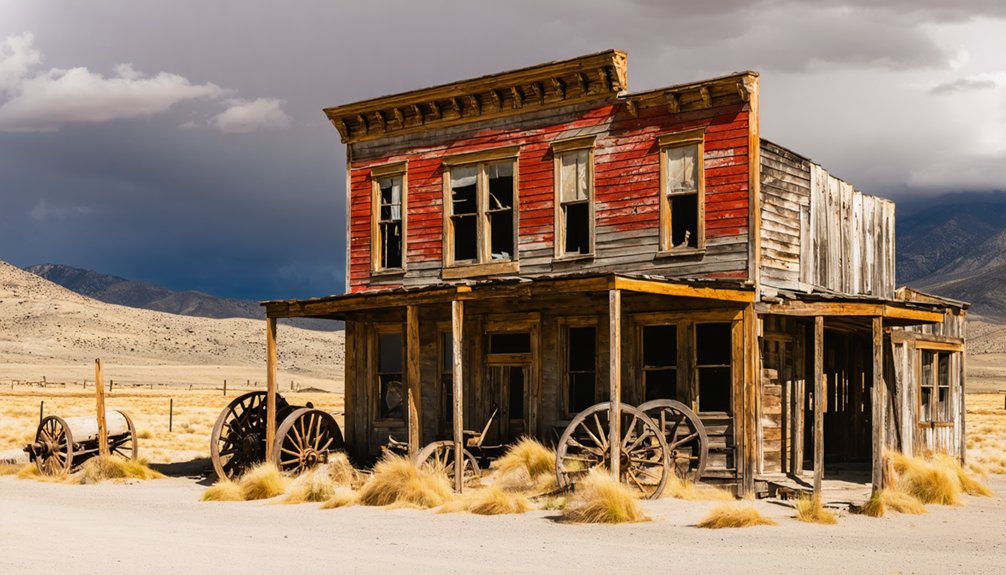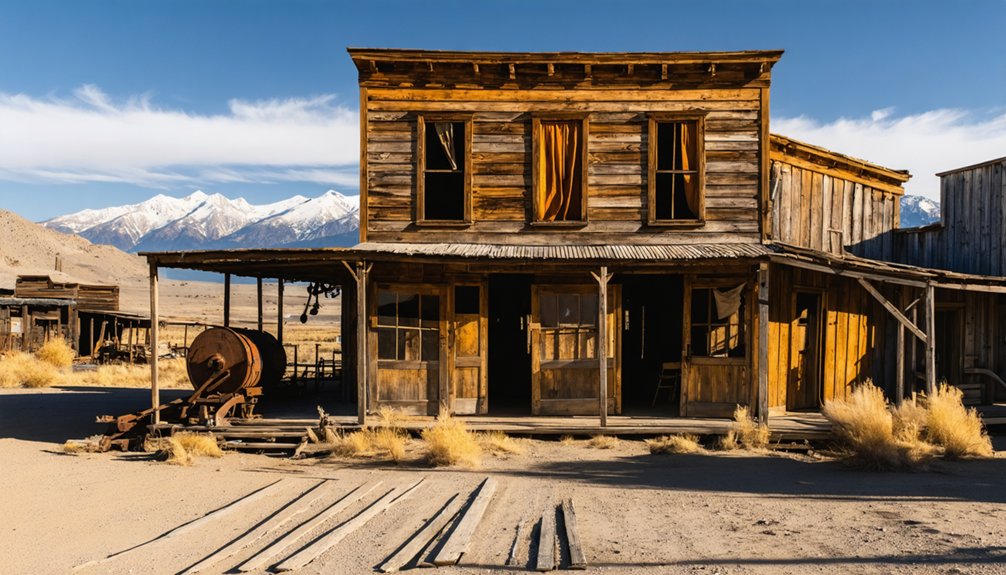
America’s Gold Rush ghost towns offer haunting glimpses into 19th-century boom-and-bust cycles. You’ll find Bodie, California preserved in “arrested decay,” with abandoned homes still containing personal belongings. Virginia City’s empty saloons and Rhyolite’s crumbling bank tell stories of fortune-seeking pioneers who vanished when minerals depleted. St. Elmo and Kennecott showcase remarkably intact structures where catastrophic events and economic decline forced mass exoduses. These silent testimonials await your exploration across the American West.
Key Takeaways
- Bodie, California stands preserved as a State Historic Park after thriving during the 1876 gold rush before becoming abandoned by 1915.
- Virginia City, Nevada grew explosively after the 1859 Comstock Lode discovery, becoming a preserved historic site with Victorian architecture.
- Mining town abandonment often followed catastrophic events like devastating fires, disease epidemics, and economic collapse.
- Ghost towns feature authentic weathered buildings, abandoned mining equipment, and original signage that create naturally spooky atmospheres.
- Many boomtowns experienced rapid growth followed by equally dramatic decline, leaving behind eerie remnants of America’s frontier past.
The Rise and Fall of Boom Towns in America’s Mining Era
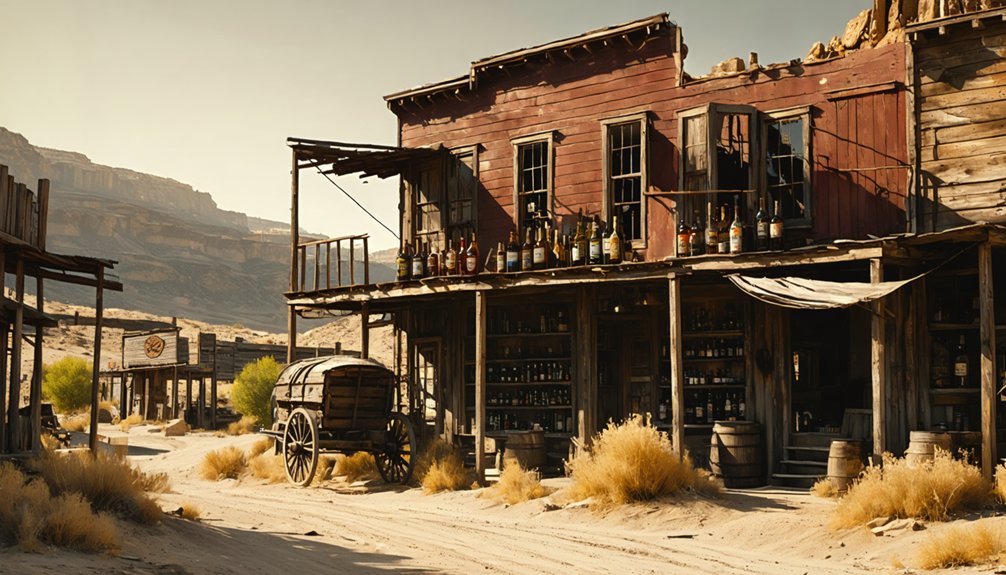
When the glint of gold was discovered in California in 1848, it sparked a transformative era in American history that would reshape the nation’s geography and economy.
You’d have witnessed an unprecedented migration as over 300,000 people rushed westward, establishing settlements virtually overnight.
Towns like Virginia City expanded from fewer than 100 residents to 20,000 within just two years following the 1859 Comstock silver discoveries.
Mining techniques evolved rapidly as prospectors extracted fortunes from the earth, with some operations yielding $50 of silver per ton at just $10 extraction cost.
Frontier life in these boomtowns was characterized by hastily built infrastructure, diverse populations of European and Asian immigrants, and thriving ancillary businesses.
Many of these settlements experienced dramatic boom and bust cycles, with towns like Goldfield, Nevada growing rapidly before declining into near abandonment.
Towns often transitioned from rough tent camps to established communities as support services increased.
But when mines depleted or prices collapsed, these once-vibrant communities emptied almost as quickly as they’d filled.
Bodie, California: Where Time Stands Still in “Arrested Decay”
A weathered tombstone in California’s eastern Sierra marks the ironic resting place of W.S. Bodey, whose misspelled name became immortalized in Bodie history when a painter’s error permanently altered the town’s identity.
You’ll find Bodie transformed from a small mining camp to a booming metropolis after the 1876 gold vein discovery. By 1880, nearly 10,000 souls inhabited this lawless settlement, where violence earned it the notorious “Badman from Bodie” reputation.
As the gold diminished in the 1880s, so did Bodie’s population, becoming a ghost town by 1915. Mining persisted until 1941, but abandonment was inevitable.
The town’s technological advancement was notable with the construction of a sophisticated hydro-electric center in 1893 by the Standard Consolidated Mining Company.
Today, Bodie serves as a fascinating window to the past, offering visitors unique insights into the authentic life of 19th-century gold miners.
Ghost town preservation began in earnest when Bodie became a National Historic Landmark in 1961 and a State Historic Park in 1962, maintaining 170 buildings in “arrested decay.”
The Haunting Ruins of Rhyolite, Nevada

How quickly fortunes can shift in the Nevada desert, where Rhyolite’s meteoric rise and dramatic fall embodied the quintessential boom-and-bust cycle of America’s mining towns.
Founded after Harris and Cross’s gold discovery in 1904, this boomtown exploded to 5,000 residents within months, boasting railroads, electricity, and a sophisticated water system.
In mere months, Rhyolite transformed from barren desert to modern metropolis, complete with infrastructure rivaling established cities.
The 1907 financial panic triggered Rhyolite’s collapse. By 1920, only 14 souls remained, with the last train departing in 1914. A devastating fire in 1908 destroyed the red light district and portions of the business area, accelerating the town’s decline.
Before its demise, the mining district produced an impressive $1.7 million in gold between 1907 and 1910, demonstrating the substantial wealth that initially attracted settlers.
Today, you’ll find:
- The iconic Cook Bank Building, the most photographed structure in ghost town photography
- The unique Bottle House, constructed from thousands of discarded bottles
- The train depot, once repurposed as a casino, now managed by the BLM
St. Elmo: Colorado’s Best-Preserved Mining Community
While Nevada’s Rhyolite surrendered to the harsh desert, high in Colorado’s Sawatch Range stands a remarkably different ghost town story. Founded in 1880 at nearly 10,000 feet elevation, St. Elmo thrived as a gold and silver boomtown that once housed 2,000 residents.
Named after an 1866 novel, the town boasted five hotels, numerous saloons, and essential services until mining declined in the 1920s. Unlike many abandoned settlements, St. Elmo’s heritage remains tangible through its forty-three surviving structures.
The town gained National Historic District status in 1979, with the Stark family serving as longtime stewards of this mining community preservation effort. The Mary Murphy Mine was the largest producer, generating more than $60 million in gold during its operation. Despite a devastating 2002 fire, St. Elmo continues to offer you an authentic glimpse into Colorado’s rugged frontier past. Many visitors report encounters with the ghost of Annabelle Stark, known as Dirty Annie, who is said to still watch over the town’s historic buildings.
Abandoned Rails and Empty Saloons: Virginia City’s Ghostly Past

As you stroll down Virginia City’s weathered boardwalks today, you’re walking the same paths where fortune-seekers rushed during the unprecedented Comstock Lode discovery of 1859, transforming a mountainside into America’s richest silver mining boomtown within months.
The town’s network of over 100 saloons, including the still-operating Bucket of Blood, once served a peak population of 25,000 residents before the catastrophic 1875 fire and declining silver production emptied most establishments by the 1880s. Before reaching this impressive number, the population had already skyrocketed from 4,000 to over 15,000 in just one year’s time.
Now with just 800 residents, Virginia City’s preserved Victorian architecture stands as a haunting monument to America’s largest silver rush, where empty rails and quiet saloons contrast sharply with the international fame and frenetic energy that once defined this “Queen of the Comstock.” The legacy of prosperous mines like Ophir and Gould lives on, having produced an astounding over $300 million in mineral deposits during the town’s heyday.
Silver Rush Legacy
When the Comstock Lode silver discovery transformed Virginia City in 1859, few could have predicted the meteoric rise and inevitable decline that would define this legendary mining town.
This phenomenal silver mining operation yielded over $400 million in precious metals, catapulting Nevada to statehood by 1864 and drawing 25,000 fortune-seekers to this once-barren landscape.
Three key facts about Virginia City’s explosive growth:
- It became one of the West’s most influential cities within just a few years.
- The population represented a global influx of miners and entrepreneurs.
- The wealth extracted became foundational to Nevada’s economic identity.
Today, as you walk these abandoned streets, ghost stories seem almost inevitable—the dramatic collapse of such prosperity created the perfect backdrop for tales of restless spirits still searching for that final silver strike.
Boardwalks Through Time
The creaking wooden planks beneath your feet transport you directly into Virginia City’s storied past, where boardwalks once bustled with miners, entrepreneurs, and fortune-seekers during the silver boom of the 1870s.
These preserved wooden pathways, many reconstructed after the devastating 1875 fire, connect over 100 former saloons, shops, and mining offices that served a peak population of 25,000.
As you walk, notice how boardwalk history intertwines with abandoned rail lines that once transported valuable ore.
The famous “Bucket of Blood” saloon exemplifies the distinctive mining architecture that survived multiple fires.
Virginia City’s wooden walkways run alongside original railbeds, offering you tangible connections to both the town’s prosperous heyday and its ghostly decline—a physical timeline you can traverse with each step.
Tales of Disaster and Exodus in Western Mining Communities
You’ll find that many western mining communities didn’t simply fade away from resource depletion, but were violently erased by catastrophic events.
Devastating fires swept through towns like Virginia City and Bodie, where closely-packed wooden structures created perfect conditions for widespread destruction, while lethal epidemics emptied mining camps already struggling with harsh conditions.
Massive flooding events, like those that ravaged Monte Cristo in the late 1890s, could destroy years of development overnight, washing away buildings and infrastructure that cash-strapped mining operations couldn’t afford to rebuild.
Devastating Fires’ Lasting Impact
Throughout America’s Gold Rush territories, devastating fires carved a path of destruction that permanently altered the landscape of countless mining communities, transforming once-thriving boomtowns into the ghost towns we encounter today.
The fire impact was often the final blow to already-declining settlements, as witnessed in Goldfield and Tonopah, Nevada in the 1940s.
Most recently, in September 2025, lightning-sparked wildfires destroyed Chinese Camp, California, a historic refuge for Chinese miners that once housed 5,000 residents.
The pattern is hauntingly consistent:
- Wooden structures built hastily during boom times provided perfect kindling
- Economic decline often preceded major fires, leaving few resources for rebuilding
- The combination of fire destruction and economic hardship typically led to permanent abandonment
When you visit these ghost towns today, you’re witnessing the lasting scars of these catastrophic events.
Epidemics Emptied Mining Camps
While the Gold Rush enticed thousands with promises of fortune, deadly epidemics regularly swept through makeshift mining settlements, transforming bustling camps into abandoned ghost towns within days.
You’d find typhoid, dysentery, and cholera spreading rapidly through these communities due to contaminated water and nonexistent sanitation. The infamous “Mountain fever” decimated Pike’s Peak camps in 1859, while the “Tonopah Plague” pneumonia outbreak emptied Nevada settlements.
These disease outbreaks thrived in overcrowded conditions where miners lived in tents or repurposed ships. Population decline was catastrophic, with new arrivals particularly vulnerable.
Native Americans suffered even worse, losing an estimated 60% of their California population to introduced diseases. The combination of malnutrition, alcohol abuse, and filth created perfect conditions for epidemics that ultimately left behind the haunting, abandoned settlements you can still visit today.
Flooding Erased Entire Communities
Water proved even more destructive than disease in many mining settlements, with catastrophic floods literally wiping towns off the map throughout the American West.
You can still find traces of these community relocations following devastating flooding disasters, though most evidence remains hidden beneath murky waters.
The Great Flood of 1862 devastated mining communities across California, Oregon, and Nevada, with entire towns like Agua Mansa nearly vanishing overnight.
Later examples include:
- Kennett, California – submerged in 1944 after Shasta Dam’s construction
- Thistle, Utah – destroyed by landslide-triggered flooding in 1983
- Valmeyer, Illinois – forced to relocate to higher ground after the 1993 Mississippi River floods
These catastrophes reshaped western landscapes, erasing physical evidence of once-thriving communities and forcing survivors to rebuild elsewhere.
Kennecott: Alaska’s Cliffside Copper Kingdom
Perched dramatically above the Kennecott Glacier in Alaska’s wilderness, the Kennecott copper mining operation began with an extraordinary discovery in 1900 when prospectors Clarence Warren and Jack Smith stumbled upon what would prove to be the richest copper ore ever found.
Within a decade, Kennecott’s economy boomed, yielding ore so pure it could be shoveled directly into sacks.
At its height, the self-contained company town housed 600 workers who earned premium wages while extracting wealth valued at $200-300 million.
By 1938, diminished ore supplies and the Great Depression forced operations to halt. Workers departed, leaving a pristine example of early 20th-century industrial might.
Today, the ghostly preservation efforts by the National Park Service allow you to explore this National Historic Landmark—a representation of American ingenuity frozen in time.
Photographing the Past: Capturing Ghost Town Architecture
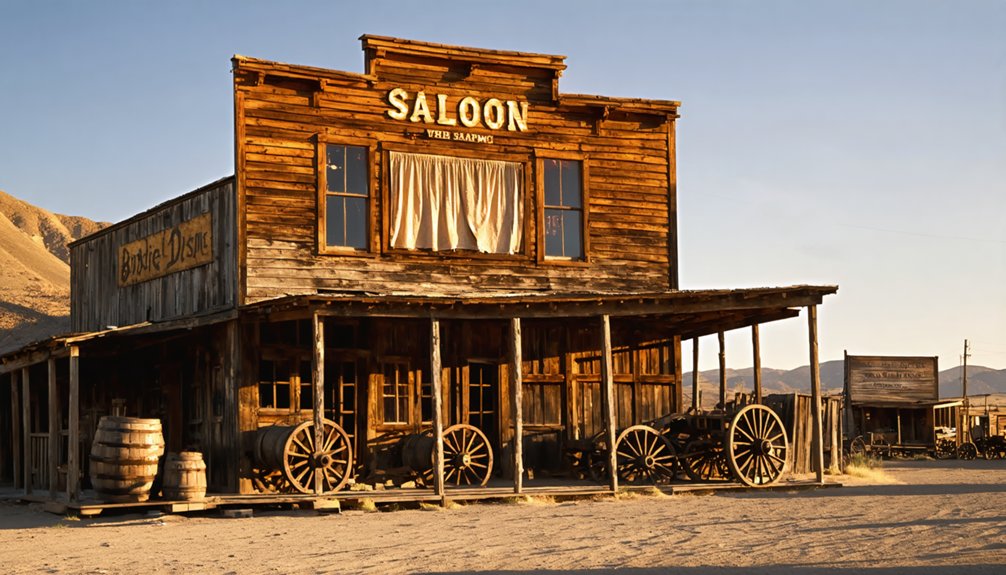
When capturing ghost towns authentically, you’ll find the most evocative light during golden hour—the hour after sunrise or before sunset—when long shadows accentuate weathered textures and architectural details.
To preserve the authentic character of these abandoned places, avoid removing or rearranging artifacts you encounter, as these objects provide vital historical context and narrative power to your photographs.
Your images should document rather than dramatize, maintaining the integrity of peeling paint, rusted metal, and structural decay that collectively tell the true story of a settlement’s rise and abandonment.
Best Light Conditions
Light transforms the haunting remnants of ghost towns from mere abandoned structures into evocative time capsules worth photographing. The interplay of light dynamics across weathered facades reveals the textures and character that time has etched into these forgotten places.
You’ll find the most compelling atmospheric conditions during early morning’s soft glow and late afternoon’s golden hour, when long shadows accentuate architectural details.
For ideal ghost town photography:
- Shoot during blue hour (twilight) for moody, atmospheric images with visible stars
- Use overcast days to capture subtle details in decaying surfaces without harsh shadows
- Experiment with artificial light at night—try light painting with flashlights or remote flashes at minimal power to maintain the authentic ambiance
Preserving Authentic Elements
Photographing ghost town architecture requires a delicate balance between documentation and artistic interpretation to preserve authenticity. When capturing these historical treasures, research site status beforehand to navigate property restrictions and guarantee respectful access. Your role extends beyond photography to historical documentation—avoid disturbing artifacts or removing elements from their original context.
Focus your lens on unique characteristics that define each town’s identity: handcrafted details in woodwork, original signage, and period-specific construction techniques. These authentic elements tell stories that modern restoration efforts might inadvertently erase.
Capture the juxtaposition of decay against craftsmanship, showing how time transforms rather than destroys. By photographing weathered textures, abandoned interiors, and structural details with deliberate attention, you’re creating a visual record that preserves these vanishing landmarks for future generations.
Beyond Gold: Silver, Copper and Other Mineral Rush Communities
While gold rushes lured countless fortune-seekers westward during the 19th century, other valuable minerals equally transformed the American landscape through boom-and-bust cycles that left ghostly remnants across the nation.
Silver mining created behemoths like Virginia City, Nevada, where 25,000 souls gathered after the 1859 Comstock Lode discovery, while copper towns like Kennicott, Alaska flourished briefly before their 1938 closure.
The zinc legacy remains visible in places like Castle Dome, Arizona, where ghostly architecture still testifies to the 3,000 residents who once called it home.
When exploring these mineral boom towns, you’ll discover:
- Leadville, Colorado became one of the West’s largest mining centers after its 1870s silver boom.
- Butte, Montana grew to 100,000 residents as America’s copper capital.
- Calico, California housed 500 silver mines before abandonment in the 1890s.
Preserving America’s Frontier Legacy for Future Generations
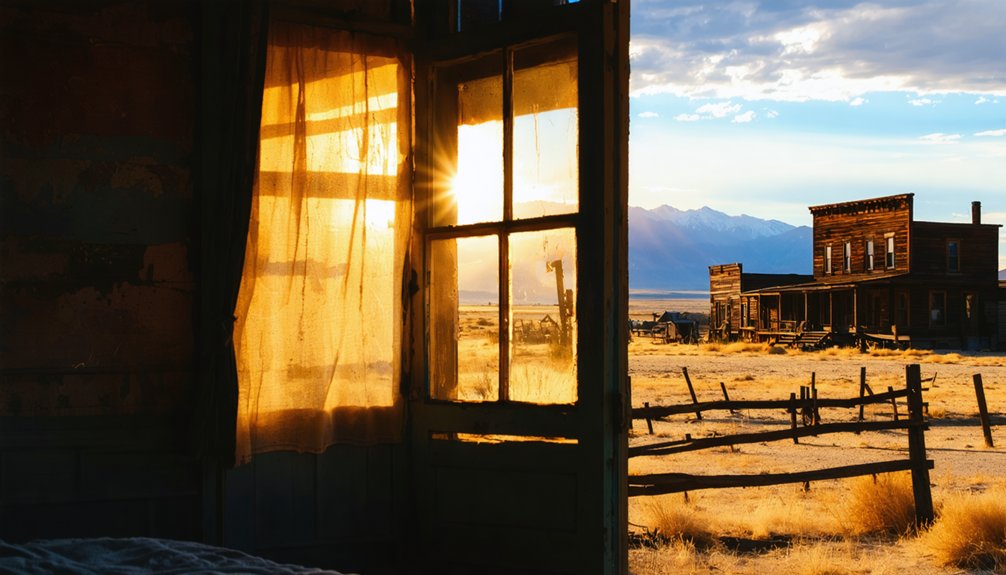
Preserving America’s frontier legacy stands as one of the most significant cultural conservation efforts in the nation’s history. When you visit sites like Bodie State Historic Park, you’ll witness “arrested decay” preservation—200 original buildings with furniture intact, frozen in time.
Ghost town preservation faces substantial challenges: harsh climates accelerate deterioration, vandalism threatens historic integrity, and funding remains limited. Yet heritage tourism provides vital revenue, with thousands visiting towns like Calico and St. Elmo annually.
You’ll find these sites protected through National Register listings and state park designations, ensuring their stories endure.
Educational programs, living history demonstrations, and interpretive displays connect you directly to frontier life. Through these efforts, you can experience America’s pioneering spirit while supporting the conservation of these irreplaceable historical treasures.
Frequently Asked Questions
Are Ghost Towns Legally Protected From Treasure Hunters and Looters?
Yes, you’ll face legal regulations if you’re treasure hunting in ghost towns, as many are protected by federal and state laws prohibiting artifact removal and vandalism.
Can You Actually Experience Paranormal Activity in These Ghost Towns?
You’ll encounter reports of ghost sightings and haunted legends, but paranormal experiences remain subjective. Many visitors document unexplained phenomena in these abandoned towns, though your personal encounter isn’t guaranteed.
What Survival Gear Should Visitors Bring to Remote Ghost Towns?
Ironically, you’ll need survival essentials for “ghost” hunting that keep you among the living: navigation tools, first aid, proper clothing, fire starters, water containers, and communication devices. Don’t become a permanent resident.
Which Ghost Towns Allow Overnight Camping or Accommodation?
You’ll find overnight options at Goldfield (Arizona), Gold Point (Nevada), and Calico (California). Each offers unique ghost town lodging with varying camping regulations for tents, RVs, and historic cabins.
How Did Children’s Lives Differ in Mining Towns Versus Cities?
You’d find child labor was endemic in mining towns, with kids working by age 11, while city children enjoyed fuller education. These education disparities meant mining families prioritized survival over schooling.
References
- https://www.loveexploring.com/gallerylist/67994/americas-eeriest-gold-rush-ghost-towns
- https://www.mentalfloss.com/geography/american-ghost-towns-can-still-walk-through
- https://www.christywanders.com/2024/08/top-ghost-towns-for-history-buffs.html
- https://www.geotab.com/ghost-towns/
- https://www.idyllicpursuit.com/9-forgotten-gold-rush-towns-you-can-still-walk-through/
- https://whakestudios.com/us-ghost-towns/
- https://www.atlasobscura.com/lists/americas-best-preserved-ghost-towns
- https://www.coyotecommunications.com/travel/ghosttowns.shtml
- https://westernmininghistory.com/map/
- https://hobblecreek.us/blog/entry/mining-towns-of-the-old-west