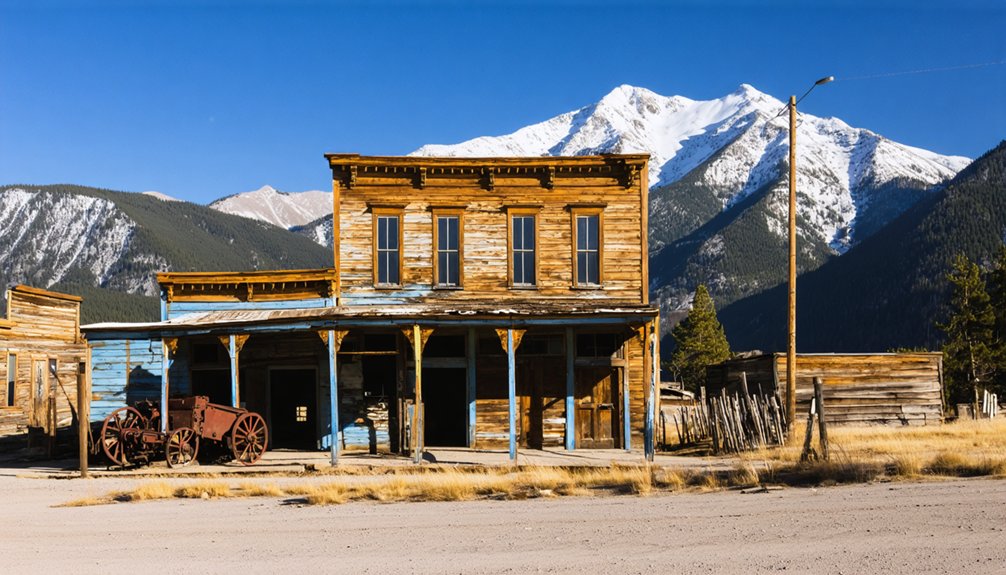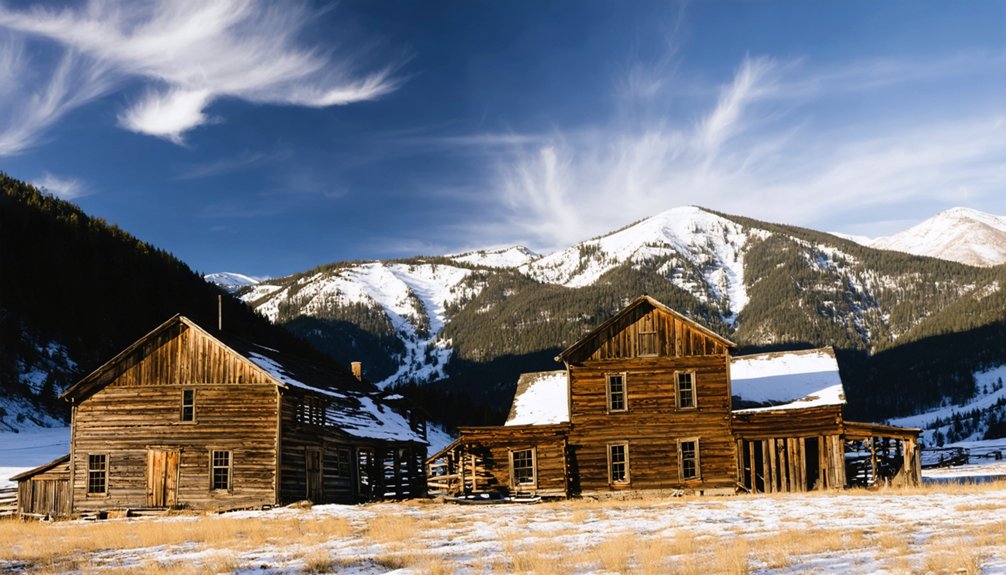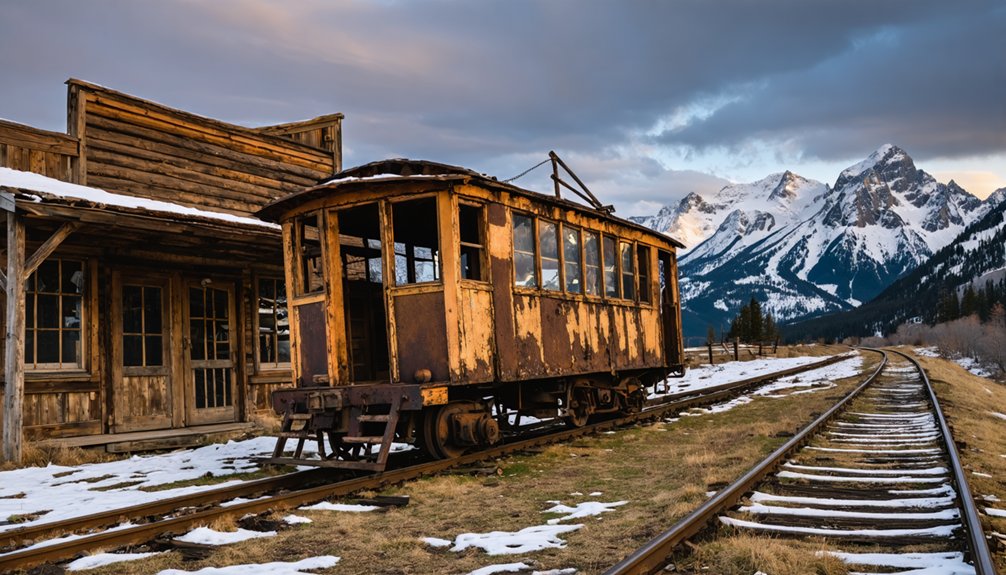
You’ll find Stumptown east of Leadville, Colorado, an 1880s silver mining settlement that once housed 1,200 residents before collapsing after the 1893 silver crash. Access this ghost town via County Road 38, where only the Ibex ore house and Irene Shaft headframe remain among toxic orange tailings. The EPA declared it uninhabitable in 1984, but photographers still capture its haunting structures. The site’s mountain elevation tells a deeper story of boom-and-bust Western mining life.
Key Takeaways
- Stumptown emerged after significant silver discoveries around 1880, peaking at over 1,200 residents by 1883.
- Located east of Leadville at coordinates 39°15’11.6″N 106°14’03.5″W, accessible via County Road 38.
- Only two structures remain, including the Ibex ore house, the largest preserved mining structure in the Leadville district.
- The ghost town was abandoned following the 1893 silver crash and declared uninhabitable by the EPA in 1984.
- The site offers photography opportunities featuring mining ruins against mountain backdrops with seasonal visual variations.
The Mining Boom That Created Stumptown
While Colorado’s mining history transformed countless mountainsides into bustling boomtowns during the late 19th century, Stumptown emerged as a particularly notable example of this phenomenon. The settlement rapidly materialized following significant silver discoveries in the region around 1880, drawing prospectors enthusiastic to claim their fortune.
You’ll find that innovative mining techniques distinguished Stumptown’s operations from other camps. Miners employed hydraulic methods alongside traditional pick-and-shovel work, maximizing extraction efficiency from the surrounding gulches. The local operations exemplified the broader transition from primitive mining conditions to modern technology that characterized Colorado’s 150-year mining legacy. Similar to the well-documented history in Duane A. Smith’s photographic accounts, Stumptown’s development followed typical boom-bust patterns seen throughout the state.
The economic impact reverberated beyond mere mineral wealth. By 1883, Stumptown boasted over 1,200 residents, supporting businesses from mercantiles to saloons.
This concentration of capital and labor transformed the remote mountain location into a temporary commercial hub, demonstrating how rapidly natural resources could generate economic ecosystems in the American West.
Although considered among Colorado’s more obscure ghost towns, Stumptown can be reached through a deliberate navigation approach along County Road 38.
Discover Stumptown—Colorado’s hidden ghost town treasure—through careful navigation on County Road 38’s winding path.
You’ll find this hidden relic at 39°15’11.6″N 106°14’03.5″W, east of Leadville on an overlook hill. GPS navigation is essential, as only two structures remain standing to mark this once-thriving mining settlement.
The horseshoe-shaped road winds through the East Side Mining District, beyond Finntown. During dry seasons, standard vehicles can navigate the route, but winter demands serious terrain safety precautions at this high elevation.
Before starting, prepare thoroughly for mountain conditions and limited signage. Like the deteriorating structures at Kingston and Alice, Stumptown’s remnants continue to face challenges from tourism, erosion, and vandalism.
What distinguishes Stumptown from better-preserved ghost towns is its minimalist remains—mostly foundations and scattered mining artifacts that whisper of its industrious past. Explorers interested in visiting this site should consult Ghosts of Lake County for detailed topographic maps and historical context.
Exploring The Abandoned Mine Structures
Stumptown’s skeletal remains stand as silent sentinels of Colorado’s mining legacy, with the imposing Ibex ore house dominating the landscape as the largest preserved historic mining structure in the Leadville district.
As you explore these deteriorating monuments to industrial ambition, exercise caution around their precarious structural stability.
Notable features you’ll encounter:
- The towering Ibex ore house, surpassing even the New Monarch in height
- The Irene Shaft headframe, descending 1,750 feet into darkness
- Distinctive orange tailings dumps marking extraction points
- Absent Little Johnny mine structures, now vanished from the surface
- Various collapsed wooden elements showing minimal mine preservation efforts
These abandoned structures harbor serious hazards including unstable frameworks, toxic contamination, and dangerous openings—reminders of the freedom sought by early prospectors and the environmental cost of their pursuit.
The EPA declared the area uninhabitable in 1984 due to the presence of toxic pollutants that contaminated both groundwater and soil.
The Little Johnny Mine was crucial to Leadville’s recovery, shipping 135 tons daily of gold ore by November 1893 after the devastating Silver Crash earlier that year.
Life And Death Of A Mountain Mining Community
Beneath the rugged skyline of Colorado’s mineral belt, Stumptown’s brief but tumultuous existence exemplifies the volatile lifecycle of Western mining settlements.
You’d find a community shaped entirely by metal markets—booming when silver brought prosperity in the early 1880s, then collapsing during the 1893 crash, only to revive with the Ibex Company’s fortuitous gold discovery.
Daily life revolved around the dangerous rhythm of extraction. Miners faced cave-ins, explosions, and toxic fumes, while families endured harsh mountain conditions and primitive housing. The dangers were similar to those faced during the Colorado Coalfield War of 1913-14, when mining families fought for better conditions and fair treatment. The discovery of Yule marble in 1873 offered some miners alternative, slightly safer employment in the Crystal River Valley.
Yet community resilience emerged through mutual aid during disasters and economic upheavals. The population ebbed and flowed with mining fortunes—swelling during bonanzas and dwindling through busts—until the inevitable abandonment that transforms thriving settlements into ghost towns.
Photographing Stumptown’s Historical Remains
The scattered remnants of Stumptown offer photographers a compelling canvas of Colorado’s mining heritage amid a dramatic Rocky Mountain backdrop. When you visit this remote site near Leadville, you’ll encounter unique challenges and opportunities that demand versatile photography techniques.
Capturing textures of weathered wood, rusted equipment, and stone foundations requires careful composition and lighting awareness. These abandoned structures represent the classic boom and bust cycle that created numerous ghost towns throughout Colorado after mines were depleted. Many of these sites are now privately owned and require permission to access, similar to other ghost towns throughout the state.
- Wide-angle shots effectively frame the ruins against expansive mountain vistas
- Close-up photography highlights detailed textures of century-old mining artifacts
- Golden hour lighting (sunrise/sunset) creates dramatic shadows across structural remains
- Seasonal visits yield dramatically different imagery—from snow-covered ruins to wildflower foregrounds
- Panoramic techniques showcase the isolation and rugged context of this forgotten settlement
Pack appropriate gear for rapidly changing mountain weather and uneven terrain.
Remember: photograph freely, but leave everything as you found it.
Frequently Asked Questions
Was Joseph the Founder or Just the Town’s Namesake?
Joseph’s Legacy lies in misunderstanding—you’ll discover he wasn’t the founder at all. Historical records emphatically prove he was merely the namesake, arriving after Stumptown’s establishment. Town History confirms this significant distinction.
What Specific Minerals Were Extracted From the Carbonate Ores?
You’ll find the carbonate extraction yielded primarily cerussite (lead carbonate), silver, and iron, with significant bismuth and manganese. The mineral composition also included pyrite, galena, and sphalerite as associated elements.
When Exactly Did the Last Residents Leave Stumptown?
The historical record remains incomplete regarding Stumptown’s final exodus. According to the last census and scattered resident stories, you’ll find no definitive date for when the final inhabitants departed this mining settlement.
Are There Any Preserved Artifacts From Daily Life?
You’ll find few preserved daily life artifacts from Stumptown. Limited archaeological discovery efforts have documented primarily mining-related objects rather than household items that would illustrate residents’ everyday existence.
What Safety Precautions Should Visitors Take When Exploring Abandoned Mines?
Never enter abandoned mines. You’ll encounter deadly hazards including cave-ins, toxic gases, unstable explosives, and drowning risks. Mine safety guidelines prohibit entry for your protection—observe only from designated areas.
References
- https://www.youtube.com/watch?v=QAoRHtpE-oM
- https://www.ghosttowns.com/states/co/stumptown.html
- https://www.youtube.com/watch?v=wDXmZ0Y9gYA
- https://leadvilleghosts.wordpress.com
- https://upcolorado.com/university-press-of-colorado/item/1915-the-trail-of-gold-and-silver
- https://eaglecountyhistoricalsociety.com/product/boom-town-to-ghost-town-the-story-of-fulford/
- https://www.goodreads.com/shelf/show/colorado-mining-history
- https://booksgeology.com/MH Colorado.htm
- https://www.gutenberg.org/ebooks/51678.html.images
- https://phantomranch.net/ghostown/articles/ghosts-of-list.htm