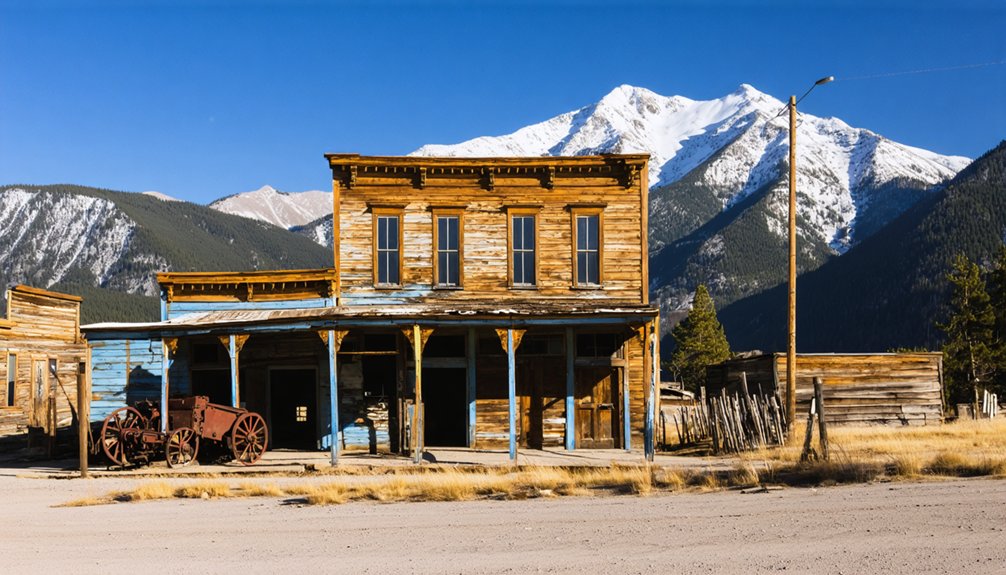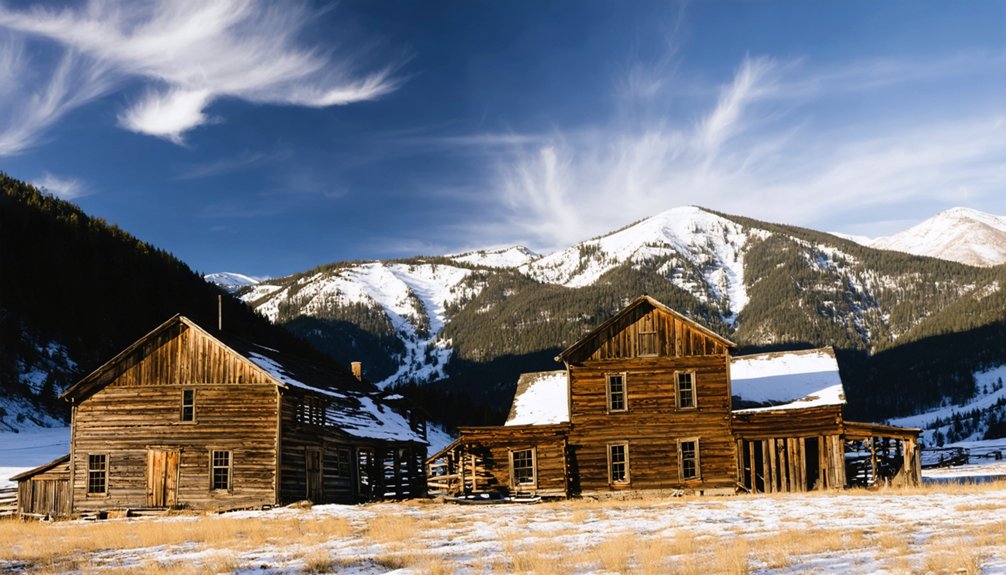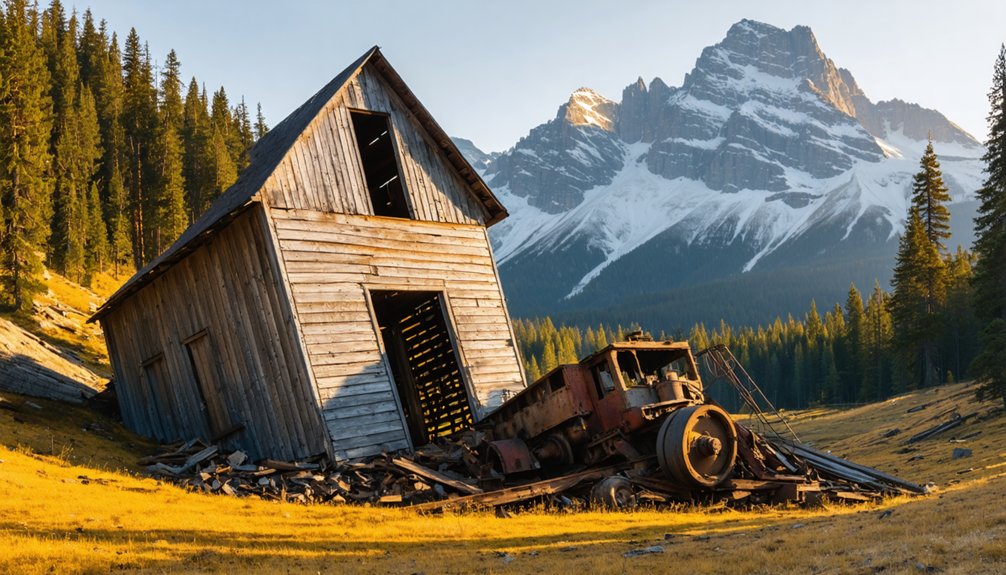
You’ll find Summit County’s ghost towns scattered across some of Colorado’s most unforgiving terrain, from 10,200-foot Montezuma—once home to 743 residents and still boasting its 1880s schoolhouse—to Lincoln City’s weathered frames along Georgia Gulch where the 1859 gold rush sparked it all. Dyersville clings to windswept slopes at 11,200 feet, while Boreas Pass settlements at 11,481 feet testify to the audacious engineering that connected miners to their high-altitude claims. The stories behind these Continental Divide camps reveal how millions in silver and gold shaped Colorado’s mining legacy.
Key Takeaways
- Summit County’s ghost towns emerged from 1859 gold discoveries and the 1879 silver boom, producing $82 million statewide during peak mining years.
- Montezuma, established in 1865 at 10,200 feet, was the county’s largest town by 1880 with 743 residents and over 100 buildings.
- Lincoln City thrived briefly after 1859 Georgia Gulch gold discoveries but was abandoned by 1861 when placer deposits were exhausted.
- Continental Divide ghost towns include Boreas Pass at 11,481 feet and Argentine Pass settlements from the 1860s silver boom era.
- Dyersville and Preston are remote high-altitude mining camps accessible by jeep trails, featuring weathered cabins and authentic historic ruins.
The Rich Mining Heritage of Summit County
When prospectors first struck gold along Georgia Gulch in August 1859, they unknowingly triggered a transformation that would define Summit County for generations. You’ll find this region became Colorado’s premier placer gold producer, with miners wielding early mining technology to extract riches from southern Tenmile and Breckenridge districts.
The real boom arrived in 1879 when silver-rich carbonate veins emerged, mirroring Leadville’s legendary deposits. The ore mineralogy proved exceptional—galena, sphalerite, and pyrite yielding up to 400 ounces of silver per ton. By 1885, zinc joined the bounty as a valuable byproduct.
From French Gulch’s lode discoveries to Monte Cristo’s replacement deposits, these mountains delivered over $82 million statewide during the Silver Boom. You’re standing where fortune-seekers once carved their destiny from solid rock.
Montezuma: A Well-Preserved Silver Mining Settlement
Though prospectors had to brave the treacherous 13,000-foot Loveland Pass to reach it, Montezuma emerged in 1865 as one of Summit County’s most enduring silver settlements. By 1880, you’d find the county’s largest town here—743 residents strong after incorporation in 1881.
The scenic mountain landscape at 10,200 feet hosted over 100 buildings including banks, saloons, brothels, and the Montezuma Mill Run newspaper. While the 1893 silver crash devastated operations, devastating fires throughout the 20th century—particularly the 1958 Christmas blaze that consumed the Summit House Hotel—reduced the town considerably.
Today’s 65 residents enjoy year round recreational opportunities near ski areas and wilderness access. You’ll still discover the 1880s schoolhouse standing as a Colorado State Historical Site, monument to Montezuma’s resilient spirit.
Lincoln City and the 1859 Gold Rush
As the feverish Pike’s Peak Gold Rush swept through Colorado in 1859, prospectors discovered rich placer deposits along Georgia Gulch near the Swan River, giving birth to Lincoln City at an elevation of roughly 10,600 feet.
You’ll find this settlement emerged during that explosive period when over 100,000 “Fifty-Niners” flooded the territory, transforming wilderness into bustling camps overnight. The prospector excitement here mirrored Central City’s meteoric growth—ten residents to ten thousand in mere weeks.
Lincoln City’s mining settlement prosperity didn’t last. By 1861, the easily accessible placer gold had been exhausted from drainages across the region, forcing miners to abandon surface operations for deeper, more capital-intensive shaft mining.
Today, you’re standing where fortune-seekers once carved freedom from mountainsides, their ambitious dreams now whispered through weathered timber frames.
Ghost Towns Along the Continental Divide
You’ll find Summit County’s most dramatic ghost towns perched along the Continental Divide, where mining camps sprouted at elevations that tested even the hardiest prospectors. Boreas Pass, sitting at 11,481 feet between Park and Summit Counties, served as both a wagon road and later a railroad route connecting ambitious miners to their high-altitude claims.
When I traced the old Argentine Pass routes during my research, I discovered that these weren’t just transportation corridors—they were lifelines to settlements like Kokomo and others that clung to mountainsides where winter lasted eight months and supplies arrived by mule train.
Boreas Pass Mining Settlement
Perched at 11,498 feet along the Continental Divide, Boreas Pass Mining Settlement stands as a memorial to the audacious engineering and human determination that characterized Colorado’s railroad era. You’ll find remnants of a community that housed 150 residents tasked with keeping Denver, South Park and Pacific Railroad’s narrow gauge tracks operational year-round.
Railroad operations demanded constant vigilance—workers battled relentless snowdrifts threatening the line’s viability, making winter inhabitability particularly brutal.
The settlement’s section house sheltered maintenance crews who cleared tracks through killing cold. It operated America’s highest post office and served as the winter terminus during 1881-82. Though Colorado & Southern abandoned the route in 1937, you can still traverse the gravel road come summer, connecting with Forest Service Road 593 toward Dyersville’s mining ruins.
Argentine Pass Historic Routes
At 13,207 feet, Argentine Pass carved a treacherous but essential corridor through the Continental Divide, spawning a constellation of mining settlements that clung to its slopes during the 1860s silver boom. You’ll find ghost towns on both flanks—Waldorf on the east served nine productive mines along the pass through Edward Wilcox’s Argentine Central Railroad, while Argentine town anchored the western district.
These high-altitude camps reveal themselves through:
- Waldorf’s post office supremacy – America’s highest elevation postal operation during the 1880s
- Montezuma’s 1865 foundation – preserved schoolhouse and cabins from prospector days
- Farnham Spur’s railroad connection – servicing the 740 Mine until the 1920s
Today, you’ll discover extensive tailings and artifacts scattered across both districts, testimonies to millions in extracted wealth.
High Elevation Town Remains
Beyond Argentine Pass, the Continental Divide’s spine harbors ghost towns that pushed elevation limits to their extreme, where oxygen thinned and winter storms arrived in August. You’ll find Boreas clinging to the divide itself, where miners once trudged between Park and Summit Counties along what’s now a historic trail corridor. Climax dominated at 11,318 feet—America’s highest post office—until the 1959 strike scattered its buildings to Leadville on flatbeds. Robinson disappeared entirely beneath Climax Mine’s Healy heap leach pads by 1911.
Today’s abandoned property restoration efforts face brutal challenges at these altitudes. Remnant building stabilization requires specialized techniques against freeze-thaw cycles that pulverize mortar and twist timbers. The Forest Service maintains minimal intervention, preserving what nature hasn’t already claimed in this oxygen-starved zone.
Remote Sites Accessible by Jeep Trails
You’ll need a capable four-wheel-drive vehicle to reach Dyersville, an 1880s mining camp tucked high above Montezuma where weathered cabin remains dot the mountainside at 11,200 feet.
The Preston ghost town site, accessible via a demanding jeep trail from Tiger Road, requires similar clearance and skill as you navigate rocky switchbacks to discover its scattered artifacts and foundation stones.
I’ve watched inexperienced drivers struggle on these routes—ground clearance, low-range gearing, and confidence on loose talus slopes aren’t optional here.
Dyersville and Preston Drives
Nestled 6 miles southeast of Breckenridge at 10,880 feet, Dyersville occupies a wind-scoured hollow along Indiana Creek where Father John Lewis Dyer—Methodist circuit rider, prospector, and eternal optimist—established his Christian mining community in January 1881. You’ll find this religious settlement’s historic architecture crumbling authentically, accessible via rough dirt roads requiring high-clearance vehicles.
What remains tells Colorado’s boom-and-bust story:
- Nearly a dozen log cabins in various stages of collapse, including Dyer’s 17-foot-square cabin reduced to rotting logs
- Krigbaum’s Angels Rest saloon—ironically positioned hundreds of feet from the settlement’s pious center
- The Warrior’s Mark Mine a quarter-mile uphill, which sustained operations until 1908
Without postal services or sustainable commerce beyond the mine, Dyersville disappeared when prosperity ended, leaving freedom-seekers today to explore its skeletal remains.
Four-Wheel Vehicle Requirements
While Dyersville’s relatively short approach roads challenge modern sedans, Summit County’s deeper backcountry ghost towns demand proper four-wheel-drive equipment.
Saints John, east of Keystone, requires high-clearance 4WD beyond Montezuma’s paved terminus. Georgia Pass’s challenging route to Swan City remains opens only July-September, mandating capable 4x4s for steep inclines and loose gravel.
I’ve watched stock Jeep Wranglers handle Boreas Pass confidently in dry conditions, but alpine tundra trails to mining ruins close quickly outside summer months. Vehicle clearance becomes critical on rougher dirt sections—tight spots and deep potholes punish standard SUVs.
Always check Forest Service updates before committing to these remote sites. Seasonal accessibility windows are brief at altitude, and you’ll need genuine off-road capability, not just marketing brochures promising adventure.
Tracking Lost Towns Through Post Office Records
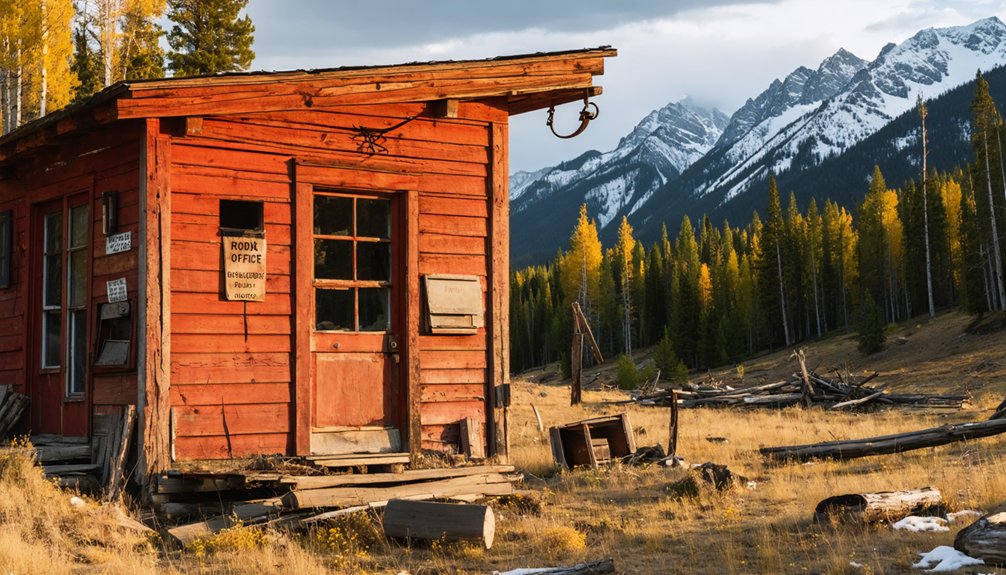
The National Archives holds the complete record:
- Microfilm M1126 documents every post office location from 1837-1955
- Roll 81 specifically covers Summit County’s operations
- Records span 683 rolls organized by state and county
Post offices weren’t just mail stops—they increased property values and legitimized mining camps, making them essential markers for tracking Colorado’s lost towns.
Remaining Structures and Cemetery Sites
Scattered across Summit County’s high alpine terrain, physical remnants of once-thriving communities tell stories that post office records alone can’t capture. You’ll find the 1882 Section House cabin at Boreas Pass still standing, now offering winter rentals where guests report ghostly encounters.
Montezuma’s partial structures survived into modern times, housing off-grid seekers throughout the 1970s. Headstones and burial sites mark forgotten settlements, though Robinson’s cemetery now lies beneath Climax Mine tailings. Tiger’s minimal remains attract curious explorers despite squatters clearing much in the 1960s.
Even Dillon’s relocated 1883 schoolhouse preserves community memory after the town’s 1955 submersion. Restoration efforts by local groups maintain interpretive signs along these sites, helping you connect with Summit County’s resilient mining heritage.
Essential Research Resources and Historical Documents
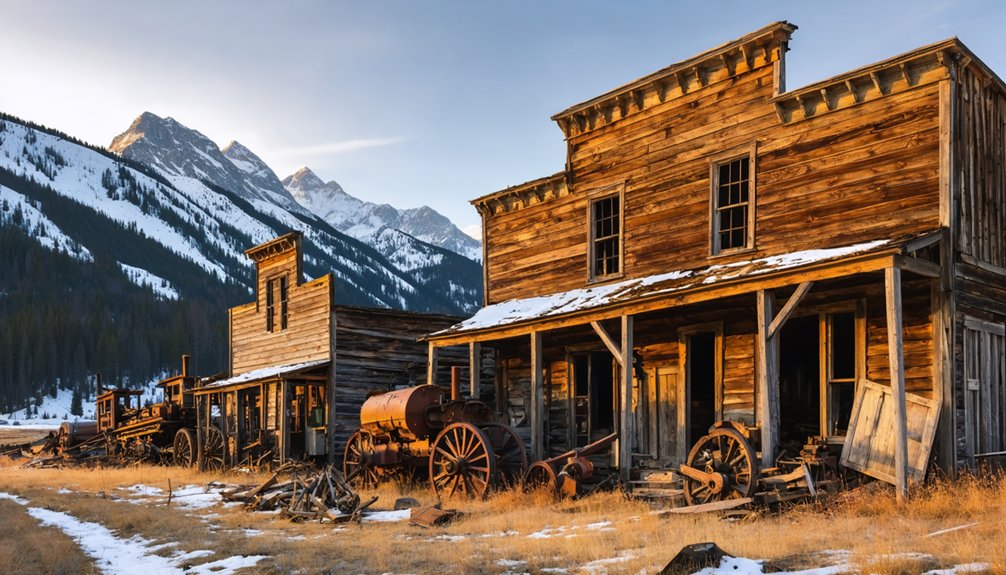
Tracing Summit County’s ghost towns requires more than boots on the ground—you’ll need access to the archival collections that preserve what weathered cabins and overgrown trails can’t tell you. Local historian discoveries by Bill Fountain demonstrate what 36 years of archival manuscript research can uncover. He worked Denver Public Library’s manuscript collections—white gloves required—to locate settlements absent from hand-drawn maps.
Weathered cabins reveal only fragments—the real stories of Summit County’s lost settlements hide in Denver’s archival vaults.
Essential resources include:
- Post office records tracking Bloomfield, Silver Lake, Quandary City, and Delaware City’s brief existence
- Spaulding and McKay mining district logbooks documenting placer claims by John and Catherine Sisler, John Nolan
- Fountain and Mather’s Historic Landscapes series (Volumes 1-6) recreating 1860s-1900s life through authentic documents
These sources solved mysteries from Conger’s Camp’s true location to Father Dyer’s Dyersville cabin placement.
Planning Your Ghost Town Exploration
Successfully exploring Summit County’s ghost towns depends on matching your vehicle capabilities to each site’s terrain demands. You’ll find regular vehicles handle Montezuma adequately, while Dyersville and Swandyke present rougher challenges requiring higher clearance.
Lincoln City and Rexford demand four-wheel drive, particularly after spring snowmelt. Don’t expect visitor amenities—these aren’t sanitized attractions with parking accommodations or facilities. I’ve learned the hard way to carry extra fuel; gas stations disappear quickly beyond Breckenridge’s conveniences.
Summer months offer ideal access, though afternoon thunderstorms roll through unpredictably at these elevations. Download offline maps before leaving town, since cell service vanishes completely. Pack emergency supplies, water, and snacks. You’re genuinely on your own out here, which makes discovering these abandoned settlements authentically rewarding rather than just another tourist stop.
Frequently Asked Questions
What Safety Precautions Should I Take When Exploring Abandoned Mining Structures?
Don’t explore abandoned mines—they’re deadly. If you’re determined despite warnings, be cautious of unstable structures, wear proper protective gear, never go alone, carry backup lights, and stay on marked trails. Most “rescues” become body recoveries.
Are There Entrance Fees or Permits Required to Visit These Ghost Towns?
Most ghost towns you’ll explore are free, though Independence requests $5 donations. You won’t need permits for public parking availability, but remember off trail hiking restrictions apply on federal lands where removing artifacts remains illegal.
Which Ghost Towns Are Suitable for Families With Young Children?
St. Elmo’s your best bet for young kids—it’s well-preserved, easily accessible, and has actual residents. You’ll respect historical preservation while avoiding trespassing concerns. Montezuma works too, offering family trails and picnic spots at a manageable elevation.
What Wildlife Might I Encounter While Exploring Summit County Ghost Towns?
You’ll likely spot mule deer, elk, and red foxes around ghost towns. Watch for nocturnal animals like foxes at dawn or dusk. Potential rattlesnake sightings are rare at Summit’s high elevations, but stay alert near sunny rocks and log piles.
Can I Use Metal Detectors or Collect Artifacts at These Sites?
You can’t legally use metal detectors or collect artifacts at Summit County ghost towns on public land due to metal detector usage restrictions and historical preservation laws protecting items over 100 years old—but private property with permission remains your option.