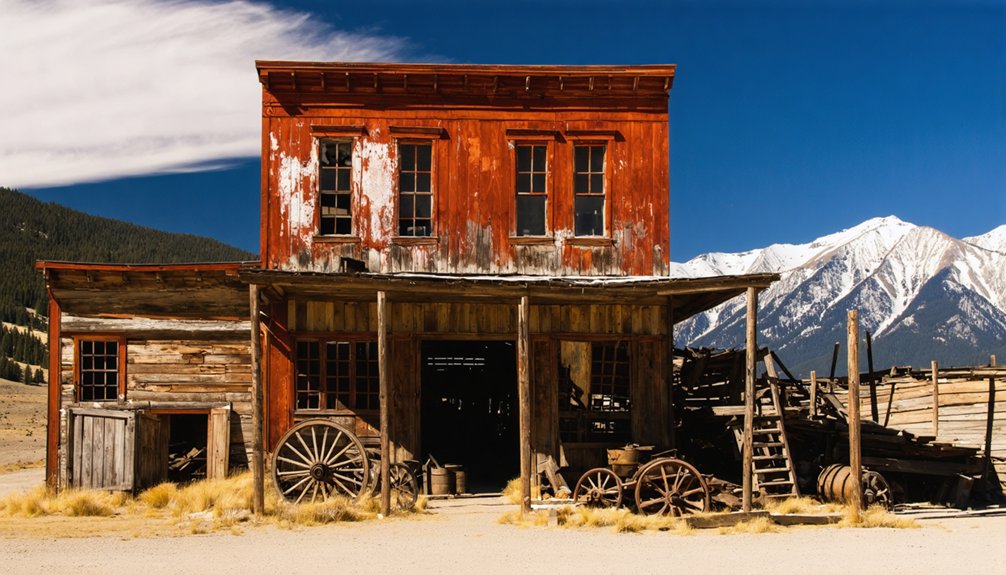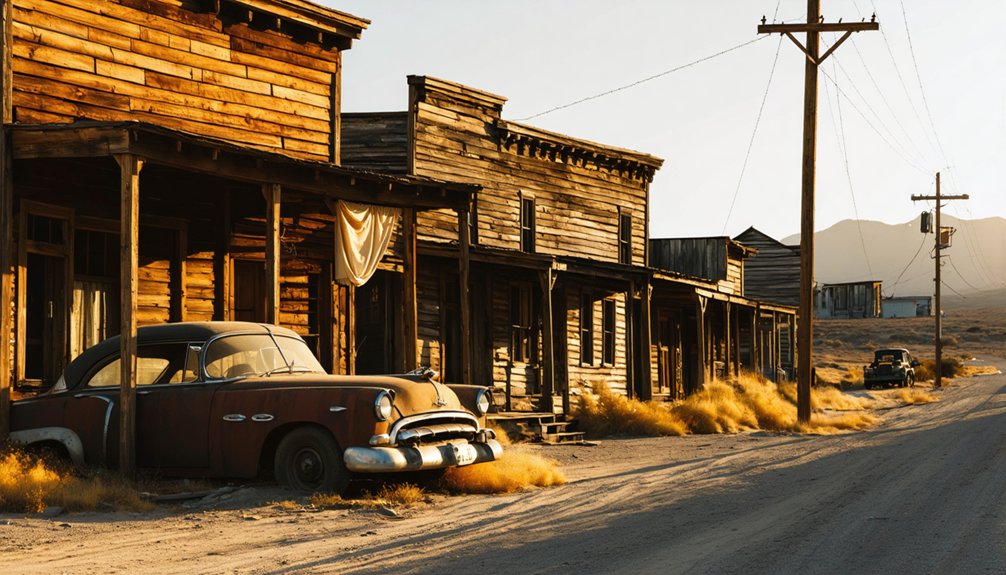
The American West’s abandoned towns harbor untold fortunes, from Beer City’s Prohibition-era contraband to Bodie’s estimated $35 million in forgotten gold. You’ll find Pactola’s submerged artifacts visible only when reservoir levels drop, while Tombstone’s silver mines still contain undiscovered wealth. Ghost towns preserve their treasures through “arrested decay,” leaving Victorian buildings and mining equipment intact. The mountains conceal the greatest secrets in places where few have ventured since their abandonment.
Key Takeaways
- Bodie’s abandoned gold mines potentially hold $35 million in hidden wealth, with 90% of structures destroyed by devastating fires.
- Oatman’s gold district produced nearly two million ounces, with geologists estimating 800,000 to 1 million ounces still hidden in abandoned mines.
- Remote bootlegger hideouts in ghost towns featured hidden tunnels and buried contraband from Prohibition-era operations.
- Underwater ghost towns like Pactola preserve gold rush artifacts, with local legends claiming valuable treasures were left behind during flooding.
- Ghost towns preserved in “arrested decay” contain original furnishings, industrial equipment, and time capsules of frontier life.
The Prohibition Fortune of Beer City, Oklahoma

Where liquor laws failed to reach, a peculiar settlement flourished. In the ungoverned Public Land Strip of Oklahoma’s Panhandle, Beer City emerged from white tents as a direct challenge to neighboring states’ temperance regimes.
Beyond the reach of temperance crusaders, Beer City rose defiantly in No Man’s Land—a canvas settlement mocking moral legislation.
You’d find this lawless refuge strategically positioned near the Kansas border, drawing cowboys and outlaws alike to its abundant saloons and brothels.
The prohibition legacy of Beer City represents America’s complicated relationship with vice regulation. When Oklahoma achieved statehood in 1907, it adopted stringent constitutional prohibition—far outlasting national temperance efforts.
Despite religious opposition from Baptists and Methodists, Beer City’s economy thrived on illicit entertainment until 1890, when the Organic Act imposed law upon No Man’s Land. The town was once managed by Pussy Cat Nell, a prominent madam who operated the Yellowsnake Hotel and Saloon.
The settlement vanished, leaving only scattered documentation of its defiant existence against moral restrictionism. This defiance was echoed decades later when Oklahoma citizens finally voted to repeal prohibition in April 7, 1959, ending the state’s 52-year dry spell.
Bodie’s Forgotten Gold: $35 Million in Abandoned Wealth
When gold was discovered in the Eastern Sierra Nevada mountains in 1876, Bodie transformed from a small mining camp into one of California’s most prosperous boomtowns.
With a population reaching 8,000 by 1879, the settlement boasted 2,000 buildings and 30 gold mines extracting nearly 10,000 tons of ore.
As veins depleted and profits plummeted after 1881, miners hastily abandoned the town, leaving behind what treasure hunters estimate as $35 million in today’s currency.
Devastating fires in 1892 and 1932 destroyed 90% of structures, yet persistent rumors suggest substantial abandoned riches remain hidden in shafts, cellars, and under floorboards.
Now preserved in “arrested decay” as a State Historic Park since 1962, Bodie’s remaining 200 buildings stand as testimony to both the gold rush’s prosperity and the wealth potentially still concealed beneath its weathered foundations. Miners who once earned as little as $4 a week endured hazardous conditions while extracting the precious metal that fueled the town’s brief prosperity. Visitors can experience the authentic wild west atmosphere as furnishings and objects remain completely untouched since the town’s abandonment.
Submerged Riches: The Underwater Ghost Town of Pactola
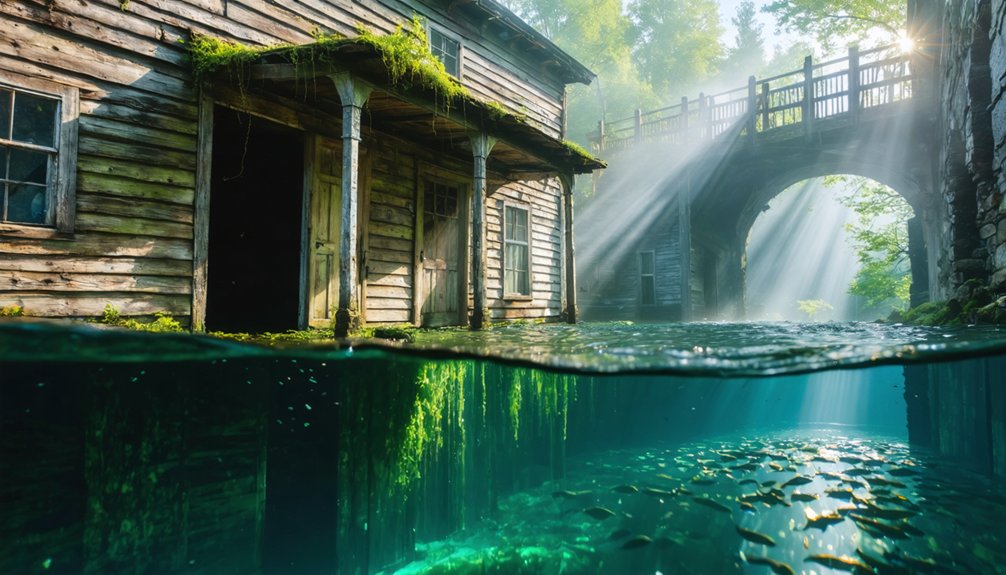
Beneath the tranquil waters of Pactola Reservoir lies a once-thriving gold rush settlement with its infrastructure and community artifacts largely preserved in their watery grave.
You’ll find remnants of the town’s peak prosperity, including salvageable goods from stores, homes, and mining operations that were hastily abandoned during the 1950s dam construction. The town was named after a lawyer’s speech referencing King Midas’s Pactolus.
The underwater location presents unique challenges for treasure hunters and historians attempting to document and recover these submerged historical assets from South Dakota’s hidden Wild West heritage. Before the area was flooded, most of the town’s buildings were auctioned off and removed as part of the reservoir preparation process.
Flooded Prosperity
The former gold mining settlement of Pactola now slumbers beneath the placid waters of South Dakota’s largest reservoir, creating what locals have dubbed “South Dakota’s Atlantis.”
Once a bustling community that peaked at over 300 residents during the Black Hills gold rush of the 1870s, Pactola’s fate was sealed between 1952 and 1956 when federal authorities constructed Pactola Dam as part of the Flood Control Act of 1944.
You’ll find Pactola history preserved in the submerged structures that remain: building foundations, a Civilian Conservation Corps dynamite bunker, and even complete cabins rest on the reservoir floor. When water levels drop, few remnants of the original town become temporarily visible to visitors.
Though authorities auctioned and relocated most buildings before flooding, remnants of the town’s prosperity endure beneath the surface. The town’s name itself connects to its golden heritage, derived from the Lydian river Pactolus known for its gold-rich sands.
Scuba divers occasionally explore these underwater ruins, fueling persistent legends of hidden treasures left behind in the hurried evacuation.
Lost Community Artifacts
Intriguing artifacts from Pactola’s vibrant past continue to captivate historians and divers exploring the submerged ghost town.
As you descend beneath Pactola Reservoir’s surface, you’ll encounter the foundations of a once-thriving community that housed over 300 residents during its peak prosperity. The CCC dynamite bunker remains one of the most significant Pactola artifacts, preserved in its underwater tomb since the 1956 flooding. Today, visitors enjoy swimming and fishing while unknowingly floating above this historical settlement.
While many structures were auctioned and relocated before inundation, numerous remnants of daily life remain entombed below. This submerged history includes building foundations from the illegal settlement established despite Lakota treaty protections.
Only one original cabin escaped the waters, standing as a solitary witness to the abandoned community’s past. These underwater relics represent a unique archaeological record of Black Hills settlement during the western expansion.
Underwater Exploration Challenge
Diving into Pactola Lake‘s depths presents unique challenges for underwater explorers seeking to document South Dakota’s submerged frontier settlement.
You’ll need specialized scuba equipment to navigate the cold waters where foundations and a CCC dynamite bunker rest among the underwater artifacts of this once-thriving mining community.
Visibility can be limited, and the submerged history lies beneath 100+ feet of water in some areas.
What remains of Pactola’s buildings has deteriorated considerably since the 1956 flooding, making identification challenging.
Visitors can enjoy recreational activities like swimming and fishing at the lake’s surface while the ghost town rests below.
While local legends speak of treasures abandoned during evacuation, most valuable items were removed before inundation.
The lake’s status as “South Dakota’s Atlantis” attracts history enthusiasts year-round, though few can access these hidden remnants—a reflection of the frontier spirit now preserved in watery silence.
Galena’s Schoolhouse Secrets: Preserved in Time

While exploring Galena’s preserved 1882 schoolhouse, you’ll encounter authentic educational artifacts that offer glimpses into 19th-century frontier learning.
The building’s original chalkboards, bearing faint traces of lessons taught generations ago, whisper stories of mining town education that spanned from 1882 until the school’s closure in 1943.
These meticulously preserved relics, maintained by the Galena Historical Society since 1983, stand as tangible connections to a time when the school district’s unusual prosperity stemmed from the lead deposits discovered beneath its very foundation.
Educational Relics Uncovered
Beneath the weathered façade of Galena’s 1882 schoolhouse lies a repository of educational artifacts that chronicles the evolution of frontier learning from the town’s mining boom to its eventual decline.
This architectural landmark, preserved since 1983 by the Galena Historical Society, offers you a glimpse into 19th-century mining town education.
When you explore this National Register-listed building, you’ll discover how mining history directly shaped educational infrastructure—from the original log cabin school of 1873 to the four-room schoolhouse built in 1879.
The 1880 school was even constructed atop rich lead deposits, later leased for mining to generate district revenue.
These buildings withstood environmental challenges, including ground instability from underground tunnels that threatened many historic structures.
Through preservation efforts, these educational relics continue to tell the story of how industry transformed community learning in the Wild West.
Chalkboard Whispers Remain
The time-worn chalkboards of Galena’s historic schoolhouses retain faint impressions of lessons taught during the mining town’s educational golden era, offering you rare glimpses into frontier pedagogy that once flourished alongside the lead mining industry.
In Liberty School, completed in 1941 and remarkably still in use today, you’ll find the most intact examples of these educational relics.
The abandoned classrooms of earlier structures—the 1873 log cabin, the 1879 frame building, and the two-story 1880 schoolhouse—have largely disappeared, their sites repurposed or demolished.
The 1937 building on Empire Street, now a private residence, preserves ghostly echoes of its educational past through preserved exterior features.
These schoolhouses, often relocated due to valuable lead deposits beneath them, symbolize how Galena’s educational history intertwined with its mining legacy.
Tombstone’s Silver Legacy Beyond Boot Hill
Although overshadowed by its notorious Boot Hill Cemetery and gunfight folklore, Tombstone’s true historical significance lies in its extraordinary silver production that fundamentally transformed Arizona’s economic landscape.
This Tombstone treasure began with Ed Schieffelin’s 1877 discovery, quickly attracting 6,000 miners and expanding the population from 100 to 14,000 in under seven years.
You’ll find the district’s silver secrets in its unprecedented output—32 million ounces, more than any other Arizona mining district, valued between $40-85 million historically (approximately $1.09-2.32 billion today).
The Goodenough Mine emerged as the major producer, while claims like Toughnut yielded ore worth $22,000 per ton.
Despite challenges from flooding requiring 7 million gallons of water pumped daily, and market crashes following the silver standard’s removal, Tombstone’s mineral wealth remains its enduring legacy.
Golden Trails: First Gold Rush West of Mississippi
While Tombstone’s silver riches dominated Arizona’s mining narrative, an earlier mineral discovery had already changed the American West’s economic trajectory.
You’ll find America’s first western gold rush occurred in 1825 along Tuerto Creek in what’s now Golden, New Mexico—predating California’s famous 1848 rush by over two decades.
The twin camps of El Real de San Francisco and Placer del Tuerto merged into Golden by 1879, creating a vibrant hub for treasure hunting enthusiasts and professional gold mining operations alike.
Though the district’s prosperity waned after 1884, its legacy persists through the restored San Francisco Catholic Church and Henderson General Store.
Today’s visitors traversing the Turquoise Trail can explore archaeological remains spanning centuries of mineral extraction—evidence of the Southwest’s longest documented treasure production.
Lost Artifacts and Valuables in “Arrested Decay”
In America’s “arrested decay” ghost towns, you’ll witness the haunting preservation method that keeps history frozen in its final moments—dusty mining tools lying where workers dropped them, store shelves still stocked with period goods, and personal belongings left as if their owners might return any day.
Among these are the abandoned sites in Detroit’s history, each telling a story of prosperity and decline. The crumbling facades of once-thriving factories whisper tales of innovation that shaped the American automotive industry. Walk through these remnants, and you can almost hear the echoes of laughter and labor that once filled the air.
These carefully maintained sites, including California’s Bodie and Colorado’s St. Elmo, offer you unprecedented access to authentic Wild West artifacts protected behind glass or roped-off areas while still maintaining the structures’ weathered authenticity.
Your visit to these time capsules reveals a wealth of historical treasures: original furnishings in abandoned homes, industrial equipment in silent mills, and even unmarked cemeteries with fragments of destroyed headstones—all preserved in their found state rather than restored or rebuilt.
Preserving Forgotten Wealth
Beyond the weathered facades and creaking doors of America’s abandoned Wild West towns lies a trove of historical artifacts and valuables that offer tangible connections to frontier life.
These remnants—mining tools, personal belongings, and original structures—form an “arrested decay” that authentically preserves the region’s volatile history.
The historical significance of these collections extends beyond mere curiosity. Tombstone’s Adams Museum safeguards original outlaw cabins and weaponry, while Vulture City’s remains reflect a mining operation that yielded 340,000 ounces of gold.
Without proper artifact conservation, however, these treasures face extinction through looting, exposure to harsh elements, and neglect.
You’ll find preservation efforts increasingly urgent as desert sands reclaim wooden structures and metal rusts away—each lost artifact diminishing our connection to the pioneer spirit that shaped America’s identity.
Time-Frozen Mining Communities
Dozens of mining communities throughout the American West stand as perfect time capsules, their physical structures and valuable contents suspended in what preservationists call “arrested decay.”
Victorian-era buildings with their ornate facades remain largely intact alongside industrial headframes and processing facilities that once buzzed with frontier productivity.
You’ll find stone kilns in Frisco, Utah that haven’t changed since the 1800s, while abandoned architecture in Silver Reef reveals foundation remnants marking original structures.
Wells Fargo buildings and city halls document the commercial infrastructure that supported these boom-and-bust economies.
The historical significance extends beyond structures—cemetery records chronicle mining deaths and frontier justice disputes through grave inscriptions.
Mine shafts contain untouched geological formations while equipment left behind provides technological artifacts from a bygone industrial era.
Treasures Behind Glass
Peering through spotty windows into Bodie’s preserved interiors reveals a remarkable collection of artifacts suspended in time since their sudden abandonment.
You’ll glimpse unopened Ghirardelli chocolate boxes, abandoned coffee presses, and personal maps predating Hawaii’s statehood—hidden artifacts preserved in their original context.
Approximately 100 deteriorating structures contain this treasure trove of historical significance: cast-iron stoves, roulette tables, baby carriages, and intimate personal belongings left behind during the mass exodus triggered by gold depletion.
Through degraded window panes, you can observe domestic scenes frozen in “arrested decay”—sofas, household items, and rusting mining equipment documenting America’s frontier experience.
This visual access through architectural barriers offers you authentic glimpses of Wild West life, allowing observation without compromising the structural integrity of these irreplaceable time capsules.
Bootlegger Hideouts and Buried Contraband
During the Prohibition era, remote abandoned towns across the American West transformed into strategic sanctuaries for bootleggers evading federal authorities.
These enterprising criminals repurposed deserted buildings into elaborate operations featuring hidden tunnels and secret compartments where contraband alcohol could be concealed from raiding agents.
You’ll find fascinating examples in places like Little Bohemia Lodge, where John Dillinger’s gang engaged in a famous shootout with the FBI, or the Barker Lake Lodge, built specifically as a gangster hideout.
Bootleggers frequently buried their illegal spirits in unmarked locations or disguised them as legitimate goods in cold storage facilities. Many hideouts were strategically positioned near waterways or railroads for swift distribution.
Today, these historical sites offer a glimpse into America’s complex relationship with freedom, law, and enterprise during a tumultuous period.
Mining Camp Treasures in Mountainous Hideaways
High in the remote reaches of the American West, abandoned mining camps reveal a trove of historical artifacts and structural remains that chronicle the boom-and-bust cycle of mineral extraction enterprises.
You’ll find these high altitude treasures scattered throughout Wyoming’s Absaroka Mountains, where Sunlight and Needle Creek operations battled severe isolation and weather.
The Gunnison Valley once supported 40,000 residents during the 1880s mining boom, while Crystal City’s population reached 500 before becoming deserted by 1917.
In Montana, Virginia City and the Hecla Mining District preserve substantial mining relics despite environmental challenges.
These settlements, some established at elevations exceeding 10,900 feet, faced extraordinary obstacles.
Snowbound for seven months yearly, miners confronted not only difficult breathing conditions but also the logistical nightmare of transporting extracted minerals over treacherous mountain trails.
Oatman’s Gold Boom: Unclaimed Fortunes in Arizona
Deep in the rugged Black Mountains of western Arizona, the forgotten town of Oatman stands as a tribute to one of America’s last great gold rushes. Following John Moss’s initial gold discovery in 1863, Oatman transformed from a settlement of merely 30 people into a bustling boomtown of 10,000 by 1924.
The district yielded astonishing wealth—nearly two million ounces of gold between 1870-1980, with some ore running $54,000 per ton.
While the Tom Reed, United Eastern, and Gold Road mines produced over $10 million in their heyday (equivalent to $300 million today), many Oatman fortunes remain unclaimed.
Despite the government’s 1942 shutdown of operations, geologists estimate 800,000 to 1 million ounces still lie within hidden mines and undeveloped deposits, awaiting rediscovery through modern exploration techniques.
Frequently Asked Questions
Have Treasure Hunters Successfully Recovered Significant Valuables From These Ghost Towns?
Yes, you’ll find evidence of successful treasure hunting in ghost town discoveries, as documented by H. Charles Beil who located multiple smaller treasures and unknown abandoned settlements across America.
What Legal Restrictions Exist for Searching Abandoned Towns for Treasures?
You’ll face federal ARPA restrictions, state permitting requirements, and potential trespassing charges. Legal ownership issues predominate as treasure hunting in ghost towns typically requires permits or constitutes felony offenses on historic sites.
How Much Unclaimed Wealth Remains in These Locations Today?
You’ll find significant hidden caches and lost fortunes remain undiscovered, with estimates ranging from thousands to millions in gold coins, bullion, and artifacts across these historically prosperous mining settlements.
Are There Maps or Documents Revealing Specific Treasure Locations?
As rare as hen’s teeth, legitimate maps revealing specific treasure locations don’t exist. You’ll find historical maps for ghost towns, but they’re designed for historical context, not treasure hunting purposes.
What Modern Technology Helps Locate Buried Treasures in Ghost Towns?
You’ll find metal detectors like Garrett Vortex and Minelab Equinox 800 indispensable for your ghost town explorations, while ground penetrating radar systems reveal subterranean structures undetectable through conventional means.
References
- https://www.blackhillsbadlands.com/blog/post/old-west-legends-mines-ghost-towns-route-reimagined/
- https://www.historyhit.com/eerie-photos-of-bodie-californias-wild-west-ghost-town/
- https://www.americansky.co.uk/travel-inspiration/top-10-wild-west-towns-in-america
- https://www.legendsofamerica.com/gt-hiddentales/
- https://www.newmexico.org/places-to-visit/ghost-towns/
- https://beerconnoisseur.com/articles/infamous-wild-west-ghost-town-beer-city-oklahoma/
- https://wildwestcity.com/old-west-ghost-towns/
- https://www.youtube.com/watch?v=xJLofgWapYE
- https://www.youtube.com/watch?v=V-tz9LF8T-c
- https://travelnevada.com/ghost-town/