You’ll find Termo’s ruins scattered across California’s remote Modoc Plateau, a railroad ghost town that flourished for barely fourteen months before losing its economic lifeline. The Nevada-California-Oregon Railway established this terminus on June 1, 1900, investing $50,000 in a massive freight house and supporting infrastructure. When the line extended fourteen miles north to Madeline in July 1901, Termo’s population departed, leaving behind what became California’s shortest-lived boom town—a story of ambitious railroad expansion and miscalculated investment that shaped the region’s frontier landscape.
Key Takeaways
- Termo was established as a remote railroad terminus on the Nevada-California-Oregon Railway when the first train arrived June 1, 1900.
- The railroad invested $50,000 in a massive freight house and infrastructure fifty miles into California’s Modoc Plateau high desert.
- Termo’s boom lasted only fourteen months until the railway extended to Madeline in July 1901, ending its economic purpose.
- The town’s post office closed in 1914 as population departed after losing its transportation hub status to Madeline.
- Termo represents California’s shortest-lived boom town, now marked by scattered buildings and abandoned water tanks in the desert.
Remote Railroad Hub in Northeastern California
The Nevada-California-Oregon Railway‘s ambitious push northward from Susanville reached Termo on June 1, 1900, establishing a remote railhead fifty miles into the Modoc Plateau‘s high desert country. You’ll find this isolated junction east of Honey Lake along Termo-Grasshopper Road, where railroad isolation defined everything.
The N-C-O constructed massive infrastructure—a 178-by-48-foot freight house, worker cottages, barns, and those distinctive oil and water tanks still visible today. This $50,000 investment in the desert served passengers transferring to Alturas-bound stages after train arrivals. Termo served as the terminus of the N-C-O until 1900, when the railway’s extension northward relegated it to ghost town status.
Local economic impacts proved short-lived; when the line extended fourteen miles north to Madeline in July 1901, Termo’s terminus status ended. The 1912 extension to Lakeview, Oregon further diminished activity, transforming this bustling narrow-gauge hub into the ghost town you’ll encounter today. Despite its remote location, the site remains accessible via 2WD roads, making it an easy destination for ghost town enthusiasts.
The Nevada-California-Oregon Railroad Arrives
After the Nevada-California-Oregon Railway consolidated its identity on January 1, 1893, the narrow-gauge line—built at three feet between rails to reduce construction costs—resumed northward expansion in 1899 beyond Amedee and Susanville into the Modoc Plateau’s high desert. Track crews pushed through Wendel before reaching Termo, where the first train arrived June 1, 1900, establishing operations approximately 130 miles from Reno.
The narrow-gauge Nevada-California-Oregon Railway reached Termo on June 1, 1900, pushing 130 miles north from Reno into Modoc’s high desert.
Termo’s narrow gauge operations as terminus transients’ hub included:
- A 178-by-48-foot freight house critics dubbed a “$50,000 folly on the desert”
- Worker cottages and barns supporting railhead activities
- Stage connections transporting passengers fifty miles onward to Alturas
- Oil and water tanks marking the remote desert outpost
- Fourteen-month terminus status until Madeline extension opened July 1901
The railway had previously been acquired by Southern Pacific in 1926, which would eventually convert the entire line to standard gauge between 1927 and 1928. The railway primarily transported freight, including agricultural products, lumber, and minerals from the remote interior regions. You’ll find this railroad nicknamed “Narrow, Crooked & Ornery” following years of notorious mismanagement.
Birth of an Unusual Name
When Nevada-California-Oregon Railroad construction crews designated this remote Modoc Plateau site in 1899, they assigned “Termo” as the official name—a curious choice that replaced earlier appellations Snowstorm and Armstrong. You’ll find no confirmed etymology in primary sources documenting this decision, despite regional railroad naming conventions typically following rancher observations or geographic features.
The etymological uncertainties persist when you compare Termo against nearby Madeline, which Gudde’s *California Place Names* addresses, or Yermo’s Spanish “wilderness” derivation. What’s documented: the post office adopted Termo in 1908, legitimizing the railroad’s temporary construction designation. This disambiguation of meanings reflects how the term “Termo” requires specific context to determine whether it references the California location, other places, or individuals sharing the name. The town sits in an area very empty of settlements, where towns hardly exist along the Nevada-California border. You’re left examining a name that defies conventional explanation—perhaps reflecting the freedom railroad crews exercised in marking their northward push through California’s frontier landscapes.
The $50,000 Folly: An Oversized Freight House
Railroad construction crews erected a massive 178-by-48-foot freight warehouse at Termo in 1899, a structure whose dimensions defied economic logic for its remote Modoc Plateau setting. The Nevada-California-Oregon Railroad’s decision sparked immediate criticism about excess infrastructure costs and location disputes.
Contemporary observers labeled it the “$50,000 folly on the desert,” positioned “50 miles from the middle of nowhere.” The warehouse’s specifications revealed the disconnect:
- Construction cost reached $50,000—excessive for anticipated freight volumes
- Dimensions dwarfed typical rural freight facilities
- Location bypassed established centers like Susanville, angering merchants
- Site selection favored Termo over more promising Madeline
- Internal railroad friction exposed poor planning decisions
The facility’s decline mirrored broader shifts as freight arrived by highway rather than rail, rendering the oversized structure obsolete.
You’ll find this oversized warehouse exemplified how corporate ambitions collided with frontier realities, creating monuments to miscalculation across the West.
Losing the Railroad Lifeline to Madeline
By July 1901, Termo’s brief tenure as the N-C-O’s northern terminus ended when construction crews pushed the line fourteen miles north to Madeline, a location railroad planners had identified as superior during Termo’s own establishment phase. This loss of transportation network stripped Termo of its economic foundation within twelve months of operation.
Madeline’s geographic advantages transformed it into a thriving livestock shipping center, supported by the Madeline Meadows Land and Irrigation Company’s aggressive marketing of agricultural opportunities. The massive freight house at Termo stood idle as commerce migrated northward.
When the N-C-O continued to Lakeview, Termo’s fate was sealed. The post office closure in 1914 reflected the agricultural decline and population exodus. Railroad workers departed, leaving only scattered buildings and water tanks marking where California’s shortest-lived boom town once stood.
From Boom Town to Abandoned Outpost
The Nevada-California-Oregon Railroad’s arrival transformed an empty stretch of Modoc Plateau into Termo, a purpose-built railroad terminus that materialized with remarkable speed in 1900. The railhead establishment brought unprecedented prosperity to this 5,305-foot elevation site, positioned 32 miles north-northeast of Susanville. By June 1st, construction crews had assembled critical infrastructure including a massive 178′ x 48′ freight house—later derided as the “$50,000 folly” due to questionable site selection.
A railroad terminus emerged from nothing on California’s high plateau, prospered briefly, then vanished when the tracks pushed north.
Termo’s brief golden age featured:
- Train depot managing freight traffic changes across the Modoc Plateau
- Multiple hotels and restaurants serving railroad workers and travelers
- Extensive stables, barns, and warehouses supporting commercial operations
- Resident population substantial enough to warrant postal service by 1908
- Alternative names including Snowstorm and Armstrong reflecting its transient nature
This boom evaporated when the line extended to Madeline in July 1901. Today, abandoned oil and water tanks scattered throughout the area stand alongside remaining outbuildings and the skeleton of the freight house, offering poignant glimpses into the town’s once-thriving existence.
What Remains Today at Termo
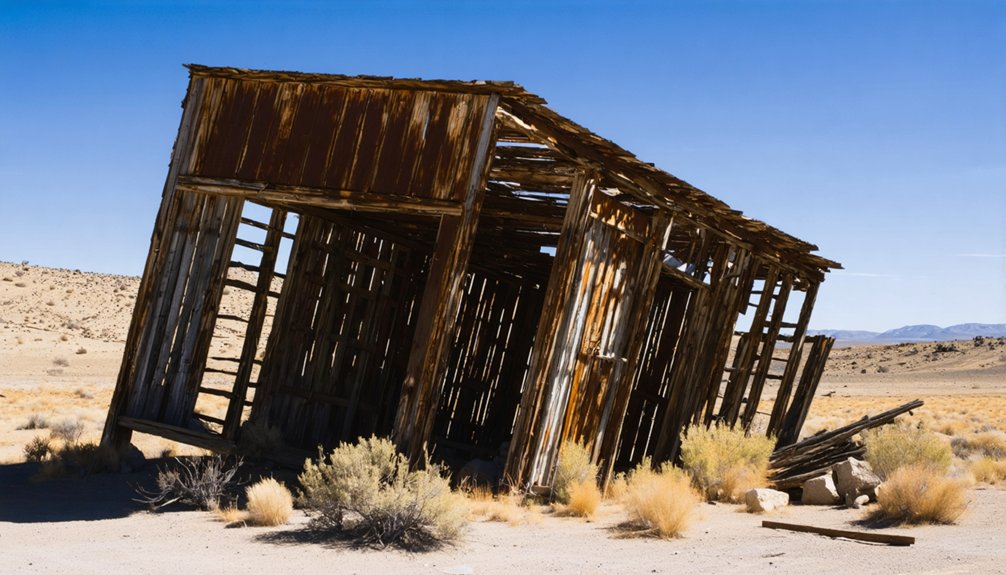
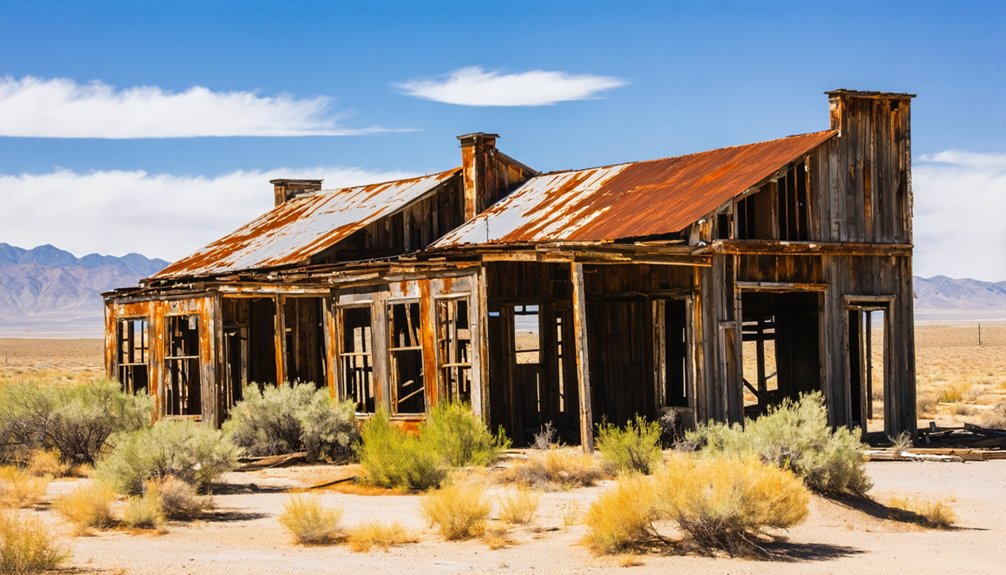
While Termo’s railroad-era prosperity vanished over a century ago, visitors today encounter scattered physical evidence of its abbreviated existence as a frontier transportation hub. You’ll find no preserved railway structures from the N.C.O. line’s 1900 terminus designation, but abandoned residential infrastructure tells a later chapter.
Boarded-up apartment buildings with collapsed drop ceilings and fire-damaged facades reveal post-railway occupation, likely linked to mid-century activities. The site’s 1992 military closure preceded military logistics repurposing of select parcels, though most structures face accelerated deterioration from Modoc Plateau weather exposure.
Unlike California’s meticulously preserved ghost towns, Termo offers minimal interpretive value—primarily debris fields and ruins accessible via Highway 395, representing a settlement that failed to sustain purpose beyond its original railroad function. As with many 395 corridor ghost towns, the region includes other historic mining and railway settlements that attracted amazingly rugged and resilient people to this remote area.
Exploring ghost towns near Moores Flat reveals stories of ambition overshadowed by harsh realities. Many of these sites are tucked away from the main roads, inviting intrepid adventurers to uncover their hidden histories. The remnants of these once-thriving communities serve as a testament to the dreams that once flourished in the unforgiving landscape.
Visiting This Modoc Plateau Relic
Reaching Termo requires little navigational effort despite its isolation—the ghost town straddles U.S. Highway 395 at coordinates 40°51′57″N 120°27′37″W, elevation 5,305 feet. You’ll find the junction marking Termo-Grasshopper Road just south of Alturas, approximately 32 miles north-northeast of Susanville.
Access considerations for contemporary visitors:
- No sparse visitor facilities exist at this Modoc Plateau location
- Roads rising east penetrate Jess Valley and Warner Mountains territory
- Lone ranch houses punctuate what’s described as California’s loneliest country
- Highway 395 provides direct access to remaining railroad infrastructure
- Site positioned on plateau terrain characteristic of Lassen County’s remote geography
The area’s designation as “loneliest country” reflects its extreme remoteness—historically 50 miles from developed settlements during railroad operations (1900-1901).
Frequently Asked Questions
What Happened to the Residents When Termo Declined After 1901?
You’ll find residents fled during the population exodus following railroad relocation in July 1901. Economic decline eliminated freight jobs and commercial opportunities, forcing workers and families northward to Madeline, leaving Termo’s infrastructure abandoned.
Are There Any Ghost Stories or Paranormal Legends Associated With Termo?
No documented ghost stories exist for Termo—despite its “ghost town” label referring only to abandonment. Available sources mention no spooky apparitions or unexplained sounds. You’ll find historical decay documented, but paranormal legends remain conspicuously absent from archival records.
Can Visitors Legally Explore the Remaining Buildings and Railroad Infrastructure?
You’ll find virtually zero regulated access guidelines or historical site permits governing Termo’s abandoned structures. This completely unincorporated settlement operates outside typical bureaucratic frameworks, though you’re still bound by California’s standard trespassing laws and private property boundaries.
What Role Did Termo Play During World War I and II?
You’ll find no documented evidence of Termo’s direct involvement in wartime production needs or military supply routes during WWI-WWII. The town’s remote location and declining population meant it remained largely isolated from both conflicts’ industrial mobilization efforts.
Are There Any Preservation Efforts Planned for Termo’s Historic Structures?
You’ll find no historic preservation initiatives or building stabilization projects documented for Termo’s structures. The remote site lacks funding, state programs, or local advocacy, leaving its railroad remnants to deteriorate naturally without intervention or protection measures.
References
- https://www.ghosttowns.com/states/ca/termo.html
- https://nvtami.com/2024/01/10/nevada-california-oregon-railway/
- https://www.youtube.com/watch?v=-ZS9Ty4mb5o
- https://nvtami.com/2023/11/16/ghost-towns-highway-395-reno-to-lakeview/
- https://kids.kiddle.co/Termo
- https://www.youtube.com/watch?v=XZimpP8h4rY
- https://landingaday.wordpress.com/tag/termo-california/
- https://mchsmuseum.com/local-history/american-era-settlement/railroads-of-the-central-coast-an-overview/
- https://nvtami.com/2025/02/21/highway-395-ghost-towns-reno-to-lakeview/
- https://railyards.com/news-and-blog/a-california-history-timeline-part-3-the-rise-and-fall-of-the-railroads/