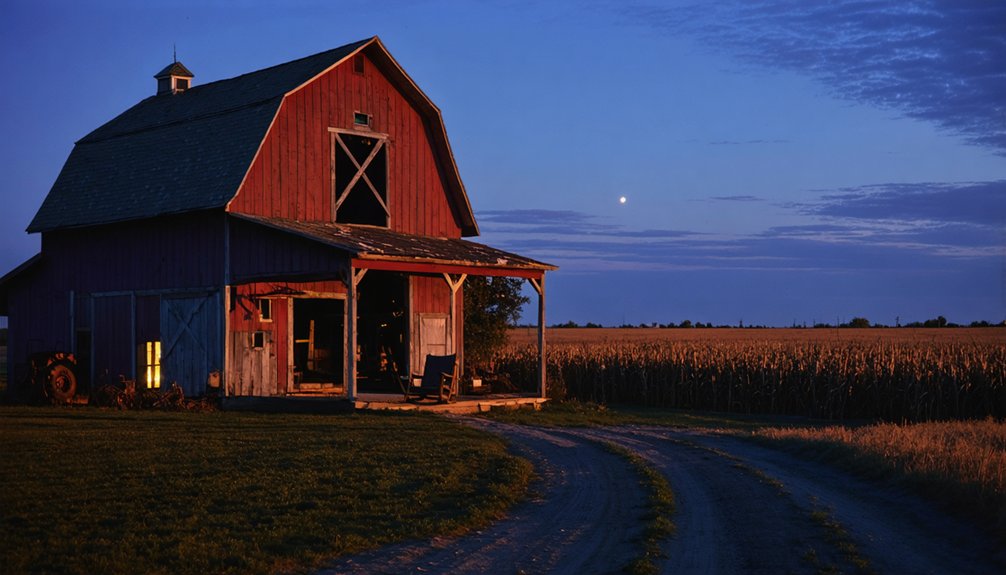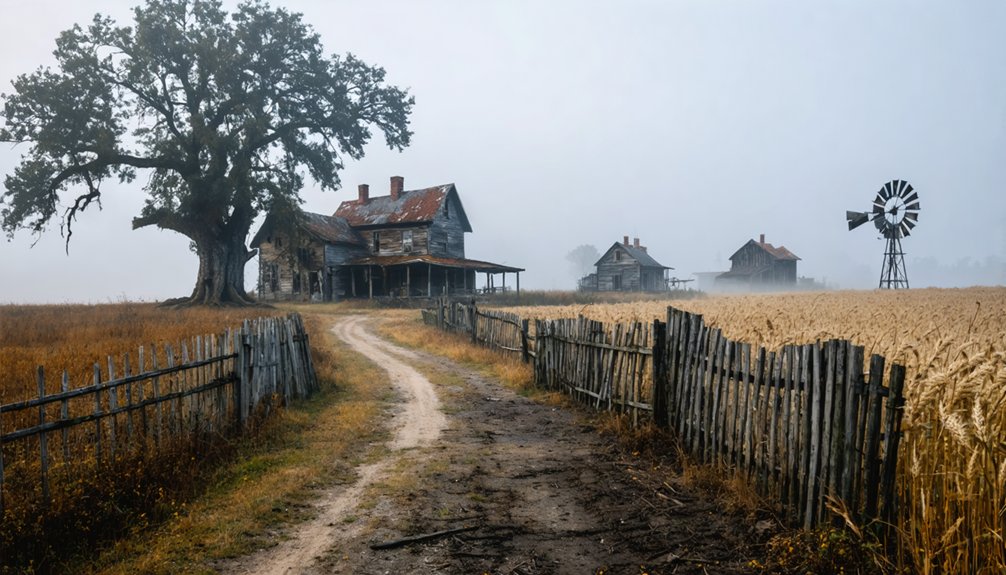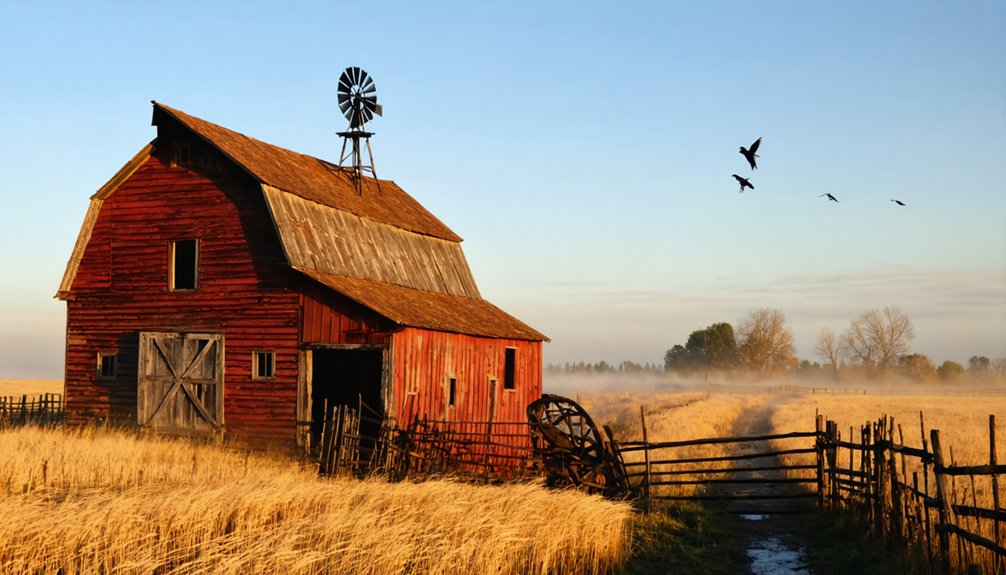
America’s abandoned farmlands hold a haunting beauty as nature reclaims over 30 million once-cultivated acres. You’ll find these ghostly landscapes concentrated in the Black Belt, Appalachia, and Indian Country, where economic pressures have hollowed rural communities. As fields return to wilderness, they’ve become accidental carbon sinks where native grasses and songbirds flourish. Beyond their melancholic charm lies the painful story of America’s vanishing family farms—and surprising opportunities for ecological renewal.
Key Takeaways
- Abandoned farmlands create natural carbon sinks as native vegetation reclaims fields once dominated by monoculture crops.
- Former agricultural sites evolve into accidental wildlife sanctuaries where songbirds and native species return over time.
- Historical agricultural structures like weathered barns and silos stand as haunting monuments to America’s farming heritage.
- Rural abandonment reveals stark demographic patterns across regions like the Black Belt and Appalachia where communities are hollowing out.
- These ghostly landscapes offer opportunities for ecological restoration, renewable energy development, and rural economic revival.
The Silent Spread: 30 Million Acres Lost in Three Decades
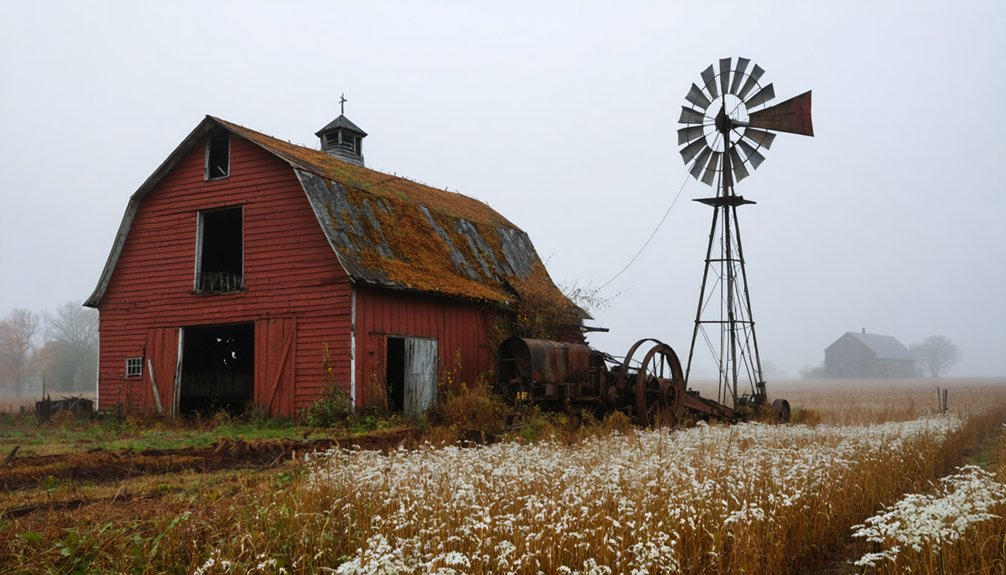
While many Americans have watched urban sprawl and suburban development reshape our landscape, a far more significant alteration has occurred largely unnoticed across our nation’s heartland.
You’re witnessing an unprecedented cropland decline—over 30 million acres vanished from agricultural production between 1986 and 2018. That’s roughly 1 million acres yearly for three decades, a staggering agricultural shift previously masked by imprecise county-level data.
America has lost nearly 1 million acres of cropland yearly since 1986—a hidden agricultural transformation now revealed through precise satellite data.
Only recently, through advanced satellite imagery and cloud computing, can you see the true extent of this phenomenon.
What USDA estimates once blurred, field-level precision now reveals in stark detail. This isn’t merely statistical change—it’s a fundamental reshaping of America’s relationship with its land, quietly transforming the countryside you cherish into something altogether different. According to Tyler Lark’s research from the University of Wisconsin, this massive land abandonment coincided with a period of rapid ethanol growth in the United States. Researchers now prefer the term retired land as it more accurately reflects the transitional nature of these areas.
Beyond Conservation: What’s Happening to America’s Forgotten Fields
Although government conservation programs like CRP might dominate public discussions about farmland shifts, they tell only a fraction of the story. Less than 20% of abandoned cropland finds its way into formal conservation programs. The majority—over half—transforms into pasture or grassland without structured land management, while another third evolves into forests, wetlands, or shrubland. This pattern mirrors national trends where pastureland losses have accounted for 88% of the total decline in American farmland.
You’ll find these forgotten fields increasingly courted for new purposes—bioenergy crops, solar arrays, and ecosystem restoration projects. Satellite data shows that roughly 30 million acres of U.S. cropland have been abandoned since the 1980s.
Meanwhile, rural communities shoulder the economic burden, with some regions facing over $22 million in annual losses as farmland disappears. The resulting economic incentives often favor conversion rather than preservation, while absentee landownership drains CRP payments from local economies.
Your abandoned farmland may represent both challenge and opportunity—a landscape caught between ecological potential and economic necessity.
Heartland Hollowing: Mapping the Geographic Hotspots
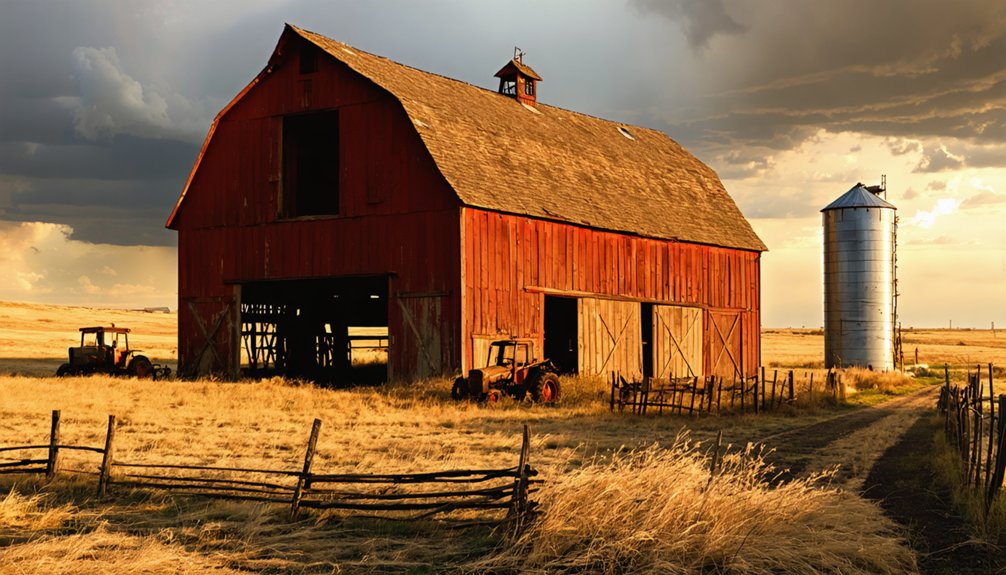
America’s Heartland—that sweeping 1.1 million square mile expanse encompassing 19 inland states—now reveals distinct geographic patterns in its agricultural abandonment.
You’ll find the most profound hollowing in the Black Belt regions spanning Louisiana, Mississippi, and Alabama, where poverty rates have reached crisis levels.
Similar abandonment patterns mark Appalachian zones and Indian Country territories within the Heartland geography. While metropolitan centers like Columbus and Minneapolis-St. Paul attract venture capital, their surrounding rural communities continue emptying out.
The remnants of past communities stand as haunting reminders of this decline, with many exploring the historical ghost towns in Appalachia. Visitors often marvel at the architecture and stories behind these deserted sites, revealing the rich cultural history that once flourished there. As these towns fade into memory, they provoke contemplation on the social and economic changes that have shaped the region.
The economic divide grows starker—major cities flourish while their rural satellites wither into obscurity.
These demographic shifts follow predictable patterns: small towns deteriorate while nearby cities grow modestly. The Walton Family Foundation has committed substantial resources to addressing these economic divides through regional innovation initiatives. Venture capital investment has tripled over the past decade to $55 billion, creating economic opportunity islands amid rural decline.
The Plains regions have weathered these changes better than their eastern counterparts, where manufacturing once thrived.
As you travel through these forgotten landscapes, you’re witnessing a 75-year transformation—agricultural concentration replacing the distributed family farm model that once defined America’s interior.
Nature’s Reclamation: Environmental Benefits of Abandonment
Despite the human cost of farm abandonment, nature quietly works to transform these forsaken lands into unexpected environmental assets. When fields lie untouched, they become powerful carbon storage systems, sequestering atmospheric carbon in rejuvenating soils and emerging vegetation.
Though typical abandonment periods of just 14 years capture only a fraction of potential benefits, protected parcels demonstrate impressive carbon accumulation over decades. Sadly, models predict that 50% of abandoned croplands will be recultivated within 30 years.
You’ll witness remarkable biodiversity recovery when these lands remain undisturbed. Native grasses replace monocultures, songbirds return to emerging thickets, and ecological networks rebuild.
While full ecosystem restoration requires 50+ years without disturbance, even brief abandonment periods show promising beginnings. Fields once viewed as failures now represent nature’s resilience—providing cleaner water, reduced erosion, and enhanced ecological services that modern farming often sacrifices for production efficiency. Reviving these abandoned areas could significantly increase global food production while preventing further deforestation of natural habitats.
The Vanishing Family Farm: Social and Economic Ripple Effects
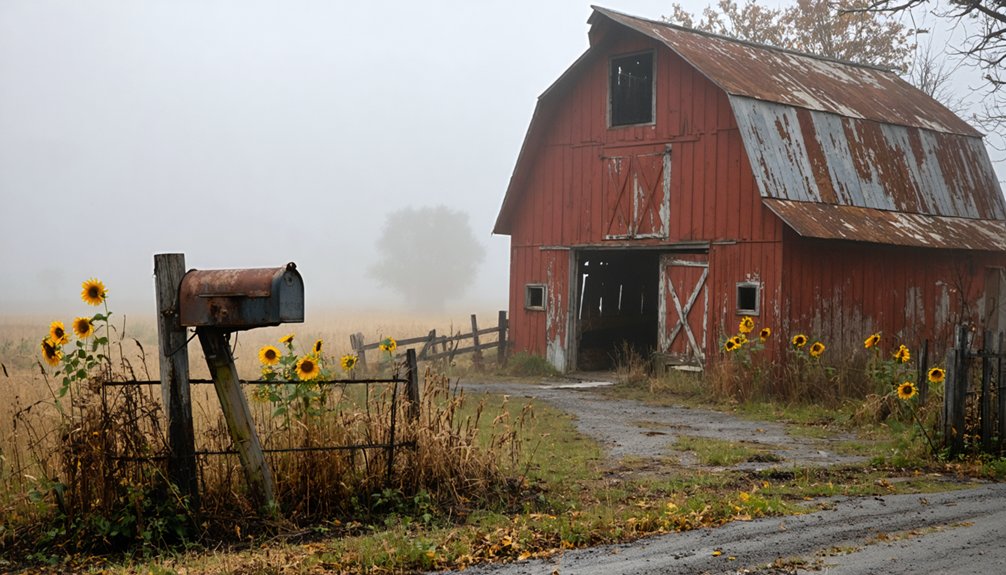
You’re witnessing a demographic collapse across America’s rural landscape as family farms fold under economic pressure, leaving once-vibrant communities with aging populations and empty storefronts.
The inheritance crisis has accelerated this decline, as younger generations can’t justify taking over operations that carry massive debt loads and razor-thin profit margins. This decline is dramatically evident in the statistics showing U.S. farms dropping to 1.88 million in 2024, the lowest number in over a century.
From 2017 to 2024 alone, approximately 160,000 farms disappeared from the American landscape, representing an 8% decline in just seven years.
When a family farm disappears, it doesn’t just represent the loss of a business—it tears at the social fabric of rural America, removing the anchor institutions that once supported schools, churches, and local economies for generations.
Rural Community Hollowing
While the iconic family farm once anchored rural American communities, today’s countryside increasingly echoes with absence rather than activity.
You’ll find a stark rural exodus occurring across America, with 76% of nonmetro counties experiencing natural decrease—more deaths than births—between 2023-2024.
This demographic hollowing is most evident in states like Georgia, where counties facing natural decrease soared from under 20 to nearly 100 in less than two decades.
The South’s recent rural population growth of 130,100 residents masks a troubling reality—it’s driven by migration, not births.
Despite this decline, community resilience remains: young adults are fueling small-town revivals post-pandemic, and rural homeownership rates (84%) far exceed urban levels (58%).
These communities aren’t dying—they’re transforming in response to economic realities.
Inheritance Crisis Accelerates
As inheritance tax exemptions hurtle toward a dramatic 50% reduction in 2026, America’s family farms face an existential crisis that threatens to reshape rural landscapes for generations.
You’ve likely witnessed the gradual emptying of once-vibrant farming communities. The inheritance impact looms largest for operations worth $7-20 million—not corporate giants but multigenerational family stewards.
When the estate tax forces heirs to sell land just to pay the government, the farm’s identity dies with its division.
Consider the grim mathematics: an Iowa corn farmer earning $162,000 annually can’t possibly save enough to cover estate taxes when exemptions drop.
With farm bankruptcies already up 55% and 140,000 operations lost in recent years, we’re witnessing the quiet collapse of America’s agricultural heritage, farm by farm, family by family.
New Life for Old Land: Potential Futures of Abandoned Acreage
America’s abandoned farmlands represent a canvas of untapped potential waiting to be reimagined for the modern era.
With over 30 million acres lying dormant since the 1980s, you’re looking at a vast frontier for innovation that transcends traditional agriculture.
You’ll find these forgotten fields offer promising opportunities for bioenergy potential, especially in the Great Plains and Mississippi River valley where abandoned acreage concentrates.
Imagine switchgrass swaying where corn once grew, powering rural economies through renewable energy.
These lands also hold remarkable promise for ecological restoration, with more than half already evolving to pasture or grassland.
The remaining third, now shrubland, forest, or wetland, silently sequesters carbon while rebuilding biodiversity.
High-resolution mapping now allows you to target specific parcels for restoration or cultivation, writing a new chapter for land once deemed lost.
Frequently Asked Questions
How Do Abandoned Farms Affect Surrounding Property Values?
Like a cracked windshield spreading, abandoned properties diminish your neighboring land’s value by 9.4% within 500 feet, triggering market fluctuations that can spiral into more foreclosures across your agricultural community.
Can I Legally Explore or Photograph Abandoned Farmland?
You can’t legally explore abandoned farmland without permission, as property rights still apply. However, you’re free to photograph these nostalgic landscapes from public roads, honoring agricultural heritage while respecting legal boundaries.
What Wildlife Species Thrive Most on Abandoned Agricultural Land?
You’ll find early successional species thriving first—cottonwoods, willows, grassland birds like Bobolinks and Grasshopper Sparrows. Wildlife adaptation follows ecological succession, creating havens where migratory birds and threatened bog turtles return.
Are There Grants Available for Restoring Historic Abandoned Farm Structures?
Yes, you’ll find numerous grant opportunities through federal tax credits, state programs, and nonprofit foundations specifically designed for historic barn restoration projects. They’ll fund your preservation work while honoring agricultural heritage.
How Does Soil Recover After Decades of Intensive Farming?
Like barren earth finding its voice, your abandoned soil’s heart slowly heals. You’ll witness carbon rebounding after 30 years, vegetation reclaiming the land, and regenerative practices accelerating nature’s meticulous soil health restoration timeline.
References
- https://houseofgreen.substack.com/p/weve-lost-14950-farms-and-2100000
- https://advancedbiofuelsusa.info/tens-of-millions-of-acres-of-cropland-lie-abandoned-study-shows
- https://www.layer1agriculture.com/resources-articles/what-america-s-farm-count-collapse-signals
- https://news.wisc.edu/abandoned-farmlands-could-play-a-role-in-fighting-climate-change-a-new-study-shows-exactly-where-they-are/
- https://farmdocdaily.illinois.edu/2024/09/loss-of-us-farmland-in-the-21st-century-the-national-perspective-from-the-census-of-agriculture.html
- https://investigatemidwest.org/2025/10/28/us-farmers-face-44-billion-in-losses-as-costs-rise-and-markets-shrink/
- https://www.farmprogress.com/farm-business/are-farmers-going-out-of-business-in-2025-
- https://agnetwest.com/thirty-million-farm-acres-abandoned-since-1986/
- https://ambrook.com/offrange/land/dont-cry-over-abandoned-cropland
- https://ci.uky.edu/irj/rural-blog/new-tool-finds-abandoned-farmland-could-be-used-fight-climate-change-30-million