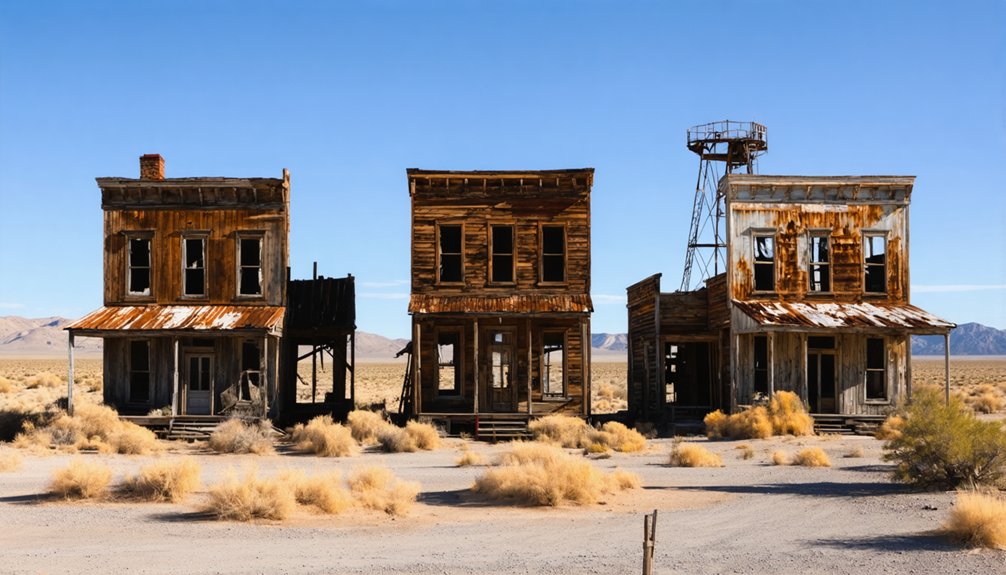
Nevada’s abandoned mines harbor dark legends stemming from their deadly past. You’ll encounter tales of spectral miners carrying phantom lamps, protective spirits guarding unclaimed silver, and the infamous “widow makers” that claimed countless lives since 1857. Ghost towns like Rhyolite and Delamar feature unexplained footprints, equipment malfunctions, and cold spots documented by paranormal investigators. The mysterious Tommyknockers and vanishing explorers add to these haunting narratives that await your discovery.
Key Takeaways
- Nevada’s abandoned mines have claimed numerous lives since 1857, earning them the ominous nickname “widow makers.”
- Spectral miners carrying lamps and tools are commonly reported in ghost towns like Rhyolite and Delamar.
- Mysterious occurrences including footprints, sounds, and equipment malfunctions are frequently documented by paranormal investigators.
- Folklore creatures like Tommyknockers supposedly warned miners of impending danger and continue to haunt abandoned shafts.
- Over 300,000 abandoned mining features remain scattered across Nevada, with many sites linked to unexplained disappearances.
The Lost Miners of Eldorado: Tales From Nevada’s Deadliest Shafts

While the gold-laden hills of Eldorado Canyon promised fortune and opportunity to those who ventured into Nevada’s rugged terrain beginning in 1858, they also harbored a deadly reputation that would define the region for decades.
You’d find yourself among a lawless mix of Civil War deserters and outlaws in these remote canyons where gunfights became “daily occurrences.”
The Techatticup Mine’s multi-level shafts, cutting 500 feet below the upper entrance, claimed countless lives through collapses and falls. Without regulated safety measures or reliable rescue operations, miners became lost souls—trapped, injured, or killed in the labyrinthine tunnels. Despite the dangers, miners persevered in the tunnels where temperatures consistently remained at around 70 degrees.
Death stalked the Techatticup’s treacherous depths, where miners vanished forever in the darkness of Nevada’s unforgiving earth.
Mining folklore tells of men who disappeared without trace, their bodies never recovered from the “deadliest shafts” in Nevada.
The mine, with its name derived from Paiute words meaning “hungry bread,” continued producing precious metals until the mid-1940s before becoming a haunting reminder of the canyon’s perilous past.
Renegades like Queho, credited with over 20 murders, only added to the canyon’s violent legacy.
Ghost Towns and Their Guardian Spirits: Mining Camp Hauntings
When you venture into Nevada’s ghost towns after sunset, you’ll occasionally witness the eerie glow of spectral miners’ lamps still illuminating abandoned shafts, revealing phantom figures continuing their eternal search for precious metals.
The history of mining in Nevada is rich with tales of fortune and despair, as countless adventurers flocked to the state in search of gold and silver. These ghostly remnants tell a story of ambition, hardship, and the relentless pursuit of wealth that defined an era. Each abandoned site serves as a testament to the dreams that sparked the Nevada mining boom, echoing the whispers of those who once toiled in the shadows.
These apparitions, believed to be miners who perished in cave-ins or accidents, maintain their ghostly claims by moving equipment, leaving inexplicable footprints, or creating the sounds of picks striking stone in long-dormant mines. Visitors to Rhyolite mining camp often report unexplained phenomena around the numerous original buildings that still stand in Nye County.
Paranormal investigators have documented numerous accounts of phantom lights moving through subterranean tunnels where no living person could navigate without modern equipment, suggesting these guardian spirits continue to patrol their territory with the same dedication they showed in life. The town of Delamar, once home to 3000 residents during its peak in 1897, is another notorious site for spectral encounters.
Spectral Miners Still Working
Throughout the forgotten boomtowns of Nevada, numerous witnesses report encountering spectral miners who seemingly haven’t abandoned their posts despite the passage of time.
These spectral sightings often feature figures dressed in period attire, carrying lanterns or tools through abandoned shafts and camps. You’ll find these apparitions most commonly in towns that experienced abrupt economic collapses, where unresolved labor and tragic accidents left indelible marks.
Miner folklore suggests these entities represent workers who died in accidents or departed without receiving their due wages. Some investigators report seeing spirits with visible injuries while exploring these abandoned structures, similar to those documented at Godby Mill.
When investigating these phenomena, you might experience equipment malfunctions or sudden cold spots—common occurrences reported by paranormal researchers.
The Godbe Mill in Pioche and Techatticup Mine in Eldorado Canyon stand as prominent locations where you can potentially witness these dedicated spirits continuing their eternal shifts in Nevada’s mineral-rich mountains. The haunted Goldfield Hotel, once populated during the town’s peak of 30,000 residents, remains a hotspot for paranormal enthusiasts seeking encounters with spirits from Nevada’s mining era.
Ghostly Claims Staked Eternally
Beyond the hollow buildings and rusted machinery of Nevada’s ghost towns, a different kind of claim has been staked—one that transcends physical ownership and persists through ethereal means.
You’ll discover these spectral sightings most concentrated in areas where dramatic population shifts occurred. In Rhyolite, where 5,000 souls vanished almost overnight, visitors report ghostly echoes emanating from the 50 former saloons.
At Belmont, once home to 2,000 miners, apparitions are said to still protect abandoned silver claims. The preserved structures of Berlin, with its period-authentic cabins and mill, serve as perfect vessels for otherworldly inhabitants. The innovative square set timbering technique, developed to prevent mine collapses, is said to still creak with phantom activity in these abandoned tunnels. Visitors exploring the Diana Mine on weekend tours might sense ghostly mining activity from the site that produced nearly $850,000 before being abandoned.
The phenomenon isn’t limited to mining camps—even Metropolis, the failed agricultural community, harbors spirits of shattered dreams.
These eternal residents continue their vigil across Nevada’s 600 ghost towns, standing sentinel over the boom-and-bust legacy.
Phantom Lights Underground
Deep within Nevada’s abandoned mine tunnels, phantom lights flicker mysteriously where no illumination should exist. These glowing apparitions, particularly prevalent in sites like Horton Mine and Rhyolite’s ruins, defy conventional explanation.
You’ll find reports of phantom orbs dancing through darkened shafts, often accompanied by the inexplicable swinging of mining chains captured on video evidence.
While some theorize natural causes—underground gases or electrical phenomena—science has yet to provide definitive answers. The eerie illuminations typically manifest in Nevada’s most notorious ghost towns: Jarbidge, Belmont, and Eldorado Canyon’s Techatticup Mine.
Local folklore suggests these lights represent guardian spirits of deceased miners who maintain eternal watch over their claims, warning trespassers of potential dangers within the unstable tunnels. These supernatural sentinels contribute to the rich tapestry of mining lore that draws paranormal enthusiasts annually. Frank himself encountered such phenomena when exploring the Horton mine, capturing what appeared to be a mysteriously swinging chain on his YouTube video that later went viral. Similar to the phantom lights, visitors to Lost City report eerie glows over the submerged Puebloan ruins visible during moonlit nights.
The Widow Makers: Mines With Deadly Reputations
If you’re seeking Nevada’s deadliest mines, search no further than Storey County’s notorious Loring Pit, where a 500-foot vehicular plunge claimed a life in 2007, or the treacherous shafts of Pershing County, responsible for the state’s most recent mining fatality in 2011.
These “widow makers” earned their grim reputations through a consistent pattern of falls down deep mine shafts (100-500 feet), ground collapses, and exposure to oxygen-depleted air pockets that have claimed lives since the first recorded mining death in 1857.
While state officials have secured approximately 20,000 of Nevada’s 50,000 abandoned mines, the persistent vandalism of safety barriers and remoteness of many sites continue to make these historic excavations as dangerous today as they were during their operational heyday.
Deep Death Traps
Though Nevada’s abandoned mines stand as historical monuments to the state’s mining legacy, they’ve earned the grim moniker “widow makers” due to their deadly record of claiming lives across the decades.
These hidden perils have claimed 19 lives since 1961, with shafts plunging as deep as 500 feet becoming silent graves for the unwary.
You’re never far from unseen dangers in Nevada’s mining country, where approximately 50,000 hazardous mines await.
Falls represent the primary death mechanism, evidenced by the 2011 fatality where a man plummeted 190 feet in Pershing County.
Despite a 12-year streak without fatalities, the threat remains—from rotted timbers that collapse without warning to toxic air chambers and unstable explosives left behind by miners of yesteryear.
Ghostly Mining Disasters
Nevada’s deadliest mining disasters have transformed ordinary excavation sites into infamous “widow makers” with chilling reputations that persist long after their final fatalities.
You’ll find ghostly echoes of tragedy at the Yellow Jacket fire that claimed 35 lives in 1869 and the 1959 Mohawk Mine collapse where three miners—Delorme, Roberson, and Sickles—remain eternally entombed in fractured rhyolite.
Mining folklore surrounding these sites often recalls how unsupported spans and aggressive extraction practices invited catastrophe. The sealed Mohawk stands as both grave and monument, while Virginia City’s 1873 explosion reminds you that mining dangers extended beyond underground operations.
These disasters eventually spurred Nevada’s 1987 Abandoned Mine Lands program, which has successfully prevented fatalities since 2014 by securing thousands of hazardous features across the state.
Cursed Shafts
Among Nevada’s most feared abandoned excavation sites, the infamous “widow makers” earned their grim nickname through consistent patterns of death that stretch across generations of mining activity.
These cursed excavations include Virginia City’s Forman Shaft, which maintained a 165-foot chasm accessible to the public for over a century before its closure in 2022.
The haunted shafts claim victims through multiple deadly mechanisms: vertical drops that trapped explorers since Nevada’s first recorded mining death in 1861; oxygen-depleted pockets where decomposing timbers create zero-oxygen environments; and deadly cave-ins where rotted supports suddenly give way.
The Yellow Jacket mine disaster of 1869 exemplifies this deadly legacy, killing over 35 miners when methane ignited 800 feet below ground, with 11 bodies remaining eternally entombed.
Supernatural Warnings: Phantom Canaries and Mining Omens
While exploring Nevada’s abandoned mining networks, you’ll encounter accounts of supernatural warnings that transcend rational explanation—phenomena miners once relied upon as harbingers of impending danger.
These phantom canaries manifest in multiple sensory experiences: sudden temperature drops in desert heat, disembodied voices echoing through shafts, and luminous orbs near mine entrances.
“Tommyknockers”—supernatural entities believed to warn miners of imminent collapse—remain central to prospector folklore.
Historical disasters like the 1869 Yellow Jacket Mine collapse correlate with concentrated spectral activity.
At Eldorado Canyon and the notorious “Widowmaker” at Delamar, mining omens appear as cold spots, unexplained footsteps, or flickering lights without sources.
Native American traditions intertwine with prospector accounts, creating a tapestry of warning signs you’ll sense when venturing too deep into Nevada’s abandoned underworld.
Silver State Curses: When Prospectors Disturbed Ancient Grounds

Long before gold rush prospectors staked their claims across Nevada’s mineral-rich landscape, indigenous populations had already established sophisticated mining operations throughout the region.
Nevada’s ancient miners crafted an intricate underground legacy long before the rush for gold transformed the West.
You’ll find evidence of this prehistoric mining activity from Carson Sink to Boulder City, where Anasazi miners extracted turquoise as early as 300 A.D.
When you explore Nevada’s ghost towns, you’re treading on culturally significant grounds where ancient whispers still linger.
Mining districts like Pahranagat and White Pine harbor stories of Native American guides who led prospectors to valuable deposits—often with warnings attached. Those who disregarded these cautions reportedly encountered misfortune, financial ruin, and inexplicable accidents.
Today, cursed artifacts recovered from these sites serve as reminders that disturbing sacred grounds carries consequences.
Modern mining companies now face legal requirements to protect these archaeological treasures, acknowledging their historical and spiritual significance.
The Tommyknockers: Nevada’s Underground Mine Creatures
The mysterious presence of Tommyknockers in Nevada’s subterranean mining world represents another supernatural dimension of the state’s rich folklore. Imported by skilled Cornish miners during the silver rushes, these diminutive, elf-like beings became integral to Western mining culture, particularly along the Comstock Lode.
You’ll find Tommyknocker traditions deeply embedded in practical safety protocols—miners attributed warning knocks before cave-ins to these benevolent creatures. Superstitious offerings remained essential: miners left the last bites of pasties or bread crusts to curry favor and protection.
Clay figurines placed strategically throughout shafts served as physical representations of their supernatural guardians.
The distinction between helpful and harmful Tommyknockers created a complex relationship—they might reveal rich ore veins or mischievously hide tools, reflecting miners’ attempts to rationalize the unpredictable dangers lurking beneath Nevada’s surface.
Unsolved Disappearances: When the Mountains Claimed Explorers

Nevada’s forbidding mountain ranges and remote desert terrain harbor more than just abandoned mines—they’ve claimed numerous explorers whose fate remains unknown.
The disappearance of Kenny Veach in 2014 exemplifies this peril. While searching for the mysterious “M Cave” near Nellis Air Force Base, Veach vanished into the wilderness, leaving only his cell phone near an abandoned mineshaft in the Sheep Range.
Kenny Veach’s haunting disappearance remains emblematic of Nevada’s unforgiving wilderness—his final trace merely a cell phone beside a forgotten shaft.
You’ll find a disturbing pattern among these vanished adventurers: they often venture alone into treacherous terrain riddled with over 300,000 abandoned mining features.
With more than 50 documented fatalities in the past half-century, the dangers are real. Despite extensive search efforts and increased mine security measures, thousands of hazardous sites remain unmarked across Nevada’s vast landscape—waiting silently for unwary explorers.
Frequently Asked Questions
Can Abandoned Mines Be Legally Explored With Proper Permits?
Yes, you can legally explore abandoned mines with proper permits, but you must adhere to strict permit requirements and legal boundaries from both state and federal agencies.
How Do Scientists Differentiate Between Mine Legends and Documentable Paranormal Phenomena?
Scientists differentiate by applying scientific methods to test observable phenomena and folklore analysis to examine cultural narratives. You’ll find they require empirical evidence while contextualizing legends within their sociohistorical framework.
What Modern Technology Helps Investigate Alleged Hauntings in Nevada Mines?
You’ll employ thermal imaging, EMF meters, and EVP recordings during ghost hunting expeditions, while utilizing gas detectors and environmental sensors to analyze naturally occurring phenomena versus potential paranormal manifestations in abandoned shaft networks.
Are Native American Tribes Involved in Addressing Spiritual Claims Around Mines?
You’ll find significant tribal involvement addressing spiritual claims around mines, as several Nevada tribes actively protect sacred sites through lawsuits, ceremonies, and protest camps based on their spiritual beliefs and cultural heritage.
How Have Mining Legends Influenced Nevada’s Tourism and Entertainment Industries?
Like seekers in Eldorado’s treasure-laden past, you’ll find Nevada’s tourism thrives on mining folklore. Ghost tours, haunted attractions, and social media content leverage these legends, creating economically valuable cultural narratives around historical boom-and-bust cycles.
References
- https://thenevadaindependent.com/article/nevada-has-the-most-abandoned-mines-in-the-nation-why-is-it-taking-so-long-to-seal-them
- https://www.reviewjournal.com/local/local-nevada/all-the-ways-a-mine-can-kill-you-nevadas-abandoned-mines-pose-endless-risks-2914561/
- https://minerals.nv.gov/uploadedFiles/mineralsnvgov/content/Programs/AML/2017_NDOM_AML_Report_Final.pdf
- https://minerals.nv.gov/uploadedfiles/mineralsnvgov/content/programs/aml/aboutabandonedmines.pdf
- https://nbmg.unr.edu/mining/MiningRecords.html
- https://experience.arcgis.com/experience/0cceabadda7c4243a5f45d2957dc8ca3
- https://pubs.usgs.gov/fs/2025/3003/fs20253003.pdf
- https://savingplaces.org/stories/explore-wild-west-mining-history-in-nevada-ghost-towns
- https://www.leg.state.nv.us/interim/77th2013/committee/statcom/lands/other/12-june-2014/perryabandonedminesreport.pdf?rewrote=1
- https://www.legendsofamerica.com/nv-eldorado/