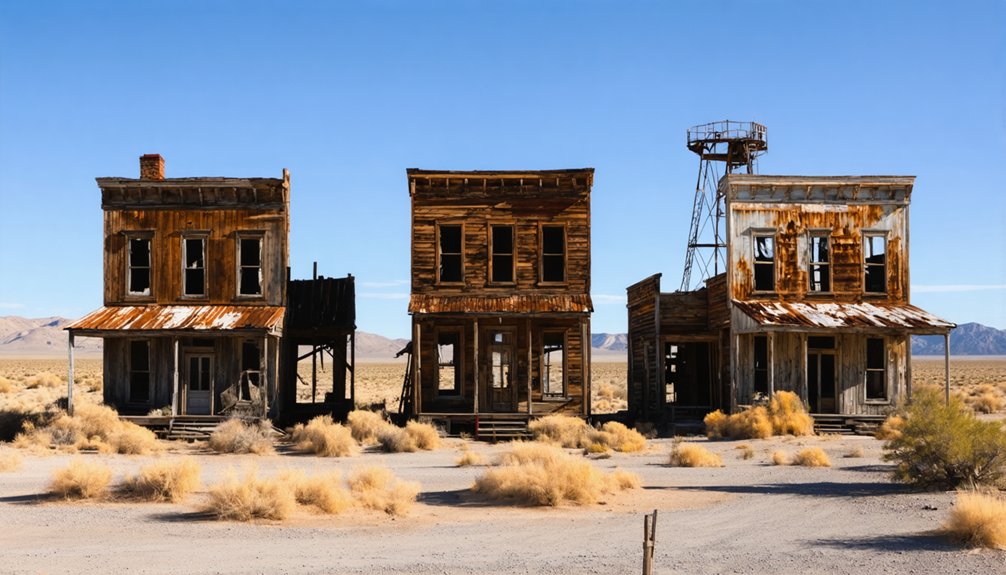
You’ll discover Nevada’s silver saga began with the 1859 Comstock Lode, which produced over $300 million in silver and gold. Virginia City emerged as its industrial heart, while Austin, Eureka, and Pioche followed with their own booms. Mining evolved from basic panning to sophisticated underground operations with square-set timbering. When ore quality declined in the 1880s, these once-vibrant communities transformed into the ghost towns that now preserve Nevada’s mineral frontier legacy.
Key Takeaways
- The Comstock Lode discovery in 1859 sparked Nevada’s silver rush, yielding $50 million within six years and establishing Virginia City.
- Austin’s silver discovery in 1862 created a boomtown reaching 10,000 residents before declining as ore quality decreased.
- Mining technologies evolved from simple hand tools to sophisticated underground systems with innovations like square-set timbering.
- Eureka became “Pittsburgh of the West” with sixteen smelters processing silver by 1878, while Pioche yielded $20 million by 1877.
- Ghost towns like Virginia City and Belmont preserve Nevada’s silver mining heritage as communities collapsed after resource depletion.
The Birth of Nevada’s Silver Empire: The Comstock Lode

When the first gleaming traces of silver ore emerged from Six-Mile Canyon in 1859, few could have predicted that the Comstock Lode would fundamentally transform Nevada’s economic landscape. Discovered by O’Riley and McLaughlin, the claim’s ownership quickly became entangled in mining disputes when Henry Comstock leveraged his grazing rights to secure interests in the find.
Within six years, despite litigation consuming nearly 20% of extraction value, the Lode yielded $50 million in silver and gold ore. This economic transformation redirected the western mining boom from California to Nevada, where extraction operations evolved from simple placer mining to sophisticated underground works pursuing silver-bearing sulfides.
The technical challenges prompted revolutionary innovations like square-set timbering and the Washoe process, establishing engineering precedents that would influence hardrock mining throughout America for generations to come. The Comstock mines were situated along the eastern slope of Mount Davidson, where the geological formation created ideal conditions for mineral deposits. The workforce included a diverse mix of ethnic groups, with miners from China, Ireland, England, Wales, and other European countries contributing to the development of this significant mining region.
Virginia City: Silver Boom and Cultural Legacy
The Comstock Lode‘s unprecedented silver wealth necessitated a permanent settlement, leading to the establishment of Virginia City in 1859. Following the discovery credited to Irish prospectors McLaughlin and O’Reilly, the city rapidly evolved into an industrial powerhouse as miners mastered underground extraction techniques.
The implementation of German square-set timbering revolutionized silver mining operations, enabling shafts to reach depths of 3,000 feet. During the “Big Bonanza” of 1873, the Consolidated Virginia and California mines generated $3 million monthly, with the district ultimately producing over $300 million in precious metals. The four Irishmen who formed this successful mining partnership became known as the Silver Kings due to their extraordinary success.
Innovation transformed the Comstock Lode into America’s silver treasury, yielding unprecedented wealth from deep beneath Nevada’s rugged terrain.
John Mackay’s ascension as a “Silver King” exemplifies the wealth distribution that financed San Francisco’s development and Nevada’s educational institutions. Virginia City miners earned high wages that attracted skilled laborers from across the globe, contributing to the town’s diverse population.
Though largely depleted by the 1890s, Virginia City’s cultural heritage endures as a monument to America’s quintessential mining boom.
Austin and the Reese River District: Central Nevada’s Silver Treasure

You’ll find the Reese River District’s silver story begins with William Talcott’s 1862 discovery in Pony Canyon, which triggered Austin’s meteoric growth from mining camps to a bustling town of 7,000-10,000 residents by 1863-1865.
The district’s prosperity manifested in eleven mills processing ore by the late 1860s, with the Manhattan Silver Mining Company consolidating operations and dominating production until 1887. The total value of silver extracted from the area ultimately reached nearly $28 million.
Austin’s fortunes waned as ore quality diminished, though the 1881 arrival of the Nevada Central Railroad briefly reinvigorated the area before the inevitable decline reduced this once-thriving hub to the preserved historic mining town you see today. The county seat status that once brought prestige to Austin was eventually moved to Battle Mountain in 1979, further affecting the town’s economic standing.
Discovery and Early Boom
Silver’s significant presence in central Nevada emerged in May 1862 when William Talcott, a former Pony Express rider, stumbled upon rich ore while searching for horses in Pony Canyon. This fortuitous silver discovery prompted immediate analysis in Virginia City, where assays confirmed substantial mineral content.
By July 1862, the Reese River mining district was formally established.
You’ll note that two settlements rapidly materialized: Austin on the canyon slopes and Clifton at its mouth. While mining accidents remained a constant threat, development accelerated unabated. The weekly Reese River Reveille began publication, documenting the area’s explosive growth. The town experienced a remarkable population surge, reaching between 8,000 to 10,000 residents at its peak during the silver boom.
David Buel founded Austin, naming it after his partner Alvah Austin, while offering strategic incentives to merchants who invested in infrastructure. By late 1863, Austin’s population surpassed 7,000, cementing its dominance over Clifton.
The town secured the Lander County seat in September 1863, establishing itself as central Nevada’s premier silver hub.
Eleven Mills Operating
Eleven massive ore-processing mills dominated Austin’s industrial landscape by 1867, marking the Reese River District‘s ascension to prominence as central Nevada’s silver production center.
You’d find these facilities strategically positioned near major mines and transportation routes, with sophisticated infrastructure including water systems and hillside placements that utilized gravity for efficient ore movement.
Mill operations ran year-round, employing stamping technology to crush high-content silver ore from both deep shaft and surface mines.
The mining infrastructure supported hundreds of tons of monthly processing capacity, cementing Austin’s position as Nevada’s second-largest silver producer after the Comstock.
Similar to Tonopah’s remarkable growth, these mills contributed to a mining boom that produced nearly $750,000 in gold and silver in its first year of serious operations.
The growing success of the mining region parallels the earlier discovery made on August 11th, 1860 that sparked Nevada’s silver industry.
Ownership structures varied among companies, syndicates, and individual investors, with management hierarchies including engineers and skilled laborers who maintained strict production standards throughout the district’s peak production years.
Transportation and Decline
Though Austin’s early prosperity relied on mule-drawn freight wagons and stagecoaches, transportation infrastructure transformed dramatically when the Nevada Central Railroad reached Clifton in 1880, followed by narrow gauge extensions to Austin in 1881.
The Austin City Railway and its “Mules Relief” locomotive addressed the steep canyon terrain, beginning daily operations by June 17, 1881.
Despite these transportation advances, Austin experienced significant decline as silver production waned. By 1887, when the Manhattan Silver Mining Company disbanded, operations largely ceased after generating $19.2 million.
Community shifts followed this economic downturn—population plummeted from over 2,000 residents in 1863 to barely 1,000 by 1890.
Austin’s role evolved from mining center to regional supply point, exemplifying how transportation development often arrived too late to prevent inevitable resource depletion.
Eureka: The “Pittsburgh of the West” Silver Smelting Hub
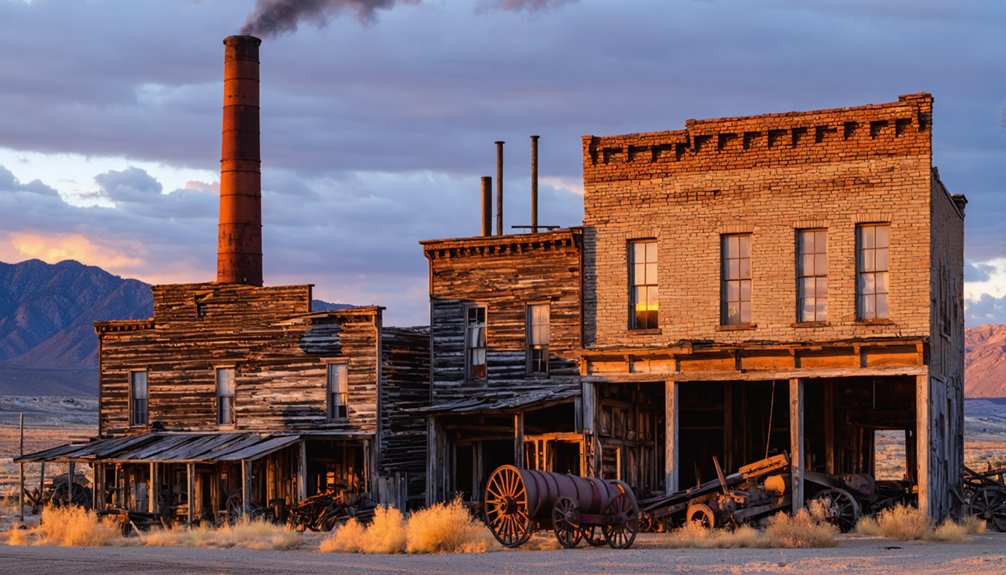
As the central node in Nevada’s silver processing network, Eureka earned its moniker “Pittsburgh of the West” through the transformative development of silver smelting operations beginning in 1869.
These smelters catalyzed Eureka’s explosive growth, processing complex silver ores from throughout central Nevada and reaching peak production of $5.2 million in silver and lead by 1878.
The environmental impact was severe—sixteen smelters consumed 175,000 pounds of charcoal daily by 1879, denuding forests within a 50-mile radius and shrouding the town in persistent black smoke.
This voracious charcoal demand sparked significant labor conflicts, culminating in the 1879 Charcoal Burners’ Strike when Italian immigrants formed a protective association demanding fair prices.
The violent confrontation at Fish Creek left five charcoal burners dead, highlighting the tension between immigrant labor power and industrial interests in Nevada’s mining economy.
Pioche: Silver Mining in Lincoln County’s Wild Frontier
While Eureka’s smelters transformed central Nevada into an industrial powerhouse, 175 miles to the southeast, another mining settlement carved its violent legacy into Lincoln County’s remote frontier.
Pioche history began with a Mormon missionary’s silver discovery in 1863-64, but Indian raids delayed settlement until 1868. Namesake financier F.L. Pioche established commercial mining in 1869, igniting explosive growth that yielded over $20 million in silver ore by 1877.
Faith and fortune collided in Pioche, where a missionary’s silver discovery birthed Nevada’s bloodiest boomtown.
- Between 1870-1872, Pioche reached its zenith, extracting $5 million in ore during peak production.
- Mining challenges included violent claim disputes, leading to the construction of the “Million-Dollar Courthouse.”
- The first 72 burials in Pioche’s cemetery were reportedly murder victims, emblematic of its lawless reputation.
After repeated boom-bust cycles, the 1907 railroad arrival provided stability until lead and zinc operations ceased in the 1950s.
Mining Technologies That Built Nevada’s Silver Towns
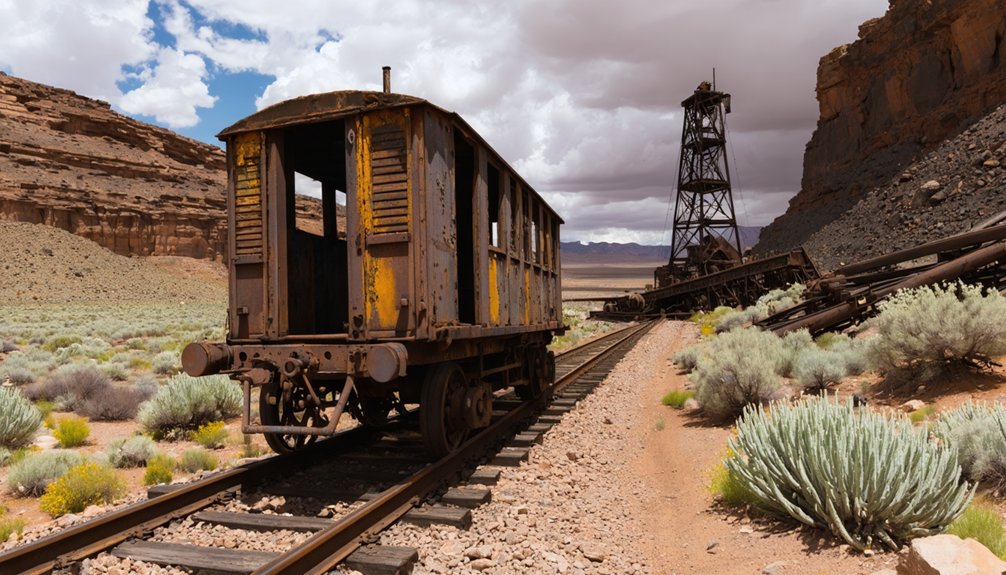
Beyond the lawless reputation and boom-bust cycles of early mining towns, Nevada’s silver industry fundamentally relied on technological innovation to extract wealth from its rugged landscape. Early mining began with simple hand tools—picks, pans, and shovels—as prospectors sought accessible surface deposits.
When these were exhausted, miners developed sophisticated underground systems reaching depths exceeding half a mile. The industry’s evolution accelerated with stamp mills that crushed hard rock into fine particles.
Chemical extraction methods proved revolutionary: over 20.5 million pounds of mercury were used on the Comstock Lode alone to amalgamate microscopic silver particles. Miners also experimented with chlorine and organic additives like sagebrush tea to improve yields.
The 1878 Sutro Tunnel exemplified engineering ingenuity, providing drainage and ventilation for deep mines, while modern heap leaching later revitalized historic districts.
From Boom to Bust: Ghost Towns and Historic Preservation
The technological innovations that propelled Nevada’s mining industry laid the groundwork for spectacular but often short-lived population centers across the state’s mineral-rich landscape.
Following the 1859 Comstock Lode discovery, towns like Virginia City flourished, then faltered as silver deposits depleted and prices plummeted by the late 19th century.
- Ghost town preservation efforts now protect structures like Tom Kelly’s Bottle House and original jails.
- Silver City and Belmont stand as well-preserved examples of Nevada’s mining heritage tourism destinations.
- Population collapses were often dramatic—Goldfield’s inhabitants dropped from 20,000 to 5,000 in just four years.
You’ll find these abandoned settlements serving dual roles today: as educational resources documenting Nevada’s boom-and-bust cycles and as cultural attractions where visitors experience the authentic freedom-seeking spirit that defined the American West.
Frequently Asked Questions
How Did Native Americans Use Silver Before European Settlers Arrived?
You’ll find that Native Americans didn’t use silver before European contact. Their native crafts utilized materials like stone and bone, while their trade routes circulated turquoise, shell, and ceramics instead of metalwork.
What Role Did Chinese Immigrants Play in Nevada’s Silver Mining?
You’ll find Chinese labor was essential in Nevada’s silver boom (1860s-1870s), diversifying from miners to service providers. Their economic contributions and cultural impacts transformed mining towns’ social dynamics despite discriminatory practices.
How Did Silver Mining Affect Local Water Supplies and Ecology?
Like King Midas’s touch turning life to death, you’d find silver mining devastated Nevada’s ecosystems through water contamination. Mercury and arsenic poisoned streams, while diversions disrupted hydrological systems, causing widespread ecological impact by the 1880s.
Were There Any Major Mining Accidents in Nevada’s Silver Towns?
You’d recognize significant mining disasters in Nevada’s silver towns: the 1869 Yellow Jacket fire killed 35-45 miners, the 1959 Mohawk cave-in entombed three men, while safety regulations emerged only after catastrophic loss of life.
Similar neglect can be seen at abandoned military sites in California, where remnants of past conflicts stand silently as a testament to the history that shaped the region. These locations, often left to decay, pose risks and attract urban explorers looking to uncover forgotten stories. As discussions about their potential repurposing increase, the significance of preserving these sites for historical reflection becomes ever more important.
How Did Silver Mining Influence Nevada’s Path to Statehood?
Like a silver bullet to Utah’s grip, silver mining accelerated Nevada’s statehood timeline through economic impact. You’ll find it generated wealth that funded infrastructure, provided political leverage, and spurred territorial separation in 1861.
References
- https://en.wikipedia.org/wiki/Silver_mining_in_Nevada
- https://nevadamining.org/new-history-page/
- https://nbmg.unr.edu/mining/MiningHistory.html
- https://ronhess.info/docs/report7_history.pdf
- https://silverinstitute.org/silver-mining-history/
- https://grokipedia.com/page/Silver_mining_in_Nevada
- https://www.carsonnvmuseum.org/exhibits/nevada-a-people-and-place-through-time/
- https://experience.arcgis.com/experience/0cceabadda7c4243a5f45d2957dc8ca3
- https://en.wikipedia.org/wiki/Comstock_Lode
- https://www.legendsofamerica.com/nv-comstocklode/