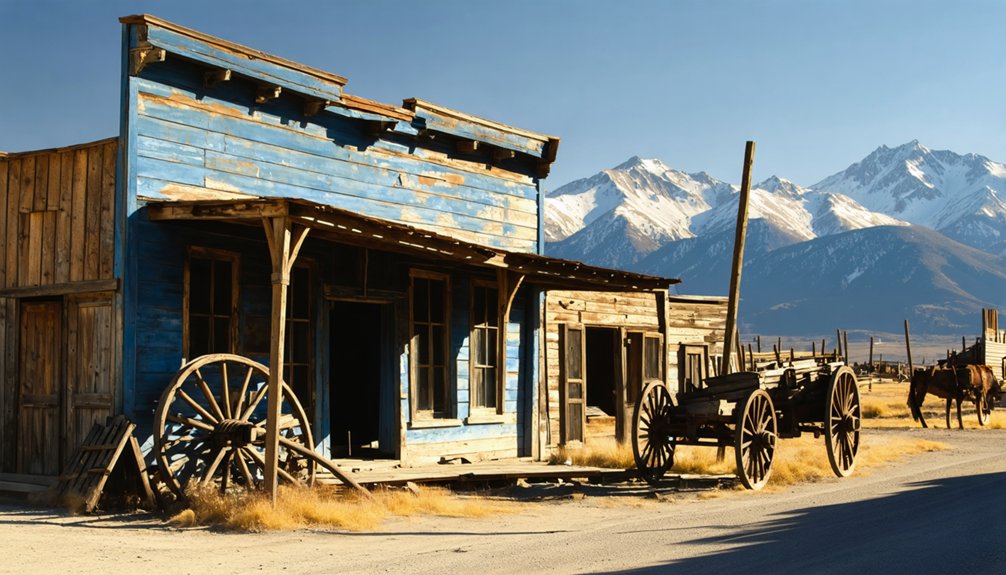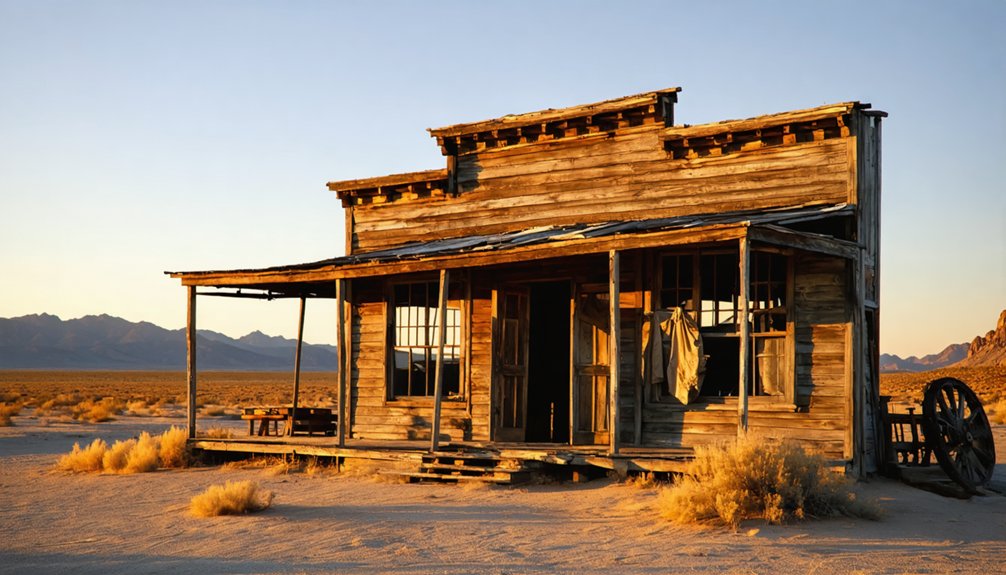
America’s most enchanting ghost towns include Bodie, California, with 170 buildings in “arrested decay”; Virginia City, Nevada, a silver rush metropolis with legendary saloons; Calico, California, a restored Mojave Desert mining town; St. Elmo, Colorado, with 43 original structures; and Terlingua, Texas, blending mercury mining history with chili culture. You’ll find authentic glimpses of gold rush violence, innovative mining techniques, and tales of paranormal encounters throughout these abandoned fragments of American frontier life.
Key Takeaways
- Bodie, California offers 170 authentic gold rush buildings in “arrested decay” and notorious history that earned the prayer “Goodbye God, I’m going to Bodie.”
- Virginia City, Nevada features preserved silver rush saloons like Bucket of Blood, mining heritage tours, and documented paranormal activity in historic buildings.
- Calico, California showcases meticulously restored 1880s desert architecture with Maggie’s Mine tour and iconic hillside letters from its $20 million silver boom.
- St. Elmo, Colorado maintains 43 original structures including an operational historic general store from its 2,000-resident gold rush heyday.
- Terlingua, Texas blends mercury mining history with chili culture, featuring an atmospheric historic cemetery and the famous Starlight Theatre.
Bodie, California: The Gold Rush Town Frozen in Time
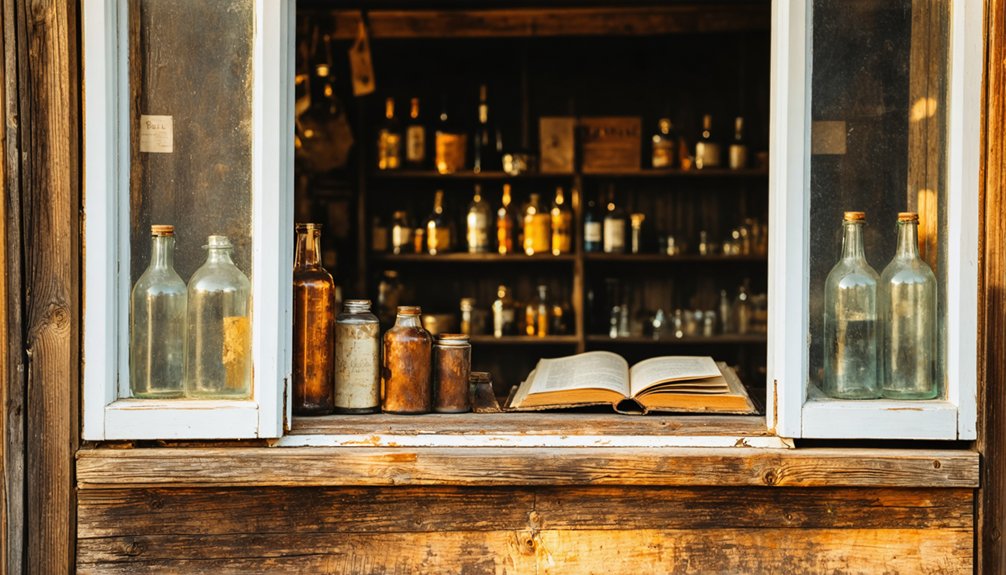
Nestled in the eastern foothills of the Sierra Nevada, Bodie stands as California’s most authentic gold rush ghost town, where time seemingly stopped in the late 19th century.
You’ll wander among 170 buildings in “arrested decay,” their weathered Bodie architecture telling stories of both prosperity and lawlessness.
Once home to 10,000 fortune-seekers after a massive gold mining discovery in 1876, the town generated over $70 million before being abandoned.
In Bodie’s heyday, thousands chased dreams of gold, creating extraordinary wealth before vanishing like the frontier itself.
Peer through windows to glimpse interiors with original furniture, cookware, and personal items left behind when residents fled to the next boomtown.
This official California gold rush ghost town earned its notorious reputation honestly—65 saloons, nightly violence, and a red-light district prompted one child’s famous prayer: “Goodbye God, I’m going to Bodie.”
The town featured a thriving community of Chinese immigrants who contributed to the economy through vegetable sales and laundry services.
For visitors who might confuse it with other locations, this Bodie is specifically a place name disambiguation from several other similarly named sites throughout America.
Virginia City, Nevada: America’s Silver Legacy Lives On
You’ll step back into America’s silver rush era when visiting Virginia City, where the once-booming metropolis of 25,000 has transformed into a preserved historical destination with fewer than 800 residents today.
The town’s legendary saloons, like the Bucket of Blood and Silver Queen, still stand with their original fixtures and reportedly ghostly inhabitants from the town’s wilder days.
Mining heritage tours of the Chollar Mine showcase the innovative square-set timbering techniques that made the Comstock Lode’s $400 million silver extraction possible, connecting you directly to the wealth that helped finance the Civil War and build San Francisco. The extraordinary success of the Consolidated Virginia Mine made John Mackay and his partners, collectively known as the Silver Kings, incredibly wealthy during the height of production. Visitors can explore the free museum in the old courthouse building, which houses exhibits of early mining equipment and photographs documenting the town’s rich history.
From Boom to Tourism
Once America’s premier silver mining boomtown, Virginia City stands today as a monument to the economic transformation that has kept many ghost towns from disappearing completely.
When the mines that produced over $400 million in precious metals finally closed in 1942, the town’s population plummeted to just 500 residents.
You’ll witness a perfect example of ghost town evolution as you explore this National Historic Landmark District.
Virginia City reinvented itself through tourism impact, preserving its frontier atmosphere and historic buildings while inviting you to experience its rich past.
Visit museums, take guided mine tours, and participate in lively reenactments.
Annual festivals celebrate the silver mining heritage that once made this small mountain town “the richest place on earth.”
The city’s multiethnic history is displayed through preserved cultural sites, reflecting a diverse population that once included significant Irish, German, Black, Chinese, and Native American communities.
The town’s historical significance is deeply rooted in the Comstock Lode, which was the first important silver-mining district in the United States and sparked silver prospecting throughout the Great Basin.
Haunted Saloons Remain
Virginia City’s haunted saloons stand as spectral monuments to the town’s wild past, where spirits of another kind now attract ghost hunters and curious tourists alike.
You’ll find the Old Washoe Club—dubbed “ground zero” for paranormal enthusiasts—where a glowing human-shaped figure appears in photographs on the main staircase. The spiral staircase itself made Ripley’s Believe It Or Not as the longest without supporting poles. The Old Washoe Club is also reportedly haunted by the ghost of Lena, a murdered call girl, whose presence is often felt in the upper floors. The club’s paranormal activities have been featured on popular television shows including Travel Channel’s Ghost Adventures and A&E’s Ghost Hunters.
At the Delta Saloon, established in 1876, listen for muffled cries from upper levels and witness the infamous “suicide table” that reportedly caused multiple owners’ deaths.
The Longbranch Saloon features a young girl’s ghost whose doll mysteriously returns to its original clothing overnight.
These haunted establishments, once frequented by Mark Twain and Ulysses S. Grant, now showcase documented ghostly encounters through guided tours and paranormal evidence displays.
Mining Heritage Preserved
Standing as America’s most significant silver discovery, the Comstock Lode transformed Virginia City into a symbol of mining innovation that you can still explore today.
When you walk these historic streets, you’re treading where revolutionary mining technology once extracted over seven million tons of silver ore worth more than $600 million.
The economic impact was staggering—Virginia City became America’s richest city during the 1870s, with mines like Con Virginia producing $3 million monthly. Nicknamed The Richest Place on Earth, this boomtown supported the Northern cause during the Civil War with its precious metals production.
You’ll marvel at the engineering ingenuity of German-designed square-set timbering that made deep extraction possible.
Though population dwindled from 25,000 to just hundreds after the boom, Virginia City’s mining heritage lives on through preserved mills, tunnels, and the V&T Railroad—offering you a glimpse into the freedom and fortune that defined America’s silver rush.
Calico, California: A Desert Mining Town Brought Back to Life
Rising from the multicolored hills of the Mojave Desert, Calico stands as one of America’s most meticulously restored ghost towns, offering visitors a glimpse into California’s silver mining past.
Once home to 3,500 fortune-seekers who extracted over $20 million in silver ore, Calico’s history captures the boom-and-bust cycle that defined the American West. The town’s population declined rapidly in the mid-1890s when silver lost value, causing mines to close and residents to seek opportunities elsewhere.
When you visit, you’ll experience:
- Walter Knott’s meticulous 1950s restoration that preserved Calico’s 1880s architecture
- Maggie’s Mine, where you can walk through an authentic silver mine
- The iconic “CALICO” letters adorning the mountainside
- Boot Hill Cemetery, where miners’ tales echo through time
Now a Regional Park designated as California’s official Silver Rush Ghost Town, Calico invites you to wander freely through the desert time capsule.
St. Elmo, Colorado: Rocky Mountain Time Capsule
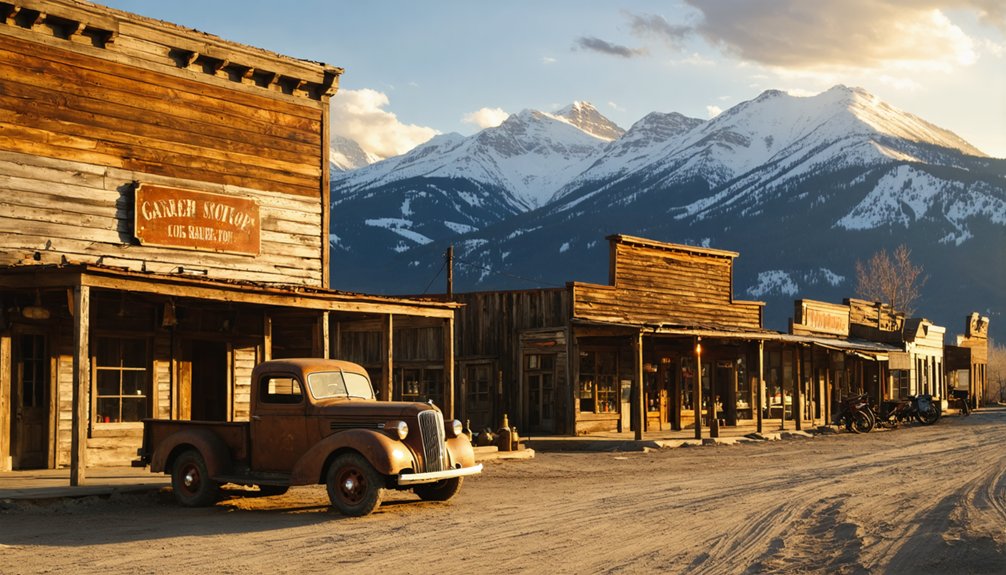
When you visit St. Elmo, you’ll walk through a remarkably intact mining town where more than 2,000 people once sought their fortunes in the gold-rich Sawatch Range.
The town’s preserved buildings—including hotels, saloons, and the general store—offer a genuine glimpse into 1880s Rocky Mountain life that few ghost towns can match.
Listen for whispers of Annabelle “Dirty Annie” Stark, whose protective spirit is said to still watch over the historic structures she helped save from destruction.
Preserved Miners’ Paradise
High among the Sawatch Mountains at nearly 10,000 feet, St. Elmo stands as one of America’s best-preserved ghost towns, where mining culture remains frozen in time.
Unlike many abandoned settlements, you’ll find 43 original structures still intact, offering an authentic glimpse into 1880s boomtown life.
The town’s remarkable ghost town preservation is largely thanks to the dedicated Stark family, who remained as guardians long after others departed when the railroad ceased operations in 1922.
During your visit, you’ll experience:
- A genuine main street lined with Victorian-era buildings
- The historic general store still open for business
- Opportunities for ATV trails through the surrounding mining district
- Tales of Annabelle Stark’s spectral presence that still haunts the town
Annabelle’s Haunting Legacy
The legend of Annabelle Stark forms the ghostly backbone of St. Elmo. As you wander the preserved streets, you’re treading through Annabelle’s legacy – the shotgun-toting woman known as “Dirty Annie” who protected this mining town long after its prosperity faded.
When the town’s population dwindled to just seven souls in 1930, Annabelle’s grip on reality loosened, but her determination never wavered. The Stark family’s preservation efforts saved St. Elmo from disappearing entirely.
Today, you might experience Annabelle’s continuing vigilance through spectral encounters – sudden temperature drops, slamming doors, or an eerie presence watching from empty windows.
As Colorado’s most haunted ghost town, St. Elmo offers more than historic buildings; it’s a chance to connect with the fierce independence that defined frontier life.
Terlingua, Texas: Where Desert Spirits and Chili Reign
Nestled along the Texas-Mexico border, Terlingua stands as one of America’s most atmospheric ghost towns, where mercury mining history meets modern chili culture in the dramatic Chihuahuan Desert landscape.
Where desert winds carry whispers of miners past and the spirited aroma of championship chili.
You’ll walk among the remnants of a once-thriving mining community that flourished until 1945 when cinnabar extraction ceased. The desert has slowly reclaimed buildings while preserving their stories, creating a hauntingly beautiful tableau against rugged desert landscapes.
Four must-see attractions in Terlingua:
- The historic cemetery, listed on the National Register of Historic Places
- Perry Mansion ruins, once home to the mining magnate
- Starlight Theatre, transformed from cinema to restaurant
- The famous chili cook-off grounds, birthplace of America’s competitive chili history
Abandoned for decades, Terlingua’s rebirth through tourism proves freedom sometimes means embracing both past and future.
Cahawba, Alabama: The Sunken Southern Capital
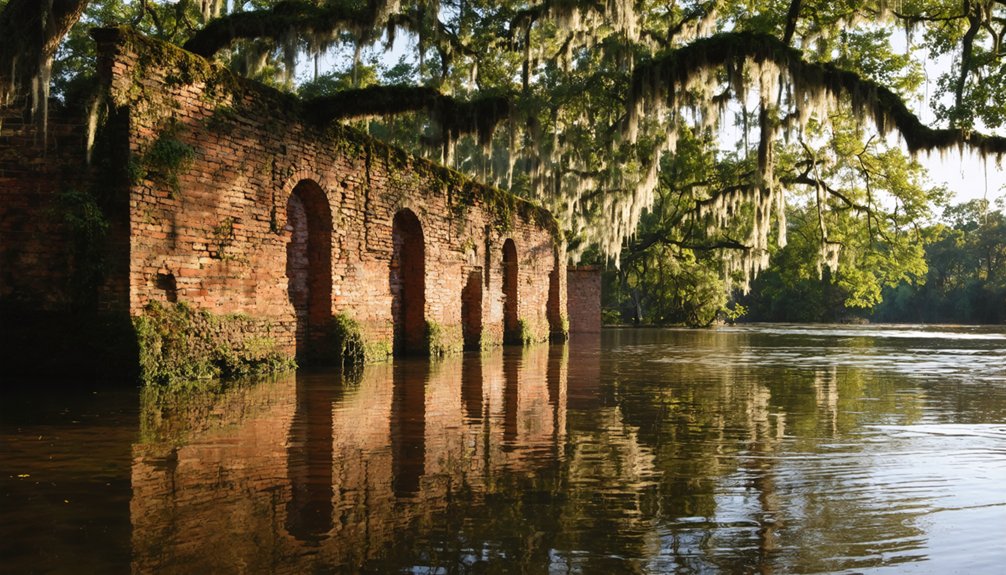
Beneath Alabama’s fertile soil lies a forgotten capital with a dramatic past—Cahawba, where you’ll discover the haunting remains of a once-prosperous city reclaimed by rivers and time.
This archaeological park preserves America’s most intact ghost town, where Cahawba history unfolds among crumbling foundations and moss-draped oak trees.
As you explore the grid-pattern streets, imagine the bustling metropolis that served as Alabama’s first capital before flooding, disease, and war sealed its fate.
Fragments of Southern architecture reveal the town’s former glory—from the brick capitol building to the elegant Crocheron mansion columns where Confederate generals once negotiated.
Don’t miss Castle Morgan, where 3,000 Union soldiers endured horrific conditions during the Civil War.
Cahawba’s silent streets now whisper stories of ambition, prosperity, and inevitable decline.
What Makes a Ghost Town Worth Visiting?
While Cahawba’s haunting ruins tell one compelling story of America’s past, not all abandoned settlements offer equally rewarding experiences for history-hungry travelers.
When evaluating ghost towns worth your time, look for places that balance historical authenticity with accessible experiences.
The most memorable ghost towns typically offer:
- Well-preserved original structures that maintain their historical integrity, like Bodie’s 100+ unrestored buildings
- Knowledgeable guided tours that bring stories to life, such as Empire Mine’s underground tunnel explorations
- Interactive experiences that connect you to the past, from gold panning to walking through miners’ quarters
- Regular cultural events that celebrate the town’s unique heritage and significance
These elements transform a simple visit into a journey through time, where you’ll experience the raw, unfiltered realities of America’s frontier spirit.
Planning Your Ghost Town Road Trip Adventure

As you chart your course through America’s forgotten landscapes, planning a ghost town road trip requires more finesse than your average vacation itinerary. Maximize efficiency by clustering destinations—pair Bodie with Yosemite or Terlingua with Big Bend National Park to optimize driving time.
Ghost town logistics demand careful consideration of seasonal accessibility, with places like Bannack offering limited winter access. Your vehicle choice matters tremendously; opt for one that handles unpaved roads and prepare for areas without cell service by downloading offline maps.
Safety should never be an afterthought. Pack emergency supplies, water, and weather-appropriate clothing when venturing into remote locations like St. Elmo or the Nevada desert.
Always share your itinerary with someone and consider guided tours where available—they’ll enrich your experience while traversing the unique challenges these haunting destinations present.
Paranormal Experiences: Legends and Hauntings
Venturing into America’s ghost towns offers more than just a glimpse into forgotten history—many visitors report encounters with the supernatural that defy rational explanation.
These abandoned settlements carry haunted histories that seem to manifest through spectral sightings across the country.
- Nevada’s mining towns like Virginia City and Goldfield feature apparitions in period clothing and phantom miners still laboring in the darkness.
- California’s Bodie is notorious for its “Bodie Curse,” where visitors who remove artifacts report misfortune until items are returned.
- Montana’s Bannack echoes with phantom gunshots from its violent vigilante past.
- Alaska’s remote ghost towns like Kennicott harbor tales of miners who perished in accidents, with visitors reporting cold spots and shadowy figures.
You’ll find these supernatural elements add a thrilling dimension to your ghost town explorations.
Photography Tips for Capturing Abandoned Americana

When you’re photographing ghost towns, you’ll need to master lighting techniques that reveal texture in weathered wood and rusted metal against the backdrop of America’s forgotten past.
Frame your shots to tell stories through architectural details like broken windows, collapsing roofs, and nature’s slow reclamation of human structures.
Consider how changing seasons transform these abandoned places—spring wildflowers contrast with decay, summer’s harsh light accentuates textures, fall colors complement faded paint, while winter snow creates hauntingly beautiful minimalist scenes.
Lighting the Past
Capturing the ethereal beauty of America’s ghost towns requires mastery of light and shadow, transforming dilapidated structures into hauntingly beautiful images.
When you’re exploring these forgotten places, understanding lighting techniques is essential for capturing ambiance that tells their stories authentically.
For the most evocative photographs:
- Use long exposures at dusk or dawn when natural light casts dramatic shadows across weathered surfaces.
- Try light painting with a flashlight to highlight specific architectural details while keeping the moody atmosphere.
- Experiment with multiple angles—low perspectives can make buildings appear more imposing against star-filled skies.
- Combine natural and artificial light sources to create contrast that emphasizes the tension between nature and human creation.
Always respect these spaces; they’re not just photo opportunities but fragments of American history waiting to be preserved through your lens.
Framing Forgotten Structures
The art of framing abandoned structures transforms ordinary ghost town photography into compelling visual narratives. Apply the rule of thirds to guide viewers through decay’s beauty, using window frames and doorways as natural reference points.
Position yourself in corners with foreground objects to establish compositional stability, while utilizing leading lines from staircases and corridors to draw attention deeper into forgotten spaces. These framing techniques create visual pathways that tell stories of America’s abandoned past.
Experiment with both vertical and horizontal orientations to dramatically alter perception of structural deterioration. For maximum impact, try unconventional angles—shoot upward from low positions to emphasize vastness or capture angled perspectives that heighten the disorienting atmosphere of abandonment.
The compositional elements you choose will determine whether viewers merely see ruins or experience the emotional resonance of America’s ghost towns.
Seasonal Shooting Strategies
As seasons dramatically transform America’s ghost towns, each offers distinct photographic opportunities that can elevate your abandoned Americana portfolio.
Embrace seasonal variations by shooting spring and fall’s soft, diffused light to highlight weathered textures, or capture winter’s snow as a natural reflector that softens shadows on decaying structures.
- Golden hour stretches longer in spring and fall, giving you extra time to capture warm, directional light on historic facades.
- Weather effects like fog and rain add mystery and reflective elements to your compositions.
- Time your visit to avoid harsh midday sun—early morning provides serene scenes with fewer tourists.
- Pack season-appropriate gear—extra batteries for winter and neutral density filters for summer’s bright light.
Your camera can reveal the haunting beauty of these places through thoughtful photographic techniques in any season.
Frequently Asked Questions
Are Children Allowed to Explore Ghost Towns Safely?
Yes, you can explore ghost towns safely with your children when you follow proper ghost town safety guidelines, choose child friendly activities, and maintain close supervision at all times.
What Is the Best Time of Year to Visit These Sites?
Imagine walking through Bodie alone at sunset! You’ll find late spring to early fall offers the best seasonal weather, while shoulder seasons (May, September) deliver fewer tourist crowds and comfortable exploration temperatures.
Can I Bring My Dog to These Ghost Town Locations?
Yes, you can bring your dog to all these ghost towns! They’re dog-friendly in outdoor areas with strict leash requirements (generally 6-feet). Remember, indoor buildings remain off-limits to your four-legged explorer.
How Accessible Are These Towns for Visitors With Mobility Limitations?
Ah, the Wild West—where wheelchairs meet their match! You’ll face significant challenges at most ghost towns with limited wheelchair access. Transportation options are scarce, with unpaved roads and rugged terrain being the norm.
However, that doesn’t mean you can’t enjoy the adventure of ghost towns to explore in California. Some sites may offer adapted paths that allow for leisurely exploration, while stunning desert landscapes provide a gorgeous backdrop. With a bit of planning, you can uncover the rich history and unique stories of these abandoned places.
Do Any Ghost Towns Offer Overnight Accommodation Within Historic Buildings?
Yes, you’ll find historic lodging in Virginia City and Gold Point, Nevada. Both offer unique experiences where you’ll sleep in authentic buildings while Gold Point’s rustic exteriors hide luxurious interiors.
References
- https://www.christywanders.com/2024/08/top-ghost-towns-for-history-buffs.html
- https://places.travel/culture-history/ghosts-welcome-8-american-ghost-towns-where-tourists-can-mingle-with-the-macabre/
- https://www.visittheusa.com/experience/5-us-ghost-towns-you-must-see
- https://nightofthejack.com/2025/01/23/top-creepy-ghost-towns-in-america/
- https://www.realgirlreview.com/dark-tourism-in-america/
- https://www.tripadvisor.com/Attractions-g191-Activities-c47-t14-United_States.html
- https://thelittlehouseofhorrors.com/bodie-the-cursed-ghost-town/
- https://en.wikipedia.org/wiki/Bodie
- https://www.youtube.com/watch?v=2Foz-2R_mH8
- https://www.mammothres.com/blog/best-mammoth/spooky-story-bodie-ghost-town