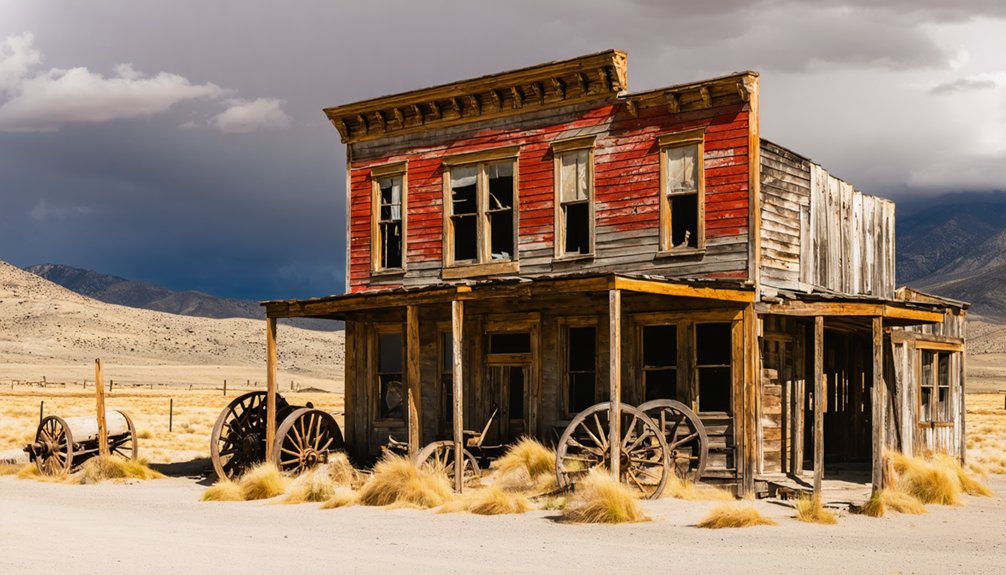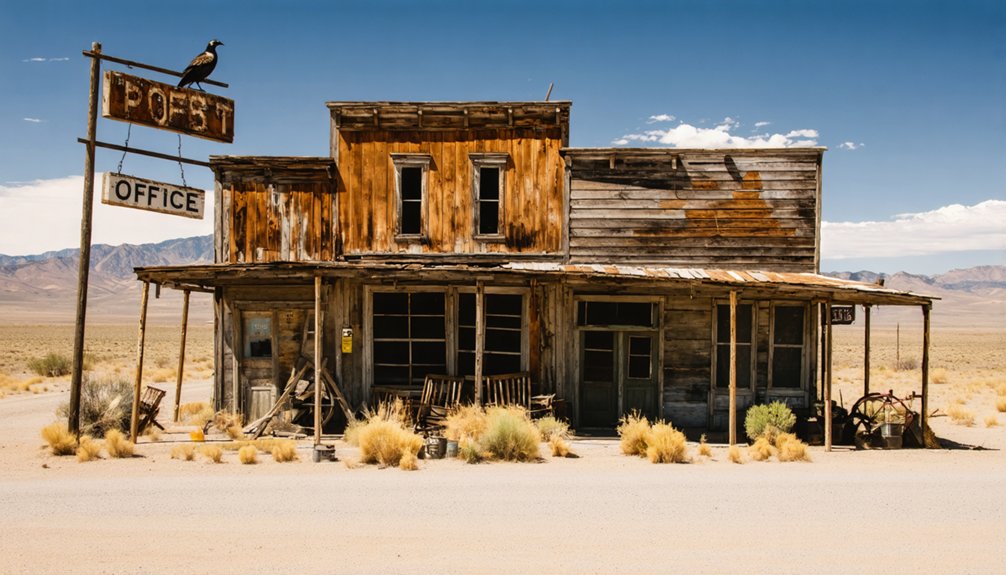
America’s most fascinating ghost towns include Bodie, California with its 170 preserved structures, Virginia City’s silver-rich Comstock Lode legacy, and Centralia, Pennsylvania’s ongoing underground fire. You’ll encounter St. Elmo’s well-preserved mining heritage, Rhyolite’s dramatic boom-bust cycle, and Kennecott’s remote Alaskan copper operations. These abandoned settlements offer powerful glimpses into America’s frontier ambition, industrial rise, and eventual decline. Their weathered buildings and empty streets tell stories you can almost hear on the wind.
Key Takeaways
- Bodie, California preserves 170 original structures in “arrested decay” and was once home to 10,000 residents during the gold rush.
- Virginia City, Nevada extracted over $300 million in precious metals and was known as the “Richest Place on Earth” in the 1870s.
- Centralia, Pennsylvania has been burning underground since 1962, with roads cracking and only six residents remaining today.
- St. Elmo, Colorado features remarkably intact historic buildings from 1880-1920 and offers adventure tourism opportunities on former mining roads.
- Rhyolite, Nevada exemplifies one of the most dramatic boom-and-bust cycles in American mining history, rising and falling within just a few years.
Bodie, California: The Gold Rush Town Frozen in Time
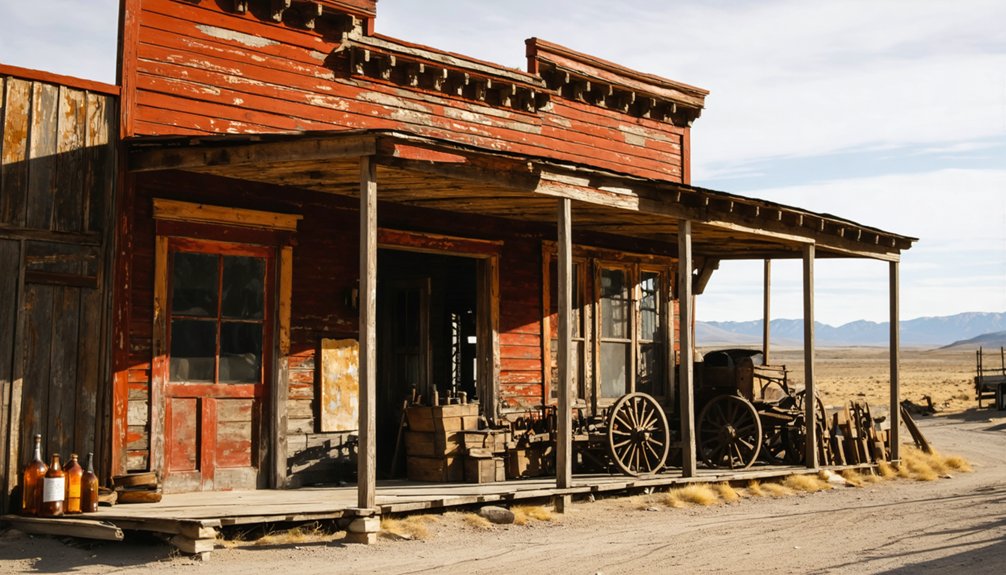
A fortune-seeking prospector named William S. Bodey discovered gold in this desolate region in 1859, unknowingly setting the stage for one of America’s most authentic ghost towns.
After rich ore discoveries in the mid-1870s, Bodie exploded from humble mining camp to a booming metropolis of nearly 10,000 souls by 1880.
You’ll find Bodie architecture remarkably preserved in a state of “arrested decay”—about 170 original structures still stand with interiors intact, offering an unfiltered glimpse into 19th-century mining life.
Bodie history reflects the quintessential Wild West narrative: saloons numbered 65, violence was commonplace, and the phrase “bad man from Bodie” entered the lexicon.
Tragically, Bodey himself never witnessed the town’s prosperity as he perished in a winter blizzard in 1866, with his remains discovered the following spring.
Now a National Historic Landmark since 1961, this frozen-in-time relic allows you to walk freely among the authentic remnants of America’s gold-fueled past. Visitors should note that Bodie is one of many places requiring disambiguation efforts due to its multiple historical references and namesakes.
Virginia City, Nevada: Silver Boom Legacy on the Comstock Lode
You’ll discover that Virginia City once reigned as a formidable industrial powerhouse, with its 25,000 residents extracting over $300 million in silver and gold from the legendary Comstock Lode.
The town’s remarkable infrastructure included the engineering marvel of the Virginia and Truckee Railroad, six-story hotels with elevators, and advanced water systems that demonstrated technological innovation unparalleled in the American West. The town was initially named after miner James “Old Virginny” Finney, before evolving into the metropolis that rivaled San Francisco. Despite its prosperity, Virginia City suffered a devastating blow when the Great Fire of 1875 destroyed much of the town, leaving 8,000 people homeless.
Today, much of Virginia City’s Victorian architecture endures as a reflection of the rapid wealth accumulation that transformed a mining camp into what many called the “Richest Place on Earth” during the 1870s.
Industrial Powerhouse Era
When the Comstock Lode was discovered in 1859, Virginia City, Nevada rapidly transformed from an obscure settlement into an industrial powerhouse that would reshape America’s economic landscape.
You’d have witnessed remarkable industrial innovation as mining operations excavated over seven million tons of silver ore, requiring advanced engineering to overcome unstable underground conditions.
The city’s population surged to 25,000 as urban transformation created a thriving metropolis with extensive water infrastructure and milling operations.
Massive operations like the “Big Bonanza” mine fueled not just Virginia City but financed the Union during the Civil War and developed San Francisco as a financial center.
This silver wealth directly led to Nevada’s statehood in 1864.
The city earned Nevada its famous nickname as the “Silver State” due to its unprecedented mineral production that dominated the national economy.
The Virginia and Truckee Railroad played a vital role in the city’s prosperity by facilitating the efficient transportation system needed for mining operations.
Though technical challenges eventually overwhelmed profitability by the late 1870s, Virginia City’s brief but intense industrial heyday forever altered western development.
Preserved Victorian Splendor
Unlike many abandoned mining settlements that fell into complete disrepair, Virginia City stands today as an exceptional representation of preserved Victorian splendor, having maintained much of its 19th-century architectural character through deliberate conservation efforts.
When you visit, you’ll witness hundreds of Victorian-era buildings that survived five devastating fires, including the 1875 blaze that destroyed 75% of the town. The National Park Service recognizes this historical preservation marvel as one of America’s largest historical landmarks.
The brick structures, once housing the International Hotel with the West’s first elevator, reflect the opulence of a boomtown that rivaled San Francisco. The town flourished due to the extraordinary wealth extracted from the Comstock Lode deposits that formed along fault fissures under Mount Davidson’s eastern slope. St. Mary’s Art Center exemplifies this Victorian architecture, originally built as a hospital with modern amenities in 1876, now part of Virginia City’s carefully protected heritage landscape.
Centralia, Pennsylvania: The Town That’s Still on Fire
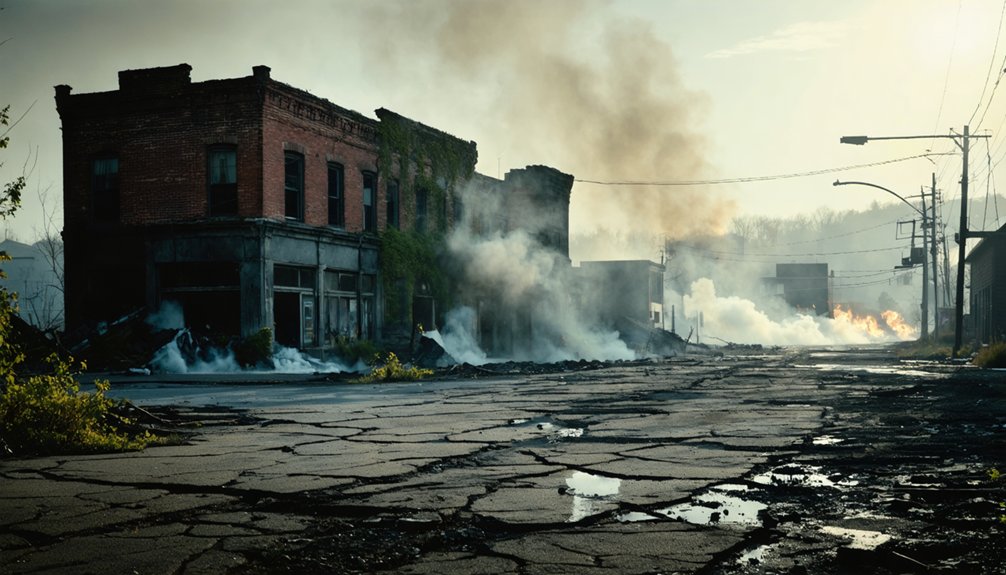
In the heart of Pennsylvania’s coal country lies Centralia, a once-thriving mining town that has been steadily consumed by an underground inferno since 1962.
What began as improper trash disposal ignited coal seams below, creating a devastating Centralia fire that continues to burn beneath the earth to this day.
The environmental catastrophe forced a mass community displacement as toxic gases and dangerous sinkholes rendered the area uninhabitable. The fire requires three key elements – heat, fuel, and oxygen – to sustain its continuous combustion.
From a population of over 1,400, fewer than six residents remain today. The fire burns at depths of up to 300 feet deep and spans across 3,700 acres of land.
Once a vibrant community of 1,400 souls, Centralia stands nearly abandoned—a hollowed shell with fewer than six stubborn holdouts remaining.
Despite multiple containment efforts—including digging vents and injecting wet sand—the fire’s complexity defeated all attempts at extinguishment.
You’ll find this modern ghost town‘s roads cracked and buckling, with steam and sulfurous fumes still escaping from fissures in the earth—a haunting reminder of industrial negligence that will continue burning for centuries.
St. Elmo, Colorado: Rocky Mountain Mining Memories
You’ll discover St. Elmo’s remarkably intact structures standing as monuments to the boom-and-bust cycle that characterized Colorado’s mining era from 1880 to the 1920s.
While many ghost towns crumbled after abandonment, St. Elmo’s gradual evolution from mining hub to tourism destination has preserved its historic character, maintained by dedicated families like the Starks who stewarded the town until 1958. The town was once home to a thriving community with over 2,000 residents during its peak mining years.
The former mining roads and railroad grades now serve outdoor enthusiasts who can explore the alpine setting through hiking, off-road trails, and fishing opportunities in the surrounding Sawatch Range.
Well-Preserved Mountain Haven
Nestled high in Colorado’s Sawatch Range at nearly 10,000 feet elevation, St. Elmo stands as one of America’s best-preserved ghost towns.
You’ll find remarkable historic architecture intact—wooden storefronts, hotels, and cabins that withstood the passage of time since the 1880s. This mountain haven captures the essence of western mining heritage with structures that once housed 2,000 residents during its gold and silver boom.
Unlike many abandoned settlements, St. Elmo survived devastating fires and economic collapse to earn its place on the National Register of Historic Places.
Since 2002, preservation efforts have protected key buildings like the Town Hall.
Today, you can explore former mining roads repurposed as recreational trails, experiencing the freedom of the mountains while walking through living history that once generated millions in mineral wealth annually.
Life After Mining
As mining operations faltered in the early 1920s, St. Elmo’s economic heartbeat began to slow. The discontinuation of railroad service in 1922 and the Mary Murphy Mine’s closure in 1925 marked the definitive end of an era that had yielded 220,000 ounces of gold alongside silver, lead, and zinc.
You’ll find that attempts at economic revival occurred sporadically—with notable strikes in 1912-1913—but these temporary boosts couldn’t sustain the once-thriving community of 2,000.
Despite devastating fires and dwindling opportunities forcing most residents to seek livelihoods elsewhere, a remarkable community resilience emerged among those who stayed.
This persistence paid off when St. Elmo achieved National Historic District status in 1979, preserving its architectural legacy and transforming industrial decline into cultural significance that continues to captivate visitors today.
Adventure Tourism Hub
St. Elmo has transformed from a bustling mining settlement into Colorado’s premier adventure tourism destination. Once populated by over 2,000 residents during the 1890s mining boom, this remarkably preserved ghost town now offers you an authentic glimpse into the American frontier experience.
The economic pivot from extraction to exploration has revitalized this historic settlement through:
- Former mining roads converted into challenging off-road vehicle trails
- Access to pristine wilderness via the Grizzly Lake Trail and Chalk Creek
- Iron City Campground serving as a basepoint for fishing, camping, and ghost town exploration
Despite devastating fires in 1890, 1898, 1899, and 2002, preservation efforts have maintained St. Elmo’s cultural integrity.
The National Register listing and Buena Vista Heritage Museum’s stewardship guarantee this historical landscape remains accessible for generations seeking connection with Colorado’s mining legacy.
Rhyolite, Nevada: From Boom to Bust in Record Time
Founded in the waning months of 1904 following a fortuitous gold discovery by prospectors Frank “Shorty” Harris and Ernest “Ed” Cross, Rhyolite represents perhaps the most dramatic boom-and-bust cycle in American mining history.
Within three years, you could have witnessed Rhyolite’s economy flourish spectacularly, producing over $1 million in gold (roughly $27 million today) while supporting 3,500-5,000 residents.
Rhyolite’s architecture reflected unprecedented ambition—a three-story bank building, $130,000 train depot, and substantial mercantile establishments gave the settlement “city airs” rather than mining camp crudeness.
Blue Heron, Kentucky: The Coal Mining Camp That Refused to Be Forgotten
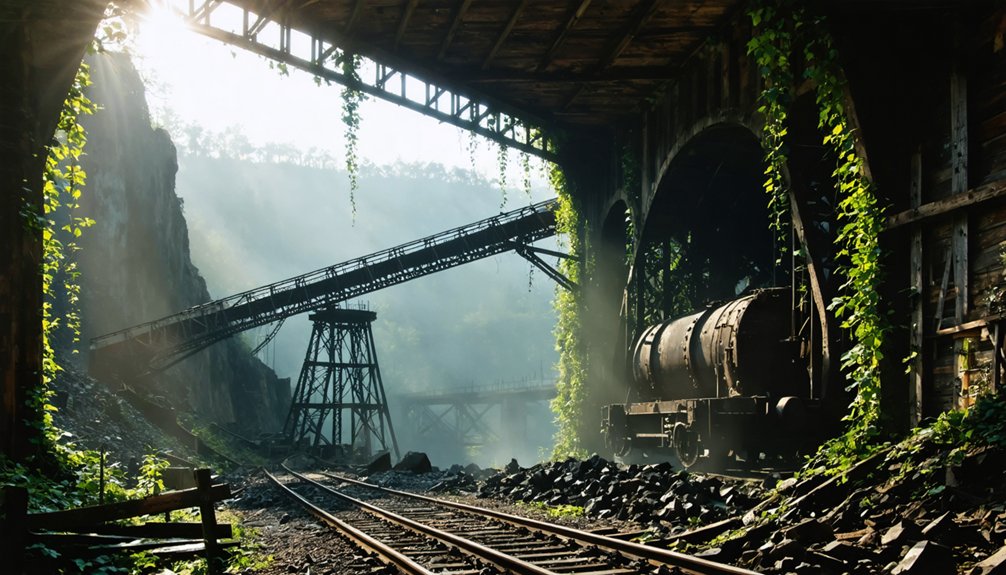
Unlike many ghost towns that arose from the gold and silver rushes, Blue Heron emerged in 1937 as a coal mining settlement known as Mine 18 along the banks of Kentucky’s Big South Fork River.
Owned by the Stearns Coal & Lumber Company, this transitory community operated until 1962 when profitability waned and the ephemeral nature of extractive settlements claimed another victim.
Today, you’ll find:
- Metal-framed ghost structures that replicate the original buildings
- Audio stations featuring oral histories from former miners
- A preserved coal tipple illustrating the industrial heritage
What distinguishes Blue Heron from other abandoned settlements is its deliberate preservation as an outdoor museum.
Rather than crumbling into obscurity, the National Park Service transformed the site into an interpretive center where the skeletal frameworks of buildings stand as monuments to the mobile, company-controlled lifestyle that defined Appalachian coal communities.
Calico, California: The Silver Rush Survivor in the Mojave Desert
When you explore Calico’s silver boom history, you’re witnessing the economic force that transformed a colorful mountainside into a bustling town of 4,000 residents and over 500 mines that produced the equivalent of half a billion dollars in today’s currency.
Walter Knott’s meticulous restoration efforts in the 1950s preserved this slice of Wild West heritage, recreating the 1880s atmosphere through careful architectural reconstruction that later became California’s official Silver Rush Ghost Town.
Today’s Calico stands as a reminder of America’s boom-and-bust resource economies while offering modern visitors a tangible connection to 19th-century mining life through its preserved buildings, mine tours, and cultural events that animate its storied past.
Mojave’s Silver Legacy
Rising from the rugged terrain of the Mojave Desert, Calico stands as one of America’s most remarkably preserved silver boom towns, its legacy beginning on April 6, 1881, when three prospectors discovered substantial silver deposits on Calico Mountain.
This mining heritage transformed the landscape as over 500 mines operated during Calico’s 1883-1885 heyday, yielding more than $20 million in silver ore.
You’ll find Calico’s story etched in time through:
- A once-thriving community of 1,200 residents with schools, telegraph, and Wells Fargo services
- Walter Knott’s 1951 preservation efforts, reconstructing the desert ghost town from historical photographs
- Its 2005 designation as California’s official silver rush ghost town by Governor Schwarzenegger
The Silver Purchase Act of 1896 collapsed Calico’s economy, but its cultural significance endures as a testimony to America’s resource-driven expansion.
Wild West Preservation
Calico’s remarkable survival represents more than just abandoned buildings in the desert—it embodies America’s most successful ghost town preservation effort.
When Walter Knott purchased this abandoned silver boomtown in 1951, he pioneered wild west historic preservation by meticulously rebuilding structures on original foundations using authentic materials, including salvaged Arizona hotel lumber.
Unlike many deteriorating ghost towns, Calico secured its future when Knott donated it to San Bernardino County in 1966.
Today, volunteer groups combat decay through specialized restoration, applying linseed oil to wooden structures and rescuing original artifacts—each wagon restoration costing up to $10,000.
California officially recognized these efforts in 2005 when Governor Schwarzenegger proclaimed Calico the state’s Silver Rush Ghost Town.
As you walk through Calico’s preserved streets, you’re experiencing America’s commitment to protecting its frontier heritage.
Kennecott, Alaska: The Copper Kingdom at the Edge of Wilderness
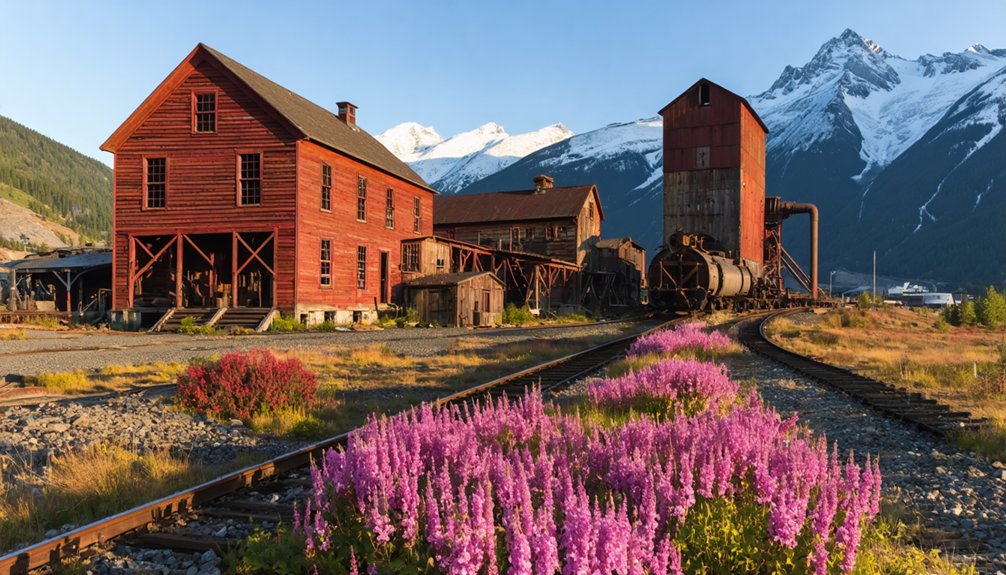
Nestled at the foot of the Wrangell Mountains, Kennecott stands as a tribute to America’s industrial ambition during the early 20th century. This copper mining ghost town emerged after a remarkable 1900 discovery of ore deposits containing up to 70% pure chalcocite—an unprecedented find that sparked a rapid transformation of this wilderness outpost.
You’ll discover three defining aspects of Kennecott’s fascinating history:
- A company town where workers earned premium wages while laboring under harsh conditions seven days weekly.
- A strictly regulated settlement that prohibited alcohol, pushing such vices to nearby McCarthy.
- A meticulously engineered marvel connected to civilization by a railroad built through impossible terrain.
When the rich veins depleted by 1938, residents departed swiftly, leaving behind a perfectly preserved tableau of American industrial might now protected as a National Historic Landmark.
Thurmond, West Virginia: The Railroad Ghost Town in Appalachia
While Alaska’s Kennecott represented industrial ambition in America’s far north, the story of Thurmond unfolds in the rugged Appalachian highlands of West Virginia. Founded in 1900 by a Confederate captain, this town transformed from a single house into the C&O Railway’s most profitable railroad hub by 1910.
You’d scarcely believe that this narrow strip between river and mountains once handled 15 passenger trains daily and generated more revenue than any other station on the line. Banks flourished with coal money, while hotels and saloons serviced constant rail traffic.
Thurmond’s freedom from road access until 1921 preserved its unique character, but ultimately sealed its fate. The 1950s shift from steam to diesel locomotives triggered unstoppable economic decline, leaving behind a hauntingly preserved relic of Appalachia’s industrial past.
Terlingua, Texas: The Mercury Mining Settlement of the Chihuahuan Desert

From the harsh landscape of the Chihuahuan Desert emerged Terlingua, a proof of humanity’s relentless pursuit of valuable resources in even the most inhospitable environments.
The cinnabar discovery in the mid-1880s transformed this remote outpost into a thriving mercury mining community that flourished under the distant ownership of Howard Perry.
You’ll find Terlingua’s mining heritage preserved in three distinct ways:
- The hauntingly beautiful cemetery, where miners’ graves tell silent stories of industrial sacrifice
- The ruins of St. Agnes Church, where community once gathered, now reclaimed by desert
- The repurposed company store, embodying economic transformation from extraction to tourism
Though abandoned after World War II’s mercury market collapse, Terlingua refused extinction.
Today’s revival through tourism and the famous chili cook-off demonstrates this ghost town’s remarkable resilience.
Frequently Asked Questions
Are Ghost Towns Legally Accessible for Overnight Camping?
With 80% of ghost towns on public lands, you’ll need camping permits based on the agency’s ghost town regulations—BLM and USFS typically allow 14-day stays while private properties require owner permission.
What Safety Precautions Should Visitors Take When Exploring Ghost Towns?
When exploring ghost towns, you’ll need safety gear including sturdy boots, respirators, and headlamps. Always remain vigilant for wildlife encounters, structural hazards, and inform others of your whereabouts before venturing into these historic frontiers.
Do Any Ghost Towns Offer Wi-Fi or Cellular Service?
Yes, some ghost towns offer limited technology access. You’ll find Wi-Fi in Cerro Gordo, California, while towns within radio quiet zones and remote locations like Garnet remain intentionally disconnected, preserving authentic ghost town amenities.
Can Visitors Collect Artifacts or Souvenirs From Ghost Towns?
No, you can’t legally collect artifacts from ghost towns. Strict ghost town regulations protect these historical sites, and violating artifact preservation laws carries serious penalties including fines and potential imprisonment.
Are There Specific Seasons When Ghost Towns Are Closed?
Yes, many ghost towns close seasonally. Weather considerations affect accessibility—mountain towns often close in winter due to snow, while desert locations may restrict summer visits during dangerous heat waves.
References
- https://www.christywanders.com/2024/08/top-ghost-towns-for-history-buffs.html
- https://whakestudios.com/us-ghost-towns/
- https://www.youtube.com/watch?v=4DSrGFx_vG4
- https://www.worldatlas.com/cities/10-famous-ghost-towns-of-america.html
- https://www.lonelyplanet.com/articles/coolest-ghost-towns-us
- https://www.geotab.com/ghost-towns/
- https://en.wikipedia.org/wiki/Lists_of_ghost_towns_in_the_United_States
- https://joybird.com/blog/top-ghost-towns-in-america/
- https://en.wikipedia.org/wiki/Bodie
- https://www.exploratography.com/blog-cal/dxan8zo55mm3dq325qd8yhi7s0e0qi