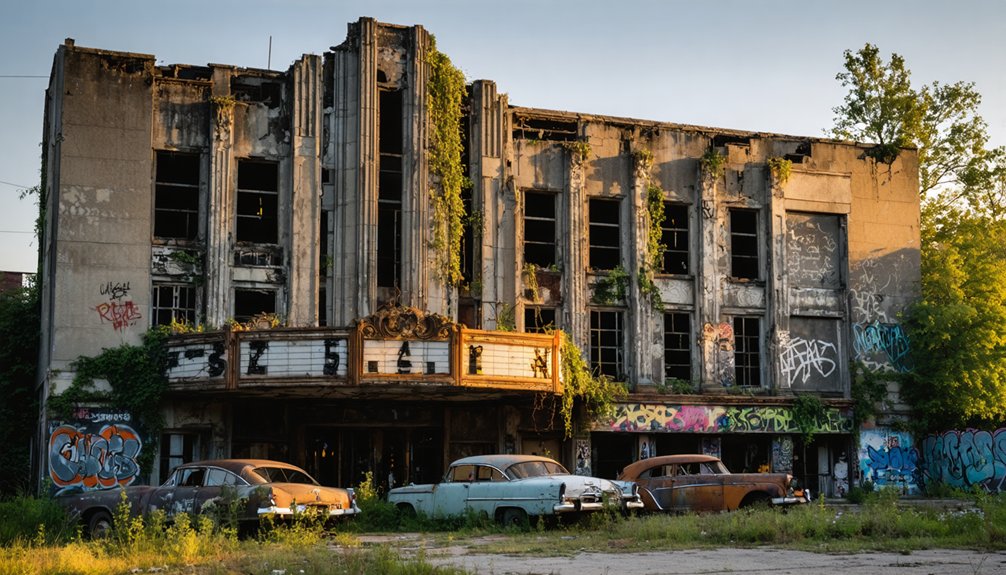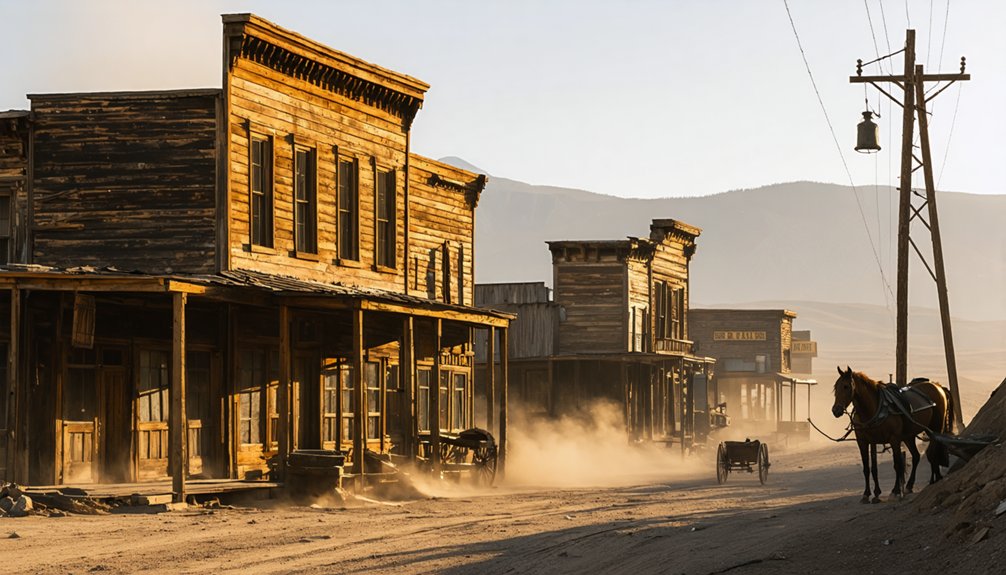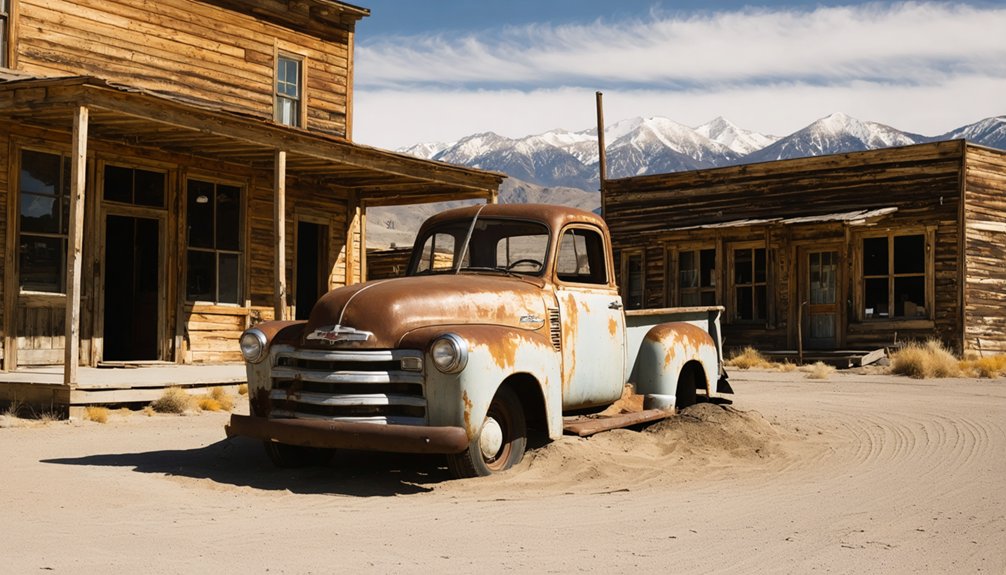
America’s best-preserved ghost towns include Bodie, California (with 110-170 original structures in “arrested decay”), St. Elmo, Colorado (featuring 43 Victorian buildings at high elevation), Batsto Village, New Jersey (40+ Revolutionary-era structures), Virginia City, Nevada (opulent architecture from the Comstock Lode era), and Bannack, Montana (60 pioneer buildings). You’ll find these time capsules maintain authentic atmospheres through careful preservation strategies, from “arrested decay” to active historical designation. Their silent streets tell compelling stories of boom-and-bust America.
Key Takeaways
- Bodie, California maintains 110-170 original structures in “arrested decay” and attracts 200,000 visitors seeking its haunting, preserved streets annually.
- Virginia City, Nevada features over 100 historic buildings from the Comstock Lode era, including Victorian architecture and underground mine tours.
- St. Elmo, Colorado preserves 43 original Victorian structures at high elevation, protected by the harsh mountain climate’s natural preservative qualities.
- Centralia, Pennsylvania was abandoned due to an underground coal fire burning since 1962, creating a toxic landscape with visible ground vents.
- Batsto Village, New Jersey showcases over 40 meticulously preserved structures from its 1766 founding as an ironworks supporting the Continental Army.
Bodie, California: The Golden Ghost Frozen in Time
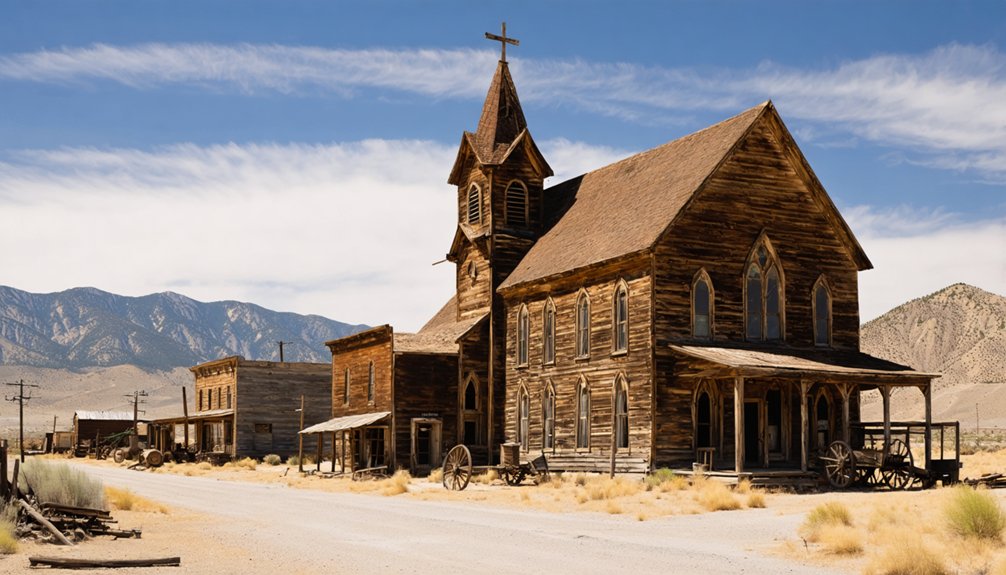
The discovery of gold in 1859 by William Bodey and his companions sparked what would become one of America’s most perfectly preserved ghost towns.
Though Bodey died in a blizzard returning from a supply run, his misspelled name lives on through Bodie’s legacy.
William Bodey never saw his namesake town flourish, yet his legacy endures through a spelling error that history refused to correct.
You’ll witness a town frozen in arrested decay, where 110-170 original structures remain stocked with period items. This site now serves as a disambiguation reference for various locations sharing the Bodie name.
What began as a small camp exploded after an 1876 gold strike, eventually generating $70 million from mining operations. The town demonstrated remarkable technological progress with an advanced hydro-electric center built in 1893.
At its peak, 10,000 residents navigated Bodie’s 65 saloons and notorious red-light district.
When exploring America’s ghost towns, nothing compares to Bodie’s authenticity.
The town that once prompted children to write “Goodbye God, I’m going to Bodie” now welcomes 200,000 visitors annually seeking freedom among its haunting, preserved streets.
Haunting Beauty of St. Elmo: Colorado’s Mountain Time Capsule
You’ll find St. Elmo’s meteoric rise directly linked to the Denver South Park & Pacific Railroad, which transported ore from its 150 mine claims before abandoning service in 1922.
The town’s 9,961-foot elevation and harsh mountain winters have inadvertently preserved 43 original Victorian-era structures, creating an authentic time capsule effect unlike lower-elevation ghost towns.
Local preservation efforts, particularly by the Stark family who maintained sole residency for decades and the Buena Vista Heritage Museum, have prevented St. Elmo’s complete deterioration despite the devastating 2002 fire that claimed six historic buildings. Among the surviving original structures are the blacksmith shop and American House Hotel. Visitors often report seeing Annabelle’s ghost in a white dress watching over the property, adding to the town’s haunted reputation.
Railroad Access Drives Growth
While many ghost towns faded from memory, St. Elmo’s transformation began when the Denver South Park & Pacific Railroad arrived in 1880.
You’ll find this mountain outpost transformed from a remote wilderness into a bustling hub virtually overnight, as the railroad connection liberated the region’s vast mineral potential.
The railroad’s impact catalyzed three critical developments:
- Efficient transportation of gold and silver ore from the 150+ mine claims, including the legendary Mary Murphy Mine
- Reliable supply lines for mining operations and the 2,000+ residents who flooded the town
- Infrastructure expansion that sparked construction of hotels, saloons, and essential services
Located at an elevation of 9,900 feet in the Rocky Mountains, St. Elmo offers visitors a glimpse into Colorado’s mining past.
This historic site shares nothing but a name with the St. Elmo Society at Yale University, though both represent significant pieces of American cultural heritage.
When mining declined and railroad service ended in 1922, most residents abandoned St. Elmo, leaving behind the preserved structures you can explore today—remnants of freedom and fortune-seeking in Colorado’s high country.
Mountain Winter Preservation
Preserved through nature’s paradoxical intervention, St. Elmo stands frozen in time at nearly 10,000 feet elevation where harsh mountain climate acts as a natural preservative.
You’ll discover how frigid winter conditions halt biological decay processes that would otherwise consume wooden structures at lower elevations.
The Sawatch Range’s unique environmental conditions—low humidity, seasonal snow cover, and limited biological activity—maintain structural integrity of 43 original Victorian-era buildings.
Cold temperatures inhibit insect infestations while snowpack shields foundations from moisture damage.
When you explore the blacksmith shop or general store, you’re witnessing how freeze-thaw cycles, though occasionally damaging, ultimately slow weathering rates.
This remote location’s environmental isolation creates a defensive barrier against both human development and natural deterioration, leaving an authentic portal to Colorado’s mining past. Originally a thriving community with five hotels, dancing halls, and a newspaper office, St. Elmo now offers visitors a glimpse into 19th-century mining town life.
Local Preservation Efforts
Beyond natural preservation forces, St. Elmo’s survival hinges on community engagement efforts spearheaded since 2010 by Historic St. Elmo and Chalk Creek Canyon, Inc. This nonprofit collaborates with private owners who maintain the town’s authentic character while balancing preservation challenges posed by weathering, fire damage, and development pressures.
Colorado’s legal framework empowers preservation through:
- National Register of Historic Places designation (secured in 1979)
- State-level oversight via History Colorado and dedicated statutes
- Local advocacy preventing inappropriate construction and vandalism
The 2002 fires that consumed the Town Hall demonstrated the fragility of these historic resources. Despite these setbacks, the community’s dedication persists through the seasonal General Store operations and strategic collaborations with museums and historical societies—all working to protect this mountain time capsule from further degradation while maintaining private property rights. The town’s buildings are treated with special wood preservatives to help maintain their structural integrity against harsh mountain conditions. Like other sites such as Animas Forks, St. Elmo benefits from tourism that helps fund the ongoing restoration efforts.
Revolutionary Remains at Batsto Village, New Jersey
Tucked within the Pine Barrens of Southern New Jersey, Batsto Village stands as a remarkably intact tribute to America’s Revolutionary War industrial might. Founded in 1766, this remote ironworks became essential to the Continental Army’s supply chain, producing military materials while remaining protected from British forces.
You’ll discover over 40 original structures that have been meticulously preserved, appearing frozen in time at their economic peak. The 36-room Richards manor house, worker homes, and massive blast furnace reveal how this self-contained company town transformed bog iron into weapons of liberation. The village later transitioned to glass-making operations when the iron industry declined in the mid-1800s.
Historic Preservation efforts intensified after New Jersey acquired the property in 1954, securing Batsto’s place on the National Register of Historic Places.
The site now offers visitors an unfiltered glimpse into revolutionary-era industrial innovation that fueled America’s fight for freedom.
Virginia City, Nevada: Silver Baron Elegance Preserved
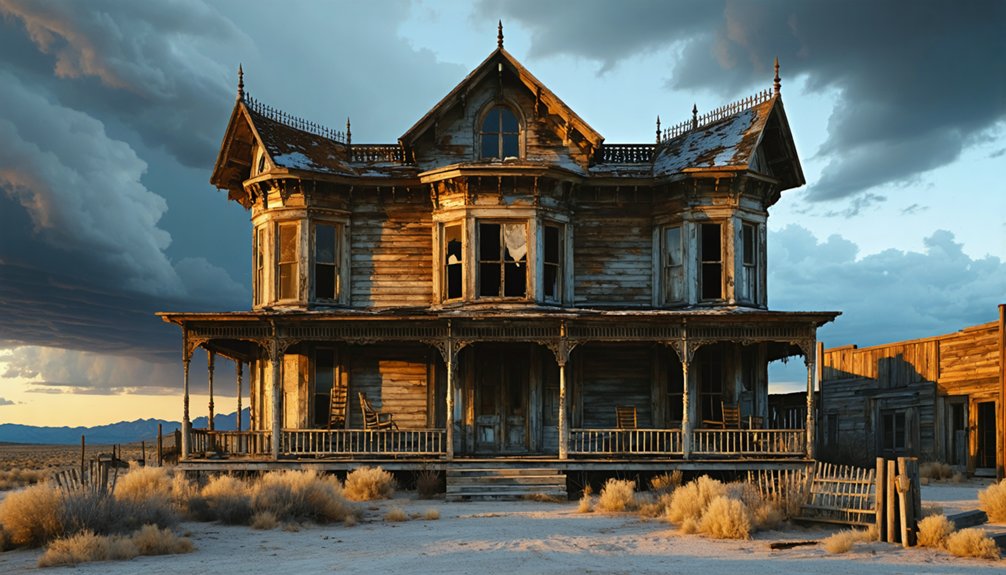
You’ll discover Virginia City’s remarkable Comstock Lode legacy, which generated over $600 million in silver and gold from more than 100 mines using innovative square-set timbering and Washoe processing techniques.
The town’s sudden transformation from settlement to 25,000-resident metropolis left behind opulent Victorian architecture spanning over 100 saloons, banks, churches, and schools that still stand at 6,200 feet elevation.
Today’s underground mine tours reveal the engineering brilliance that allowed miners to extract millions of tons of ore from beneath Mount Davidson while supporting Virginia City’s rapid urban development above.
Comstock Lode Mining Legacy
When you walk the historic streets of Virginia City, Nevada today, you’re treading upon what was once America’s most significant silver discovery—the legendary Comstock Lode unearthed in June 1859.
This silver legacy yielded over $500 million in precious metals, transforming Nevada into statehood by 1864 and establishing revolutionary mining techniques still studied today.
The Comstock mining operations pioneered innovations that would define American hardrock mining:
- Square-set timbering technology that prevented deadly cave-ins in soft ore bodies
- The Washoe process for silver extraction, representing a breakthrough in ore processing
- Corporate investment structures that financed massive underground operations
Though government order L-208 shut down operations in 1942, you can still explore the remains of these engineering marvels—tangible monuments to American industrial ingenuity and unbridled western expansion.
Opulent Victorian Architecture
Virginia City’s architectural splendor stands as a tribute to the extraordinary wealth generated by the Comstock Lode, with its remarkably preserved Victorian structures offering visitors a glimpse into America’s Gilded Age opulence.
You’ll find an impressive collection of Victorian elegance throughout the town, with most buildings dating from the post-1875 fire reconstruction. The architectural heritage includes Late Victorian, Italianate, and Second Empire styles, primarily built from wood and brick.
Notable mansions like the 1859 Mackay Mansion and Italianate-styled Cobb Mansion showcase ornate woodwork and decorative brackets. The Four Ward School exemplifies Second Empire design.
Today, these structures form the backbone of a National Historic Landmark district that draws over two million visitors annually.
Virginia City’s commitment to preservation has transformed this mining boomtown into a living museum of Victorian architecture you can freely explore.
Underground Mine Tours
Descending into the labyrinthine tunnels of Virginia City’s historic mine tours transports visitors back to the silver-rich era that once fueled America’s westward expansion.
You’ll discover two distinct underground exploration experiences: the Chollar Mine with its 400-foot original tunnel and the Ponderosa Mine housed in the former Bank of California.
Experience authentic mining technology through:
- Square-set timbering systems that revolutionized excavation techniques
- Demonstrations of primitive candle lighting that miners depended on daily
- Over 300 pieces of preserved equipment showcasing 19th-century industrial ingenuity
Both mines operate year-round, offering intimate glimpses into the harsh realities miners faced while extracting the $17 million in precious metals that built Virginia City’s opulence.
The 25-45 minute guided tours illuminate not just physical tunnels but pathways through America’s resilient frontier spirit.
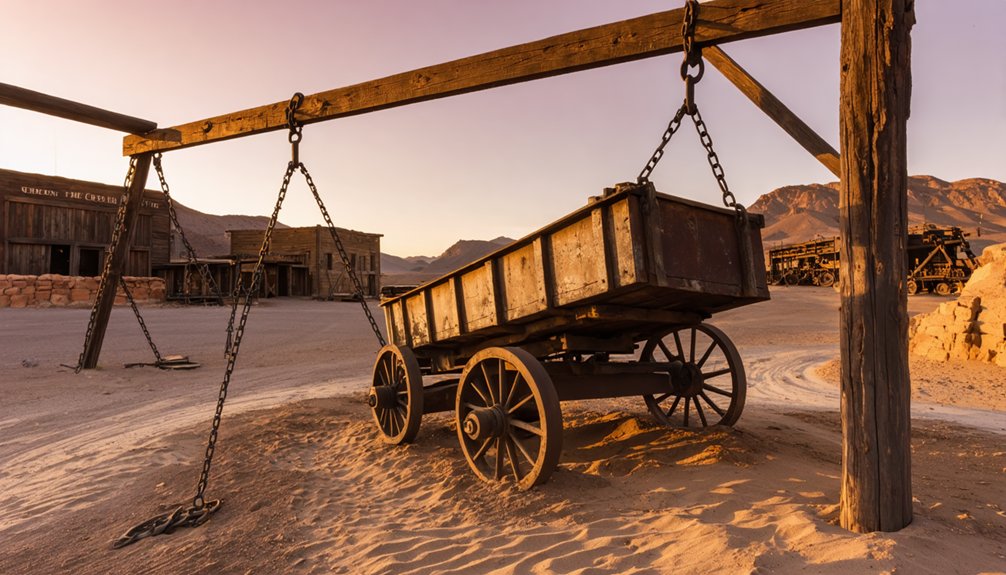
Nestled within the rugged landscape of central Nevada, Berlin represents one of America’s most remarkable dual-purpose historic sites. Established in 1897 following silver discoveries, this preserved ghost town showcases authentic mining heritage through its original structures, 30-stamp mill, and three miles of underground tunnels that once yielded $849,000 in ore.
You’ll find Berlin’s uniqueness amplified by its proximity to North America’s largest concentration of ichthyosaur fossils, marine reptiles from the Triassic period discovered in 1928. This dual significance prompted the area’s 1957 designation as Berlin-Ichthyosaur State Park.
While exploring the town’s miner cabins and post office, you can follow over 80 interpretive signs detailing personal stories of its brief boom period before abandonment in 1911.
Alternatively, you can venture into the Diana Mine during summer guided tours.
Terlingua: Texas Mercury Mining Meets Desert Revival
While Berlin’s history showcases silver mining alongside ancient fossils, Terlingua represents a different kind of extraction economy in America’s ghost town portfolio. Founded in 1903 when Howard Perry established the Chisos Mining Company, this Texas outpost quickly became the nation’s leading mercury producer, extracting the toxic element from cinnabar ore.
You’ll find Terlingua history preserved in limestone structures where Mexican miners once lived, often unaware they’d face mercury poisoning within five years.
The town’s boom-to-bust narrative follows a familiar arc:
- Peak population reached 2,000 residents during the 1910s-20s
- Operations continued for forty years until the 1940s bankruptcy
- Final mining attempts failed by 1973, completing the transformation to ghost town
Today, Terlingua draws freedom-seeking visitors with its preserved ruins and annual chili championship.
Bannack, Montana: From Gold Rush Glory to Abandoned Outpost

As you wander through Bannack’s preserved downtown, you’ll find the notorious hanging tree where Sheriff Henry Plummer met his fate at vigilante hands in 1864.
The town’s 60+ original structures remain largely intact, creating an authentic time capsule untouched by commercial development since its abandonment.
You can explore the Hotel Meade, the old church, and numerous other buildings that stand in various states of weathered decay, offering a glimpse into the harsh realities of frontier boom-and-bust cycles.
Sheriff Plummer’s Hanging Tree
The tree’s dark significance emerges through these facts:
- Plummer was hanged in 1864 without trial on the very gallows he constructed.
- The Vigilance Committee executed him alongside deputies Buck Stinson and Ned Ray.
- Despite 100+ murders attributed to his gang, concrete evidence remains disputed.
This monument to frontier vigilante justice stands as a stark reminder of freedom’s fragile nature when mob rule displaces due process.
A warning from history that resonates through Bannack’s silent streets.
Preserved Original Buildings
Beyond Plummer’s infamous hanging tree, Bannack’s physical legacy stands frozen in time through its remarkably preserved structures.
You’ll find over 60 original buildings lining Main Street, deliberately maintained in a state of “arrested decay” rather than artificially restored—a hallmark of authentic ghost town preservation.
The Montana Department of Fish, Wildlife, and Parks acquired the site in 1954, implementing a conservation philosophy that prioritizes historical significance over tourist development.
As you explore, you’ll discover the 1875 Hotel Meade (originally the courthouse), the 1877 church (the only religious structure ever built in town), and the schoolhouse that served students until 1951.
Unlike many historical sites, Bannack’s buildings remain accessible for direct exploration, allowing you to experience pioneer-era construction without modern intrusions.
Centralia, Pennsylvania: Modern Ghost Town Created by Underground Fire
Once a thriving coal mining community with over 1,400 residents, Centralia, Pennsylvania now stands as America’s most infamous modern ghost town, abandoned due to an unstoppable underground fire that’s burned continuously since May 1962.
Walking through Centralia today, you’ll encounter a post-apocalyptic landscape where toxic air seeps from ground vents and temperatures below reach 350°F.
The apocalypse isn’t coming; it’s already here, venting poison beneath your feet as you traverse Centralia’s haunted streets.
This coal seam fire has created:
- An expanding 8-mile network of burning tunnels spanning 3,700 acres
- Dangerous sinkholes that have swallowed portions of the town
- A federal condemnation of the entire borough in 1992, forcing nearly all residents to relocate
Despite government warnings, you can still visit this eerie reminder of nature’s unstoppable force.
Rhyolite, Nevada: Banking on Desert Dreams and Mining Fortunes
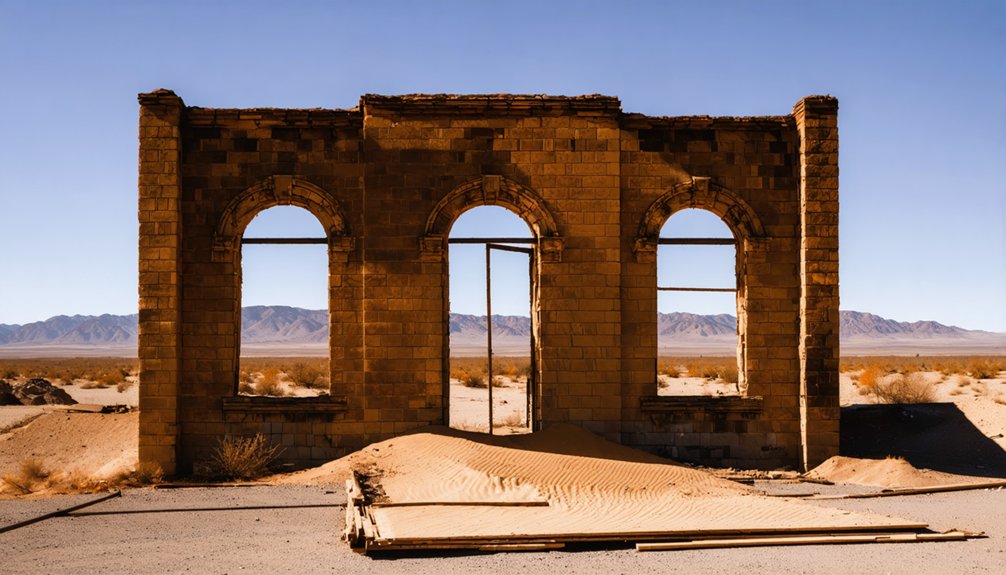
Rising from the rugged Nevada desert in 1904 after prospectors Frank “Shorty” Harris and Ernest “Ed” Cross discovered high-grade quartz ore, Rhyolite transformed from a humble two-tent mining camp into one of America’s most spectacular boom-and-bust towns.
You’ll find Rhyolite’s architecture tells a story of explosive wealth—a three-story bank building that cost $90,000 and Tom Kelly’s iconic Bottle House constructed with 50,000 beer bottles stand as symbols to boundless optimism.
The town’s mining legacy yielded over $1 million in gold within three years before rapidly collapsing. By 1911, the Montgomery Shoshone Mine closed; electricity disappeared by 1916.
When 1921 arrived, only two residents remained, leaving behind a perfectly preserved monument to American frontier ambition and overreach.
Garnet, Montana: Best-Preserved Mining Town of the American West
Nestled high in Montana’s Garnet Mountain Range, Garnet stands as America’s best-preserved mining ghost town, offering visitors a remarkably intact window into the Western mining era.
Originally called Mitchell, this gold mining boomtown flourished after the 1873 Nancy Hanks Mine discovery, yielding $690,000 in gold during 1896 alone. The town’s prosperity ended with a devastating 1912 fire, triggering gradual abandonment.
When exploring Garnet’s mining history, you’ll discover:
- About 30 surviving structures including miners’ cabins, a saloon, and store ruins – all preserved by the BLM since 1970
- Evidence of quick, practical construction techniques focused on mining operations rather than permanence
- Self-guided interpretive trails revealing how this transient community lived and worked
Unlike many ghost towns, Garnet remains remarkably authentic despite over a century of exposure to elements.
Frequently Asked Questions
Are These Ghost Towns Safe to Visit With Small Children?
Most aren’t safe for small children. You’ll need strict supervision, professional guides, and established locations like Bodie State Park for family friendly activities. Follow child safety tips meticulously.
Can Visitors Stay Overnight in Any of These Ghost Towns?
You’ll find overnight accommodations in Garnet (cabin rentals) and Virginia City (historic hotels), while St. Elmo offers limited camping options nearby. Bodie doesn’t permit staying after park closure hours.
Which Ghost Town Is Most Accessible for Visitors With Disabilities?
Like a beacon of accessibility, Calico Ghost Town offers the most wheelchair access with paved pathways, ADA facilities, and guided tours. You’ll find designated parking and maintained routes throughout this state-designated historic site.
Do Any Towns Have Paranormal Activity or Ghost Hunting Tours?
You’ll find ghost hunting opportunities in Jerome and Calico, where organized paranormal tours explore their haunted history. Bodie occasionally hosts ghost hunts, while Garnet offers overnight cabin stays for paranormal enthusiasts.
For those keen on discovering the eerie allure of the past, you can also explore ghost towns in Washington, where remnants of old mining camps and abandoned buildings tell stories of bygone eras. Many of these sites are steeped in legend, enticing visitors with tales of lost souls and the adventures that once thrived in these now-desolate landscapes. Whether you’re drawn by the thrill of the supernatural or the fascinating history, Washington’s ghost towns offer a hauntingly beautiful glimpse into history.
When Is the Best Season to Photograph These Ghost Towns?
Like ghosts emerging from temporal mist, fall’s golden hour light reveals a photographer’s paradise. You’ll capture the most evocative images when autumn’s warm tones accentuate weathered textures, avoiding summer’s harsh midday glare.
References
- https://www.mentalfloss.com/geography/american-ghost-towns-can-still-walk-through
- https://www.christywanders.com/2024/08/top-ghost-towns-for-history-buffs.html
- https://www.californist.com/articles/interesting-california-ghost-towns
- https://www.geotab.com/ghost-towns/
- https://www.youtube.com/watch?v=eyOASXxAmMI
- https://www.united.com/en/us/hemispheres/places-to-go/5-western-ghost-towns.html
- https://www.timeout.com/usa/things-to-do/ghost-towns-usa
- https://en.wikipedia.org/wiki/Lists_of_ghost_towns_in_the_United_States
- https://thelittlehouseofhorrors.com/bodie-the-cursed-ghost-town/
- https://en.wikipedia.org/wiki/Bodie