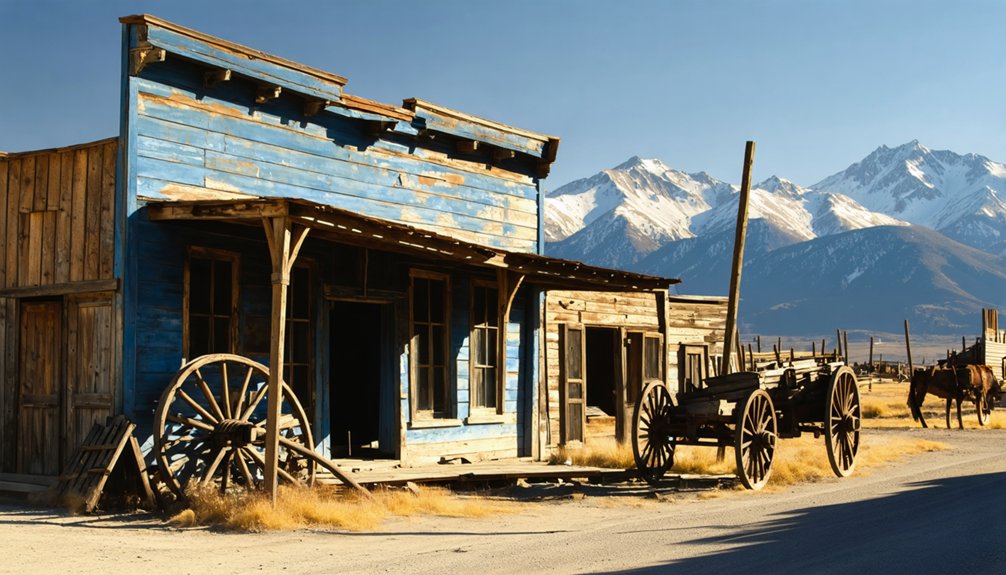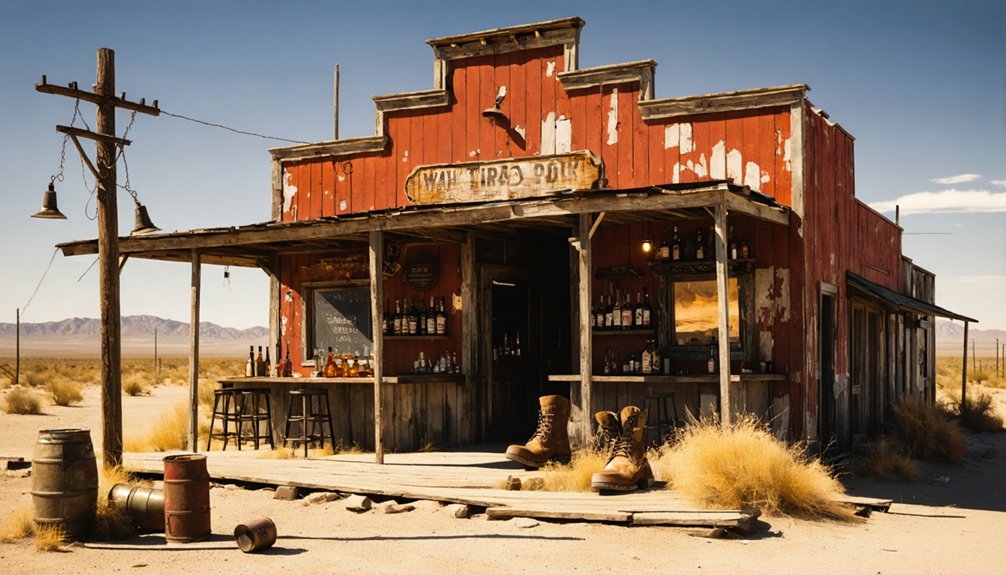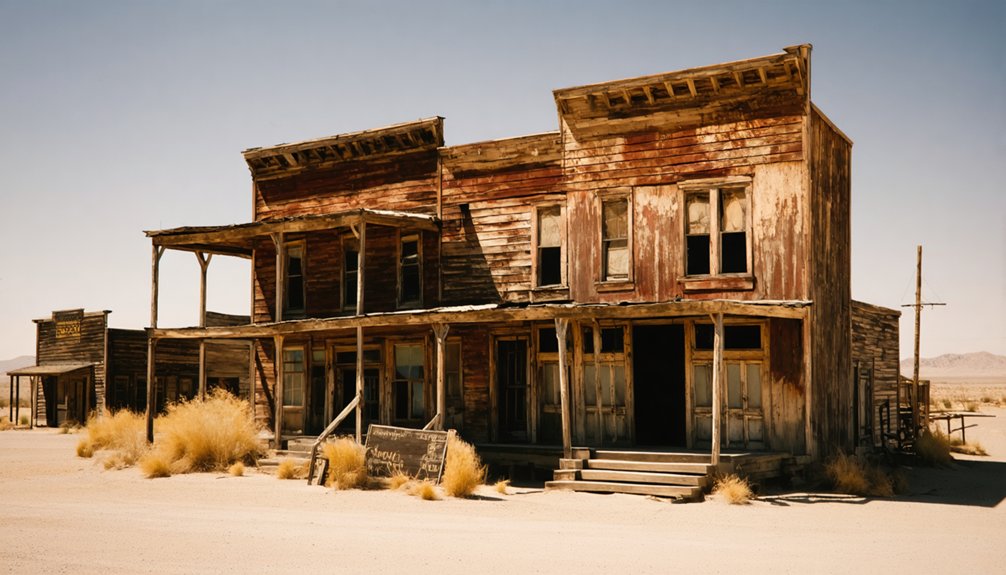
You’ll find America’s best Wild West ghost towns in Bodie, California, where 200 original structures stand in “arrested decay,” and Tombstone, Arizona, home of the O.K. Corral gunfight. Don’t miss St. Elmo’s preserved mining infrastructure, Oatman’s wild burros roaming Route 66, or Rhyolite’s dramatic boom-and-bust ruins. Each town offers unique photography opportunities and authentic historical experiences that transport you to the frontier’s lawless, gold-fevered past.
Key Takeaways
- Bodie, California offers 200 original structures in “arrested decay” with authentic gold mining artifacts still in place.
- Tombstone, Arizona features preserved Victorian architecture and daily reenactments of the famous O.K. Corral gunfight.
- St. Elmo contains approximately 40 original structures including the town hall and schoolhouse listed on the National Register.
- Oatman combines mining history with free-roaming wild burros descended from pack animals along historic Route 66.
- Rhyolite showcases dramatic ruins including the photogenic John S. Cook Bank building from its 1904-1907 boom period.
Bodie, California: A Gold Mining Town Frozen in Time
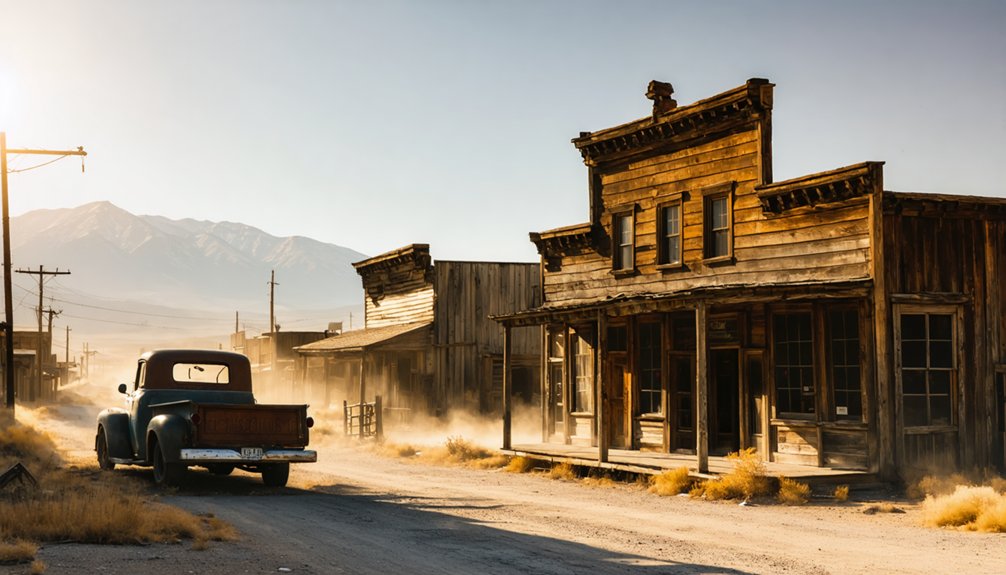
Gold dust and faded dreams linger in the thin mountain air of Bodie, California, a remarkably preserved ghost town that offers visitors a genuine glimpse into America’s gold rush era. Founded in 1859 after William Bodey discovered gold, the town exploded into a boomtown following a profitable vein discovery in 1876.
At its peak, Bodie’s population reached nearly 10,000 residents with 2,000 structures including 65 saloons. The town earned a reputation for lawlessness and was often compared to other notorious frontier settlements like Tombstone and Deadwood. This historical location is one of many that share the name, requiring visitors to specify Bodie, California when researching to avoid confusion with other similarly named places.
You’ll find Bodie history frozen in “arrested decay,” with abandoned buildings still stocked with goods and furniture. The gold mining operations yielded up to $70 million before declining in the 1880s.
Today, you can wander among 200 original structures, experiencing what locals described as “Goodbye God, I’m going to Bodie”—a proof of its notorious lawlessness.
The Gunslinger’s Paradise: Tombstone, Arizona
Unlike many abandoned settlements, Tombstone flourished from a staggering silver discovery in 1879 that transformed a desolate mesa into a booming city of 14,000 residents within just a few years.
You’ll walk the same streets where the infamous 1881 Gunfight at the O.K. Corral unfolded between the Earp brothers, Doc Holliday, and the outlaw Cowboys—perhaps the most legendary shootout in Western history.
The town’s remarkably preserved Victorian architecture, including the notorious Bird Cage Theatre and Boot Hill Graveyard, offers an authentic glimpse into the violent yet vibrant frontier society that earned Tombstone its reputation as “The Town Too Tough To Die.” At the height of its boom period, the town featured 110 saloons and numerous gambling halls that catered to miners and cowboys seeking entertainment after long days of work. Boot Hill Graveyard contains numerous historic gravestones with inscriptions that provide fascinating insights into the lives and often violent deaths of Tombstone’s early residents.
Legendary O.K. Corral
Though often mistakenly thought to have occurred inside the corral itself, the legendary gunfight at the O.K. Corral actually unfolded in a vacant lot near Fremont and Third Street.
You’ll stand where this iconic 30-second shootout between the Earp brothers with Doc Holliday and the outlaw Cowboys erupted on October 26, 1881. This brief but deadly exchange of nearly 30 gunshots left three Cowboys dead and cemented Tombstone’s place in Western lore.
Today, you can witness daily reenactments of this defining moment in frontier justice at the preserved historic complex.
Examine Wyatt Earp’s own map marking the gunfight’s location, explore C.S. Fly’s photo gallery, and visit the Tombstone Epitaph newspaper offices. The newspaper was one of two publications that heavily reported on the subsequent Spicer hearings that ultimately found the lawmen acted within their rights.
The O.K. Corral remains the quintessential symbol of the clash between law and outlaw culture in the American West. Visitors can enjoy the historic attractions from 9 a.m. to 5 p.m. daily, immersing themselves in this legendary chapter of frontier history.
Silver Makes History
When Ed Schieffelin discovered rich silver veins in southeastern Arizona Territory in 1877, he transformed a desolate area mockingly called “Goose Flats” into what would become one of America’s most infamous frontier boomtowns.
You’ll be standing on ground that once yielded an estimated $40-$85 million in silver during the 1880s. Schieffelin’s mining claims—Lucky Cuss, Tough Nut, and Contention—attracted thousands, expanding Tombstone’s population to nearly 14,000 at its peak.
The wealth generated an impressive frontier town with 110 saloons, 14 gambling halls, and four churches. His initial ore samples from “The Tombstone” claim were valued at an astonishing $2,000 per ton.
Today, with a population of only around 1,380 residents, Tombstone relies primarily on tourism to sustain its economy and preserve its Wild West heritage.
Despite encountering challenges when mining shafts hit the water table in 1881, engineers implemented massive Cornish pumps that removed millions of gallons daily, allowing the extraction to continue and cementing Tombstone’s legacy as “The Town Too Tough to Die.”
Western Architecture Preserved
As you stroll through Tombstone today, you’ll witness one of America’s best-preserved frontier towns, where the architecture tells as much of the Wild West story as any history book could.
The evolution of historic materials—from wooden clapboard and adobe to fire-resistant brick after the 1881-1882 fires—reveals the town’s resilience.
Distinctive architectural features like false-front façades, ornate cornices, and wooden porches with decorative brackets transport you to the 1880s.
The O.K. Corral, Bird Cage Theatre, and Doc Holliday’s Saloon stand as authentic symbols of Tombstone’s heyday.
National Park Service guidelines guarantee preservation efforts maintain historic integrity while allowing you to experience the untamed spirit of the frontier.
The town’s transformation from a booming silver mining hub with a population of 14,000 during its peak in the 1880s to its current smaller size makes its preserved architecture even more remarkable.
Allen Street remains closed to modern traffic, preserving the illusion that you’re walking through the genuine Wild West.
St. Elmo’s Mountain Mining Heritage
Perched at nearly 10,000 feet elevation in Colorado’s Chalk Creek Canyon, St. Elmo offers you a glimpse into the architectural heritage of 1880s alpine mining communities, with its remarkably preserved wooden structures dating from the town’s boom period.
You’ll walk among more than 150 historic buildings that once supported a thriving population of 2,000 residents, including hotels, saloons, and commercial establishments that served the Mary Murphy Mine and numerous other mining operations.
St. Elmo’s exceptional preservation status on the National Register of Historic Places allows you to experience authentic frontier life as it existed during Colorado’s silver rush, complete with original structures that survived the fires of the 1890s and the economic decline of the 1920s. The town has gained additional mystique from reports of Annabelle Stark’s ghost watching over the property and protecting it from vandals.
Alpine Mining Architecture
St. Elmo’s alpine mining architecture represents a triumph of 19th-century engineering ingenuity. When you explore the town, you’ll notice how buildings frequently encroach upon street right-of-ways—evidence of L.C. Cornwell’s impractical gridiron layout yielding to mountainous terrain demands.
The mining infrastructure evolved from primitive tents and log cabins to sturdy wood-frame structures as prosperity increased.
The ambitious 1,845-foot Alpine Tunnel burrowing through the Continental Divide exemplifies the extraordinary measures miners took to connect this remote settlement. You’ll find distinctive log construction using peeled logs with saddle notches and mud chinking throughout the 40 surviving original structures.
Don’t miss the Minor Exchange Building (1892), which changed from bank and saloon to general store, and the Mary Murphy Mine, which produced an astounding 220,000 ounces of gold worth $4.4 million.
1880s Mountain Boom
The 1880s mountain boom transformed what was originally called Forest City into the thriving mining settlement of St. Elmo. When high-grade silver was discovered on Chrysite Mountain in 1875, fortune-seekers flocked to Chalk Creek Canyon, creating a bustling historic mining community with nearly 2,000 residents by the 1890s.
- The Mary Murphy Mine dominated the local economy, extracting $60 million in gold and employing 250 men who processed up to 100 tons of ore daily.
- You’ll find evidence of mining evolution in St. Elmo, from simple placer mining that yielded $14 million in gold to advanced hydraulic techniques and processing plants.
- This ghost town once boasted five hotels, multiple saloons, two banks, and its own newspaper—a reflection of mining prosperity before the 1920s decline.
Preserved Frontier Life
While preserving its frontier character at 9,961 feet in the Sawatch Range, today’s St. Elmo offers you a remarkably authentic glimpse into 1880s mining culture.
Approximately 40 original structures remain intact, including the town hall (now a museum), schoolhouse, and general store—all listed on the National Register of Historic Places.
You’ll encounter frontier architecture that housed a once-thriving community of 2,000 residents who supported over 150 mine claims.
The Mary Murphy Mine alone extracted 220,000 ounces of gold valued at $4.4 million. The town’s preserved buildings showcase the economic foundations of Western expansion, from ore processing to community gathering spaces.
Explore on foot, horseback, or ATV, experiencing firsthand how miners lived when St. Elmo served as an essential supply hub via the Denver, South Park and Pacific Railroad.
Wild Burros and Gold Rush History in Oatman
Roaming freely through the dusty streets of Oatman, Arizona, wild burros serve as living reminders of the town’s gold rush heritage dating back to 1915 when two prospectors struck gold worth approximately $10 million.
These descendants of pack animals that once supported the booming mining operations now define Oatman’s identity, transforming it from a near-ghost town of about 100 residents into a thriving tourist destination along historic Route 66.
When you visit this living slice of burro heritage and mining legacy, you’ll encounter:
- Wild burros that freely wander the town, including the famous “Oliver” who leads a herd of about 13 animals
- Original wooden boardwalks from the boomtown era when 3,500 people called Oatman home
- A delicate ecological balance as authorities manage the burro population toward sustainable levels
Rhyolite: Nevada’s Rapidly Rising and Falling Boomtown
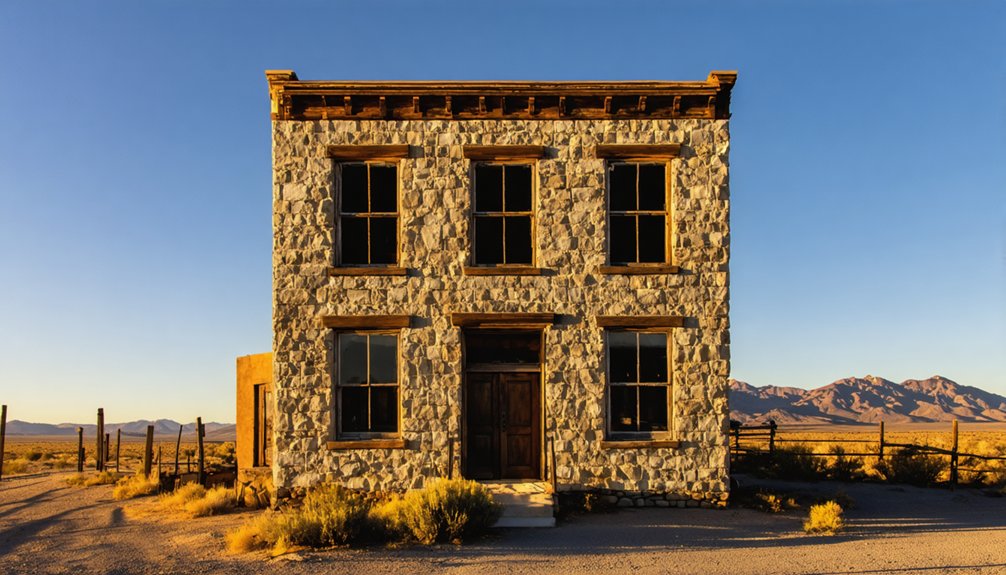
Rising from the Nevada desert like a mirage in 1904, Rhyolite stands as perhaps the most dramatic example of boom-and-bust economics in American mining history.
Within six months, this gold rush town exploded to 5,000 residents, boasting 50 saloons, electricity, and three railroads.
When you visit today, you’ll find haunting Rhyolite ruins that tell a tale of spectacular collapse.
The impressive three-story John S. Cook Bank building—now the most photographed ghost town structure in America—once symbolized prosperity before economic forces, including ore depletion and the 1906 San Francisco earthquake, triggered decline.
Deadwood: Where Outlaws and Legends Roamed
When you step into Deadwood, you’ll encounter a town that preserved its notorious gambling heritage after the 1876 gold rush attracted thousands of fortune seekers to this illegal settlement on Lakota land.
You can visit the exact spot where Wild Bill Hickok met his demise while holding the famous “Dead Man’s Hand” of aces and eights during a poker game in 1876.
Thanks to gambling revenues reintroduced in 1989, Deadwood’s historic district now meticulously maintains its frontier architecture and offers regular reenactments of pivotal moments from its lawless past.
Notorious Gambling Scene
During the tumultuous gold rush of 1876, Deadwood emerged as a gambling mecca that would define the very essence of the Wild West’s unbridled frontier spirit.
The infamous “wickedest town on earth” boasted 56 gambling halls where outlaw legends and prospectors wagered fortunes amid a lawless atmosphere that financed the town’s explosive growth.
When you visit modern Deadwood, you’ll experience the revival of this notorious gambling scene:
- Play at casinos that evolved from the original 14 gaming halls of 1989 to today’s expansive venues offering everything from $1,000-limit blackjack to sports betting.
- Explore buildings where gambling once occurred alongside “sporting houses” and opium dens.
- Witness how gaming revenue saved this historic town from ghost status, funding restoration projects that preserved its Wild West character.
Hickok’s Final Hand
While sipping whiskey and clutching what would become immortalized as the “Dead Man’s Hand,” Wild Bill Hickok met his fate in Deadwood’s Saloon No. 10 on August 2, 1876.
A cowardly shot from Jack McCall ended the legendary gunfighter’s life mere weeks after his arrival in this booming gold rush town of 25,000 souls.
You’ll find Hickok’s legacy permeates Deadwood’s history. His aces and eights poker hand transformed into an enduring symbol of frontier risk and sudden mortality.
Visit Mount Moriah Cemetery where Hickok rests eternally overlooking the gulch, alongside other notorious figures including Calamity Jane. The cemetery has become a pilgrimage site for Wild West enthusiasts.
Daily reenactments of McCall’s sensationalized trial offer you a glimpse into the rough justice of this lawless mining community.
Gold Rush Preservation
Beneath the weathered facades of Deadwood’s historic buildings lies a remarkable story of preservation that has transformed this once-lawless mining camp into a living museum of the American frontier.
As you wander through this National Register-listed town, you’re experiencing one of America’s most authentic gold rush preservation efforts.
- The entire city stands as a protected historic district, maintaining the architectural integrity of false-front structures from the 1876 boomtown era.
- Historic Homestake Mine sites showcase 125 years of mining heritage, having produced over 40 million ounces of gold before closing in 2001.
- Preservation efforts carefully balance authentic historical accuracy with modern safety requirements, allowing visitors to step back into the heyday of Western expansion.
Exploring the Authentic “Arrested Decay” Experience
When you step into a ghost town preserved through “arrested decay,” you’re experiencing a unique approach to historical conservation that deliberately maintains structures in their weathered state.
Unlike traditional restoration, this method intervenes only enough to prevent collapse while allowing natural aging to continue.
At Bodie, California—the quintessential example of arrested decay—you’ll walk among 200 buildings where dust-covered possessions remain exactly as residents left them.
The California Department of Parks strictly enforces this preservation policy, making only essential repairs that don’t compromise historical authenticity.
This preservation philosophy extends beyond America to sites like Chernobyl and Pompeii, offering you a rare glimpse into frozen moments of history.
The appeal lies in the unfiltered connection to the past—where peeling wallpaper and weathered wood tell stories that pristine restoration simply can’t convey.
Photography Opportunities in America’s Ghost Towns
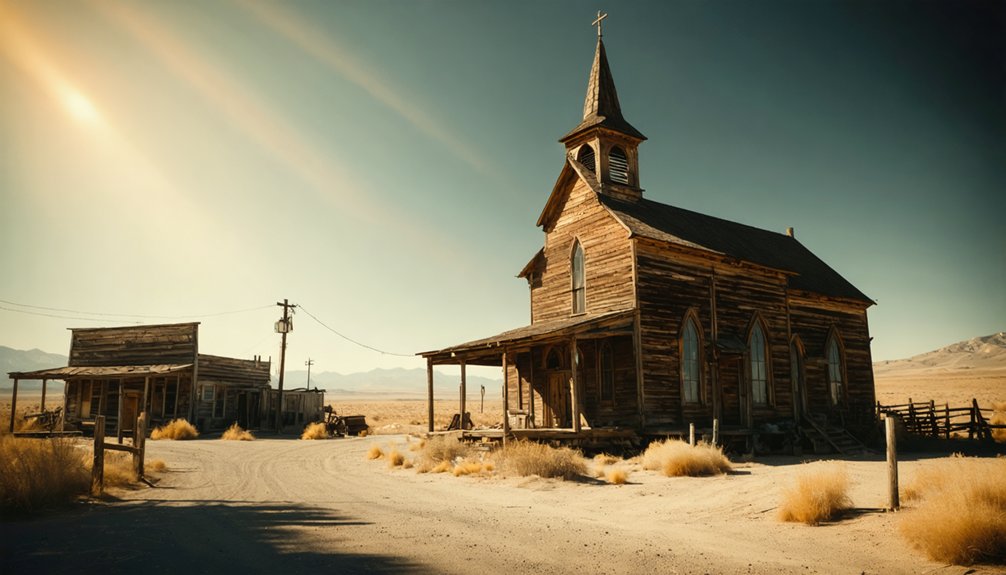
Ghost towns offer photographers unparalleled opportunities to capture America’s vanishing frontier history through their lenses.
When shooting these abandoned settlements, you’ll want to bring a tripod for those atmospheric long exposures (10-30 seconds), which perfectly capture the eerie stillness while highlighting architectural details in low light. Wide-angle lenses (20-24mm) create dramatic perspectives that emphasize the isolation these towns embody.
- Composition techniques – Frame wide shots of main streets and notable buildings first, then focus on details like doorknobs, window frames, and weathered signage to tell the town’s story.
- Lighting strategies – Shoot at twilight for natural shadows and softer contrasts; use light painting techniques for highlighting specific features.
- Subject focus – Document both the architectural decay and abandoned artifacts—tools, furniture, vehicles—that reveal human narratives within these forgotten spaces.
Planning Your Western Ghost Town Road Trip
Planning a successful ghost town road trip requires strategic preparation to maximize your exploration of these fascinating historical remnants across the American West.
Begin by selecting ideal starting points like Bodie State Historic Park in California or Rhyolite in Nevada, which anchor thorough ghost town itineraries.
Road trip essentials include checking weather forecasts to avoid impassable conditions, filling fuel tanks completely before reaching remote locations, and packing adequate food and water supplies.
Most destinations require at least two hours for proper exploration, with some access roads featuring gravel terrain.
Consider guided tours for expert commentary, particularly afterhours Ghost Walks where available.
Las Vegas serves as a convenient hub for Nevada’s ghost towns, while California’s route includes nine strategic stops beginning at Shasta State Historic Park.
Preserving the Old West: How These Towns Survived

Although many Western boomtowns disappeared completely after their economic purposes faded, the ghost towns you can visit today survive through deliberate preservation strategies balancing authenticity with accessibility.
Among the best preserved ghost towns in Wyoming, visitors can experience a captivating glimpse into the past. Each town offers unique stories and well-maintained structures that reflect the rich history of the Old West. Walking through these abandoned streets allows one to appreciate the legacy of those who once called these places home.
These historic preservation efforts often involve multiple government agencies working alongside community engagement initiatives to maintain these time capsules of American frontier life.
- Arrested decay approach – Places like Bodie, California are deliberately maintained in a state of “suspended deterioration” that preserves authenticity while preventing complete collapse.
- Adaptive reuse – Original structures repurposed for visitor centers, research facilities, and maintenance storage while maintaining historical integrity.
- Economic revitalization – Tourism revenue funds ongoing preservation, with former mining settlements like St. Elmo transforming from abandoned ruins to destinations attracting thousands annually.
Frequently Asked Questions
Are These Ghost Towns Safe for Families With Young Children?
Most ghost towns aren’t safe for families with young children due to structural instability, environmental hazards, and limited emergency services. You’ll need to prioritize ghost town safety over family-friendly activities when visiting.
Can You Stay Overnight in Any of These Historic Towns?
You can stay overnight in all four ghost towns, with each offering unique accommodation options from authentic miners’ cabins to historic hotels, though local regulations may restrict availability seasonally.
Which Ghost Towns Are Accessible During Winter Months?
Bodie, Garnet, and St. Elmo are accessible in winter with proper preparation. You’ll need specialized vehicles or equipment due to harsh winter weather. Pack emergency supplies and check travel tips before starting on these adventures.
Are Any of These Towns Reportedly Haunted?
Like restless miners still searching for gold, you’ll find ghost stories abound in these towns. Tombstone, Deadwood, and Frisco are particularly renowned for their paranormal activities and documented hauntings.
How Accessible Are These Towns for Visitors With Mobility Challenges?
You’ll find limited wheelchair access in most ghost towns due to historic preservation challenges. Bisbee and Jerome offer some accommodations, while remote locations like Panamint City remain virtually inaccessible for mobility-impaired visitors.
References
- https://www.mentalfloss.com/geography/american-ghost-towns-can-still-walk-through
- https://www.americansky.co.uk/travel-inspiration/top-10-wild-west-towns-in-america
- https://www.youtube.com/watch?v=yeTVfoQxqJc
- https://www.geotab.com/ghost-towns/
- https://www.atlasobscura.com/lists/americas-best-preserved-ghost-towns
- https://en.wikipedia.org/wiki/Lists_of_ghost_towns_in_the_United_States
- https://wildwestcity.com/old-west-ghost-towns/
- https://www.bodiehistory.com
- https://en.wikipedia.org/wiki/Bodie
- https://www.exploratography.com/blog-cal/dxan8zo55mm3dq325qd8yhi7s0e0qi