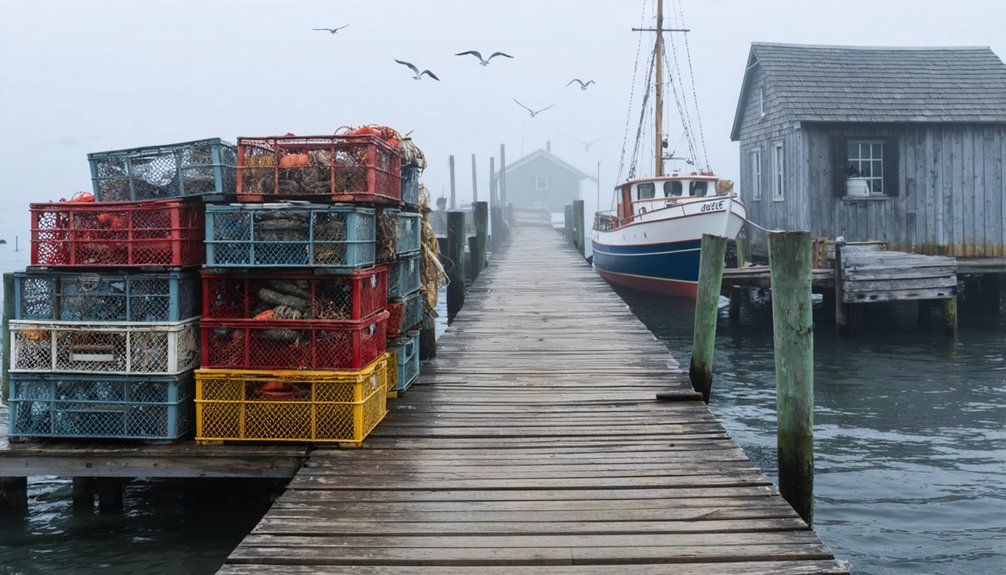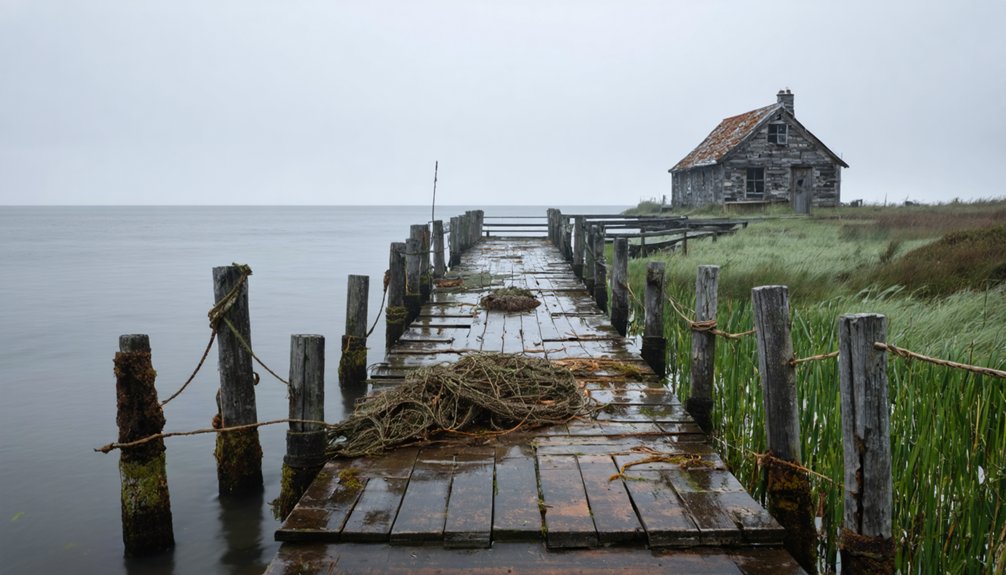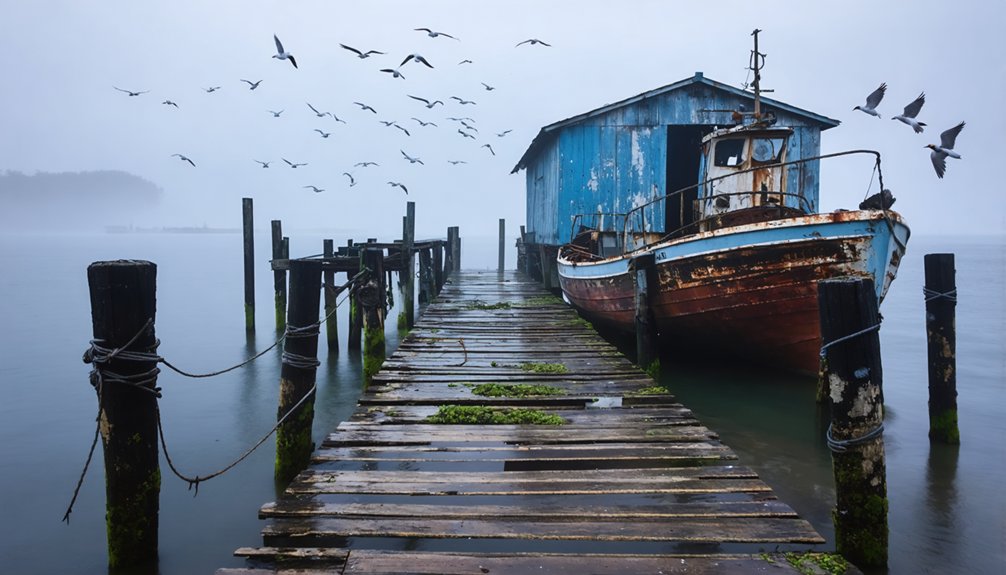
You’ll find compelling evidence of America’s coastal fishing heritage in ghost towns like Terminal Island, where Japanese immigrants revolutionized tuna fishing before WWII internment, and Dogtown, which changed from maritime settlement to abandonment. These sites reveal economic collapse from depleted fish stocks, industrial competition, and natural disasters. Architectural remnants—weathered piers, processing plants, and vacant structures—silently chronicle once-thriving maritime economies. These disappearing coastal settlements hold untold stories of cultural resilience and adaptation.
Key Takeaways
- Physical remnants of coastal fishing villages (1890s-1940s) provide photographic evidence of unique construction techniques adapted to maritime environments.
- Terminal Island’s abandoned Japanese fishing community (1907-1942) revolutionized Southern California’s tuna industry before internment destroyed the settlement.
- Economic factors including depleted fish stocks, industrial competition, and natural disasters primarily caused coastal fishing villages’ abandonment.
- Swan Island represents successful preservation of maritime heritage with intact 18th and 19th-century structures protected by geographic isolation.
- Ghost towns like Dogtown transitioned from thriving fishing communities to abandoned settlements following ecological changes that collapsed local economies.
The Rise and Fall of Terminal Island’s Japanese Fishing Community
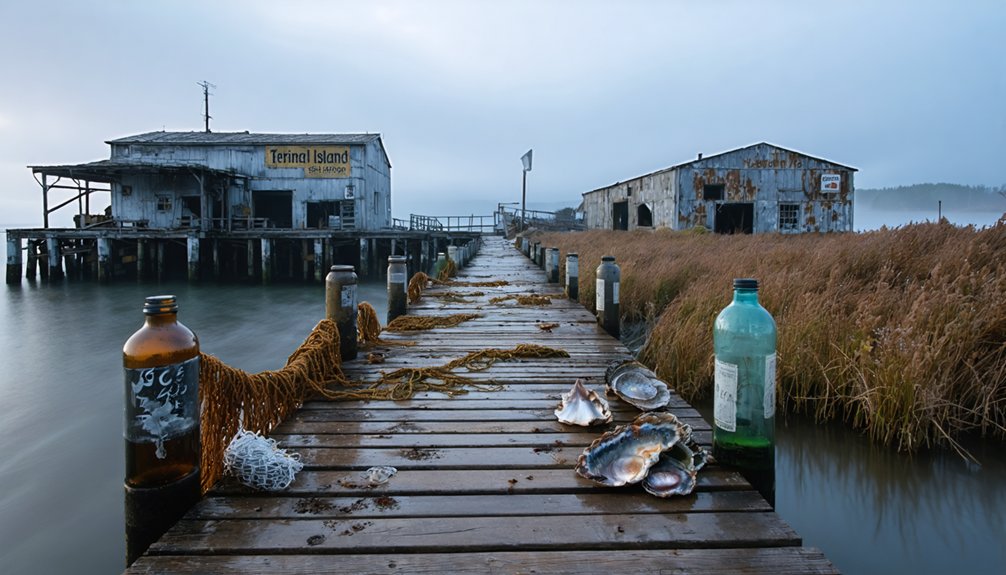
Although largely forgotten in modern American history, Terminal Island’s Japanese fishing community stands as one of the most significant examples of both immigrant entrepreneurship and wartime injustice.
You’ll find that by 1907, just two years after California’s abalone fishing ban, approximately 600 Japanese immigrants had established “Furusato” on Terminal Island. This community, preserving Japanese heritage while developing its own unique “kii-shu ben” dialect, grew to 3,000 residents by 1941.
Their introduction of long-line tuna fishing revolutionized Southern California’s economy. The community established a thriving cultural presence with schools and parades that celebrated their heritage. These tight-knit residents participated in traditional activities like mochi-making and folk dances that maintained their cultural connections.
This demonstration of community resilience was violently disrupted after Pearl Harbor. On February 2, 1942, residents received only 48 hours to evacuate—the first forced removal on the West Coast.
Authorities bulldozed their village, seized fishing boats, and sent families to internment camps, effectively erasing this thriving maritime community.
Dogtown’s Transition From Coastal Settlement to Abandoned Curiosity
You’ll find that Dogtown’s coastal history is steeped in unusual legends of witchcraft that circulated among local residents, creating a mystical aura that persists in regional folklore.
The settlement’s once-thriving fishing economy supported families through harvesting and processing seafood until ecological changes and market pressures in the mid-19th century rendered these operations unsustainable.
This economic collapse forced most inhabitants to abandon their coastal livelihoods, leaving behind deteriorating structures that now serve as historical curiosities for occasional visitors to this forgotten maritime community. Despite its decline, Dogtown’s proximity to the Point Reyes National Seashore provides visitors with beautiful natural landscapes to explore alongside its historical remnants. The name “Dogtown” was actually common throughout the Old West, with multiple theories explaining its origin including one about miners living in poor conditions “like dogs.”
Witchcraft Legends Persist
As Dogtown’s population dwindled in the early 19th century, persistent legends of witchcraft and dark magic began to transform the settlement’s identity from a struggling colonial outpost to a place of mystery and superstition.
The witchcraft folklore emerged as residents shifted from conventional social structures to unconventional lifestyles. Located on Cape Ann peninsula, Dogtown consists of approximately 6000 acres of undeveloped wilderness that has preserved these historical associations.
You’ll discover that Dogtown’s eerie legends stemmed from several distinctive characteristics:
- Women dressed as men and men performing “women’s work” challenged period norms
- Widows kept dogs for protection, contributing to the area’s peculiar name
- Former slaves and social outcasts created an alternative community
- Inhabitants practiced survival skills that resembled traditional “witchcraft”
By 1814, the once-thriving settlement had experienced a dramatic decline with only six houses remaining of the original eighty structures. These narratives have preserved Dogtown’s legacy beyond its physical remains, transforming a failed settlement into a cultural touchstone that continues to captivate visitors seeking connection to America’s complex colonial past.
Fishing Economy Collapsed
While Dogtown’s witchcraft legends colored its cultural legacy, the fundamental cause of the settlement’s abandonment stemmed from the collapse of its coastal fishing economy in the late 18th and early 19th centuries.
You’ll find that these once-thriving communities faced an unsustainable future as fish stocks declined from overfishing and environmental degradation.
Larger commercial operations outcompeted the small-scale fishing traditions that had sustained Dogtown for generations. Without economic sustainability, residents migrated toward diversified opportunities elsewhere, leaving their maritime heritage behind.
As populations dwindled, infrastructure deteriorated without maintenance.
The American Revolution and Embargo Act created additional pressures that accelerated Dogtown’s decline.
The villages that once buzzed with activity around daily catches transformed into quiet, weathered remnants of former prosperity.
Nearby areas with richer gold deposits attracted miners away from Dogtown, further depleting its population and economic vitality.
The social fabric unraveled as families dispersed, converting vibrant fishing communities into ghost towns where only traces of maritime culture remained in abandoned structures and local memory.
Swan Island: A Preserved Maritime Heritage in Maine
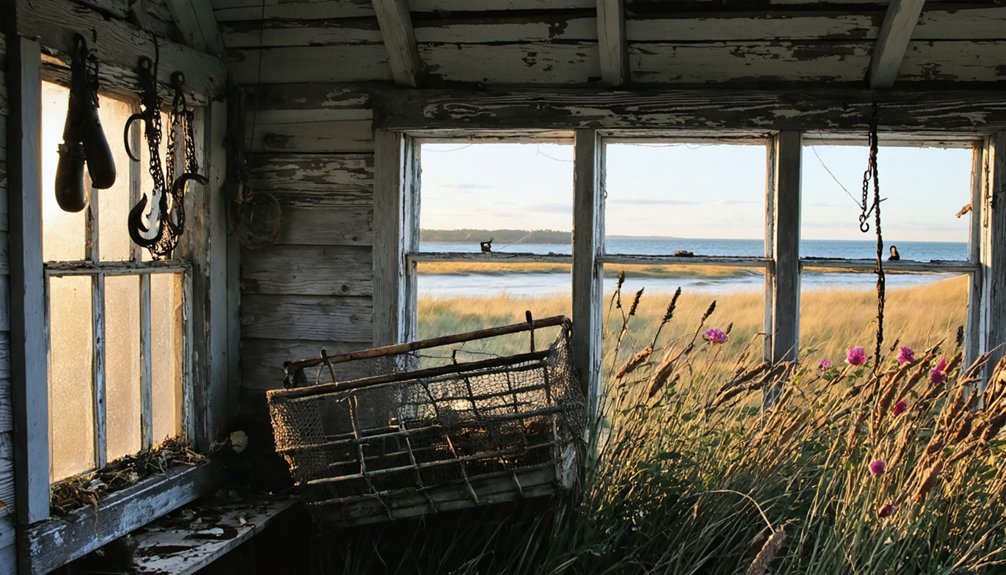
When you visit Swan Island, you’ll witness remarkably preserved fishing families’ homes that offer authentic glimpses into Maine’s maritime past.
The island’s natural isolation provided both advantages for early fishing communities and protection from modern development that would have otherwise destroyed these historical structures.
Maine’s conservation efforts since the 1940s have transformed Swan Island into an exemplary case of marine heritage preservation, where historical infrastructure remains intact alongside protected wildlife habitats. The Department of Wildlife began acquiring land on the island in the early 1940s specifically for waterfowl management. Once known as the Town of Perkins, this prodigious farming community also relied heavily on fishing activities that shaped its economic landscape for generations.
Fishing Families’ Rustic Homes
Swan Island’s rustic homes stand as enduring symbols to the resilience of fishing families who established themselves along Maine’s coastal frontier. The vernacular architecture reflects both practicality and prosperity, with structures dating from the 18th and 19th centuries.
The island’s fishing heritage is embedded in these weathered dwellings, strategically positioned near shorelines for direct access to maritime livelihoods.
Notable architectural elements include:
- The Lilly-Wade Property (c.1860) with its Italianate farmhouse details
- Robinson-Powell House (c.1886-1889) featuring decorative woodwork and carved vergeboard
- Locally-sourced timber construction adapted to harsh coastal conditions
- Functional outbuildings supporting maritime and agricultural activities
You’ll find these homes represent a harmonious integration of fishing, farming, and shipbuilding—testament to the self-sufficient lifestyle of coastal New Englanders who valued independence above all.
Island Isolation Advantages
Despite its challenging accessibility, Swan Island’s isolated nature has paradoxically preserved its maritime heritage in ways mainland communities could never achieve.
You’ll find the island’s seclusion has created a time capsule effect, protecting 18th and 19th-century structures from development pressures that typically transform coastal communities.
Among the isolation advantages is the remarkable integrity of the National Register-listed historic district, where Revolutionary War-era buildings stand alongside former sea captains’ homes.
This isolation benefit extends to the archaeological record—Abenaki sites dating back 9,000 years remain relatively undisturbed.
When you visit via private boat, you’ll experience a rare convergence of cultural preservation and natural conservation.
The island’s limited accessibility has maintained the authentic character of this maritime heritage site, creating an unfiltered window into coastal New England’s past.
Maine’s Marine Preservation Success
Although beset by numerous challenges, Maine’s Swan Island stands as one of the state’s most remarkable maritime preservation achievements, embodying both cultural resilience and conservation ingenuity.
The cessation of ferry service in 2022 threatens this historic gem, now listed among Maine’s Most Endangered Historic Places.
Swan Island preservation efforts continue through community volunteer engagement despite significant obstacles:
- Friends of Swan Island, formed in 2001, coordinates volunteers to rehabilitate historic homesteads
- The “Swan Island Project” partners with Richmond schools, fostering youth involvement in preservation
- Legislative action through LD 976 established a working group to restore public transportation
- Annual operations function on a modest $80,000 budget, highlighting the efficiency of grassroots conservation
These collaborative initiatives demonstrate how determined citizens can safeguard maritime heritage even when facing institutional constraints and funding limitations.
Good Harbor’s Journey From Lumber Port to Ghost Settlement
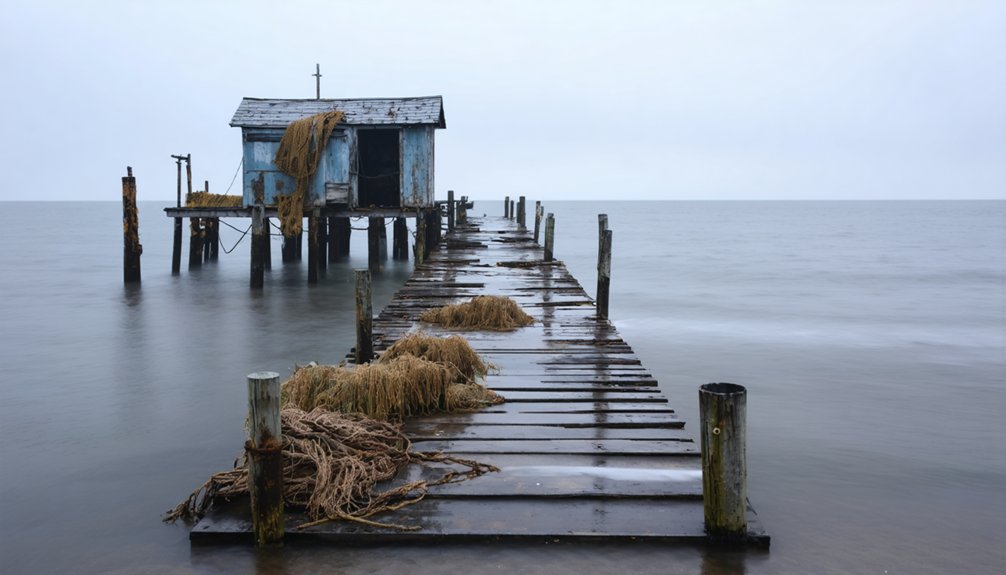
When Good Harbor emerged as a coastal settlement in the mid-19th century, its identity was firmly rooted in the burgeoning lumber industry that dominated the region. Beginning around 1863, the area’s logging heritage supported cordwood production for steam vessels, establishing a peripheral yet essential role in coastal commerce.
You’ll find Good Harbor’s story reflects adaptation rather than surrender. As timber resources declined, residents pivoted toward fishing traditions, transforming infrastructure from lumber shipping to fish processing. Docks once busy with schooners carrying lumber became moorings for fishing fleets, while the community’s rhythms synchronized with seasonal harvests.
This resilience couldn’t withstand 20th-century economic shifts, resource depletion, and improved transportation alternatives. The gradual outmigration led to deteriorating infrastructure and eventual abandonment.
Today, Good Harbor’s skeletal remains stand as evidence to a settlement that twice reinvented itself before time finally claimed it.
Falk’s Legacy: When Logging Towns Meet Coastal Industry
Among the diverse forms of coastal industrial settlements, Falk represents a compelling case study in the convergence of logging operations with maritime infrastructure.
As you explore this ghost town’s history, you’ll discover how technological innovation transformed coastal economies between 1870-1940.
- Steam donkey equipment and logging innovations dramatically increased timber extraction efficiency, enabling operations to expand deeper inland.
- Coastal migrations brought Scandinavian specialists who operated advanced milling technologies, creating multicultural industrial communities.
- Former fishermen abandoned maritime pursuits, beaching their boats to join the more lucrative logging industry.
- Environmental transformation was swift and thorough, with old-growth forests vanishing within decades.
This pattern reflects broader economic shifts along America’s coastlines, where timber gradually supplanted fishing as the dominant industry before eventually succumbing to resource depletion and market changes.
Bombay Beach: From Seaside Resort to Environmental Cautionary Tale
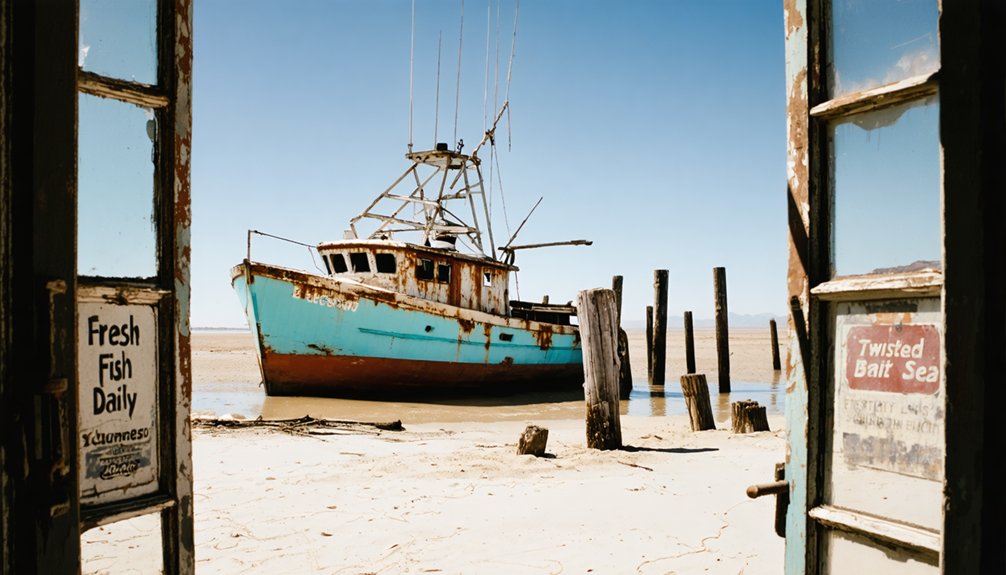
Unlike most American ghost towns that declined from resource depletion or economic shifts, Bombay Beach represents a distinctly environmental tragedy born from human intervention.
You’ll find this community 223 feet below sea level, created by accident in 1905 when the Colorado River breached irrigation canals, flooding the Salton Sink.
By the 1950s, this “miracle in the desert” rivaled Palm Springs, attracting celebrities like Sinatra and the Beach Boys. Its infrastructure expanded with marinas, stores, and paved streets as visitor numbers surpassed Yosemite National Park.
The Salton Sea’s golden age witnessed a desert paradise that outshone natural wonders and drew America’s elite to its improbable shores.
The 1970s brought environmental decay as rising water levels and chemical runoff devastated the ecosystem. Fish died, residents fled, and buildings decayed.
Yet from this destruction emerged an artistic renaissance, with post-2018 Bombay Beach transforming into an open-air gallery where artists capture the haunting juxtaposition of natural grandeur against human ruin.
Economic Forces Behind Coastal Ghost Town Formation
Although many might attribute the demise of coastal fishing villages solely to environmental factors, economic forces have played an equally significant role in transforming vibrant maritime communities into ghost towns.
You’ll find these economic pressures manifested through market dynamics that overwhelmed traditional fishing livelihoods.
- Declining fish stocks coupled with stringent fishing regulations squeezed small-scale operations, reducing profitability by up to 60%
- Competition from industrial fishing operations undercut local economies while fuel and equipment costs escalated
- Failed economic diversification left communities vulnerable when single industries collapsed
- Erosion of local consumer bases accelerated as younger generations migrated to urban centers with broader opportunities
These economic realities, intertwined with natural disasters and infrastructure degradation, created downward spirals from which many coastal villages couldn’t recover, leaving only weathered remnants of once-thriving communities.
Architectural Remnants of America’s Maritime Past

The architectural footprints left behind in America’s abandoned fishing villages offer invaluable insights into maritime heritage that economic analyses alone can’t capture.
You’ll find diverse architectural styles spanning from weathered fishing cottages to Victorian mansions throughout these maritime relics. Cortez Village exemplifies this diversity with 97 structures on the National Register, including the 1907 Pillsbury Boat Shop and 1940s wooden cistern.
McClellanville presents both modest shotgun houses and grand homes with detailed architecture, revealing socioeconomic stratification within fishing communities.
Rogers Street Fishing Village’s structures—including an 1886 lighthouse, French Canadian-styled fisherman’s house, and wooden fishing sheds—demonstrate how functional needs shaped coastal settlements.
These remnants, often documented through photographic records from 1890s-1940s, reveal how communities adapted construction techniques to local materials and maritime demands.
Cultural Heritage Preservation in Abandoned Coastal Communities
Cultural heritage preservation in abandoned coastal communities faces unprecedented challenges from climate-driven sea level rise and severe weather events that threaten to erase irreplaceable historical records.
You’ll find that effective cultural resource management requires integrating traditional knowledge with modern conservation techniques to mitigate coastal heritage impacts.
Consider these essential preservation approaches:
- Engage local communities through citizen science initiatives like Scotland’s Shorewatch model
- Incorporate Indigenous shell mounds and middens into extensive coastal management plans
- Develop sustainable tourism frameworks using the albergo diffuso model to revitalize heritage villages
- Implement community-based monitoring systems that leverage local expertise for post-storm assessment
The dual threats of rising seas and land subsidence demand immediate action.
Frequently Asked Questions
What Fishing Techniques Were Unique to These Coastal Ghost Towns?
Distinctive deep-sea dwellers developed net fishing innovations like brush weirs and tidal traps alongside specialized spearfishing techniques. You’ll find these abandoned communities once utilized hukilau communal harvesting and unique hook crafting methods.
How Did Local Indigenous Communities Interact With These Fishing Settlements?
Indigenous peoples often shared fishing traditions with settlers while experiencing cultural exchange through trade networks, though these interactions frequently resulted in displacement and appropriation of their traditional harvesting territories.
What Weather Events Contributed to These Towns’ Abandonment?
You’ll find hurricane damage devastated coastal fishing settlements, particularly the unnamed town where hundreds perished in 1893. Severe storms destroyed Bayocean’s infrastructure, while climate change accelerated these communities’ inevitable abandonment.
Are There Underwater Archaeological Remains From These Coastal Communities?
Yes, underwater exploration has revealed archaeological remains with significant coastal heritage value. You’ll find submerged burial sites, shell middens, and fishing artifacts preserved in peat sediment along America’s coastlines.
What Ghost Stories or Folklore Emerged From These Abandoned Fishing Villages?
Fog-shrouded ghosts whisper from America’s forgotten shores. You’ll discover haunted tales of vengeful wreckers in Helltown, Nantiinaq’s terrifying presence in Portlock, and maritime spirits explaining mysterious disappearances—folklore origins deeply rooted in isolation, tragedy, and cultural blending.
Exploring the eerie remnants of colonial ghost towns in America unveils stories that echo through time, revealing the hardships and resilience of early settlers. Each decaying structure holds whispers of the past, inviting those brave enough to uncover the mysteries that linger in the silence. As you wander through overgrown streets, the spectral presence of history becomes palpable, urging you to listen to the tales that shaped the very fabric of the nation.
References
- https://www.nps.gov/slbe/learn/historyculture/ghosttowns.htm
- https://www.visitredwoods.com/listing/falk-historic-logging-ghost-town/526/
- https://www.explore.com/travel/25-ghost-towns-around-us-and-history-behind-them/
- https://www.messynessychic.com/2021/11/23/the-japanese-fishing-village-that-vanished-from-los-angeles/
- https://www.outoftheoffice4good.com/post/exploring-the-almost-ghost-town-of-bombay-beach-ca
- https://www.themodernpostcard.com/the-salton-sea-a-ghost-of-former-glory-in-the-california-desert/
- https://www.loveexploring.com/gallerylist/188219/the-us-state-with-the-most-ghost-towns-revealed
- https://priceschool.usc.edu/news/terminal-island-history-japanese-los-angeles/
- https://en.wikipedia.org/wiki/Terminal_Island
- https://ryono.net/ryono/kay/Terminal Island History.pdf