America’s landscape is dotted with the physical remnants of failed utopian experiments. You’ll discover Plymouth Colony’s divided farmlands, Oneida’s silverware factory, and Brook Farm’s Hive foundations. Religious communes left underground church structures along riverbanks, while countercultural Drop City offers concrete dome foundations showcasing alternative architecture. These archaeological sites reveal how idealistic communities transformed their physical environments before ultimately collapsing. Each ruin tells a story of ambitious social experiments that couldn’t sustain their vision.
Key Takeaways
- Plymouth Colony’s failed communal system (1620-1623) led to economic reforms that allocated private land plots, dramatically improving productivity.
- Oneida Community transitioned from a utopian commune to a successful silverware manufacturing company in 1881 after internal social conflicts.
- Brook Farm’s infrastructure remnants include The Hive and archaeological evidence of communal dining areas reflecting transcendentalist ideals.
- Utopia, Ohio preserves underground church foundations and flood-damaged structures that reveal unsustainable communal economic practices.
- Drop City’s concrete dome foundations showcase innovative architectural approaches that pioneered solar technology integration and material repurposing.
Plymouth’s Failed Collectivism and Its Physical Legacy
While the Pilgrim settlers of Plymouth Colony are often romanticized in American history, their initial economic system represents one of America’s earliest failed utopian experiments.
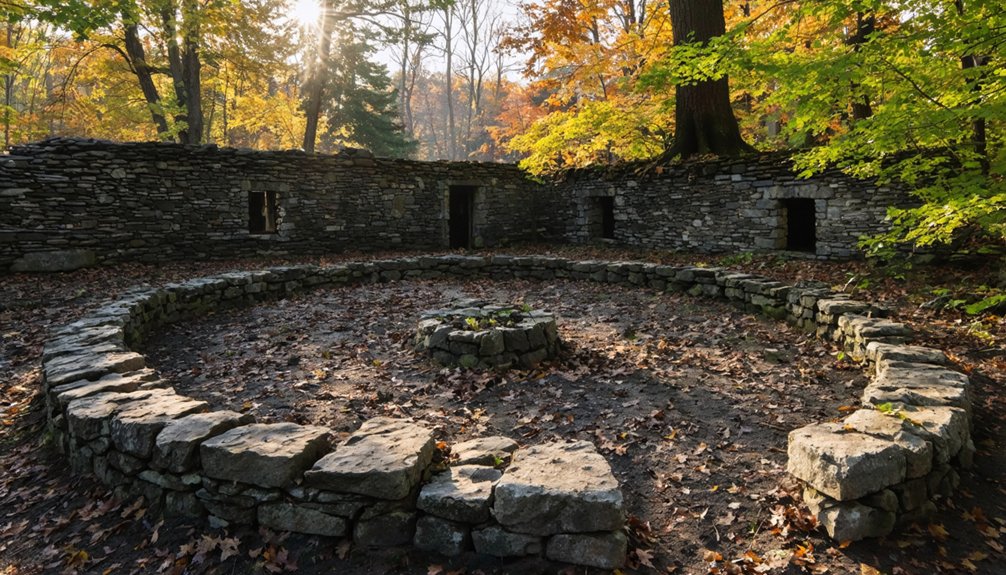
You’ll find few physical remains of their 1620-1623 collective failure, as the communal system left virtually no distinct structures or artifacts.
Governor Bradford’s detailed writings document how their idealistic “common stock” arrangement—where all property and profits were shared equally—quickly bred discontent.
Young men resented working for others without personal gain, while agricultural productivity plummeted under communal farming. The colony’s population, which had peaked at 150 colonists, struggled to produce enough food to sustain itself during this period.
The dramatic economic reform of 1623, when Bradford allocated private land plots to families, transformed the colony’s fortunes. Bradford critiqued their initial system as vanity and conceit, highlighting its fundamental flaws.
Though no physical monuments to collectivism remain, Plymouth’s experiment provides a tangible historical lesson: productivity flourished once individuals could directly benefit from their own labor.
Brook Farm: From Transcendentalist Haven to Historic Site
Walking the grounds of Brook Farm today, you’ll find preserved remnants of the original infrastructure that once housed Ripley’s ambitious Transcendentalist experiment.
The site’s physical features—including foundations of the ill-fated Phalanstery that burned in 1846—offer tangible connections to the community’s brief six-year existence. The community published The Harbinger magazine, which addressed contemporary social and political issues of the time. After the community’s dissolution, the property served various purposes, including as a Civil War training camp and later as a Lutheran orphanage.
Though the utopian venture collapsed financially, its enduring literary legacy persists through works like Nathaniel Hawthorne’s “The Blithedale Romance,” which drew direct inspiration from his brief residency at the farm.
Brook Farm Infrastructure
At the heart of the Brook Farm community stood an eclectic collection of buildings that embodied both practical function and transcendentalist ideals.
The Hive served as the central communal living hub where members gathered for meals, while the hilltop Eyrie housed the Ripleys as they oversaw their experimental society.
The most ambitious structure was the Phalanstery, a massive building designed to house fourteen families following Fourier’s socialist principles. Its architectural significance lay not in ornate design but in its practical embodiment of utopian ideals.
Tragically, it burned shortly after completion—a devastating blow to the community’s sustainability.
The farm’s buildings reflected a blend of Italianate and rural Gothic styles, creating spaces where intellectual pursuits merged with manual labor across the 175-acre campus, balancing individual expression with communal harmony. Weekly dances and leisure activities were regularly held at The Hive, fostering the community’s vibrant social life. Archaeological excavations have revealed that The Hive functioned as the community’s centralized dining area, evidenced by numerous dinnerware artifacts found exclusively at this location.
Literary Inspirations Endure
Despite its relatively brief existence, Brook Farm generated literary ripples that continue to influence American thought and literature today. When you visit the historic site, you’re walking through spaces that shaped Hawthorne’s critical reflections and inspired The Harbinger’s progressive discourse on social reform.
The community embodied transcendentalist ideals through its experimental merging of intellectual and physical labor, attracting figures like Margaret Fuller and Ralph Waldo Emerson. Their philosophical foundations—connecting nature, spirituality, and human improvement—remain preserved in both the physical site and literary legacy. The Institute for Agriculture and Education required members to perform extensive manual labor while still engaging in intellectual pursuits, truly embodying their worker-thinker ideal.
Brook Farm’s utopian experiment, though ultimately unsuccessful in practice, succeeded in crystallizing literary influences that continue to inform American debates about individualism versus community responsibility—questions that remain essential in contemporary discussions of societal organization and freedom. The site has been designated as a national historic site in the twenty-first century, offering public access with hiking and picnic facilities for visitors interested in its historical significance.
Oneida’s Complex Marriage and Commercial Success

You’ll find Oneida’s most controversial legacy in its “complex marriage” system, where members shared sexual partners while rejecting exclusive relationships in favor of communal bonds.
The community’s radical social experiment didn’t prevent economic success, as their silverware manufacturing business flourished even after the abandonment of their unconventional lifestyle in 1879.
Their shift from stirpiculture (selective breeding) to silverware production represents one of history’s most unusual pivots from utopian experimentation to mainstream commercial enterprise. The community faced growing internal strife around 1874 despite achieving notable economic prosperity, with younger members increasingly desiring traditional monogamous relationships. John Humphrey Noyes, who established the colony in 1848, eventually fled to Canada due to mounting legal pressures and community gossip.
Oneida’s Radical Marriage System
While many utopian communities experimented with alternative social structures, Oneida’s “Complex Marriage” system stands as perhaps the most radical reimagining of human relationships in American communal history.
Under this arrangement, you’d find yourself “married” to every member of the opposite sex, with sexual relations occurring through sanctioned “interviews” arranged by third parties.
Freedom came with constraints—social control manifested through the “Mutual Criticism” system and elder oversight. Women enjoyed unprecedented sexual autonomy while still operating within communal boundaries.
Despite its theological underpinnings and sophisticated birth control through male continence, complex marriage proved unsustainable.
Silver Business Transcends Commune
As Oneida’s complex marriage system formed the social foundation of the community, an equally remarkable economic transformation was taking shape.
What began as a diverse portfolio of small enterprises—from silk production to animal traps—ultimately found lasting success in silverware manufacturing.
You’ll find the community’s economic journey reflects their practical adaptability:
- Started silverware production in 1877, evolving into one of the world’s largest tableware manufacturers
- Transformed from commune to joint-stock company in 1881, preserving wealth while abandoning utopian structure
- Employed 200+ workers with progressive conditions, creating substantial community impact
- Built worker housing and funded local services, extending their influence beyond factory walls
This silverware legacy persisted long after the commune dissolved, demonstrating how commercial success transcended the community’s controversial social experiment—the products outlived the utopia.
From Stirpiculture to Silverware
The paradoxical success of Oneida emerged from two seemingly contradictory foundations: a radical approach to human sexuality and a pragmatic business acumen that eventually outlived the community’s social experiments.
While you explore Oneida’s artifacts today, you’re witnessing the commercial legacy of a community that once practiced “complex marriage”—where every adult was considered married to all others.
Their system of sexual autonomy forbade exclusive attachments while requiring mutual consent, overseen by elder “Central Members.”
Their stirpiculture program—a pioneering eugenics experiment—produced 58 children raised through communal parenting.
Mothers saw their children only weekly, preventing maternal bonds that might undermine community cohesion.
The Ghost Settlements of Religious Utopias
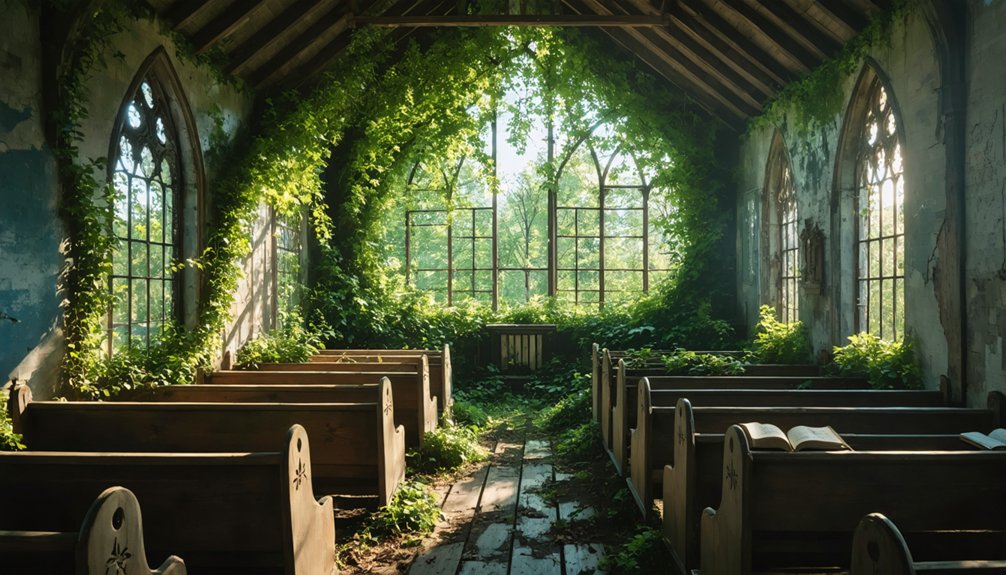
Throughout the American frontier, remnants of failed religious utopias stand as silent monuments to idealism crushed by harsh realities.
These settlements, born from Second Great Awakening fervor, collapsed when spiritual practices couldn’t overcome economic challenges and natural disasters.
If you explore these ghost settlements today, you’ll find:
- Utopia, Ohio’s remnants along riverbanks where Wattles’ followers perished in the catastrophic 1847 flood
- Underground church foundations revealing secret worship spaces where perfectionist theology once flourished
- Abandoned communal structures designed for labor-based bartering systems that couldn’t sustain rising land prices
- Nauvoo’s impressive ruins—once America’s largest utopian experiment before persecution drove Mormons westward
These physical remains offer tangible connections to communities that sacrificed everything pursuing spiritual perfection, only to discover their heavenly vision couldn’t withstand earthly realities.
Helicon and New Australia: Remnants of Exclusive Colonies
While many utopian experiments failed due to economic or religious pressures, both Helicon Home Colony and New Australia collapsed primarily due to their inherent contradictions of exclusivity.
If you visit Englewood, New Jersey today, you’ll find no physical remnants of Upton Sinclair’s 1906 Helicon experiment. Despite its progressive veneer of cooperative living and intellectual exchange, Helicon’s legacy remains tarnished by its explicit racial and religious barriers.
Nothing remains of Helicon’s progressive experiment in Englewood—only its contradictory legacy of equality within and exclusion without.
The colony barred Black, Jewish, and non-white applicants while simultaneously promoting equality within its walls. This paradox of exclusive ideals ultimately undermined Helicon’s utopian vision, even before fire destroyed the settlement after just five months.
Similar contradictions plagued New Australia, where would-be reformers created hierarchies mirroring the systems they’d fled. These sites represent America’s complex relationship with communal living—idealistic yet fundamentally flawed.
Drop City’s Dome Foundations: Countercultural Archaeology

Unlike many utopian communities that left few physical traces, Drop City‘s architectural remnants continue to offer archaeologists a tangible window into 1960s counterculture.
The legacy of such communities can also be found in urban exploration in rust belt towns, where decaying factories and abandoned homes tell stories of economic shifts and resilience. Explorers often document their findings, revealing layers of history that connect the past to the present. These sites serve not only as reminders of a bygone era but also as canvases for artistic expression and grassroots activism.
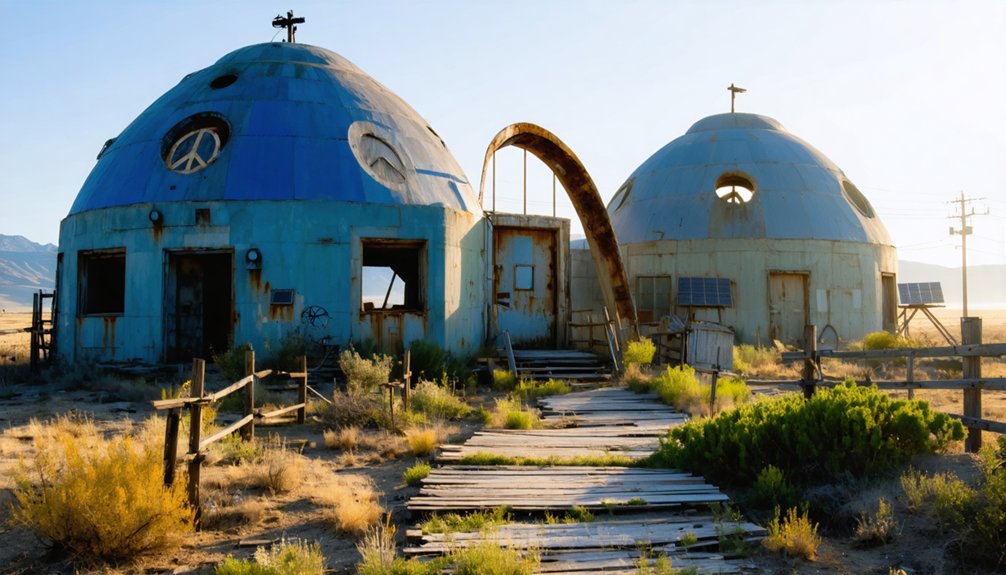
If you visit the former 7-acre site near Trinidad, Colorado, you’ll find concrete foundations where innovative dome architecture once stood—experimental structures built from car roofs and scrap materials that embodied Buckminster Fuller’s vision.
The counterculture impact of these remnants reveals:
- Geometric experimentation that redefined communal living spaces
- Pioneering solar technology integration decades before mainstream adoption
- Material repurposing that challenged consumer culture and waste
- Spatial arrangements that reflected non-hierarchical social structures
These archaeological traces document not just failed utopian dreams, but the practical implementation of alternative building methods that influenced generations of sustainable architects and community planners.
Communes That Vanished Without a Trace
Despite extensive documentation of America’s utopian experiments, numerous communal societies have disappeared with virtually no physical evidence of their existence. The Ephrata Community, once vibrant with spiritual communal living, gradually faded after a typhus outbreak in 1777, leaving minimal traces by its final dissolution in 1934.
You’ll find that secular communes often suffered quicker, more complete erasures. Fruit Hills Commune collapsed within seven years, while Nashoba’s Owenite venture lasted barely two years—both victims of inexperience and internal discord.
These communal failures typically left no architectural remnants beyond occasional foundations or repurposed structures. Unlike the substantial brick buildings preserved at Harmony or the Oneida Mansion House, many smaller Noyesian communities and Fourierist experiments vanished completely, leaving historians to piece together their existence solely through written accounts rather than physical artifacts.
Visiting and Preserving America’s Utopian Ruins

The physical traces of America’s utopian experiments haven’t all vanished into historical obscurity. When you visit these remnants today, you’ll encounter a delicate balance between preservation and natural decay, with sites like Utopia, Ohio revealing stone foundations and repurposed structures that tell complex stories of idealistic visions.
Visiting strategies for these often-remote locations require:
- Research access restrictions beforehand, as many sites face ownership disputes or environmental hazards
- Respect preservation efforts by staying on marked paths to prevent accelerating deterioration
- Look for interpretive signage that contextualizes ruins within their historical frameworks
- Support local preservation initiatives through heritage tourism dollars when possible
Preservation challenges persist as communities navigate funding shortages while balancing authentic presentation against the inevitable forces of time and nature that continuously reshape these physical memories of alternative American dreams.
Frequently Asked Questions
Were Any Utopian Communities Financially Successful After Dissolution?
Yes, you’ll find several utopian communities achieved financial sustainability post-dissolution, like Amana Colonies’ shift to profitable manufacturing and Oneida’s silverware company, demonstrating economic adaptability beyond their communal origins.
How Did Nearby Towns React to These Experimental Communities?
Neighboring towns typically viewed utopian experiments with suspicion, often economically isolating these communities. You’d find community reactions ranging from outright hostility to occasional cultural exchange, but rarely genuine integration or acceptance.
What Personal Items Remain From Former Commune Members?
Like seeds scattered after a wildflower’s death, you’ll find personal artifacts from commune members preserved in museums—diaries, handcrafted furniture, clothing, and commune belongings that whisper stories of their utopian dreams.
Did Any Communes Successfully Integrate With Indigenous Populations?
No, you won’t find documented examples of successful indigenous cooperation among historical utopian experiments. Their colonial foundations fundamentally prevented meaningful cultural exchange, operating within systems that prioritized displacement rather than integration.
Were There Utopian Communities Founded Specifically for Racial Minorities?
Like oases in a desert of discrimination, you’ll find numerous utopian communities founded for minorities—Mound Bayou, Soul City, and Nicodemus embodied racial equality and community resilience amid America’s segregated landscape.
References
- https://www.mentalfloss.com/history/failed-utopias
- https://fee.org/articles/the-dark-side-of-paradise-a-brief-history-of-americas-utopian-experiments-in-communal-living/
- https://www.yesmagazine.org/health-happiness/2022/06/01/american-communes-failed-experiment
- https://isismagazine.org.uk/2012/05/top-5-failed-utopias/
- https://tools4literature.weebly.com/utopia-failures.html
- https://www.vice.com/en/article/failed-utopias-throughout-history-v25n1/
- https://constitutingamerica.org/90day-aer-americas-founding-knowledge-of-failed-utopian-ideologies-establishing-a-us-constitution-based-on-tradition-and-natural-rights-to-prevent-tyranny-guest-essayist-joerg-knipprath/
- https://www.nps.gov/articles/utopias-in-america.htm
- https://www.afa.net/the-stand/faith/2019/11/the-pilgrims-tried-socialism-it-did-not-work
- https://www.hoover.org/research/how-private-property-saved-pilgrims