To trace colonial ghost towns effectively, you’ll need to research archival records before visiting and acquire topographic maps with GPS coordinates. Pack essential gear including sturdy boots and proper lighting. Learn to interpret foundation patterns and identify period-specific artifacts like clay pipes and brick types. Always respect legal boundaries by securing proper permissions. Connect with local historical societies to access specialized knowledge. These initial steps will reveal centuries of hidden stories beneath your feet.
Key Takeaways
- Research historical archives and maps before fieldwork to identify potential ghost town locations and understand their historical context.
- Use GPS coordinates with overlaid historical maps to navigate accurately to abandoned settlement sites.
- Analyze foundation patterns and building remains to uncover social hierarchies and construction techniques from colonial periods.
- Document findings through photographs in varying light conditions, detailed measurements, and field sketches with numbered elements.
- Verify land ownership and obtain necessary permissions to avoid trespassing while researching abandoned colonial settlements.
Research Historical Archives Before Your Visit
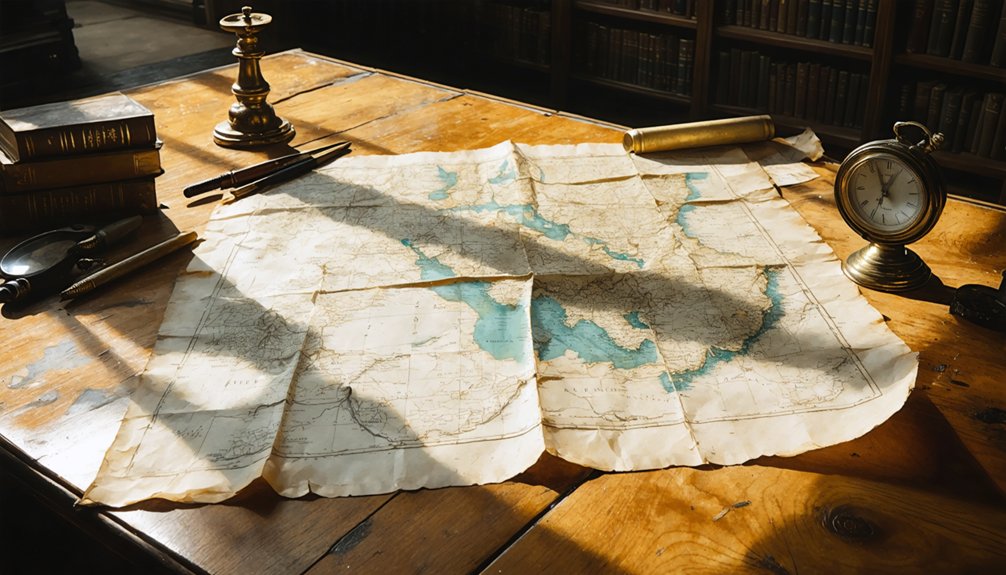
Before starting your exploration of colonial ghost towns, thorough archival research serves as the foundation for any meaningful fieldwork.
Identify relevant repositories holding government records, land deeds, maps, and missionary reports—often located in national archives or former colonial capitals.
Contact archives in advance to understand access requirements and restrictions. You’ll likely need research permits or formal introduction letters. Digital catalogs can streamline your document search, though some materials remain available only in physical form.
When interpreting colonial documents, maintain critical awareness of their inherent biases. Cross-reference multiple sources to verify information and identify contradictions. Pay attention to marginalia and annotations that might reveal hidden narratives. Many documents, especially those from Oaxaca, contain valuable references to pre-colonial places and events that can guide your field investigations.
Remember that archival research isn’t merely academic—it’s your practical roadmap for locating ghost town sites and understanding their historical context before stepping foot on location.
Consider how anticolonial memory shapes the way historical sites are preserved and interpreted in formerly colonized regions.
Acquire Detailed Topographic Maps and GPS Coordinates
Armed with archival knowledge, your next step involves securing detailed cartographic resources that will guide your physical exploration. USGS topographic maps from 1960-1980 reveal colonial ghost town structures absent from modern maps.
Overlay historical layers with current topographic data using ArcGIS Pro or Gaia GPS to identify abandoned settlements with precision.
For ideal topographic mapping and GPS accuracy:
- Adjust opacity settings to emphasize historical features over current basemaps
- Extract exact GPS coordinates from georeferenced maps for fieldwork planning
- Download waypoints for offline accessibility in remote colonial sites
- Cross-reference historical map features with GPS data during exploration
These historical topos help discover ghost towns and homesteads that have been abandoned over time.
Record precise locations while in the field, allowing you to systematically catalog remnants and share findings with fellow researchers exploring these forgotten colonial settlements.
Software like Surfer can help create visual density maps of artifact distributions when conducting archaeological work at these sites.
Pack Essential Ghost Town Exploration Equipment
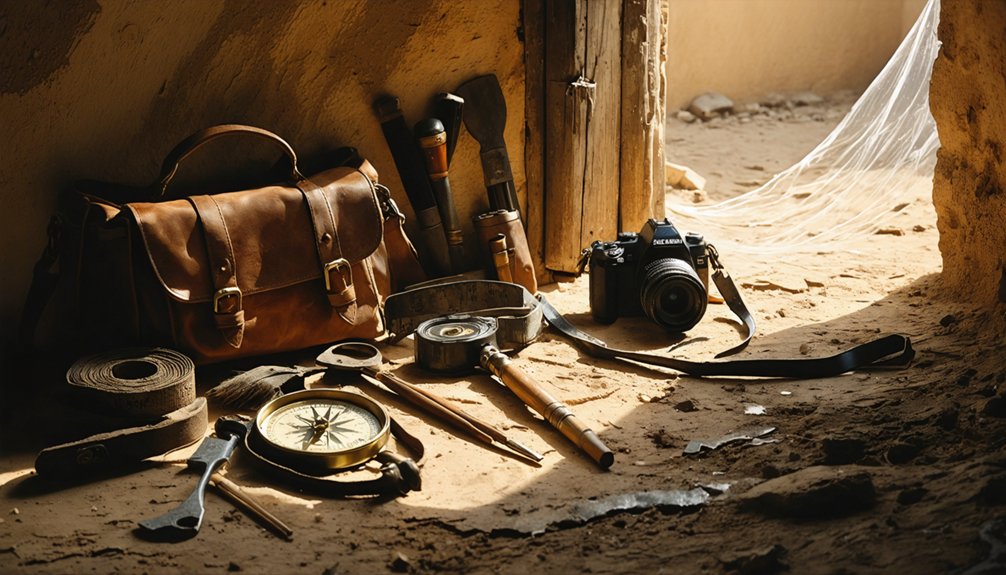
Properly equipped explorers maximize both safety and discovery potential when investigating colonial ghost towns.
Your exploration gear should include water-resistant boots with ankle support and traction soles to navigate unstable terrain safely. Protective tactical gloves with reinforced palms shield your hands from rusted metal and broken surfaces.
Essential safety equipment includes reliable lighting—carry both a high-quality flashlight and a headlamp for hands-free movement, plus backups. When selecting flashlights, prioritize models with adjustable focus for effectively illuminating both wide areas and distant details. Consider GPS devices or offline map applications to track your location in remote areas with no cellular reception.
Don’t overlook respiratory protection; N95 or P100 masks protect against asbestos and mold in deteriorating structures.
Finally, pack a thorough first-aid kit containing bandages, antiseptic wipes, and personal medical supplies, alongside a multi-tool and water bottle for extended explorations.
This methodical approach to equipment selection guarantees you’re prepared for whatever you’ll encounter in these historic remnants.
Interpret Foundation Patterns and Building Remains
Deciphering foundation patterns offers three critical insights into colonial settlements that most casual observers overlook. Through foundation analysis, you’ll discover social hierarchies, construction techniques, and community planning principles that shaped colonial life.
Rectilinear layouts reveal European influences, while foundation materials document local resource adaptation.
When performing architectural interpretation, focus on:
- Foundation dimensions and depth – larger structures often indicate public buildings or wealthier residences
- Construction material variations – brick sizing, mortar composition, and timber types that date specific colonial periods
- Spatial relationships between buildings – revealing neighborhood functions and social stratification
- Hearth and chimney placements – signifying domestic practices adapted to local environments
You’ll find that building clusters often reveal functional zones, with centralized structures typically serving administrative or ceremonial purposes while surrounding foundations indicate residential or commercial use. Urban versus rural settings significantly influenced colonial tavern functions, with urban tavern assemblages reflecting more diverse social and drinking activities compared to their rural counterparts.
Identify Colonial-Era Artifacts and Material Culture
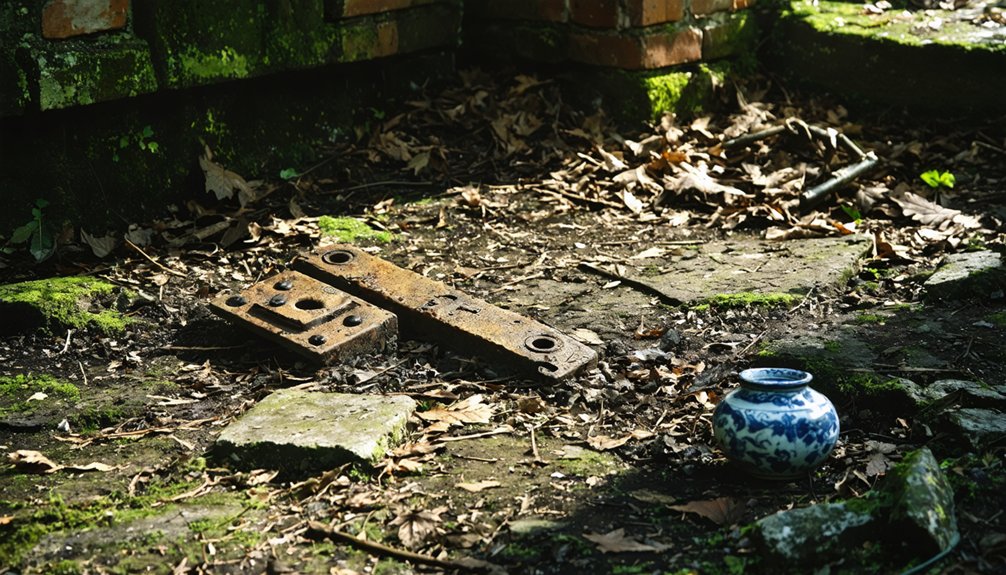
Colonial ghost towns yield rich material signatures through everyday tools like clay pipes, bone implements, and metal fasteners that reflect residents’ daily activities and socioeconomic status.
You’ll distinguish local products from European imports by examining distinctive characteristics—earthenware’s porous, low-fired body versus salt-glazed stoneware’s “orange peel” texture, or hand-forged square nails versus machine-cut varieties. Examining glass artifacts from colonial sites can reveal important information about social status, trade networks, and daily life practices as documented in collections from places like Colonial Williamsburg.
Construction materials often reveal settlement patterns and cultural adaptation, with foundation remnants containing diagnostic elements such as specific brick formats, architectural hardware, and building techniques that demonstrate the fusion of European traditions with locally available resources. The presence of ceramic and stone smoking pipes in colonial contexts provides valuable insights into social gatherings and trade networks that connected these early settlements.
Daily Life Tools
Material remnants of colonial existence provide archaeological windows into the daily routines, social hierarchies, and technological capacities of early settlements. When exploring ghost towns, you’ll identify daily life tools through careful observation of ceramics usage, glassware styles, and household implements that reveal socioeconomic status.
You can distinguish colonial artifacts by examining:
- Textile production tools like wool cards, lucets, and drop spindles that indicate domestic manufacturing
- Writing implements such as quills, slate pencils, and personal seals reflecting literacy levels
- Time-keeping devices including portable sundials and noon marks showing technological adaptation
- Recreational items like dice and whirligigs demonstrating leisure activities
These material remains reflect how colonists navigated practical challenges while maintaining cultural connections, revealing the complexity of frontier life through everyday objects rather than just architectural remnants. Careful analysis of these artifacts helps archaeologists reconstruct social stratification among colonial populations.
Construction Material Signatures
The identification of construction material signatures represents one of the most reliable methods for authenticating colonial-era structures and distinguishing them from later reproductions.
Look for Savannah Gray bricks with their distinctively larger dimensions and inferior firing quality alongside smaller, harder Philadelphia bricks – their combined presence indicates specific colonial trade networks and construction periods.
Examine mortar techniques closely, as joint patterns served as functional gridlines for craftsmen and remain key chronological indicators.
You’ll notice that pre-1940 freehand construction relied on these joints for dimensional accuracy.
When analyzing paint remnants, high lead concentrations (85-95% pigment) with remarkable flexibility point to authentic colonial craftsmanship.
These white lead compounds mixed with linseed oil created durable finishes that have survived centuries, unlike modern reproductions with lower-quality adhesion to brick characteristics.
Imported Versus Local
Distinguishing between imported and locally-made artifacts requires careful analysis of material composition, production techniques, and stylistic elements found at colonial ghost town sites.
When examining artifacts, you’ll discover that imported ceramics like tin-glazed tiles contrast sharply with hand-formed local bricks in both quality and design.
To identify origin accurately, consider:
- Manufacturing techniques – European ceramics show wheel-thrown uniformity while local artifacts often display hand-built irregularities
- Material composition – Imported glassware contains specific mineral compositions absent in colonial-produced items
- Decorative elements – British clay pipes feature distinctive molded patterns whereas Native American-made pipes show different stylistic treatments
- Cultural hybridity – Look for artifacts combining European materials with indigenous craftsmanship, revealing complex cultural exchanges
These distinctions help you reconstruct the economic networks and cultural interactions that defined colonial settlements before their abandonment.
Document Your Findings With Proper Techniques
Properly documenting ghost town remnants requires systematic approaches that preserve historical information for future generations. Start by formulating specific questions about construction materials and craftsmanship before visiting sites.
Your documentation techniques should include photographs in varying light conditions to capture structural details and building “ghosts”—shadows of former elements that reveal past configurations.
Complement visual storytelling with precise written descriptions using architectural terminology and detailed measurements of at-risk features. Create field sketches with systematically numbered elements for cross-referencing with your photos.
Don’t overlook the intangible qualities like atmosphere and spatial relationships that bring these remnants to life. Finally, integrate your findings with archival sources like maps and deed records to develop a thorough understanding of the site’s evolution through time.
While documentation captures the physical evidence of colonial ghost towns, successful exploration depends on understanding the legal framework that governs these historic sites.
Steering preservation strategies and legal frameworks requires methodical preparation before you set foot on historic ground.
- Verify land ownership through county records and obtain necessary permissions—trespassing carries legal consequences that can impede future research.
- Research applicable historic preservation ordinances, as modifications may require Certificates of Appropriateness from local commissions.
- Consult management plans from similar sites to inform your approach to arrested decay principles.
- Consider legal tools such as easements or trusts if you’re pursuing long-term preservation efforts.
Early collaboration with regulatory bodies streamlines approvals and guarantees your explorations respect both legal boundaries and the integrity of these irreplaceable historical resources.
Connect With Local Historical Societies and Experts
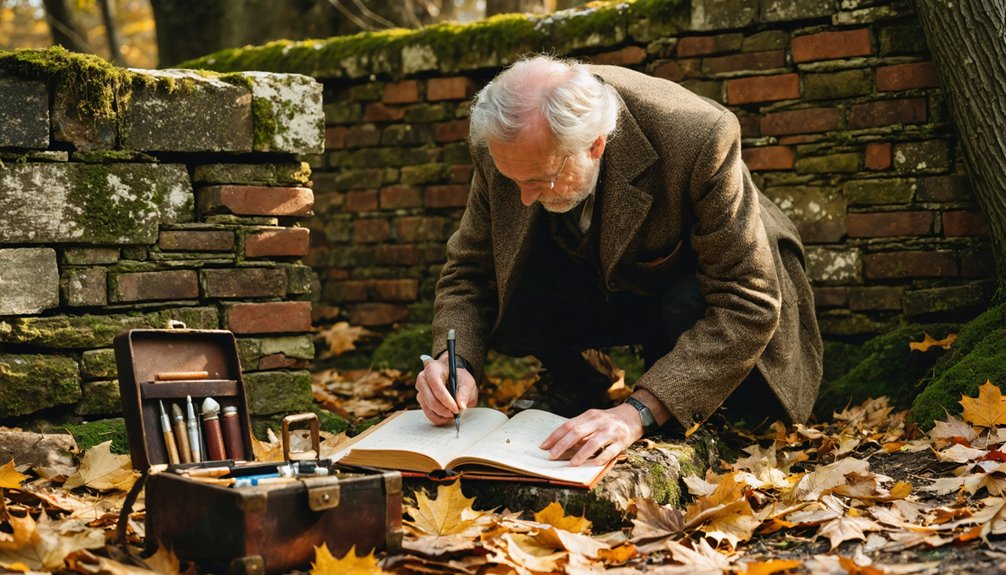
Local historical societies function as essential knowledge repositories where professional historians and community experts converge, offering unparalleled access to specialized resources you won’t find in conventional research databases.
When conducting ghost town investigations, schedule expert consultations with archivists who can guide you through digitized collections, including rare Sanborn maps that reveal detailed building layouts.
You’ll benefit from metadata prepared by trained researchers, ensuring efficient navigation through cataloged materials.
Engage with community members who contribute family histories and oral accounts that illuminate town infrastructure and social dynamics.
University partnerships often yield interdisciplinary research through spatial analysis centers and student projects.
Take advantage of GPS-guided platforms that connect desktop research with on-site exploration, transforming abstract knowledge into tangible discoveries while accessing cached digital materials in remote locations.
Recognize Cultural Significance Beyond Physical Structures
When investigating colonial ghost towns, you’ll need to examine the narratives embedded in these sites beyond their physical remnants, as they represent complex histories of expansion, displacement, and cultural transformation.
The remnants of ghost towns in California often reveal traces of once-thriving communities that have long since faded into memory. Each crumbling structure and rusted artifact tells a story of hope, struggle, and resilience amidst the challenges of their time. Exploring these locations can provide unique insights into the region’s historical landscape and the people who shaped it.
Colonial interpretations have historically marginalized Indigenous perspectives, which often view these places not as abandoned but as part of continuing spiritual and cultural landscapes with cyclical patterns of human presence.
Understanding these layered meanings requires engagement with oral histories and intangible cultural heritage that contextualize the visible structures within broader frameworks of memory, identity, and ongoing cultural significance.
Colonial Narratives Matter
Nearly every colonial ghost town preserves not just physical remnants of the past, but complex historical narratives that demand critical examination.
When you explore these sites, remember that colonial narratives often obscure indigenous perspectives and experiences of displacement, conflict, and resistance.
To develop a more thorough understanding, you should:
- Question whose stories are centered in the site’s interpretation and whose are marginalized
- Research indigenous histories of the area before colonial settlement occurred
- Examine how socioeconomic and racial dynamics shaped the town’s development and decline
- Consider how preserved structures symbolize power relationships rather than neutral historical artifacts
Beyond Visible Remains
Colonial ghost towns reveal far more than their crumbling architectural remains when approached with an informed perspective.
You’ll discover cultural narratives embedded in landscape features—road alignments, boundary markers, and agricultural terraces—that speak to former settlement patterns even when buildings have vanished.
Look beyond structures to recognize intangible heritage preserved through oral histories, indigenous stories, and community memory.
Local festivals and storytelling events often celebrate these layered histories.
Natural features like significant trees, old stone walls, and waterways hold spiritual significance and cultural meaning across different communities.
Pay attention to subtle traces: livestock pounds, wells, and roadside markers embody communal practices that survived physical decay.
These elements, combined with archaeological evidence, reveal contested histories and spectral geographies that challenge dominant narratives and honor diverse historical experiences.
Photograph Ruins Effectively for Documentation
Documenting colonial ghost town remnants through photography requires meticulous preparation and technical expertise to capture their historical significance and physical condition accurately.
Employ shadow play to reveal architectural details and texture emphasis to showcase weathering patterns that tell the story of time’s passage.
For ideal documentation results:
- Use wide-angle lenses (16-35mm) for establishing shots that contextualize buildings within their landscape, then switch to prime lenses for artifact details.
- Shoot during golden hour when low-angle light accentuates structural textures and dimensional qualities.
- Maintain consistent aperture settings (f/7.1-f/9) for maximum depth of field across all documentation shots.
- Incorporate multiple perspectives of the same subject—wide contextual, mid-range structural, and macro detail—to create thorough visual records.
Frequently Asked Questions
How Do You Distinguish Between Colonial Ruins and Indigenous Structures?
Examine materials and design: colonial architecture typically features symmetrical layouts with European masonry, while indigenous craftsmanship shows regionally-adapted materials and astronomical alignments reflecting spiritual worldviews rather than utilitarian functions.
Are Metal Detectors Allowed at Protected Ghost Town Sites?
No, you’re not allowed to use metal detectors at protected ghost town sites. Historic preservation laws explicitly prohibit this activity, and metal detecting regulations carry serious penalties including fines, equipment confiscation, and possible criminal charges.
What Safety Precautions Should I Take When Exploring Abandoned Mines?
Don’t enter abandoned mines—they’re extremely dangerous. If you must explore, bring proper exploration gear including gas monitors, hard hats, and sturdy lighting. Always inform others of your location and expected return time.
How Do Seasonal Changes Affect Accessibility to Remote Ghost Towns?
Seasons dance across ghost towns’ threshold like gatekeepers. Winter accessibility diminishes with snow-blocked roads and frozen infrastructure, while summer exploration offers ideal conditions despite heat risks. You’ll need to plan meticulously around these cyclical barriers.
Can I Legally Collect Small Artifacts as Souvenirs?
No, you can’t legally collect artifacts, even small ones. Federal and state legal regulations strictly prohibit removal without permits. Instead, focus on artifact preservation through photography and respectful observation.
References
- https://en.wikipedia.org/wiki/List_of_ghost_towns_in_Colorado
- https://www.colorado.com/articles/colorado-ghost-towns
- https://www.uncovercolorado.com/archaeological-sites/
- https://www.forestsociety.org/property/monson-center
- https://www.geotab.com/ghost-towns/
- https://pehc.colostate.edu/2022/03/dearfield-colorados-almost-forgotten-black-ghost-town/
- https://www.atlasobscura.com/lists/americas-best-preserved-ghost-towns
- https://www.cambridge.org/core/journals/advances-in-archaeological-practice/article/colonial-archives-or-archival-colonialism/3B4BA89388201E2F41E245DEDD158D47
- https://liu.diva-portal.org/smash/get/diva2:1899963/FULLTEXT02.pdf
- https://read.dukeupress.edu/south-atlantic-quarterly/article/123/2/321/387190/On-Anti-colonial-Time-Encountering-Archival-Traces