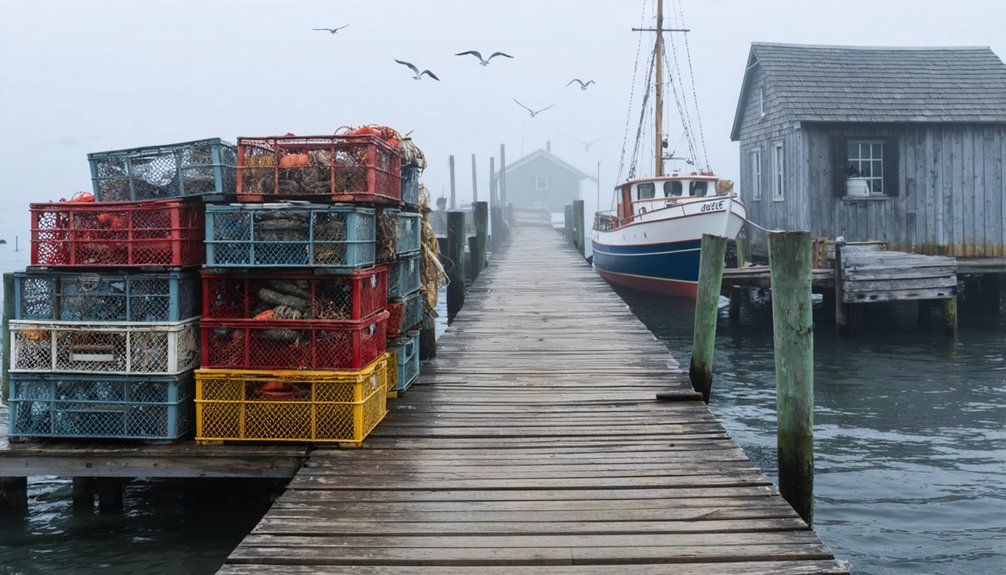
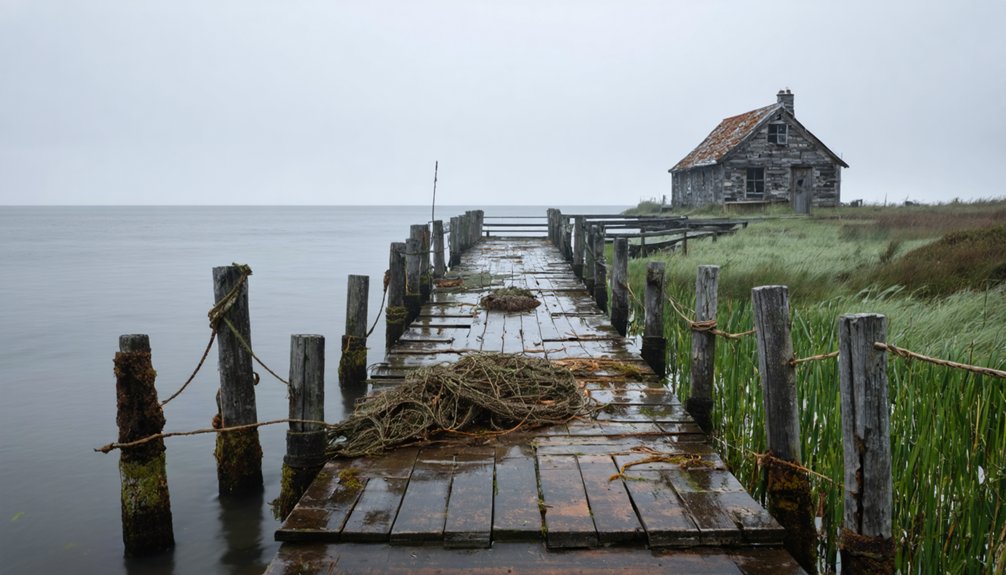
Abandoned coastal fishing settlements contain archaeological treasures that reveal centuries of maritime life. You’ll find middens with fish bones, ancient hooks, and weathered tools that connect to generational fishing practices. These sites offer insights into how communities strategically positioned themselves near water sources and developed sophisticated fishing techniques. From Atlit Yam to Newfoundland, these ghost villages tell stories of ecological collapse and cultural resilience. The treasures await your discovery.
Key Takeaways
- Abandoned fishing villages contain archaeological treasures including middens with fish bones, shells, and ancient fishing tools.
- Maritime artifacts like bone hooks and stone net weights provide insights into traditional fishing technologies spanning millennia.
- Weathered structures and tools in deserted settlements connect modern observers to generational fishing practices.
- Oral histories and folklore preserved from abandoned coastal communities represent vital cultural heritage transmission pathways.
- Once-thriving harbors reveal sophisticated maritime economies through settlement patterns positioned for optimal resource access.
The Archaeological Footprint of Ancient Fishing Communities
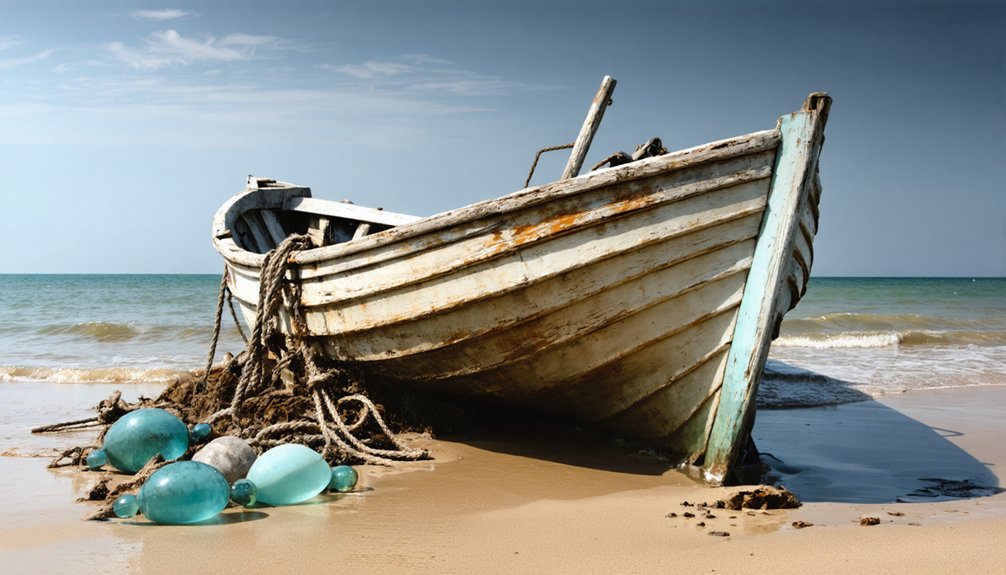
When examining the archaeological footprint of ancient fishing communities, you’ll find an extensive material record spanning multiple coastal regions and millennia. The settlement patterns reveal strategic placement near water—coastal caves, estuaries, and islands—maximizing access to marine resources.
Ancient fishing communities left strategic imprints along coastlines, revealing humanity’s enduring connection to marine environments.
Evidence manifests in middens containing fish bones, shells, and otoliths, with distinct fragmentation patterns indicating preservation methods. You’ll discover fishing tools preserved in remarkable detail: bone and antler hooks from Makran and Aegean sites, stone net weights, and remnants of weirs. Recent excavations on the Makran coast have uncovered stone fishing hooks and other artifacts from the 4th millennium BCE.
The absence of hooks at some locations suggests alternative capture methods.
These communities left behind not just implements but entire ecosystems frozen in time—their remains providing insights into ancient sea levels, migration patterns, and human adaptation to coastal environments through targeted exploitation of diverse aquatic species. The systematic exploitation of marine resources can be traced back to the 11th millennium BP, when environmental changes increased nutrient concentration in Aegean waters.
Cultural Echoes: Heritage and Identity in Abandoned Shores
Cultural echoes reverberate through abandoned fishing settlements, carrying complex narratives that intertwine maritime heritage with communal identity. You’ll find these coastal ghost towns rich with stories embedded in their weathered fish stages, smokehouses, and specialized tools—tangible connections to generational maritime practices.
The cultural resilience of these communities persists through oral histories and maritime folklore that transcend physical abandonment. Traditional ecological knowledge, seasonal fishing techniques, and community rituals represent vital heritage transmission pathways now threatened by economic shifts and urbanization. Thousands of European fishers established seasonal fishing camps along Newfoundland’s shores from the 16th to 18th centuries, creating the foundations for later permanent settlements.
When you explore these abandoned shores, you’re witnessing the intersection of material and intangible heritage—where specialized fishing implements tell stories of adaptation and survival. Recent excavations in Koupal have revealed fishing hooks and weights indicating organized fishing activities dating back to 4000 BCE.
Among these historical remnants, modern enthusiasts can discover coastal fishing techniques for beginners that pay homage to the practices of ancient communities. By learning the art of net casting or the proper use of bait, newcomers can connect with the past while embracing the ocean’s bounty. Each cast into the water reverberates with the stories of those who came before, making their fishing journey not just a hobby, but a continuation of a rich cultural legacy.
Despite socioeconomic transformations that triggered their abandonment, these settlements continue serving as powerful anchors for descendants seeking connections to ancestral coastal practices.
When the Tide Turned: Ecological Collapse and Settlement Abandonment

The dramatic ecological collapse of marine ecosystems represents the primary catalyst for coastal settlement abandonment worldwide. You’ll find the signs of this devastation etched into ghost towns where generations once harvested the sea’s bounty.
The collapse of fishing sustainability follows a predictable pattern:
- Bottom trawling decimates seafloor habitats, destroying nurseries essential for commercial species
- Overfishing removes apex predators, triggering mesopredator release and ecological reorganization
- Habitat destruction eliminates filter feeders, causing eutrophication and harmful algal blooms
- Economic systems implode as fish populations crash, forcing mass exodus
Without ecological resilience, these once-vibrant communities couldn’t adapt.
Three billion people worldwide depend on marine biodiversity for livelihoods, yet when fish populations plummet, entire economic networks disintegrate. Processing plants close, support industries collapse, and generations-old maritime knowledge becomes obsolete. The Atlantic cod fishery collapse led to a fishing moratorium that devastated coastal communities across Newfoundland, resulting in unprecedented unemployment and migration. The Fleming survey documented significant declines in juvenile Atlantic cod abundance across all age groups from the 1960s to the 1990s, providing crucial evidence of the ecological shifts that preceded community collapse.
Ghosts of Prosperity: Material Remains of Bygone Fishing Economies
Ancient harbors and weathered settlements provide tangible evidence of once-thriving maritime economies that have since vanished into history.
At sites like Atlit Yam, you’ll discover the archaeological signature of economic resilience—over 6,000 fish remains with 92% Gray triggerfish, alongside 34 grouper and 32 drum specimens in a single feature, revealing sophisticated ancient fishing practices.
The material record tells a story of prosperity through integration. Granaries once held an estimated 26,000 grains of emmer and naked wheats, while waterlogged seeds of fig, grape, and lentil demonstrate agricultural diversity. The site’s well-preserved stone semicircle with seven megaliths suggests ritualistic practices centered around water resources.
Unfired clay figures, shell necklaces, and carved bones speak to artistic sophistication and status expression.
These artifacts aren’t merely relics—they’re physical evidence of communities that successfully balanced marine and terrestrial resources until environmental disruption forced their abandonment. Similar to Early Mesolithic Scandinavian sites, approximately 90% of settlements were strategically positioned on what were once islands, providing ideal access to marine resources.
Preserving Maritime Legacy: Conservation Efforts and Coastal Memory

While abandoned fishing communities stand as physical reminders of maritime history, modern conservation efforts now actively preserve these coastal legacies through innovative partnerships and policy frameworks.
Today’s maritime conservation approaches merge traditional fishing wisdom with contemporary science, ensuring these heritage sites remain relevant for future generations. The Remnant-Revive Collective demonstrates how community engagement can transform declining fishing villages into sustainable models for development. Alternative energy installations, especially offshore wind facilities, are now being integrated thoughtfully into coastal planning to balance renewable energy needs with preservation of marine ecosystems.
Coastal heritage preservation efforts include:
- Interstate commissions like ASMFC implementing management frameworks for migratory species through state-federal partnerships
- Ecosystem restoration projects that remove barriers and reestablish historic spawning grounds in rivers like the Penobscot
- Living shoreline development that protects eroding coastlines while enhancing habitat value
- Community-based education initiatives that revive traditional fishing practices and cultural knowledge
You’ll find these conservation approaches not only preserve physical remnants but also revitalize the cultural traditions that shaped coastal communities for centuries.
Frequently Asked Questions
How Do Climate Patterns Influence Abandonment Cycles of Fishing Settlements?
With Arctic erosion reaching 20 meters yearly, your fishing settlement’s resilience depends on climate variability patterns—shifting ocean temperatures, precipitation cycles, and storm dynamics—forcing abandonment when adaptation becomes impossible.
What Personal Artifacts Reveal About Daily Family Life in Fishing Communities?
You’ll find family heirlooms like decorated wooden bowls reveal kinship ties, while personalized fishing tools with totemic markings demonstrate intergenerational knowledge transfer and individual status within community hierarchies—tangible evidence of ancestral practices.
Do Abandoned Settlements Experience Periods of Temporary Reoccupation?
Like ghosts of the past, abandoned settlements frequently welcome temporary inhabitants during seasonal migrations. You’ll find this pattern in Chukotka, California islands, and worldwide coastal regions pursuing traditional subsistence activities.
How Did Gender Roles Evolve in Coastal Fishing Economies?
You’ve witnessed gender division evolve from rigid patriarchal systems toward more fluid arrangements, with women’s roles expanding beyond processing into direct fishing and leadership, despite persistent labor shifts caused by industrialization and market pressures.
What Indigenous Knowledge Systems Were Lost With Settlement Abandonments?
You’ve lost specialized fishing techniques, cultural heritage embedded in oral traditions, governance systems for environmental stewardship, and localized ecological knowledge that connected your communities to marine ecosystems across generations.
References
- https://www.nature.com/articles/s41598-024-55047-z
- https://www.ncei.noaa.gov/data/oceans/coris/library/NOAA/other/rapid_assess_process_shaped_fish_depend_st_croix.pdf
- https://ecologyandsociety.org/vol29/iss1/art9/
- https://www.pnas.org/doi/10.1073/pnas.0405150101
- https://tos.org/oceanography/article/distress-signals-historical-waypoints-in-northwest-atlantic-fisheries-since
- https://ncwf.org/blog/coastal-fisheries-management/
- https://www.science.org/doi/10.1126/sciadv.adt4782
- https://www.tcd.ie/tceh/assets/pdf/north_atlantic_fish_revolution_ca_ad_1500.pdf
- https://arkeonews.net/archaeologists-unearth-prehistoric-fishing-evidence-on-the-makran-coast-of-iran/
- https://pmc.ncbi.nlm.nih.gov/articles/PMC4376368/