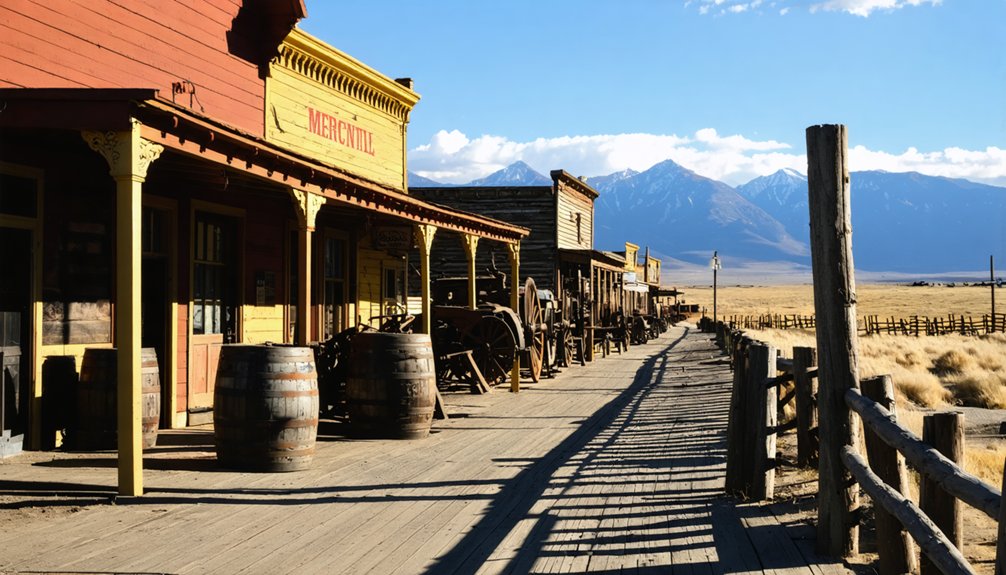
Tremont House began as a gold mining settlement in Nevada’s Virginia Range in 1906, founded by the Ramsey brothers. You’ll find it was briefly prosperous after the construction of a thirty-ton mill in 1909, but severe water scarcity ultimately prevented substantial growth. The town’s fortunes declined as residents moved to neighboring Ramsey, which offered better water access. Today, the ghost town sits on private property with limited access, its remnants telling tales of boom-bust mining economics.
Key Takeaways
- Tremont House was abandoned when residents left in search of reliable water sources due to severe scarcity in the area.
- Founded in 1906 after gold discovery by the Ramsey brothers, Tremont developed quickly but never achieved the scale of larger mining towns.
- Water scarcity was the primary obstacle to Tremont’s sustainability, hampering both mining operations and agriculture.
- The Nevada-California-Oregon Railway established Tremont as a shipping point before water shortages led to its abandonment.
- Tremont is now located on gated private property with limited access, with preservation efforts focusing on documenting remaining structures.
The Rise of Tremont: A Mining Settlement in the Virginia Range
In early 1906, the Virginia Range of Nevada saw the birth of yet another mining boomtown when Texas brothers Tom and Bladen Ramsey discovered gold in its rugged terrain. Their find sparked a swift migration of prospectors and entrepreneurs who established Tremont by summer, strategically positioned near the Southern Pacific’s Nevada & California Railroad for efficient ore transport.
Tremont’s economy flourished briefly as claims were staked and development ensued. The town initially grew with the establishment of a saloon, restaurant, and store. However, the settlement faced significant challenges as lack of water prevented substantial growth. The mining technology employed reflected contemporary methods, culminating in the 1909 construction of a thirty-ton amalgamation and cyanide mill by the Ramsey Comstock Mining Company.
This facility represented the town’s industrial pinnacle, processing free-milling ore through mercury-coated copper plates. Though Tremont never achieved the scale of Goldfield, it exemplified Nevada’s characteristic boom-bust pattern of resource-driven settlement.
Life in Early 20th Century Tremont: Challenges of a Desert Mining Town
While settlers flocked to Tremont with golden aspirations in 1906, they quickly encountered the harsh realities of desert mining life. You’d have found your economic fortunes tied directly to mining productivity—when ore quality diminished, so did your prospects.
Water scarcity proved particularly devastating, giving neighboring Ramsey a competitive advantage that drew residents away. The health risks were substantial, as miners often developed silicosis from dust exposure, similar to the tragic situation in Delmar, Nevada.
Water remained Tremont’s Achilles’ heel, while Ramsey’s abundant supply lured desperate settlers from the parched settlement.
Daily life centered around Loftus & Braun’s establishment, where cultural interactions fostered community resilience despite challenging conditions. You’d rely on Apache station’s railroad access for supplies and ore transportation, while Foster’s Station (later Tremont Station) connected you to agricultural markets. The Foster family’s contribution of land for a depot-warehouse in 1869 helped establish vital transportation infrastructure for the community.
Unlike successful Nevada mining towns, Tremont’s isolation and environmental constraints prevented sustained growth. As mining operations ceased, you’d witness the painful cycle of business closures and population decline that ultimately transformed your hopeful settlement into a ghost town.
Water Scarcity and Its Impact on Tremont’s Development
Water scarcity represented the most formidable obstacle to Tremont’s sustainability as a mining settlement. Following the accidental flooding of 1905 that created the Salton Sea, the town initially benefited from this unexpected water source.
However, as canals became clogged with silt, the water flow essential for community survival diminished rapidly. The situation mirrored the original agricultural crisis when the Colorado River canal became silted, leading to water supply problems. California’s extreme shift between severe drought conditions and heavy precipitation between 2020-2023 exemplifies similar water management challenges faced historically.
You’d have witnessed Tremont’s brief prosperity collapse as agricultural sustainability plummeted. Farmers switched from flood to drip irrigation, but crop failures mounted as water quality deteriorated.
Poor water management led to increased salinity and accumulation of agricultural pollutants in the remaining water sources. The environmental impact was severe—toxic dust storms from exposed lakebeds threatened residents’ health, while wildlife habitats disappeared.
As water rights disputes intensified and remediation efforts stalled, Tremont’s population dwindled, ultimately contributing to its ghost town status.
The Nevada & California Railroad Connection
You’ll find Tremont’s brief economic prosperity directly tied to the Nevada-California-Oregon Railway‘s arrival in the 1880s, creating a rail-driven boom that established the town as a minor shipping point.
Water scarcity plagued the settlement throughout its existence, ultimately contributing to its abandonment as rail traffic declined in the early 1900s.
Today, only weathered foundation stones and the crumbling remnants of the railway station remain, silent reminders of the town’s dependence on a transportation system that eventually bypassed it.
Originally founded as the Nevada & Oregon Railroad in 1880, the railway that served Tremont was part of an ambitious plan to connect Reno with the Columbia River region.
The railroad’s choice of narrow gauge tracks significantly reduced construction costs while still allowing essential freight transport to remote communities like Tremont.
Rail-Driven Boom Era
As the Western Nevada Railroad Company laid its first spike in Reno on May 28, 1881, Tremont House‘s future became inextricably linked to the development of this ambitious narrow gauge line.
By September 1881, workers had completed 21 miles of grading and 10 miles of track, establishing the railroad influence that would transform the region.
You’d have witnessed Tremont House experiencing unprecedented economic development during the boom years of 1899-1912, when construction resumed after years of financial struggles. Similar to the California and Nevada Railroad, this line operated on a 3ft narrow gauge system that was common for regional railways of the era.
Though the railroad bypassed larger towns like Susanville (much to local merchants’ disappointment), it stimulated mining operations and settlements throughout the corridor.
The 3-foot narrow gauge tracks, while limiting interoperability with standard gauge lines, created cost-effective transportation that connected previously isolated communities.
Despite locals nicknaming it the “Narrow, Crooked & Ornery,” the line proved essential to Tremont House’s brief prosperity.
The company underwent several name changes, eventually becoming the Nevada-California-Oregon Railway in 1888, reflecting its ambitious interstate expansion goals.
Water Scarcity Challenges
While the railroad brought prosperity to Tremont House, beneath the surface lurked a persistent challenge that would ultimately contribute to the town’s decline.
The Nevada & California Railroad’s steam locomotives demanded regular water access, creating a dependency on limited local sources.
As droughts intensified, water pressure at Tremont House’s supply points diminished. The railroad’s water rights often conflicted with local farming needs, creating tensions as resources dwindled.
You’d have seen crews desperately hauling water by wagon when wells ran dry.
These shortages created devastating economic impacts. Train schedules faltered, commerce stalled, and the railroad’s operational costs soared.
Despite investments in storage tanks and reservoirs, the harsh desert climate proved relentless.
Eventually, residents began abandoning Tremont House, seeking places where water—and the prosperity it enabled—flowed more reliably.
Abandoned Station Remains
Ghostly remnants of the Nevada & California Railroad haunt Tremont House today, silent monuments to the town’s vibrant past. The railroad’s presence dates back to 1880 when the Nevada & Oregon line was organized with dreams of connecting Reno to the Columbia River.
By 1882, tracks reached just 30 miles north before financial troubles stalled progress.
You’ll find architectural clues in the abandoned station’s Mission Revival style, typical of the 1880s railroad history that transformed these isolated mining towns.
When Moran Brothers purchased the struggling line at auction for $372,000 in 1884, they unknowingly prolonged Tremont House’s brief prosperity.
As mining techniques evolved and larger operations dominated the region, the railroad’s importance waned.
Commercial Establishments: Saloons, Stores and Community Spaces
The commercial heartbeat of Tremont pulsed through its diverse establishments, creating a vibrant economic landscape in this now-vanished California ghost town.
The town’s economy initially centered around a tavern established during the New City West period, serving as both refreshment stop and lodging for stagecoach travelers on the Detroit-Chicago Road. This tavern’s significance extended beyond simple commerce—it functioned as the nucleus for community gatherings and informal business deals.
The humble tavern served as Tremont’s economic engine and social hub, where drinks flowed and deals were made.
As Tremont grew, general stores emerged selling essentials from food to clothing, while a hotel catered to dune tourists. The cooperage, blacksmiths, and carpenters added manufacturing diversity.
Community life centered around the City West schoolhouse built in 1876, which doubled as a meeting hall. When the town was acquired for the Indiana Dunes National Lakeshore, these establishments disappeared, their stories preserved only in historical records.
Neighboring Ghost Towns: Ramsey District and Beyond
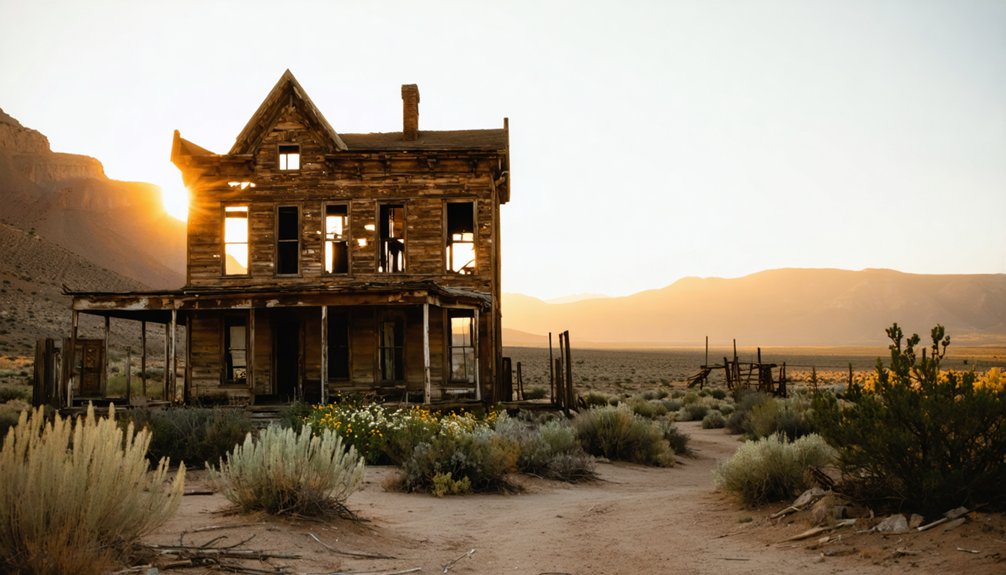
While exploring Tremont, you’ll notice it actually resides in Nevada’s Ramsey District rather than California, where transportation networks connected to the Southern Pacific Railroad’s Nevada & California line at Apache emerged to support mining operations.
Your journey through this area reveals how resource scarcity, particularly water shortages, affected settlement patterns, pushing residents from Tremont toward the better-supplied Ramsey where population once reached 1,000 before declining to just two homes by 1936.
Today, you’ll find abandoned structures consisting mainly of rock foundations, scattered metal debris, and mine dump piles throughout the district, with similar remnants in neighboring ghost towns like Dayton, Silver City, and Mound House.
Transportation Networks Emerged
As transportation needs grew alongside mining operations in the region, Tremont House and surrounding settlements became intricately connected through evolving networks that shaped their rise and ultimate abandonment.
The transportation evolution began with primitive overland routes like the Carson River Route (1848) and stagecoach stops at Desert Well and Hawes Stations.
You’d have witnessed horse-drawn freight wagons filling gaps where rails hadn’t reached. By 1880, the Carson and Colorado Railroad transformed ghost town connectivity, establishing simple platforms at Tremont House and Ramsey.
Southern Pacific’s Nevada and California Railroad further expanded this network by 1905.
These railways became lifelines, connecting isolated mining communities to broader markets until mid-20th century abandonment.
When rail services discontinued, towns that relied on this connectivity quickly declined into the ghost towns you’ll find today.
Resource Scarcity Effects
Resource scarcity played a decisive role in Tremont House’s ultimate abandonment, creating a pattern of decline that rippled through the Ramsey District and beyond.
You’ll find that water shortages particularly devastated these once-promising settlements, undermining community resilience despite early gold discoveries that sparked initial growth.
The Southern Pacific Railroad couldn’t compensate for fundamental resource management failures. While rail connections temporarily boosted economic activity, they simultaneously increased competition for already limited water supplies.
Mining operations further strained resources, creating unsustainable extraction patterns without long-term investment in infrastructure.
Town promoters’ unfulfilled promises of guaranteed water accelerated Tremont’s downfall. The boom-and-bust cycle discouraged sustainable planning, leaving communities vulnerable when ore deposits dwindled.
This resource scarcity ultimately forced residents to relocate, transforming vibrant towns into abandoned relics of the mining era.
Abandoned Structures Today
Today, scattered throughout the Ramsey District and neighboring valleys, Tremont House’s abandoned structures stand as silent testimonials to California’s boom-and-bust mining history.
While specific information about these abandoned buildings remains limited in available research, they represent part of California’s extensive network of ghost towns that once thrived during mineral rushes.
Urban exploration enthusiasts often document these forgotten places, capturing decaying architecture that tells stories of rapid development followed by equally swift abandonment.
The Ramsey District likely contains remnants similar to those found in better-documented ghost towns like Bodie or Eagle Mountain—weathered wooden structures, rusted mining equipment, and foundations marking where bustling communities once stood.
These sites serve as physical reminders of California’s cyclical resource economy and the transient nature of prosperity tied to extraction industries.
Exploring Tremont Today: Remnants and Access Challenges

Visiting Tremont House today reveals a ghost town dramatically transformed from its early 1900s heyday, with remarkably few physical structures remaining to mark its once-thriving presence.
Following the National Park Service‘s 1966 acquisition, systematic demolition eliminated most commercial buildings that once catered to tourists attracted by the South Shore railroad station.
Your ghost town exploration will be limited to a road bearing the community’s name, a picnic shelter, and minimal architectural artifacts.
Visitor accessibility presents challenges due to gate barriers, private land complications, and conservation priorities that prevent reconstruction. You’ll find navigation difficult compared to other ghost town destinations.
The Westchester Township History Museum preserves Tremont’s story through archival materials rather than structural preservation, making this site more valuable for its protected dunes ecosystem than its vanished commercial footprint.
Preservation Efforts and Historical Significance
Despite its relatively short-lived existence, Tremont House holds significant historical value as a representative example of Nevada’s boom-and-bust mining settlements from the early 1900s.
The site serves as a physical record of how water scarcity could determine a community’s fate, despite promising mineral deposits and railroad access.
Current preservation techniques remain limited, with the site now on gated private property.
Historical documentation efforts by Nevada ghost town historians have cataloged remaining structures and incorporated Tremont into broader surveys of regional mining settlements.
These research initiatives connect Tremont to the larger Comstock mining legacy while demonstrating typical frontier development patterns.
You’ll find Tremont’s significance lies not in its longevity but in what it teaches about resource dependency and the fragility of single-industry towns across the American West.
Frequently Asked Questions
Were There Any Notable Crimes or Outlaws in Tremont?
You won’t find notable outlaws or crime history in Tremont’s past. Unlike other ghost towns, this railway stop and tourist hub maintained a peaceful existence throughout its short-lived history.
What Indigenous Tribes Inhabited the Tremont Area Before Settlement?
You’ll find the North Fork Mono tribe primarily inhabited Tremont’s lands, with Yokut and Miwok influences in their cultural practices. Their tribal history included seasonal subsistence activities before settlers disrupted their freedom.
Did Tremont Experience Any Significant Natural Disasters?
You won’t find earthquake impact or flood damage in Tremont’s history. Instead, water scarcity was your settlement’s true disaster, forcing residents to abandon their homes for better-resourced competing towns.
Are There Documented Paranormal Experiences at Tremont Ghost Town?
Yes, paranormal experiences are documented at Tremont House. You’ll find detailed ghost sightings throughout its history, including apparitions in period clothing. Several paranormal investigations have confirmed unexplained phenomena on multiple floors.
How Did Women Contribute to Tremont’s Mining Community?
You’ll find women’s roles in Tremont centered on running boarding houses, providing laundry services, and offering community support through caregiving. Their economic contributions stabilized the mining community during uncertain times.
References
- https://usghostadventures.com/galveston-ghost-tour/tremont-house-hotel/
- https://www.youtube.com/watch?v=ivff3mb7u4U
- https://ghostcitytours.com/galveston/haunted-galveston/tremont-house-hotel/
- https://www.nvexpeditions.com/lyon/ramsey.php
- https://nvtami.com/2023/05/02/a-silver-weekend/
- https://www.thetremonthouse.com/history/
- https://thetremont.ca
- https://www.youtube.com/watch?v=DCfK_BhzyLY
- https://www.publiclandsforthepeople.org/wp-content/uploads/2015/06/Desert-Fever-History-of-Mining-in-the-CDCA.pdf
- https://www.govinfo.gov/content/pkg/GOVPUB-I53-PURL-gpo185067/pdf/GOVPUB-I53-PURL-gpo185067.pdf